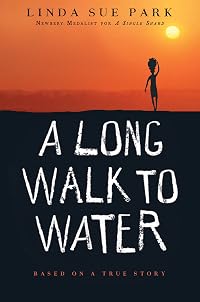
A Long Walk to Water: Based on a True Story
by Linda Sue Park
On This Page
Description
When the Sudanese civil war reaches his village in 1985, eleven-year-old Salva becomes separated from his family and must walk with other Dinka tribe members through southern Sudan, Ethiopia, and Kenya in search of safe haven. Based on the life of Salva Dut, who, after emigrating to America in 1996, began a project to dig water wells in Sudan.Tags
Recommendations







Member Reviews
Salva Dut is 11 years old when war raging in the Sudan separates him from his family. To avoid the conflict, he walks for years with other refugees, seeking sanctuary and scarce food and water. Park simply yet convincingly depicts the chaos of war and an unforgiving landscape as they expose Salva to cruelties both natural and man-made. The lessons Salva remembers from his family keep him from despair during harsh times in refugee camps and enable him, as a young man, to begin a new life in America. As Salva’s story unfolds, readers also learn about another Sudanese youth, Nya, and how these two stories connect contributes to the satisfying conclusion. This story is told as fiction, but it is based on real-life experiences of one of show more the “Lost Boys” of the Sudan. Salva and Nya’s compelling voices lift their narrative out of the “issue” of the Sudanese War, and only occasionally does the explanation of necessary context intrude in the storytelling. Salva’s heroism and the truth that water is a source of both conflict and reconciliation receive equal, crystal-clear emphasis in this heartfelt account. (Fiction. 10-14)
-Kirkus Review show less
-Kirkus Review show less
Oh, wow. This could end up on my list of top reads in 2016. Based on a true story, this short YA novel alternates between the story of Salva Dut, a young boy in 1980s southern Sudan, and Nya, a young girl in southern Sudan, 2008. War erupts in Salva's village while he is at school. His teacher urges the boys to flee into the bush, and not to go home. Salva flees, running, and then walking for hours, then days, then weeks, then months, then years. His harrowing voyage through bush, wild animal territory, war-torn devastation, desert, and across the Nile is harrowing. Nya walks hours each morning to a murky pond to fetch water for her family, then turns around and repeats the journey each afternoon. She does this seven months of the year; show more the remaining months are too dry to rely even on this poor source of water, so the family migrates to camps on the shores of a lake, where conditions are brutal, and warring tribes competing for the same resource bring unrest and unease. How Salva's story intersects with Nya's will give you goosebumps, but there are a lot of years of unimaginable hardship in between. This is such a powerful and heartbreaking book, but DON'T let that dissuade you from reading it, and DON'T miss the commentary by Salva Dut himself -- he is a real person, and the story is based on his experience -- and author Linda Sue Park (I love everything I've read of hers). The book is ultimately uplifting and hopeful. I cried a lot throughout the book -- both from grief and from joy. I finished it earlier this week, and have become something of an evangelist for the book, pressing it on everyone I know. Stelios took me up on it, and is listening in his car, just as mesmerized as I was. I was so struck earlier this week while listening to the book: I was driving my nice car with seat warmers on nice, paved roads to a store to buy cardstock to make die-cut letters for my school's news broadcast team -- all such frivolous luxuries, when Salva and Nya lack even the most basic necessity: clean water. I think everyone should read this book. show less
This powerful story interweaves two true-life journeys in Sudan: Salva Dut, a Lost Boy forced to flee war in 1985, and Nya, an 11-year-old fetching water for her family in 2008. The 720L Lexile and fast-paced, alternating chapters make it an engaging and emotionally resonant read—perfect for middle-grade students. My readers are moved by Salva’s harrowing trek through heart-stopping dangers and inspired by how he later helps build wells. Nya’s tale highlights daily life and the significance of clean water. It sparks deep conversations about resilience, privilege, and global empathy—making it a classroom favorite.
Park tells, side by side, the stories of two young characters, Salva, a young boy in 1980s Southern Sudan, forced to run for his life when the war against the northern government comes to his village, and Nya, a young girl in nearly present day Sudan whose life is defined by her endless walks to and from a distant pond to supply her family with precious and hard to come by water. When gunshots ring out near Salva's school, his teacher rushes the kids out the door insisting that they must not return to their villages and potential slaughter but flee into the bush alone. What follows is Salva's perilous journey among strangers across dangerous terrain to the safety of an Ethiopian refugee camp. Nya's village struggles to find fresh water show more that won't sicken people, but it's becoming more and more difficult, until strangers arrive in her village with an unexpected gift.
A Long Walk to Water is a short book, but a weighty one based on the true story of Salva Dut's terrifying childhood in his war-torn native country. It digs into the harsh realities of war in Sudan caused by both rebellion against the northern government that wants to force its Islamic beliefs on the whole nation and the dangerous animosity between the rival tribes of the south. Salva's story is both heartbreaking and often hopeless, but his refusal to give up and his coming of age under impossible circumstances are ultimately inspirational. Nya's story seems almost out of place, at first, highlighting the practical implications of living in an area where struggling to survive is forced to be the top priority, but the dual stories come together to offer a touching and pitch perfect ending. show less
A Long Walk to Water is a short book, but a weighty one based on the true story of Salva Dut's terrifying childhood in his war-torn native country. It digs into the harsh realities of war in Sudan caused by both rebellion against the northern government that wants to force its Islamic beliefs on the whole nation and the dangerous animosity between the rival tribes of the south. Salva's story is both heartbreaking and often hopeless, but his refusal to give up and his coming of age under impossible circumstances are ultimately inspirational. Nya's story seems almost out of place, at first, highlighting the practical implications of living in an area where struggling to survive is forced to be the top priority, but the dual stories come together to offer a touching and pitch perfect ending. show less
Salva is eleven years old when gunfire erupts near his school in South Sudan and his teacher instructs the students to flee into the bush. He begins walking east, sometimes with others, sometimes alone, once with a family member for a brief time. Eventually he makes his way to a refugee camp in Ethiopia, where he lives until Ethiopia forces them back across the border at gunpoint. Like many of the "lost boys", Salva spends his entire childhood and teens fleeing east, south, and finally to America.
Twenty-three years later, Nya also spends her days walking, back and forth to a well twice a day, simply to bring enough water for her family to survive. In the dry season, she and other families gather at a clay-baked watering hole, where she show more digs until water seeps into the hole and she can collect it. She knows they should boil it, but if they did, too much would evaporate. So instead, they drink the dirty water hoping not to get sick.
Linda Sue Park weaves these two narrative threads together to form a picture of youth set against a backdrop of war and drought. She based the Salva story line on the life of Salva Dut, the founder of the nonprofit Water for South Sudan. Despite being targeted to upper middle school students, I enjoyed this short novel. I love the cover. show less
Twenty-three years later, Nya also spends her days walking, back and forth to a well twice a day, simply to bring enough water for her family to survive. In the dry season, she and other families gather at a clay-baked watering hole, where she show more digs until water seeps into the hole and she can collect it. She knows they should boil it, but if they did, too much would evaporate. So instead, they drink the dirty water hoping not to get sick.
Linda Sue Park weaves these two narrative threads together to form a picture of youth set against a backdrop of war and drought. She based the Salva story line on the life of Salva Dut, the founder of the nonprofit Water for South Sudan. Despite being targeted to upper middle school students, I enjoyed this short novel. I love the cover. show less
In two timelines, the stories of Salva and Nya begin in South Sudan but at different time periods. Their stories progress -- Salva's quite rapidly, Nya's slowly. This work does not skirt over any of the true and weighty events of Salva or Nya's lives. Salva Dut Ariik has the right to tell the story of his life in any light he chooses, via the succinct vehicle of Linda Sue Park's authorship. Linda Sue Park is a Korean-American author, who did not experience the South Sudanese civil war, nor was she ever a Black African refugee. However, I appreciate that rather than creating a work of utter imagination, she engaged in a conversation with someone who did live those realities and then paid a well-researched, "based on a true story" homage show more to that conversation. And we KNOW who that true story is based upon, a fact that is too often left out of such stories!
I think that overall, A Long Walk to Water is a brilliant book. Thoroughly engaging, fast-moving, and enjoyable to read, I found myself forgetting how this story could have been written as a emotionally-drenched tragedy, rather than as a story of hope and the unpredictability of life. This is not to say that A Long Walk to Water is not emotional – several times I choked back tears. Later in the book, the tears caught me by surprise! The way the book is written centers on the themes of self-determination and perseverance, however, so the more watery and dark subject matter of disease, death, family separation, refuge-seeking, civil war, politics, globalization, and genocide are present but not domineering. Of course, I think there should be lots and lots books where these dark subjects dominate. Yet this work shows that these realities can shape people's lives without pigeon-holing them.
This book did make me wonder, what about the Lost Girls? This is a question I need to look into! show less
I think that overall, A Long Walk to Water is a brilliant book. Thoroughly engaging, fast-moving, and enjoyable to read, I found myself forgetting how this story could have been written as a emotionally-drenched tragedy, rather than as a story of hope and the unpredictability of life. This is not to say that A Long Walk to Water is not emotional – several times I choked back tears. Later in the book, the tears caught me by surprise! The way the book is written centers on the themes of self-determination and perseverance, however, so the more watery and dark subject matter of disease, death, family separation, refuge-seeking, civil war, politics, globalization, and genocide are present but not domineering. Of course, I think there should be lots and lots books where these dark subjects dominate. Yet this work shows that these realities can shape people's lives without pigeon-holing them.
This book did make me wonder, what about the Lost Girls? This is a question I need to look into! show less
I am pretty sure that I cried six separate times while reading this book. When I was a child in the 1970's & 1980's, 'Feed the World' and aid to Africa were very much in the news. We often heard from our elders to 'think about the starving children in Africa' when we refused to eat a meal prepared for us. How could we know what that really meant? This is where the importance of literature is paramount. Reading 'A Long Walk to Water' can help us to more fully grasp the intense level of inequality across our planet. Water, a basic need is the resource that this entire story of warring tribes and political factions centers around. Water, the access to it determines education & health. Water, the availability of which dictates extreme show more imbalances in quality of life. This book reminds me of reading 'The Poisonwood Bible' by Barbara Kingsolver, after which, for months, eating became an indelibly conscious act of gratitude. show less
Members
- Recently Added By
Lists

A Child's Book Tour of East Africa ::: Ethiopia, Kenya, Sudan, Uganda
68 works; 4 members

Read on.... from Kwame Alexander's book \ BOOKED
31 works; 1 member

Books Set In Africa
81 works; 4 members

Childhood: Books for or about children in different cultures around the wor
345 works; 18 members

Books Read in 2022
5,226 works; 115 members

Best middle grade books
130 works; 24 members

Books Read in 2023
5,638 works; 147 members

Youth: Earth Science
205 works; 1 member

AR Level 5 in cloudLibrary
170 works; 1 member
Author Information

62+ Works 23,596 Members
Linda Sue Park was born in Urbana, Illinois on March 25, 1960. She received a B.A. in English from Stanford University. After graduating, she worked as a public-relations writer for a major oil company for two years. She obtained advanced degrees in literature from Trinity College, Dublin in Ireland and from the University of London. Before show more becoming a full-time author, she held numerous jobs including working for an advertising agency, teaching English as a second language to college students, and working as a food journalist. Her first book, Seesaw Girl, was published in 1999. Her other books include The Kite Fighters, Tap Dancing on the Roof: Sijo (Poems), and A Single Shard, which won the 2002 Newbery Medal. She also wrote Storm Warning, which is the ninth book in the 39 Clues series. Her title A Long Walk to Water made the New York Times bestseller list. (Bowker Author Biography) show less
Some Editions
Awards and Honors
Awards
Common Knowledge
- Canonical title*
- Der lange Weg zum Wasser
- Original publication date
- 2010-11-15
- People/Characters
- Salva Dut; Nya
- Important places
- Sudan
- Dedication
- To Ben, again
- First words
- Going was easy.
- Last words
- (Click to show. Warning: May contain spoilers.)"My name is Salva."
- Publisher's editor
- Stevenson, Dinah
- Original language
- English
*Some information comes from Common Knowledge in other languages. Click "Edit" for more information.
Classifications
Statistics
- Members
- 5,244
- Popularity
- 2,608
- Reviews
- 177
- Rating
- (4.22)
- Languages
- 6 — Chinese, English, French, German, Portuguese, Spanish
- Media
- Paper, Audiobook, Ebook
- ISBNs
- 36
- ASINs
- 21