
Nicole Kornher-Stace
Author of Archivist Wasp
About the Author
Nicole Kornher-Stace was born in Philadelphia in 1983. Her short fiction and poetry have appeared in various anthologies and magazines. Her poem "The Changeling Always Wins" placed 2nd in the 2010 short form Rhysling Award. She is the author of Desideria, Demon Lovers and Other Difficulties, The show more Winter Triptych, and Archivist Wasp. show less
Series
Works by Nicole Kornher-Stace
Demon Lovers and Other Difficulties 3 copies
The Promise 1 copy
Present 1 copy
Seer Of Cities 1 copy
Associated Works
Clockwork Phoenix 3: New Tales of Beauty and Strangeness (2010) — Contributor — 52 copies, 3 reviews
Tagged
Common Knowledge
- Birthdate
- 1983
- Gender
- female
- Agent
- Kate McKean
- Short biography
- Nicole Kornher-Stace uses she/they pronouns.
- Nationality
- USA
- Birthplace
- Philadelphia, Pennsylvania, USA
- Places of residence
- New Paltz, New York, USA
- Associated Place (for map)
- USA
Members
Reviews

Archivist Wasp is becoming something of a phenomenon in library-people circles. Being an archivist myself, I was immediately curious when I saw this title, and others I know have made wry quips about fighting for tenure. (But not like this, I hope. My god.) It's a story set in a rough, uncompromising world that feels very much like a lot of other recent dystopian novels, but what Nicole Kornher-Stace does differently is to make the pre-collapse civilization just a little further in the show more future than usual. I liked not having a one-to-one correlation between the world I know and the world that Wasp's people have lost. There were just enough points of contact to be eerie, but not so many that it felt too familiar.
The archives that Wasp and her predecessors care for is made up of the tiniest shreds of memory harvested from those who no longer remember much, or perhaps anything at all. In my profession, we spend a lot of time thinking about the ramifications of our collecting decisions. How do those decisions shape what gets considered "real" history? But what if there was so little information that it didn't even make sense to choose what to keep? How does that change what we think we know? Wasp ultimately finds she's in a similar position. There's a lot of good stuff in here about memory, societal power, and whose version of the truth gets to "win". It's really worth a read. show less
The archives that Wasp and her predecessors care for is made up of the tiniest shreds of memory harvested from those who no longer remember much, or perhaps anything at all. In my profession, we spend a lot of time thinking about the ramifications of our collecting decisions. How do those decisions shape what gets considered "real" history? But what if there was so little information that it didn't even make sense to choose what to keep? How does that change what we think we know? Wasp ultimately finds she's in a similar position. There's a lot of good stuff in here about memory, societal power, and whose version of the truth gets to "win". It's really worth a read. show less
 This review was written for LibraryThing Early Reviewers.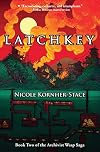
(Cross-posted from: http://www.nerds-feather.com/2018/08/microreview-book-latchkey-by-nicole.html)
Latchkey takes the genre-bending mythology of Archivist Wasp and grounds it in a bigger, busier world, creating a different but worthy reading experience.
First, a confession: I was never on the Archivist Wasp bandwagon when it first came out. While it was on my radar, it never quite bubbled up to the top of the list, and by last year it was just another title to sigh over when browsing the Small show more Beer Press catalogue. Maybe someday, I thought, once I've read all the other books, I can read that one... Anyway, it turns out the fastest way to push a book up your to-be-read pile is to win an ARC of its sequel, and thanks to the generosity of Mythic Delirium, Latchkey's publisher, I ended up doing just that. While I'll focus the rest of this review on talking about the book whose title is at the top of the page, let me just quickly note two things. First, my response to Archivist Wasp is that it's an objectively very accomplished and unusual book that was enjoyable but didn't quite hit me in the way it seems to have done for others. (It also needs noting that this is a rare female-led YA without any romance plot). Second, it's going to be hard for me to review Latchkey without comparing it to its predecessor, which means there will be mild spoilers for Archivist Wasp itself. If you haven't had the pleasure of the first volume yet, I recommend you do so before reading on.
Latchkey opens several years after the events of Archivist Wasp, in a post-apocalyptic world where the ghosts of the dead are a constant presence. Isabel, formerly known as Wasp, used to be the Archivist - a young woman chosen through ritual combat to be the ghost hunter for a religious sect dedicated to an entity named Catchkeep. Following her adventures in the Underworld with a nameless ghost, learning about a pre-apocalyptic child soldier project called "Latchkey", Isabel has overthrown the abusive systems governing her own life and that of the girls around her (who, side note, were all being trained up to murder her in ritual combat themselves), and built a tentative relationship with the neighbouring town of Sweetwater. But her upbringing and experiences in the underworld have left Isabel with serious trauma, and its hard for her to connect with communities of people who had previously seen her as a rival or a weapon. In Latchkey, an existential threat to the village collides with the (literal) return of ghosts from Isabel's past, as it becomes clear that the route to saving her people's future, and to helping undo some of the harm inflicted on the ghosts of the Latchkey Project, are inextricably linked and in Isabel's hands.
Despite being a continuation of the story told in Archivist Wasp, with many of the same characters and a similar tone, Latchkey ends up hitting quite different notes to its predecessor. Where the first book was a slim, focused narrative with strong notes of a mythological journey - Wasp is literally travelling through the underworld, after all - Latchkey feels in some ways like a more straightforward blend of mystery and action. That's not intended to be a criticism, as the space the book opens up is put to great use showing us how Isabel's world has changed and expanded since her journey with the ghost, bringing a strong sense of wider community and more in-depth worldbuilding to the series. One basic but obvious thing is the different use of names: in Archivist Wasp, almost nobody has a name except for Catherine Foster, the ghost Wasp and her companion are tracking down; Wasp herself only reveals her true name under serious pressure, as part of a pivotal scene for her character. In contrast, Latchkey has a "normal" level of background names for all the people in Isabel's orbit, which immediately throws the questions of identity in Archivist Wasp into much sharper focus by contrast. As Isabel uncovers information about more of the Latchkey children, their names obviously become an integral part of the process of reclaiming their identities, and it makes the lack of name for "the ghost" (i.e. the original spirit who took Isabel to the underworld, who is himself a product of the Latchkey project) even more poignant.
The stronger plot thread for Isabel's "present" also means that Latchkey is a much busier book than Archivist Wasp. Most of the time, this is handled well, although I felt some of the balls got dropped on occasion. For example, a lot is made about evacuation of Sweetwater's non-fighting population into the subterranean tunnels, which ultimately only seems to serve as a vehicle for getting Our Heroes underground for an adventure despite lots of signalling about the kids not having enough supplies or responsible adults which ultimately comes to nothing. Also, the last 15% of the book feels like it's transparently heading for a cliffhanger ending, which is frustrating: if these scenes are setting up your next book, dear author, is it possible to put them in that book so I will actually have the right, fresh emotional reaction to them by the time that books comes out? I can see the logic behind subverting expectations and ending Latchkey with some quieter scenes completing the arc about reclaiming identity, rather than the more traditionally climactic battle, but because there's so obviously too much to do to wrap it up in the remaining pages, the execution didn't work for me.
In the end, I'm left personally very happy with where Latchkey took the story, but with some questions about execution and a sense that for some, the tonal direction this sequel takes might undermine the unique, detached feeling of the first volume. Archivist Wasp was so self-contained that this doesn't feel like a necessary continuation, but it's certainly one that makes the most of its foundations and delivers a strong, intriguing new facet to Isabel's world. I'm still not sure this is a series I'm ever going to love, but it's one that continues to interest me, and Kornher-Stace is doing a lot of very thoughtful, interesting things with Isabel's story that are sure to appeal to those who enjoy well-crafted genre-bending YA. show less
Latchkey takes the genre-bending mythology of Archivist Wasp and grounds it in a bigger, busier world, creating a different but worthy reading experience.
First, a confession: I was never on the Archivist Wasp bandwagon when it first came out. While it was on my radar, it never quite bubbled up to the top of the list, and by last year it was just another title to sigh over when browsing the Small show more Beer Press catalogue. Maybe someday, I thought, once I've read all the other books, I can read that one... Anyway, it turns out the fastest way to push a book up your to-be-read pile is to win an ARC of its sequel, and thanks to the generosity of Mythic Delirium, Latchkey's publisher, I ended up doing just that. While I'll focus the rest of this review on talking about the book whose title is at the top of the page, let me just quickly note two things. First, my response to Archivist Wasp is that it's an objectively very accomplished and unusual book that was enjoyable but didn't quite hit me in the way it seems to have done for others. (It also needs noting that this is a rare female-led YA without any romance plot). Second, it's going to be hard for me to review Latchkey without comparing it to its predecessor, which means there will be mild spoilers for Archivist Wasp itself. If you haven't had the pleasure of the first volume yet, I recommend you do so before reading on.
Latchkey opens several years after the events of Archivist Wasp, in a post-apocalyptic world where the ghosts of the dead are a constant presence. Isabel, formerly known as Wasp, used to be the Archivist - a young woman chosen through ritual combat to be the ghost hunter for a religious sect dedicated to an entity named Catchkeep. Following her adventures in the Underworld with a nameless ghost, learning about a pre-apocalyptic child soldier project called "Latchkey", Isabel has overthrown the abusive systems governing her own life and that of the girls around her (who, side note, were all being trained up to murder her in ritual combat themselves), and built a tentative relationship with the neighbouring town of Sweetwater. But her upbringing and experiences in the underworld have left Isabel with serious trauma, and its hard for her to connect with communities of people who had previously seen her as a rival or a weapon. In Latchkey, an existential threat to the village collides with the (literal) return of ghosts from Isabel's past, as it becomes clear that the route to saving her people's future, and to helping undo some of the harm inflicted on the ghosts of the Latchkey Project, are inextricably linked and in Isabel's hands.
Despite being a continuation of the story told in Archivist Wasp, with many of the same characters and a similar tone, Latchkey ends up hitting quite different notes to its predecessor. Where the first book was a slim, focused narrative with strong notes of a mythological journey - Wasp is literally travelling through the underworld, after all - Latchkey feels in some ways like a more straightforward blend of mystery and action. That's not intended to be a criticism, as the space the book opens up is put to great use showing us how Isabel's world has changed and expanded since her journey with the ghost, bringing a strong sense of wider community and more in-depth worldbuilding to the series. One basic but obvious thing is the different use of names: in Archivist Wasp, almost nobody has a name except for Catherine Foster, the ghost Wasp and her companion are tracking down; Wasp herself only reveals her true name under serious pressure, as part of a pivotal scene for her character. In contrast, Latchkey has a "normal" level of background names for all the people in Isabel's orbit, which immediately throws the questions of identity in Archivist Wasp into much sharper focus by contrast. As Isabel uncovers information about more of the Latchkey children, their names obviously become an integral part of the process of reclaiming their identities, and it makes the lack of name for "the ghost" (i.e. the original spirit who took Isabel to the underworld, who is himself a product of the Latchkey project) even more poignant.
The stronger plot thread for Isabel's "present" also means that Latchkey is a much busier book than Archivist Wasp. Most of the time, this is handled well, although I felt some of the balls got dropped on occasion. For example, a lot is made about evacuation of Sweetwater's non-fighting population into the subterranean tunnels, which ultimately only seems to serve as a vehicle for getting Our Heroes underground for an adventure despite lots of signalling about the kids not having enough supplies or responsible adults which ultimately comes to nothing. Also, the last 15% of the book feels like it's transparently heading for a cliffhanger ending, which is frustrating: if these scenes are setting up your next book, dear author, is it possible to put them in that book so I will actually have the right, fresh emotional reaction to them by the time that books comes out? I can see the logic behind subverting expectations and ending Latchkey with some quieter scenes completing the arc about reclaiming identity, rather than the more traditionally climactic battle, but because there's so obviously too much to do to wrap it up in the remaining pages, the execution didn't work for me.
In the end, I'm left personally very happy with where Latchkey took the story, but with some questions about execution and a sense that for some, the tonal direction this sequel takes might undermine the unique, detached feeling of the first volume. Archivist Wasp was so self-contained that this doesn't feel like a necessary continuation, but it's certainly one that makes the most of its foundations and delivers a strong, intriguing new facet to Isabel's world. I'm still not sure this is a series I'm ever going to love, but it's one that continues to interest me, and Kornher-Stace is doing a lot of very thoughtful, interesting things with Isabel's story that are sure to appeal to those who enjoy well-crafted genre-bending YA. show less
This review was written for LibraryThing Early Reviewers.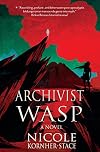
Excellent writing, and a harsh, abusive, survival story. Wasp is a ghost hunter (sort of) and a tormented shaman figure to her people, desperately seeking a way out of her life and also the history of her apocalypse. Not an easy book, but an intense adventure through death and dreamlands, to find one ghost's past. Some superhero actions (peripherally), some Mad Max dystopia. Mostly just an excellently told tale.
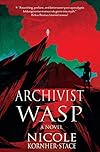
Kornher-Stace, in Archivist Wasp, indicates that more can be learned when glimpsing something at the edge of your vision than by examining it head-on. That's how this book revealed itself to me. Someone mentioned it. It was on lists. I had an idea of what this book was. Then, the author talked about the importance of friendships. The author had opinions about how to tell a story. I drastically readjusted my expectations for the book.
This is my relationship with a lot of books. They're on my show more radar for quite a while and then I read them and enjoy them because I've spent enough time pruning my TBR topiary that it contains few duds. None of that prepared me for the actual reading experience.
The story allows the reader to follow along as the main character questions her place in the world, learns truths and builds the foundation of something new. There are some core questions about the world of this book that I'd expect to have answered. Wasp doesn't get all the answers and neither do we. I like that a reader steeped in fantasy has plenty of elements to argue about the beauty of the magic. Likewise, a reader expecting flying cars and the consequences of weaponized technology run amok has plenty for their mind to churn through.
I'm of a few minds about the bones of the world this story is built around. However, the story fleshes it out nicely. Most character decisions are a superposition of selfish and selfless. It's a hard effect to pull off and you can't just focus on any one thing that's shown or told. There's a constant clash between centuries of tradition and experience vs the moment-to-moment discovery.
I read this book to experience how Konher-Stace tells a story and how well a non-romantic relationship can carry a book. I was successful on both counts. It was a constant joy that left me wanting to read more by the author. Next, I'm reading the short story, "On the Leitmotif of the Trickster Constellation in the Northern hemispheric Star Charts, Post-Apocalypse." After I read a few other things, I'll return to [[[book:Latchkey|39211089]Latchkey]]. show less
Lists
Best Dystopias (1)
Awards


You May Also Like


Associated Authors
Statistics
- Works
- 17
- Also by
- 14
- Members
- 1,155
- Popularity
- #22,249
- Rating
- 3.7
- Reviews
- 69
- ISBNs
- 26
