
James Baen (1943–2006)
Author of The World Turned Upside Down
About the Author
Series
Works by James Baen
The Best of Destinies: The Best Stories and Articles from Science Fiction's Newest and Best Magazine 1980 (1980) — Editor — 38 copies
Worlds of If Science Fiction 173, July/August 1974 (Vol. 22, No. 6) (1974) — Editor — 17 copies, 1 review
Worlds of If Science Fiction 175, November/December 1974 (Vol. 22, No. 8) (1974) — Editor — 6 copies
New Destinies 5 copies
Premier Issue of Destinies 1 copy
Destinites Volume 1 number 1 1 copy
Destinites Volume 1 number 2 1 copy
Destinites Volume 1 number 3 1 copy
Destinites Volume 1 number 4 1 copy
The best from IF 1 copy
Associated Works
Tagged
Common Knowledge
- Legal name
- Baen, James Patrick
- Other names
- Baen, Jim
- Birthdate
- 1943-10-22
- Date of death
- 2006-06-28
- Gender
- male
- Education
- City University of New York
- Occupations
- editor
publisher - Organizations
- SFWA
Baen Books
US Army
Galaxy Science Fiction
Ace Books - Nationality
- USA
- Birthplace
- Pennsylvania, USA
- Places of residence
- New York, New York, USA
- Place of death
- Raleigh, North Carolina, USA
- Burial location
- David Drake's Backyard, Pittsboro, North Carolina, USA
- Associated Place (for map)
- USA
Members
Reviews
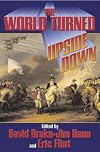
The World Turned Upside Down, edited by David Drake, Eric Flint, Jim Baen
29 Stories, the likes of which I've not seen for over 50 years. These are stories that are so gripping that I do remember the majority of them…if not their authors or titles. Well, "gripping" may be too strong; let's say "memorable". Indeed, I have memories of rethinking the plots of many of these very stories in the past 50 years (and wondering who wrote them and what were they called). These are the types of stories show more that stick with you and tickle at the back of your mind with "what would I have done?" "is this possible?" "this story was so prescient."
There's one tale the plot line of which, if not the actual story, was possibly the inspiration for an episode of "Star Trek, the Next Generation" where the young hero is condemned to death despite his innocent ignorance of what seems to be an arbitrary law. How would you feel, knowing that you're about to die for doing something you thought was at worst a silly prank? Or, how would you feel being the executioner of someone who truly does not deserve to die?
There's only one story that is monster-scary, "Who Goes There?" and it was made into two movies: "The Thing From Another World," 1951; and the remake, "The Thing" in 1982. (I remember the 1951 movie, with James Arness—Matt Dillon, from "Gunsmoke"—as the monster…okay, I date myself.)
These vignettes, averaging about 24 pages…including prefaces and postscripts by the editors, describe situations that require meditative effort to comprehend. Not that they're complicated or intricate; but that they serve as examples of "thought experiments" conducted by philosophers or psychoanalysts. What would be right action under THESE conditions.
Forgive me, but these are the Sci-Fi tales I grew up on; these are the stories that fed my psychological needs. The short-stories of today just don't "touch" me in the same way. Or captivate me to the same extent. I recommend each story and the whole book of them to anyone who wants to either reawaken lost emotions—or to inspire the emotions of a prior age's childhood.
My recommendation is that you not read this book too quickly. Give each story it's due and let yourself digest it before you move on to the next. show less
29 Stories, the likes of which I've not seen for over 50 years. These are stories that are so gripping that I do remember the majority of them…if not their authors or titles. Well, "gripping" may be too strong; let's say "memorable". Indeed, I have memories of rethinking the plots of many of these very stories in the past 50 years (and wondering who wrote them and what were they called). These are the types of stories show more that stick with you and tickle at the back of your mind with "what would I have done?" "is this possible?" "this story was so prescient."
There's one tale the plot line of which, if not the actual story, was possibly the inspiration for an episode of "Star Trek, the Next Generation" where the young hero is condemned to death despite his innocent ignorance of what seems to be an arbitrary law. How would you feel, knowing that you're about to die for doing something you thought was at worst a silly prank? Or, how would you feel being the executioner of someone who truly does not deserve to die?
There's only one story that is monster-scary, "Who Goes There?" and it was made into two movies: "The Thing From Another World," 1951; and the remake, "The Thing" in 1982. (I remember the 1951 movie, with James Arness—Matt Dillon, from "Gunsmoke"—as the monster…okay, I date myself.)
These vignettes, averaging about 24 pages…including prefaces and postscripts by the editors, describe situations that require meditative effort to comprehend. Not that they're complicated or intricate; but that they serve as examples of "thought experiments" conducted by philosophers or psychoanalysts. What would be right action under THESE conditions.
Forgive me, but these are the Sci-Fi tales I grew up on; these are the stories that fed my psychological needs. The short-stories of today just don't "touch" me in the same way. Or captivate me to the same extent. I recommend each story and the whole book of them to anyone who wants to either reawaken lost emotions—or to inspire the emotions of a prior age's childhood.
My recommendation is that you not read this book too quickly. Give each story it's due and let yourself digest it before you move on to the next. show less
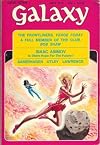
The headline story in this 1974 issue of Galaxy is Verge Foray's "The Frontliners"; feisty female secret agents engage in interplanetary politics and secret agent stuff - but are ready to turn back to child-rearing for the good of the species at the drop of a hat. Definitely of its time. It was refreshing, then, to turn the page to Bob Shaw's short "A full member of the club". This was inspired by an observation of Bob's; he kept seeing adverts on the tv for After Eight mints, where posh show more people were passing around the After Eights at a dinner party. (If After Eights aren't familiar to you, think Ferraro Rocher. "With zeze chocolates you are truly spoiling us, Ambassador.")
Bob was incensed. "I can buy those sweeties in my corner shop!" he wrote. "Rich people wouldn't have those! They'd have fabulous chocolates hand-crafted by Fabergé!" And the likes of you and me wouldn't know where to buy them, either. Bob's writing style was way ahead of Foray's, too.
A couple of sound stories from Saberhagen and Utley follow, and finally some factual pieces; Jerry Pournelle on rocket science and the AAAS, and Isaac Asimov on the things the human race must do and the things we must stop doing in order to survive the next forty years. I'm sorry to report from forty years up the line that we're still doing the things we shouldn't do. By the bucketload. And to some extent, this Asimov article reads most unlike the man's usual projected persona. A bit sobering, that.
And the magazine is full of publicity and inserted squibs for the launch of the magazine "Worlds of If".
Finally, more BoSh; the second part of the serialisation of "Orbitsville". show less
Bob was incensed. "I can buy those sweeties in my corner shop!" he wrote. "Rich people wouldn't have those! They'd have fabulous chocolates hand-crafted by Fabergé!" And the likes of you and me wouldn't know where to buy them, either. Bob's writing style was way ahead of Foray's, too.
A couple of sound stories from Saberhagen and Utley follow, and finally some factual pieces; Jerry Pournelle on rocket science and the AAAS, and Isaac Asimov on the things the human race must do and the things we must stop doing in order to survive the next forty years. I'm sorry to report from forty years up the line that we're still doing the things we shouldn't do. By the bucketload. And to some extent, this Asimov article reads most unlike the man's usual projected persona. A bit sobering, that.
And the magazine is full of publicity and inserted squibs for the launch of the magazine "Worlds of If".
Finally, more BoSh; the second part of the serialisation of "Orbitsville". show less

An artifact of another time that suffers primarily from second rate stories that are utterly forgettable. It caught my eye because it had a story by Raccoona Sheldon in it. If you know who she is it might catch your eye also. The best story in here was by Bob Shaw. The novelette by Fritz Lieber was dated but entertaining and set in San Francisco.
This could have been very self indulgent - a collection of the editors' favourite stories from the golden age of science fiction (from the time you were thirteen or so :-)) but by-and-large, they have come up with excellent stories and authors, some of which I had not heard of and some of which are definate classics.
Some stories show their age - inevitably given the fact they were written over half a century ago, but the great surprise is the way most manage to remain interesting despite show more their age.
Of these, the classic Arthur C Clarke 'Rescue Party' opens the anthology but in many ways Rick Raphael's 'Code Three' takes pride of place as an example of descriptive science fiction. It's basically the story of a highway patrol on the superhighways of an international freeway system that is basically impossible to imagine these days. The weirdest piece by far was P Schuyler's 'Spawn'. CL Moore's (Caroline Lucille) 'Shambleau' is one of the greatest stories ever written to be set on Mars, despite it being a Mars that is difficult to envision these days, but it's her first ever published story and has a great deal of back story that appears well developed if it was her first ever story. show less
Some stories show their age - inevitably given the fact they were written over half a century ago, but the great surprise is the way most manage to remain interesting despite show more their age.
Of these, the classic Arthur C Clarke 'Rescue Party' opens the anthology but in many ways Rick Raphael's 'Code Three' takes pride of place as an example of descriptive science fiction. It's basically the story of a highway patrol on the superhighways of an international freeway system that is basically impossible to imagine these days. The weirdest piece by far was P Schuyler's 'Spawn'. CL Moore's (Caroline Lucille) 'Shambleau' is one of the greatest stories ever written to be set on Mars, despite it being a Mars that is difficult to envision these days, but it's her first ever published story and has a great deal of back story that appears well developed if it was her first ever story. show less
Lists
You May Also Like


Associated Authors
Statistics
- Works
- 82
- Also by
- 1
- Members
- 2,889
- Popularity
- #8,871
- Rating
- 3.6
- Reviews
- 24
- ISBNs
- 45