
Jerry Pournelle (1933–2017)
Author of The Mote in God's Eye
About the Author
Jerry Eugene Pournelle was born in Shreveport, Louisiana on August 7, 1933. During the Korean War, he served in the U. S. Army. He received a B.S. in psychology in 1955, an M.S. in psychology in 1958, and a Ph.D. in political science in 1964 from the University of Washington. He worked for Boeing show more and NASA where he worked on the Mercury, Gemini, and Apollo missions. He also advised the federal government on military matters and space exploration. He wrote science fiction and helped popularize the military science fiction genre. His first novel, Red Heroin, was published in 1969 under the pen name Wade Curtis. His other novels published under his own name included Janissaries, Starswarm, and The Mercenary. He also wrote novels with Larry Niven including Oath of Fealty, The Mote in God's Eye, Lucifer's Hammer, Inferno, Escape from Hell, and Footfall. Pournelle was widely credited as the first major author to write a published novel entirely on a computer. He wrote a witty advice columns for computer users in Byte magazine. He received the John W. Campbell Award for Best New Writer of 1973. He died of heart failure on September 8, 2017 at the age of 84. (Bowker Author Biography) show less
Series
Works by Jerry Pournelle
Life Among the Asteroids (The Endless Frontier, Vol. 4) (1992) — Editor; Contributor — 37 copies, 1 review
Pournelle's PC Communications Bible: The Ultimate Guide to Productivity With a Modem (1992) 6 copies
Contrattacco su Marte 4 copies
Reflex [short story] 3 copies
L'incognita dei Grendel 2 copies
Two Steps Farther Out 1 copy
Girth of Fire 1 copy
From Inferno [Short Story] 1 copy
Bind Your Sons To Exile 1 copy
Space Viking 1 copy
Flucht vom Planet der Affen 1 copy
Mote Lite 1 copy
Peace With Honor 1 copy
CoDominium The Prince (1-5) 1 copy
Il pianeta dell'onore 1 copy
The truth goes marching on 1 copy
Jenseits des Gewissens. 1 copy
A Pegada II Livro 2 1 copy
The Craft of Science Fiction 1 copy
Associated Works
L. Ron Hubbard Presents Writers of the Future, Volume 34 (2018) — Contributor — 84 copies, 2 reviews
A History of Strategy: From Sun Tzu to William S. Lind (2015) — Foreword, some editions — 40 copies, 1 review
Analog Science Fiction/Science Fact: Vol. LXXXIX, No. 6 (August 1972) (1972) — Contributor — 24 copies
Analog Science Fiction/Science Fact: Vol. XCIII, No. 1 (March 1974) (1974) — Contributor — 24 copies
Analog Science Fiction/Science Fact: Vol. LXXXIX, No. 5 (July 1972) (1972) — Contributor — 23 copies
Analog Science Fiction/Science Fact: Vol. LXXXVIII, No. 4 (December 1971) (1971) — Contributor; Contributor — 22 copies
Analog Science Fiction/Science Fact: Vol. LXXXVIII, No. 5 (January 1972) (1971) — Contributor — 21 copies
Analog Science Fiction/Science Fact: Vol. LXXXVIII, No. 6 (February 1972) (1972) — Contributor — 19 copies
The Magazine of Fantasy and Science Fiction June 1974, Vol. 46, No. 6 (1974) — Contributor, some editions — 17 copies
Evolution @ Intersection — Contributor — 2 copies
Tagged
Common Knowledge
- Legal name
- Pournelle, Jerry Eugene
- Other names
- Curtis, Wade
Pournelle, J. E. - Birthdate
- 1933-08-07
- Date of death
- 2017-09-08
- Gender
- male
- Education
- University of Washington (BS|1955|Psychology and Mathematics)
University of Washington (MS|1958|Experimental Statistics and Systems Engineering)
University of Washington (Ph.D|1964|Psychology and Political Science) - Occupations
- writer
essayist
journalist
author - Organizations
- Boeing
NASA
Aerospace Corporation
North American Rockwell
Pepperdine Research Institute (founding President)
Operations Research Society of America (show all 18)
American Astronautical Society
American Institute of Aeronautical and Astronautical Engineers
American Association for the Advancement of Science
Royal Astronomical Society
British Interplanetary Society
BYTE Magazine
Citizen's Advisory Council on National Space Policy (chair)
Society for Creative Anachronism
Science Fiction and Fantasy Writers of America (past President)
Authors Guild
The Lunar Society, Inc. (chair)
United States Army - Awards and honors
- American Security Council Bronze Medal (1964)
John W. Campbell Award (1973)
Inkpot Award (1979)
Prometheus Hall of Fame Award (1991)
Robert A. Heinlein Society Award (2005)
Hubbard Writers/Illustrators of the Future (Lifetime Achievement, 2006) (show all 9)
Robert A. Heinlein Memorial Award (2016)
Forry Award (1979)
Phoenix Award (2010) - Relationships
- Pournelle, J. R. (daughter)
- Cause of death
- heart failure
- Nationality
- USA
- Birthplace
- Shreveport, Louisiana, USA
- Places of residence
- Shreveport, Louisiana, USA (birthplace)
Capleville, Tennessee, USA
Studio City, California, USA - Place of death
- Los Angeles, California, USA
- Burial location
- Forest Lawn-Hollywood Hills Cemetery, Los Angeles, California, USA
- Associated Place (for map)
- California, USA
Members
Discussions
Happy Fathers Day! in Good Show Sir! — bad science fiction and fantasy covers (June 2025)
teotwawki, scientist with diabetes saves technology texts in Name that Book (February 2016)
Inferno by Larry Niven / Return from Tomorrow by George G Ritchie....coincidence? in Science Fiction Fans (April 2013)
Science Fiction book about Space Colonization in Name that Book (February 2012)
Based on Dante's inferno - man travels through hell, meets Mussolini? in Name that Book (October 2011)
Niven and Pournelle in Science Fiction Fans (August 2011)
fantasy dragon/phoniex tattoo in Name that Book (December 2010)
Reviews

Science-Fiction and Fantasy stories are often problematic when depicting other species - in that the "aliens" usually don't feel nearly alien enough. Generally, the best you can hope for is a "planet of hats" situation, or at worst the zero-effort "human in an alien suit." Rarely does a reader encounter aliens such as those in "The Mote in God's Eye" - aliens that are truly *alien.* If you can, avoid all spoilers before reading this book, because discovering who the aliens are, what they show more believe, what they are hiding, and how they work is all part of the fun. show less

A long time ago, in a land far, far away, I was a member of the Science Fiction Book Club.
Remember that? If you read Ace Doubles (remember (THOSE?) or just about any Ace book or most sci-fi mags, you found blowi-ns for the SFBC. "Choose any four books! FREE!" Well, that was my kind of price. Mind you, I was 13 years old at the time. I think that first lot was volume one and two of "The Hugo Winners" (still have it, minus the dust jacket), Asimov's "The Gods Themselves", "The Fall of show more Colossus", and "A Treasury of Great Science Fiction". Wow! And all I had to pay was shipping!
And send those cards in every month to keep them from sending me more books. Which I would have to pay for.
Show of hands…how many of you often forgot to send those cards in? Yeah, me too.
Now, one of those books I got "unwanted" was Larry Niven and Jerry Pournelle's "The Mote in God's Eye", which was pretty highly regarded when it came out. In fact, a blurb from no less than Robert Heinlein say it was the finest science fiction novel he'd ever read. Really. And it ended up being nominated for a lot of awards…Hugo, Nebula, etc. With all this going for it, you'd think I would find time to read the damned thing, especially when I paid full price for it.
Well. In my defense, I was 13 at the time. No, I never read it. Kept it for years, kept it on my list of to-reads, but somehow it never got read. Years passed, that copy disappeared, I bought another. Still never read it. I DID read Niven & Pournelle's other works, namely "Lucifer's Hammer" and "Inferno". Great stuff. But somehow I still never got around to reading "Mote".
Fast forward now to 2016. Shell and I are at a semi-annual book sale in Fairview, Tennessee. And look; what's that on that Sci-Fi table? Why, it's a battered copy of "Mote"! I was torn…if I bought it, would I actually READ it this time? Well, it was only fifty cents. It went home in my sack. And yes, I did finally read it.
Take my advice. DON'T WAIT FORTY YEARS. This really IS an excellent book. It amazes me it's never been made into a movie, but then I could say the same about "Lucifer's Hammer" (but do we really need another "Armageddon"?) or "Inferno". It's not just about the first contact with aliens, but in the personal and political results of just such a meeting. From both points of view. It's hugely fascinating, exciting, and occasionally funny. Better yet, it kept me guessing to the very end just what would happen to whom. No, I won't spoil it for you.
Oh. There is a sequel too, titled "The Gripping Hand". You bastards, now I have to go get THAT. And I will get it, and I will read it, I won't wait forty years. And that's my advice to you, dear friends: go out and get yourself a copy of this one, and READ THE DAMNED THING. You'll love it. show less
Remember that? If you read Ace Doubles (remember (THOSE?) or just about any Ace book or most sci-fi mags, you found blowi-ns for the SFBC. "Choose any four books! FREE!" Well, that was my kind of price. Mind you, I was 13 years old at the time. I think that first lot was volume one and two of "The Hugo Winners" (still have it, minus the dust jacket), Asimov's "The Gods Themselves", "The Fall of show more Colossus", and "A Treasury of Great Science Fiction". Wow! And all I had to pay was shipping!
And send those cards in every month to keep them from sending me more books. Which I would have to pay for.
Show of hands…how many of you often forgot to send those cards in? Yeah, me too.
Now, one of those books I got "unwanted" was Larry Niven and Jerry Pournelle's "The Mote in God's Eye", which was pretty highly regarded when it came out. In fact, a blurb from no less than Robert Heinlein say it was the finest science fiction novel he'd ever read. Really. And it ended up being nominated for a lot of awards…Hugo, Nebula, etc. With all this going for it, you'd think I would find time to read the damned thing, especially when I paid full price for it.
Well. In my defense, I was 13 at the time. No, I never read it. Kept it for years, kept it on my list of to-reads, but somehow it never got read. Years passed, that copy disappeared, I bought another. Still never read it. I DID read Niven & Pournelle's other works, namely "Lucifer's Hammer" and "Inferno". Great stuff. But somehow I still never got around to reading "Mote".
Fast forward now to 2016. Shell and I are at a semi-annual book sale in Fairview, Tennessee. And look; what's that on that Sci-Fi table? Why, it's a battered copy of "Mote"! I was torn…if I bought it, would I actually READ it this time? Well, it was only fifty cents. It went home in my sack. And yes, I did finally read it.
Take my advice. DON'T WAIT FORTY YEARS. This really IS an excellent book. It amazes me it's never been made into a movie, but then I could say the same about "Lucifer's Hammer" (but do we really need another "Armageddon"?) or "Inferno". It's not just about the first contact with aliens, but in the personal and political results of just such a meeting. From both points of view. It's hugely fascinating, exciting, and occasionally funny. Better yet, it kept me guessing to the very end just what would happen to whom. No, I won't spoil it for you.
Oh. There is a sequel too, titled "The Gripping Hand". You bastards, now I have to go get THAT. And I will get it, and I will read it, I won't wait forty years. And that's my advice to you, dear friends: go out and get yourself a copy of this one, and READ THE DAMNED THING. You'll love it. show less
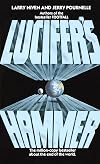
The dream team of Niven and Pournelle are back with another thick, broad-scope, end of the world novel. They go back to the basics this time; there are no aliens, space travel, or galactic empires. Lucifer's Hammer is a simple asteroid disaster story, with the narrative split into roughly equal thirds.
The first two hundred pages focuses on our ensemble cast prior to the asteroid hitting earth, as scientists assure the public that it has a near zero chance of coming anywhere close to Earth. show more Tensions rise as that number climbs over the weeks, with a lot of characters running for the hills, but a solid majority sticking to their nine-to-five grinds until the very end. The second portion is the shortest, detailing how each of characters survives (or dies) during the ensuring apocalypse scenario. The final third follows two large communities that coalesce in the weeks after the disaster, seeking to find high ground above the inland lakes that is both defensible and low enough to avoid the coming brutal winters of the imminent ice age.
Unfortunately, Lucifer's Hammer is not dreamy at all. This is my least favorite of their shared works, in no small part because what they do best is missing completely: aliens. Both Footfall and The Mote In God's Eye are highlighted and buoyed by creative, well-developed alien species. Here we're stuck in the human realm, a place where Niven and Pournelle often become mired in their own decrepit viewpoints. And lets talk about those characters for a moment, because there are an egregious amount of them. There are simply too many to develop effectively, and I often found myself confused (especially toward the end) trying to keep track of them all. This confusion is worsened by some unforced errors in naming, with some primary characters named Harvey, Harry, and (Al) Hardy.
We spend the first several hundred pages getting to know these characters, but end up with not much to show for it, making for an opening that is both dull and gratuitous with detail. I've read enough bourbon-swilling and lustful adultery from these two, thanks. The middle portion during the disaster itself is probably the best, though the mass of characters gets in the way because the dream team insists we see every moment through every group’s eyes, meaning that what should be exciting and momentous grows tedious after it’s repeated for the tenth time. I will say that one of the strengths of Lucifer's Hammer is it's ability to show how quickly things can go bad, and by "bad" I mean grotesquely horrific. This book is not afraid of detailing the morbid realities of an apocalypse.
In my reading, the main thematic viewpoint is a borderline deification of science and technology. In N&P's minds, modern society takes for granted so many luxuries that function as the crux between where we are now, and a feudal peasant society that includes human sacrifices for sun gods. They have a decisively pessimistic view on innate human nature, seeing humans as scared sheep, quick to revert to safety and close mindedness when faced with challenges beyond their comprehension. It's also full of their classic soapboxing about conservative complaints from the era, including: NASA not getting enough funding, Ralph Nader's consumer protection policies, hippie communes, environmentalism, anti-nuclear power policies, you name it. This drags the entire book down even further. It's reactionary, silly, and obtuse. Most of these points get hit hardest in the final third of the novel, which left me with a horrid taste in my mouth.
The post-Hammerfall world is divided into the civilized valley, run by a senator, who works mainly within the framework of necessary socialism (though there is the required griping about how they can't wait to get back to some form of capitalism). The one black person in this community, a former astronaut, literally says that he's "seen enough equality" in his lifetime. They happily take up slavery as a necessary evil as they pat themselves on the back for leading society towards technological advancement. Then there's the seething mass of Luddite, religious, ethnic, militarized, and communistic cannibals who spread through communities and absorb them through violence and acceptance of their cannibalistic rituals. It started to feel like a satire at points, though I'm sure that it wasn't intended to be, knowing their real life politics.
What else is there to say? This is basically all of the bad from the dream team without much of the good. I didn't enjoy Seveneves, but it does this disaster plot much better. Hell, even Niven and Pournelle did it better a few years later with Footfall, which I discovered was the book they initially wanted to write, at least until the publisher told them to nix the alien part of the plot. Thankfully they were able to correct that error, but sadly I am unable to correct the error of reading all six hundred pages of this. show less
The first two hundred pages focuses on our ensemble cast prior to the asteroid hitting earth, as scientists assure the public that it has a near zero chance of coming anywhere close to Earth. show more Tensions rise as that number climbs over the weeks, with a lot of characters running for the hills, but a solid majority sticking to their nine-to-five grinds until the very end. The second portion is the shortest, detailing how each of characters survives (or dies) during the ensuring apocalypse scenario. The final third follows two large communities that coalesce in the weeks after the disaster, seeking to find high ground above the inland lakes that is both defensible and low enough to avoid the coming brutal winters of the imminent ice age.
Unfortunately, Lucifer's Hammer is not dreamy at all. This is my least favorite of their shared works, in no small part because what they do best is missing completely: aliens. Both Footfall and The Mote In God's Eye are highlighted and buoyed by creative, well-developed alien species. Here we're stuck in the human realm, a place where Niven and Pournelle often become mired in their own decrepit viewpoints. And lets talk about those characters for a moment, because there are an egregious amount of them. There are simply too many to develop effectively, and I often found myself confused (especially toward the end) trying to keep track of them all. This confusion is worsened by some unforced errors in naming, with some primary characters named Harvey, Harry, and (Al) Hardy.
We spend the first several hundred pages getting to know these characters, but end up with not much to show for it, making for an opening that is both dull and gratuitous with detail. I've read enough bourbon-swilling and lustful adultery from these two, thanks. The middle portion during the disaster itself is probably the best, though the mass of characters gets in the way because the dream team insists we see every moment through every group’s eyes, meaning that what should be exciting and momentous grows tedious after it’s repeated for the tenth time. I will say that one of the strengths of Lucifer's Hammer is it's ability to show how quickly things can go bad, and by "bad" I mean grotesquely horrific. This book is not afraid of detailing the morbid realities of an apocalypse.
In my reading, the main thematic viewpoint is a borderline deification of science and technology. In N&P's minds, modern society takes for granted so many luxuries that function as the crux between where we are now, and a feudal peasant society that includes human sacrifices for sun gods. They have a decisively pessimistic view on innate human nature, seeing humans as scared sheep, quick to revert to safety and close mindedness when faced with challenges beyond their comprehension. It's also full of their classic soapboxing about conservative complaints from the era, including: NASA not getting enough funding, Ralph Nader's consumer protection policies, hippie communes, environmentalism, anti-nuclear power policies, you name it. This drags the entire book down even further. It's reactionary, silly, and obtuse. Most of these points get hit hardest in the final third of the novel, which left me with a horrid taste in my mouth.
The post-Hammerfall world is divided into the civilized valley, run by a senator, who works mainly within the framework of necessary socialism (though there is the required griping about how they can't wait to get back to some form of capitalism). The one black person in this community, a former astronaut, literally says that he's "seen enough equality" in his lifetime. They happily take up slavery as a necessary evil as they pat themselves on the back for leading society towards technological advancement. Then there's the seething mass of Luddite, religious, ethnic, militarized, and communistic cannibals who spread through communities and absorb them through violence and acceptance of their cannibalistic rituals. It started to feel like a satire at points, though I'm sure that it wasn't intended to be, knowing their real life politics.
What else is there to say? This is basically all of the bad from the dream team without much of the good. I didn't enjoy Seveneves, but it does this disaster plot much better. Hell, even Niven and Pournelle did it better a few years later with Footfall, which I discovered was the book they initially wanted to write, at least until the publisher told them to nix the alien part of the plot. Thankfully they were able to correct that error, but sadly I am unable to correct the error of reading all six hundred pages of this. show less

First contact stories tend to fall into two tropes: either the benevolent aliens come to help to poor humans or Independence Day. Niven and Pournelle deftly side step these tropes and give us a first contact story both riveting and real. Moties, as they are named, are both benevolent and dangerous. And it falls to a diverse, flawed sortie of humans to determine the fate of both the Moties – and the human race.
A fast-paced plot, combined with complex characters and an intricate world of show more limiting technologies, create a story both mind-expanding and heart-wrenching. There are no good guys and bad guys, simple creatures, Motie and Human alike, working towards the survival of their species.
My only complaint is, once again, is the portrayal women. Only one female with speaking lines, but she is an integral part of the story, mostly. She could be replaced with a male and the story wouldn’t change much, despite her being presented as an educated woman with intelligence. She is often the “heart” of the discussion, favoring emotion-driven benevolence over logic. There are remarks to a male-centric society and she seems accepting, even supporting, of that institution. One of the few shallows characters, sadly, but better than most women in pre-1980s sci-fi/fantasy novels.
It will up to the individual to determine if this book lives up to the hype, but for my part, I think it does. Worth the time to read. show less
A fast-paced plot, combined with complex characters and an intricate world of show more limiting technologies, create a story both mind-expanding and heart-wrenching. There are no good guys and bad guys, simple creatures, Motie and Human alike, working towards the survival of their species.
My only complaint is, once again, is the portrayal women. Only one female with speaking lines, but she is an integral part of the story, mostly. She could be replaced with a male and the story wouldn’t change much, despite her being presented as an educated woman with intelligence. She is often the “heart” of the discussion, favoring emotion-driven benevolence over logic. There are remarks to a male-centric society and she seems accepting, even supporting, of that institution. One of the few shallows characters, sadly, but better than most women in pre-1980s sci-fi/fantasy novels.
It will up to the individual to determine if this book lives up to the hype, but for my part, I think it does. Worth the time to read. show less
Lists
Best Dystopias (1)
1970s (2)
Awards


You May Also Like


Associated Authors
Statistics
- Works
- 145
- Also by
- 47
- Members
- 40,611
- Popularity
- #433
- Rating
- 3.7
- Reviews
- 539
- ISBNs
- 503
- Languages
- 14
- Favorited
- 34


