

June Singer (1918–2004)
Author of Boundaries of the Soul
About the Author
June Singer, Ph.D., is a Jungian analyst and the author of several books
Disambiguation Notice:
Date of birth and date of death are listed as per Social Security Index on FamilySearch, dates in Wikipedia (as of March 2024) are incorrect.
Works by June Singer
Associated Works
Jung and the Lost Gospels: Insights into the Dead Sea Scrolls and the Nag Hammadi Library (1989) — Foreword, some editions — 227 copies, 2 reviews
Analytic Life: Personal and Professional Aspects of Being a Jungian Analyst (1988) — Author, some editions — 16 copies, 1 review
Tagged
Common Knowledge
- Legal name
- Singer-Sunshine, June Rose
- Other names
- Kurlander, June Rose (birth name)
- Birthdate
- 1918-10-23
- Date of death
- 2004-01-29
- Gender
- female
- Education
- Northwestern University (PhD|Psychology)
Ohio State University (BA|Art Education)
C. G. Jung Institute, Zurich (Jungian analyst) - Occupations
- gnostic scholar
psychologist
jungian analyst
lecturer - Organizations
- C. G. Jung Institute of Chicago
Analytical Psychology Club of Chicago
Inter-Regional Society of Jungian Analysts
International Association for Analytical Psychology
Institute of Transpersonal Psychology - Cause of death
- cerebral hemorrhage
- Nationality
- USA
- Birthplace
- Cleveland, Ohio, USA
- Places of residence
- Cleveland, Ohio, USA
Palo Alto, California, USA
Chicago, Illinois, USA
San Francisco, California, USA
Minnesota, USA - Place of death
- Beachwood, Ohio, USA
- Disambiguation notice
- Date of birth and date of death are listed as per Social Security Index on FamilySearch, dates in Wikipedia (as of March 2024) are incorrect.
- Associated Place (for map)
- USA
Members
Reviews

Singer's "Psychological Interpretation of William Blake" is for the most part a Jungian sermon that takes Blake's prophetic works as its scripture. Sometimes she just rambles off into outright theologizing in that distinctive Jungian fashion. Nor does she avoid the scientism and occasional outright materialistic philosophy to which the Jungian discourse is prone. At times, Singer's chief concern seems to be whether or not Blake was a good Jungian. But even so, The Unholy Bible is a fairly show more diligent and perceptive study of Blake's mature work.
Following a quick but useful biographical preliminary, the largest section of the book is Singer's analysis of The Marriage of Heaven & Hell, which is quite thorough. Her attention to the symbolic value of the pictorial elements of the plates is especially welcome. She traces some principal themes in the Proverbs of Hell, and offers careful consideration of the Memorable Fancies.
The book could have used more proofreading. The erroneous transcriptions from Blake's plates are particularly galling. (See 137, 142, e.g.) And here's an author's blunder: She reverses the symbolic attribution of the sheep and the goats relative to Blake's context! (141)
The later sections of the book treat Blake's prophecies which are the "unholy Bible." These are viewed from a wider angle than The Marriage, and with some success.
The final two chapters seemed relatively disposable to me. "Sources of Creative Activity" hagiographizes Jung and defends Blake against charges of insanity and mysticism -- the latter subject to an evidently narrow, yet largely implicit definition. The two pages of "The Symbol" extol "the slender filament which reaches from our world to the Infinite" (247), if you care for that sort of thing.
For diehard Jungians, there's probably no better book on Blake. For general readers unfamiliar with Blake's work, this might not be an optimal introduction, because of its tendency to confuse interpretations of Blake's writing with assertions of Jungian doctrine. But I did enjoy reading it, and I learned some things along the way. show less
Following a quick but useful biographical preliminary, the largest section of the book is Singer's analysis of The Marriage of Heaven & Hell, which is quite thorough. Her attention to the symbolic value of the pictorial elements of the plates is especially welcome. She traces some principal themes in the Proverbs of Hell, and offers careful consideration of the Memorable Fancies.
The book could have used more proofreading. The erroneous transcriptions from Blake's plates are particularly galling. (See 137, 142, e.g.) And here's an author's blunder: She reverses the symbolic attribution of the sheep and the goats relative to Blake's context! (141)
The later sections of the book treat Blake's prophecies which are the "unholy Bible." These are viewed from a wider angle than The Marriage, and with some success.
The final two chapters seemed relatively disposable to me. "Sources of Creative Activity" hagiographizes Jung and defends Blake against charges of insanity and mysticism -- the latter subject to an evidently narrow, yet largely implicit definition. The two pages of "The Symbol" extol "the slender filament which reaches from our world to the Infinite" (247), if you care for that sort of thing.
For diehard Jungians, there's probably no better book on Blake. For general readers unfamiliar with Blake's work, this might not be an optimal introduction, because of its tendency to confuse interpretations of Blake's writing with assertions of Jungian doctrine. But I did enjoy reading it, and I learned some things along the way. show less

1. Singer’s “Psychological Interpretation of William Blake” is for the most part a Jungian sermon that takes Blake’s prophetic works as its scripture. Sometimes she just rambles off into outright theologizing in that distinctive Jungian fashion. Nor does she avoid the scientism and occasional outright materialistic philosophy to which the Jungian discourse is prone. At times, Singer’s chief concern seems to be whether or not Blake was a good Jungian. But even so, The Unholy Bible show more is a fairly diligent and perceptive study of Blake’s mature work.
Following a quick but useful biographical preliminary, the largest section of the book is Singer’s analysis of The Marriage of Heaven & Hell, which is quite thorough. Her attention to the symbolic value of the pictorial elements of the plates is especially welcome. She traces some principal themes in the Proverbs of Hell, and offers careful consideration of the Memorable Fancies.
The book could have used more proofreading. The erroneous transcriptions from Blake’s plates are particularly galling. (See 137, 142, e.g.) And here’s an author’s blunder: She reverses the symbolic attribution of the sheep and the goats relative to Blake’s context! (141)
The later sections of the book treat Blake’s prophecies which are the “unholy Bible.” These are viewed from a wider angle than The Marriage, and with some success.
The final two chapters seemed relatively disposable to me. “Sources of Creative Activity” hagiographizes Jung and defends Blake against charges of insanity and mysticism — the latter subject to an evidently narrow, yet largely implicit definition. The two pages of “The Symbol” extol “the slender filament which reaches from our world to the Infinite” (247), if you care for that sort of thing.
For diehard Jungians, there’s probably no better book on Blake. For general readers unfamiliar with Blake’s work, this might not be an optimal introduction, because of its tendency to confuse interpretations of Blake’s writing with assertions of Jungian doctrine. But I did enjoy reading it, and I learned some things along the way. Source: The Hermetic Library Blog (library.hrmtc.com)
2. Reviewed by Margret Shaefer (bq.blakearchive.org)
June K. Singer's "The Unholy Bible: a psychological interpretation of William Blake" is a Jungian reading of Blake's prophetic books with special emphasis on "The Marriage of Heaven and Hell", Unfortunately, it is neither psychological nor interpretive. Singer, a Jungian analyst, regards Blake's works as "a pre-form of certain of Jung's essential concepts," and in her book she has set out to
explain Blake's thought by systematically recasting it into Jungian terminology. The problem with her effort is that it merely involves a translation of one poetic mythology into the terms of another.
Unfortunately, this process neither explains nor clarifies, but merely obfuscates Blake's thought. For Blake's Angels, Devils, Emanations, Dragon-men, and Unnam'd Forms Singer substitutes mandalas. show less
Following a quick but useful biographical preliminary, the largest section of the book is Singer’s analysis of The Marriage of Heaven & Hell, which is quite thorough. Her attention to the symbolic value of the pictorial elements of the plates is especially welcome. She traces some principal themes in the Proverbs of Hell, and offers careful consideration of the Memorable Fancies.
The book could have used more proofreading. The erroneous transcriptions from Blake’s plates are particularly galling. (See 137, 142, e.g.) And here’s an author’s blunder: She reverses the symbolic attribution of the sheep and the goats relative to Blake’s context! (141)
The later sections of the book treat Blake’s prophecies which are the “unholy Bible.” These are viewed from a wider angle than The Marriage, and with some success.
The final two chapters seemed relatively disposable to me. “Sources of Creative Activity” hagiographizes Jung and defends Blake against charges of insanity and mysticism — the latter subject to an evidently narrow, yet largely implicit definition. The two pages of “The Symbol” extol “the slender filament which reaches from our world to the Infinite” (247), if you care for that sort of thing.
For diehard Jungians, there’s probably no better book on Blake. For general readers unfamiliar with Blake’s work, this might not be an optimal introduction, because of its tendency to confuse interpretations of Blake’s writing with assertions of Jungian doctrine. But I did enjoy reading it, and I learned some things along the way. Source: The Hermetic Library Blog (library.hrmtc.com)
2. Reviewed by Margret Shaefer (bq.blakearchive.org)
June K. Singer's "The Unholy Bible: a psychological interpretation of William Blake" is a Jungian reading of Blake's prophetic books with special emphasis on "The Marriage of Heaven and Hell", Unfortunately, it is neither psychological nor interpretive. Singer, a Jungian analyst, regards Blake's works as "a pre-form of certain of Jung's essential concepts," and in her book she has set out to
explain Blake's thought by systematically recasting it into Jungian terminology. The problem with her effort is that it merely involves a translation of one poetic mythology into the terms of another.
Unfortunately, this process neither explains nor clarifies, but merely obfuscates Blake's thought. For Blake's Angels, Devils, Emanations, Dragon-men, and Unnam'd Forms Singer substitutes mandalas. show less
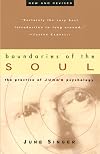
It must be emphasized that "Boundaries of the Soul" is as much a book about the nuts-and-bolts of the actual psychotherapeutic process -- right down to lengthy sections describing such topics as the nuances of a psychotherapist's waiting room -- as it an introduction to the conceptual framework of Jungian psychology.
Singer's systematic breakdown of Jungian psychology is actually very concise, informative and digestible, but in total comprises, perhaps, only a third of the content; the rest show more of the book explores the actual practice and experience of psychotherapy, and will likely only be of interest to prospective psychoanalysts or analysands.
That being said, despite the significant lack of brevity, I finished the book feeling that I had extracted a basic but clear understanding of Jungian psychology -- and there were actually quite a few literary gems of wisdom that I collected as well. Singer was a talented writer.
My only objective criticism of the book is that Singer periodically injected her feminist, egalitarian, some would even say cultural Marxist politics into the book. In several instances, she actually criticized Jung himself for not designing a psychology that was 100% compatible with her ideological beliefs, and she writes Jung off as being "a product of his era" whenever she disagrees with certain attitudes or beliefs of Jung's that were "patriarchal".
Well, perhaps I could level the same criticism at Singer: she was as much an ideological product of her era as Jung was of his. show less
Singer's systematic breakdown of Jungian psychology is actually very concise, informative and digestible, but in total comprises, perhaps, only a third of the content; the rest show more of the book explores the actual practice and experience of psychotherapy, and will likely only be of interest to prospective psychoanalysts or analysands.
That being said, despite the significant lack of brevity, I finished the book feeling that I had extracted a basic but clear understanding of Jungian psychology -- and there were actually quite a few literary gems of wisdom that I collected as well. Singer was a talented writer.
My only objective criticism of the book is that Singer periodically injected her feminist, egalitarian, some would even say cultural Marxist politics into the book. In several instances, she actually criticized Jung himself for not designing a psychology that was 100% compatible with her ideological beliefs, and she writes Jung off as being "a product of his era" whenever she disagrees with certain attitudes or beliefs of Jung's that were "patriarchal".
Well, perhaps I could level the same criticism at Singer: she was as much an ideological product of her era as Jung was of his. show less

Full of psychological & spiritual insights that speak to today's sexual confusion. Singer shows how a person can at once embrace complementary & contradictory attitudes toward sex & gender. Finally, she proposes a range of choices by which people can identify themselves, secure that the masculine/feminine interaction within each individual is not only normal, but the dynamic factor in their wholeness. Index. Bibliography. Source: Publisher
Lists
You May Also Like


Associated Authors
Statistics
- Works
- 13
- Also by
- 4
- Members
- 1,070
- Popularity
- #24,040
- Rating
- 3.8
- Reviews
- 11
- ISBNs
- 35
- Languages
- 2
- Favorited
- 2