
Works by John Ruscio
50 Great Myths of Popular Psychology: Shattering Widespread Misconceptions about Human Behavior (2010) 307 copies, 7 reviews
Tagged
Common Knowledge
- Birthdate
- 20th century
- Gender
- male
- Nationality
- USA
- Associated Place (for map)
- USA
Members
Reviews
50 Great Myths of Popular Psychology: Shattering Widespread Misconceptions about Human Behavior by Scott O. Lilienfeld
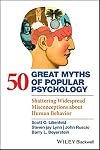
There would have to be something really wrong with this book for me not to like it - it debunks a lot more than just 50 myths of psychomythology (I love that phrase the authors used...adding it to the toolbox.) From only using 10% of our brains to out of body experiences to hypnosis to shock therapy being dangerous, these guys cover a lot of urban myths, commonly held beliefs, commonly told stories...and they back up their treatments.
I, being a psycho-anything skeptic, already looked into show more pretty much most of the myths, though #4, Visual Perceptions Are Accompanied by Tiny Emissions from the Eyes, was a new one. I disagree in part with #16, If You're Unsure of Your Answer When Taking a Test, It's Best to Stick with Your Initial Hunch. I think that unless you are not sure about any answer and have more confidence that your initial hunch is wrong, stick with it, but someday I'll read the references to see if I need to recalibrate my thinking.
The very good thing about this book that sets it apart from the last book I read (O'Reilly's fictional collaboration about a major religious figure)is that all the cites are there for the picking. If you don't buy into the debunking, or do and want to read more, the authors tell you where to find the studies/sources that they used to refute the myths.
Keeping this one handy in case I run into someone who think dreams actually have symbolic meaning or someone who thinks that holding anger in is bad.
Recommended. show less
I, being a psycho-anything skeptic, already looked into show more pretty much most of the myths, though #4, Visual Perceptions Are Accompanied by Tiny Emissions from the Eyes, was a new one. I disagree in part with #16, If You're Unsure of Your Answer When Taking a Test, It's Best to Stick with Your Initial Hunch. I think that unless you are not sure about any answer and have more confidence that your initial hunch is wrong, stick with it, but someday I'll read the references to see if I need to recalibrate my thinking.
The very good thing about this book that sets it apart from the last book I read (O'Reilly's fictional collaboration about a major religious figure)is that all the cites are there for the picking. If you don't buy into the debunking, or do and want to read more, the authors tell you where to find the studies/sources that they used to refute the myths.
Keeping this one handy in case I run into someone who think dreams actually have symbolic meaning or someone who thinks that holding anger in is bad.
Recommended. show less
50 Great Myths of Popular Psychology: Shattering Widespread Misconceptions about Human Behavior by Scott O. Lilienfeld
Although I usually end up with a dissatisfied feeling when reading a book based on rave reviews, this one was not the case. It provides much needed corrective to some of the fuzzy thinking that pervades modern culture, particularly in the area of popularized psychology. He deals with the 50 myths one by one, and also provides a great many more related myths with the pertinent information in a shorter bit at the end of each chapter. Should be required reading for all people in professions show more that routinely invoke ideas of popular psychology, particularly for those doing motivational speaking. show less
50 Great Myths of Popular Psychology: Shattering Widespread Misconceptions about Human Behavior by Scott O. Lilienfeld
People only use ten percent of their brains.
Playing Mozart with make a developing fetus turn into a smart child.
Students learn best when teaching styles match their learning styles.
There’s safety in numbers and opposites attract.
Those who confess to crimes are almost always actually guilty.
Shock therapy is brutal and hurts the patient.
These are popular perceptions of psychology in the everyday world and media. They are presented in television shows, movies, self-help guides, popular show more best-selling books, and proverbs. Most people, even college-educated people, believe these things to be true. But psychological research does not bear them out. Lilienfeld takes these and 43 other commonly-held perceptions about the mind the personality and presents the distinctions between scientific fact and mass media fiction. He helps his readers gain tools in critical thinking about media and science, understand the major features of psychological research from the last 50 years, and gain a fuller understanding of how the mind really works.
This would be an excellent supplement for freshmen psychology courses or for anyone hoping to know a little more about the fact behind some of these widely-held truisms. show less
Playing Mozart with make a developing fetus turn into a smart child.
Students learn best when teaching styles match their learning styles.
There’s safety in numbers and opposites attract.
Those who confess to crimes are almost always actually guilty.
Shock therapy is brutal and hurts the patient.
These are popular perceptions of psychology in the everyday world and media. They are presented in television shows, movies, self-help guides, popular show more best-selling books, and proverbs. Most people, even college-educated people, believe these things to be true. But psychological research does not bear them out. Lilienfeld takes these and 43 other commonly-held perceptions about the mind the personality and presents the distinctions between scientific fact and mass media fiction. He helps his readers gain tools in critical thinking about media and science, understand the major features of psychological research from the last 50 years, and gain a fuller understanding of how the mind really works.
This would be an excellent supplement for freshmen psychology courses or for anyone hoping to know a little more about the fact behind some of these widely-held truisms. show less
Lists
Awards

You May Also Like


Associated Authors
Statistics
- Works
- 4
- Members
- 342
- Popularity
- #69,720
- Rating
- 3.9
- Reviews
- 7
- ISBNs
- 19
- Languages
- 5