
Thomas Stephen Szasz (1920–2012)
Author of The Myth of Mental Illness : Foundations of a Theory of Personal Conduct
About the Author
Thomas Szasz is professor emeritus of psychiatry at the State University of New York's Upstate Medical University in Syracuse, New York.
Image credit: Photograph by Jeffrey A. Schaler
Works by Thomas Stephen Szasz
The Myth of Mental Illness : Foundations of a Theory of Personal Conduct (1961) 724 copies, 10 reviews
The Manufacture of Madness: A Comparative Study of the Inquisition and the Mental Health Movement (1970) 297 copies, 2 reviews
The Myth of Psychotherapy: Mental Healing as Religion, Rhetoric, and Repression (1978) 126 copies, 1 review
Ceremonial Chemistry: The Ritual Persecution of Drugs, Addicts, and Pushers (1974) 90 copies, 3 reviews
The Age of Madness: The History of Involuntary Mental Hospitalization, Presented In Selected Texts (1973) — Editor — 73 copies, 2 reviews
Law, Liberty, and Psychiatry: An Inquiry into the Social Uses of Mental Health Practices (1974) 53 copies, 1 review
Karl Kraus and the Soul-Doctors: A Pioneer Critic and His Criticism of Psychiatry and Psychoanalysis (1976) 43 copies
The theology of medicine: The political-philosophical foundations of medical ethics (Harper colophon books ; CN 545) (1977) 41 copies, 2 reviews
Friedman and Szasz on Liberty and Drugs: Essays on the Free Market and Prohibition (1992) 32 copies, 1 review
Ceremonial Chemistry 1 copy
Ideologie en waanzin 1 copy
Esquizofrenia 1 copy
La battaglia per la salute 1 copy
Cifrematica, La, vol. 1 La vita, il suo numero, la sua scrittura, il suo valore (2007) — Author — 1 copy
Associated Works
Everything You Know Is Wrong: The Disinformation Guide to Secrets and Lies (2002) — Contributor — 1,027 copies, 6 reviews
The Columbia Reader on Lesbians & Gay Men in Media, Society, and Politics (1999) — Contributor — 86 copies
Tagged
Common Knowledge
- Legal name
- Szasz, Thomas Stephen
- Birthdate
- 1920-04-15
- Date of death
- 2012-09-08
- Gender
- male
- Education
- University of Cincinnati (BS|physics|MD|1944)
- Occupations
- university professor
psychiatrist - Organizations
- Citizens Commission on Human Rights
State University of New York
Syracuse University
Chicago Institute for Psychoanalysis - Awards and honors
- Humanist of the Year (1973)
Rollo May Award (1998)
Martin Buber Award (1974)
Humanist Laureate Award (1995) - Nationality
- Hungary
- Birthplace
- Budapest, Hungary
- Places of residence
- Syracuse, New York, USA
Cincinnati, Ohio, USA - Place of death
- Manlius, New York, USA
- Associated Place (for map)
- USA
Members
Reviews
The Myth of Mental Illness: Foundations of a Theory of Personal Contact (Perennial library) by Thomas S. Szasz
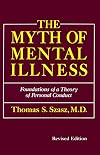
Szasz makes a frontal assault on the power of psychiatry, arguing that mental illness is a myth and that the power accorded to psychiatrists to decide if people are legally responsible for their actions, have them committed to hospitals, and prescribe various psychotropic medications is fundamentally misfounded. The basic premise of his argument is that only organs can be sick, and the mind is not an organ. Rather, what we see as mental illness are the results of rule-breaking behavior by show more "mentally ill" people, an attempt to game their social interactions to receive the socially beneficial role of a "sick person" as accorded by Judeo-Christian morality and modern standards of care.
While there is some benefit to challenging the hegemony of mental illness (a recent paper says "Almost half of college-aged individuals had a psychiatric disorder in the past year."), Szasz's argument fails on two major grounds.
The first is modern understanding that cognitive events are linked to neurological events, or in other words, that mental illness are in some way brain disorders. We can draw a spectrum from something totally neurological--Parkinson's disease, to something totally psychological--Borderline Personality Disorder, say, and put things like schizophrenia, depression, bipolar, and their related pharmacological treatments and neurological origins somewhere between them. It's unfair to hold a book published in the late 1960s to modern beliefs, but again, Szasz doesn't have much to say about this.
The second problem is more damning: even if we accept Szasz's belief that the mentally ill are just playing the game of life by different rules, what is to be done with them? As any good historian of mental illness knows, the lines between insane, criminal, and sinful are far from clear. Psychiatry is the modern way of dealing with malcontents, of offering a source of power and authority that people can draw on to change their lives and social behaviors. Szasz might be right in his argument that psychiatry probably isn't medicine, and it certainly isn't science, but he doesn't engage with the notion that psychiatry is something, and that it performs a socially necessary role. Rather than assailing psychiatry as an evil system of fraud that makes people crazy, we must ask how unhappy people can be helped, how their complex problems can be untangled, and what resources are necessary for that to happen. show less
While there is some benefit to challenging the hegemony of mental illness (a recent paper says "Almost half of college-aged individuals had a psychiatric disorder in the past year."), Szasz's argument fails on two major grounds.
The first is modern understanding that cognitive events are linked to neurological events, or in other words, that mental illness are in some way brain disorders. We can draw a spectrum from something totally neurological--Parkinson's disease, to something totally psychological--Borderline Personality Disorder, say, and put things like schizophrenia, depression, bipolar, and their related pharmacological treatments and neurological origins somewhere between them. It's unfair to hold a book published in the late 1960s to modern beliefs, but again, Szasz doesn't have much to say about this.
The second problem is more damning: even if we accept Szasz's belief that the mentally ill are just playing the game of life by different rules, what is to be done with them? As any good historian of mental illness knows, the lines between insane, criminal, and sinful are far from clear. Psychiatry is the modern way of dealing with malcontents, of offering a source of power and authority that people can draw on to change their lives and social behaviors. Szasz might be right in his argument that psychiatry probably isn't medicine, and it certainly isn't science, but he doesn't engage with the notion that psychiatry is something, and that it performs a socially necessary role. Rather than assailing psychiatry as an evil system of fraud that makes people crazy, we must ask how unhappy people can be helped, how their complex problems can be untangled, and what resources are necessary for that to happen. show less
The Manufacture of Madness: A Comparative Study of the Inquisition and the Mental Health Movement by Thomas Szasz
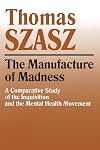
It's so wonderful when you come across a clear-thinking honest man. And you can always tell how close they've come to the mark by the cries of outrage they engender. Szasz lays the psychiatric game on a butcher's block and gives it a great and well-deserved whack. This is the kind of book I look for. Truths are so hard to come by in this world.

The "Sin" of Szasz's title is that of Genesis, chapter 11: attempted clarity in human communication. The book is written in short chapters composed entirely of aphorisms which outline an iconoclastic approach to contemporary society, organized around broad subjects such as "Family," "Education," "Freedom," and "Mental Illness."
The author is a psychiatrist and professor of psychiatry who is sharply critical of the institutional setting of his profession, as well as the professionalization of show more his vocation. He advocates (although not until the last dozen pages of the book) for what he calls "autonomous psychotherapy," and against the therapeutic paradigm as a whole. If that sounds a little paradoxical, it is.
Philosophically, Szasz is a modern resisting postmodernism. He aligns himself with Emerson, Mill, and Adler, against Rousseau, Marx, and Freud. (20-21) He is a fierce (small-l) libertarian, and profoundly anti-paternalistic. The chapters on "Significance" and "Control and Self-control" should be of special value to Thelemites. show less
The author is a psychiatrist and professor of psychiatry who is sharply critical of the institutional setting of his profession, as well as the professionalization of show more his vocation. He advocates (although not until the last dozen pages of the book) for what he calls "autonomous psychotherapy," and against the therapeutic paradigm as a whole. If that sounds a little paradoxical, it is.
Philosophically, Szasz is a modern resisting postmodernism. He aligns himself with Emerson, Mill, and Adler, against Rousseau, Marx, and Freud. (20-21) He is a fierce (small-l) libertarian, and profoundly anti-paternalistic. The chapters on "Significance" and "Control and Self-control" should be of special value to Thelemites. show less
I love this book. This is a little book of maximums and quotes by Dr. Szasz. If you don't know Dr. Szasz, he is a psychiatrist who hates psychiatry. More correctly, but he objects to the medical model that underpins psychiatry. He believes that this error in it's basic assumptions has lead to bad consequences and blind alleys. His most famous book is called 'The Myth of Mental Illness.'
This concern with using a 'wrong model' has lead Dr. Szasz to look at language, and in this book of show more maximums are his thoughts on how we use language to define and color our moral judgments. It's kind of an expansion of the old proverb, 'what's good for the goose is good for the gander.'
For instance, Dr. Szasz notes that we say 'policemen receive bribes,' but we say 'politicians receive campaign contributions.' Why the difference? Why do we say, 'tobacco is sold by merchants,' but 'marijuana is sold by pushers.' When we don't like a TV program, we wouldn't call a TV repair man. Why then, when we don't like the way a person behaves, do we call a medical psychiatrist?
The best way to get a feel for this book is just to read the preface and learn how the doctor came up with the title of this book. He says, "we all know what is the first or "original" sin: eating from the tree of knowledge of good and evil. But we have tended to forget what the second sin was: Speaking clearly." In the first sin, God wished to prohibit man from knowing the difference between good and evil, and consequently Man could not make moral judgments. The knowledge of good and evil was the providence of only God. But man went against God's command, and by eating the fruit, became aware of something only God was meant aware of, the difference between good and evil. As a result, God punished man, and drove him out of the Garden.
The second sin occurred during the construction of the tower of Babble. At that time, all men spoke only one language, and because there was only one language, men could be clear with one another, and there was no limit to what they could accomplish; they could build a tower to the Heavens if they desired. But again, Man encroached on the providence of God: Thinking and Speaking clearly. God came down and punished Man by confusing his language and thereby confusing his thought process. That is why today, Man is enjoined to follow the law, and not worry about the details, they 'why's' and 'wherefore's.'
But all men are sinners. If a man is to be a man, it is his nature to question Authority, to make judgments, to wonder what is really good and what is really evil. It is Man's nature to attempt to think and speak clearly. But it has always been the goal of Authority to prevent Man from doing these things for himself without obtaining permission. In early history, it was the Church that demanded that Man not question Church wisdom. Then it was the Government state that demanded Man not questions the decrees of the state. Today, it the medical psychiatrists who seek to control us by confusing out thinking. Authorities have always tended to honor and reward those who close man's mind by confusing his tongue, and have always tended to fear and punish those who open it by the plain and proper use of language.
Every age has it's high priests who seek to control us by debasing out language and confusing us. And every age has the iconoclasts who cry out that the Emperor has no clothes, and we are being bamboozled. Dr. Szasz sees himself in the latter category, with men like Voltaire, Bierce and Mencken.
This book is out-of-print, but is not difficult to find. show less
This concern with using a 'wrong model' has lead Dr. Szasz to look at language, and in this book of show more maximums are his thoughts on how we use language to define and color our moral judgments. It's kind of an expansion of the old proverb, 'what's good for the goose is good for the gander.'
For instance, Dr. Szasz notes that we say 'policemen receive bribes,' but we say 'politicians receive campaign contributions.' Why the difference? Why do we say, 'tobacco is sold by merchants,' but 'marijuana is sold by pushers.' When we don't like a TV program, we wouldn't call a TV repair man. Why then, when we don't like the way a person behaves, do we call a medical psychiatrist?
The best way to get a feel for this book is just to read the preface and learn how the doctor came up with the title of this book. He says, "we all know what is the first or "original" sin: eating from the tree of knowledge of good and evil. But we have tended to forget what the second sin was: Speaking clearly." In the first sin, God wished to prohibit man from knowing the difference between good and evil, and consequently Man could not make moral judgments. The knowledge of good and evil was the providence of only God. But man went against God's command, and by eating the fruit, became aware of something only God was meant aware of, the difference between good and evil. As a result, God punished man, and drove him out of the Garden.
The second sin occurred during the construction of the tower of Babble. At that time, all men spoke only one language, and because there was only one language, men could be clear with one another, and there was no limit to what they could accomplish; they could build a tower to the Heavens if they desired. But again, Man encroached on the providence of God: Thinking and Speaking clearly. God came down and punished Man by confusing his language and thereby confusing his thought process. That is why today, Man is enjoined to follow the law, and not worry about the details, they 'why's' and 'wherefore's.'
But all men are sinners. If a man is to be a man, it is his nature to question Authority, to make judgments, to wonder what is really good and what is really evil. It is Man's nature to attempt to think and speak clearly. But it has always been the goal of Authority to prevent Man from doing these things for himself without obtaining permission. In early history, it was the Church that demanded that Man not question Church wisdom. Then it was the Government state that demanded Man not questions the decrees of the state. Today, it the medical psychiatrists who seek to control us by confusing out thinking. Authorities have always tended to honor and reward those who close man's mind by confusing his tongue, and have always tended to fear and punish those who open it by the plain and proper use of language.
Every age has it's high priests who seek to control us by debasing out language and confusing us. And every age has the iconoclasts who cry out that the Emperor has no clothes, and we are being bamboozled. Dr. Szasz sees himself in the latter category, with men like Voltaire, Bierce and Mencken.
This book is out-of-print, but is not difficult to find. show less
Lists
Awards


You May Also Like


Associated Authors
Statistics
- Works
- 59
- Also by
- 2
- Members
- 2,430
- Popularity
- #10,558
- Rating
- 3.7
- Reviews
- 39
- ISBNs
- 169
- Languages
- 11
- Favorited
- 7