
H. Gilbert Welch
Author of Overdiagnosed: Making People Sick in the Pursuit of Health
About the Author
H. Gilbert Welch is an academic physician, a professor at Dartmouth Medical School, and a nationally recognized expert on the effects of medical testing. He is the author of two previous books, Should I Be Tested for Cancer? and the highly acclaimed Overdiagnosed.
Works by H. Gilbert Welch
Less Medicine, More Health: 7 Assumptions That Drive Too Much Medical Care (2015) 104 copies, 25 reviews
Tagged
Common Knowledge
- Gender
- male
- Education
- Harvard Medical School
- Occupations
- physician
professor - Organizations
- Dartmouth Institute
- Nationality
- USA
- Associated Place (for map)
- USA
Members
Reviews
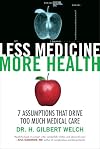
You might think that the biggest problem in medical care is that it costs too much. Or that health insurance is too expensive, too uneven, too complicated -- and gives you too many forms to fill out. But the central problem is that too much medical care has too little value.
Welch characterizes healthcare as a U-shaped curve, with high potential for harm at both the low- and high-utilization ends. He argues against the “7 Assumptions That Drive Too Much Medical Care,” of the book’s show more subtitle, specifically that:
1 -- All risks can be lowered
2 -- It’s always better to fix the problem
3 -- Sooner is always better
4 -- It never hurts to get more information
5 -- Action is always better than inaction
6 -- Newer is always better
7 -- It’s all about avoiding death.
What healthcare policy book is fascinating? gripping? witty? This one! Much of it feels counter-intuitive; but when explained, it flips nearly to common sense. My only quibble is that I needed just a little more explanation/documentation to convince me about some of the most surprising material (for example, the low value of mammography).
This book is a must-read. I'll read more by Welch. show less
Welch characterizes healthcare as a U-shaped curve, with high potential for harm at both the low- and high-utilization ends. He argues against the “7 Assumptions That Drive Too Much Medical Care,” of the book’s show more subtitle, specifically that:
1 -- All risks can be lowered
2 -- It’s always better to fix the problem
3 -- Sooner is always better
4 -- It never hurts to get more information
5 -- Action is always better than inaction
6 -- Newer is always better
7 -- It’s all about avoiding death.
What healthcare policy book is fascinating? gripping? witty? This one! Much of it feels counter-intuitive; but when explained, it flips nearly to common sense. My only quibble is that I needed just a little more explanation/documentation to convince me about some of the most surprising material (for example, the low value of mammography).
This book is a must-read. I'll read more by Welch. show less
 This review was written for LibraryThing Early Reviewers.
I once had a wonderful physician who used to tell me, "I'll give you my medical-legal opinion and then I'll tell you what I think." She taught me to always ask doctors to think a bit more about their recommendations. If the test is positive, what would we do differently? What are the possible secondary consequences? What happens if we do nothing?
Dr. Welch, a primary care physician, has given us a thoughtful but radical critique of common medical practices, based on epidemiological show more statistics. In other words, he looks at data on outcomes of medical interventions to find out whether common medical practices contribute to or diminish overall health and well-being.
The most controversial claims that Dr. Welch makes are about the wisdom of foregoing routine medical screening tests including mammograms, colonoscopies, and PSA screenings. He cites epidemiological studies that show no improvement in overall outcomes for those who are screened versus those who are not. This is counterintuitive because the medical community has stressed for years that early detection is key to surviving cancer. Empirically, data shows few marginal advantages to early screening. So why not be screened on the off chance you would gain from it? Welch points out that screening carries substantial health costs as well because it leads to treatments that may diminish quality of life while failing to deliver the promised quantity of life. Worst of all, most treatments have side-effects that require further treatment, ultimately resulting in cascades of medical problems.
While Welch is highly critical of many common medical interventions, he is not dismissive of medicine. He finds common tests like blood pressures quite useful when understood in appropriate context. Many people develop "white coat" high blood pressure, that is high pressures due to anxieties associated with being in a medical clinic. If treated aggressively, blood pressure can plummet causing confusion and blackouts. Thus, to be useful, blood pressures must be monitored, not assumed to be accurate at a single moment in time.
I found Welch's arguments persuasive. More medicine does not seem to produce more health in many cases. I doubt I will submit to another mammogram without cause to believe something is wrong. The value in this book is the information that allows readers to make better health choices through evidence-based medicine. Welch is an empiricist, not a demagogue. The seven assumptions about health that he debunks are well worth consideration when making health choices.
This is an important book because it encapsulates much that is wrong with the way we think about health. It echoes what Atul Gawande has to say about end of life care, that quality of life should count in our definition of health. Medical intervention often trades off quality of life in exchange for a few more weeks or months of survival. Whether this trade-off is worthwhile should be a thoughtful choice, not a foregone conclusion. show less
Dr. Welch, a primary care physician, has given us a thoughtful but radical critique of common medical practices, based on epidemiological show more statistics. In other words, he looks at data on outcomes of medical interventions to find out whether common medical practices contribute to or diminish overall health and well-being.
The most controversial claims that Dr. Welch makes are about the wisdom of foregoing routine medical screening tests including mammograms, colonoscopies, and PSA screenings. He cites epidemiological studies that show no improvement in overall outcomes for those who are screened versus those who are not. This is counterintuitive because the medical community has stressed for years that early detection is key to surviving cancer. Empirically, data shows few marginal advantages to early screening. So why not be screened on the off chance you would gain from it? Welch points out that screening carries substantial health costs as well because it leads to treatments that may diminish quality of life while failing to deliver the promised quantity of life. Worst of all, most treatments have side-effects that require further treatment, ultimately resulting in cascades of medical problems.
While Welch is highly critical of many common medical interventions, he is not dismissive of medicine. He finds common tests like blood pressures quite useful when understood in appropriate context. Many people develop "white coat" high blood pressure, that is high pressures due to anxieties associated with being in a medical clinic. If treated aggressively, blood pressure can plummet causing confusion and blackouts. Thus, to be useful, blood pressures must be monitored, not assumed to be accurate at a single moment in time.
I found Welch's arguments persuasive. More medicine does not seem to produce more health in many cases. I doubt I will submit to another mammogram without cause to believe something is wrong. The value in this book is the information that allows readers to make better health choices through evidence-based medicine. Welch is an empiricist, not a demagogue. The seven assumptions about health that he debunks are well worth consideration when making health choices.
This is an important book because it encapsulates much that is wrong with the way we think about health. It echoes what Atul Gawande has to say about end of life care, that quality of life should count in our definition of health. Medical intervention often trades off quality of life in exchange for a few more weeks or months of survival. Whether this trade-off is worthwhile should be a thoughtful choice, not a foregone conclusion. show less
This review was written for LibraryThing Early Reviewers.
Bashing the status quo is a common theme in popular health and medical non-fiction. Atul Gawande did it in Being Mortal, where he dispels the notion that extending lifespan is the sole goal of treating the elderly. Giles Yeo did it in his anti-diet Gene Eating. Overdiagnosed has a similar mission, this time targeting the need to find and correct every minor abnormality. It is, of course, a problem concentrated in the First World, where doctors, patients and corporations conspire with varying show more degrees of good will to achieve what statistics prescribe to be the healthy norm. To be more precise, Welch focuses on the US with its peculiar system of health insurance: "The United States is one of only two countries in the world that allow direct-to-consumer advertising of prescription drugs (the other is New Zealand)."
Welch takes a systematic look at some of the causes of overdiagnosis: (1) narrowing the acceptable range for metrics such as blood pressure, blood sugar and PSA (prostate specific antigen); (2) more powerful and frequent scans causing increased findings of benign abnormalities known as "incidentalomas"; (3) aggressive sampling of tissues to find indicators of cancer which may never cause a problem; (4) mail-order DNA analysis encouraging people to look for problems which may not exist.
I did enjoy Welch's journalistic exposé, partly because I am from the school of thought that healthy diet and activity should be the main focus for the average Joe rather than trying to preempt far-off conditions and diseases. As Welch puts it, "There is no need to do a genetic test to learn about the common, powerful risk factors for diabetes: obesity, sedentary lifestyle, and family history." The highlights for me are the statistical data which show how overdiagnosis "creates" problems; lucid explanations of cognitive biases which affect how statistics are presented and how we perceive them; and how positive feedback loops drive an endless cycle of testing and treatment.
Like Gawande, Welch believes treatment should be a collaboration between patient and doctor: "When we have major responsibilities to others, such as young children, we are likely to place more value on the 'staying alive' side of the equation. But later in life, we may place more value on 'staying well.' So we should expect that people will make different decisions about early diagnosis and that individuals’ decisions may change over time." Absolutely right.
Here I wish to record three of the biases which the layperson should keep in mind. First, absolute risk is more important than relative risk. Saying you are three times more likely to survive a condition if it is caught early via frequent testing is not useful if that condition's prevalence is one in a million and you are not otherwise predisposed. Second, survival rate statistics are plagued by lead-time bias. If two people die from a disease at 80, one was diagnosed at 74 via a regular test and the other at 76 when symptoms first present themselves, it's not helpful to consider the first person as having a longer survival rate. Third, overdiagnosis bias, while difficult to quantify because of the scale of studies required, is very real. If you "find" 50% more patients with a condition by narrowing your criteria, many of these relatively minor conditions will never materialise in ill health. If you are interested in this kind of behavioural science, refer to Daniel Kahneman's classic Thinking, Fast and Slow.
There are a few issues which I do not feel Welch adequately addressed. The obesity epidemic is absolutely real in the First World. Doctors and health practitioners need to play an active role in promoting good health in the overweight or malnourished. Metrics such as BMI are useful in this regard, but ranges need to be adjusted for ethnicity and considered alongside diet and exercise. Borderline high cholesterol, blood sugar and blood pressure in conjunction with being overweight need to treated differently to a single errant reading in a person who otherwise feels fine.
Another issue is how Welch in his zeal sometimes downgrades common practice as harmful with little evidence. Genetics has little value: "With the exception of a few relatively uncommon genetic mutations, by far the most important risk factor for breast cancer is a woman’s age." Yet that's the point: a doctor can and should use genetics if there is a family history and reasonable penetrance of cancer-associated genes. It's a tool to help people measure and manage risk rather than a factor which itself determines treatment. According to Welch, even ultrasounds for pregnant women are harmful, despite being cost effective and physically safe, because of the psychological impact of false positives.
Welch is on a mission and his arguments are one-sided. That said, sometimes you need a one-sided exposé to redress the balance of public opinion. show less
Welch takes a systematic look at some of the causes of overdiagnosis: (1) narrowing the acceptable range for metrics such as blood pressure, blood sugar and PSA (prostate specific antigen); (2) more powerful and frequent scans causing increased findings of benign abnormalities known as "incidentalomas"; (3) aggressive sampling of tissues to find indicators of cancer which may never cause a problem; (4) mail-order DNA analysis encouraging people to look for problems which may not exist.
I did enjoy Welch's journalistic exposé, partly because I am from the school of thought that healthy diet and activity should be the main focus for the average Joe rather than trying to preempt far-off conditions and diseases. As Welch puts it, "There is no need to do a genetic test to learn about the common, powerful risk factors for diabetes: obesity, sedentary lifestyle, and family history." The highlights for me are the statistical data which show how overdiagnosis "creates" problems; lucid explanations of cognitive biases which affect how statistics are presented and how we perceive them; and how positive feedback loops drive an endless cycle of testing and treatment.
Like Gawande, Welch believes treatment should be a collaboration between patient and doctor: "When we have major responsibilities to others, such as young children, we are likely to place more value on the 'staying alive' side of the equation. But later in life, we may place more value on 'staying well.' So we should expect that people will make different decisions about early diagnosis and that individuals’ decisions may change over time." Absolutely right.
Here I wish to record three of the biases which the layperson should keep in mind. First, absolute risk is more important than relative risk. Saying you are three times more likely to survive a condition if it is caught early via frequent testing is not useful if that condition's prevalence is one in a million and you are not otherwise predisposed. Second, survival rate statistics are plagued by lead-time bias. If two people die from a disease at 80, one was diagnosed at 74 via a regular test and the other at 76 when symptoms first present themselves, it's not helpful to consider the first person as having a longer survival rate. Third, overdiagnosis bias, while difficult to quantify because of the scale of studies required, is very real. If you "find" 50% more patients with a condition by narrowing your criteria, many of these relatively minor conditions will never materialise in ill health. If you are interested in this kind of behavioural science, refer to Daniel Kahneman's classic Thinking, Fast and Slow.
There are a few issues which I do not feel Welch adequately addressed. The obesity epidemic is absolutely real in the First World. Doctors and health practitioners need to play an active role in promoting good health in the overweight or malnourished. Metrics such as BMI are useful in this regard, but ranges need to be adjusted for ethnicity and considered alongside diet and exercise. Borderline high cholesterol, blood sugar and blood pressure in conjunction with being overweight need to treated differently to a single errant reading in a person who otherwise feels fine.
Another issue is how Welch in his zeal sometimes downgrades common practice as harmful with little evidence. Genetics has little value: "With the exception of a few relatively uncommon genetic mutations, by far the most important risk factor for breast cancer is a woman’s age." Yet that's the point: a doctor can and should use genetics if there is a family history and reasonable penetrance of cancer-associated genes. It's a tool to help people measure and manage risk rather than a factor which itself determines treatment. According to Welch, even ultrasounds for pregnant women are harmful, despite being cost effective and physically safe, because of the psychological impact of false positives.
Welch is on a mission and his arguments are one-sided. That said, sometimes you need a one-sided exposé to redress the balance of public opinion. show less
I just finished Less medicine, more health: 7 Assumptions that Drive Too Much Medical Care , and heartily recommend it!
The seven assumptions are All Risks can be Lowered, It's always better to Fix the problem, Sooner is Always Better, It never hurts to get more Information, Action is always better than inaction, Newer is Always Better, and It's all about Avoiding Death.
Notice those "always" and "never"s? Dr. Welch does recognize that every situation is different and sometimes our new show more technology is just what is needed. It's assuming that all the situations are the same that sinks us.
Completely side stepping the monetary costs of modern medicine, he talks about the medical costs of using these assumptions as if they were universally appropriate.
On the Avoiding Death assumption, I'd just point out that given how many people would rather risk diabetes, heart disease, etc. than give up chocolate, the convenience of fast food, alcohol, smoking, and other of life's joys, I think it's pretty clear that quality of life is more important to most people than just adding a few more days.
He also mentions (as I have so often pointed out) that sometimes the added "life" is spent uncomfortably, in the hospital. Would you rather have three months at home, or six months in the hospital? Added life should imply an ability to actually live it. I also liked the story from the early days of palliative care where the people who opted for palliation lived three months (on average) longer than those who chose interventions. Live worth living has got to be better than being a guinea pig.
Under the "lowering risks" assumption Welch talks about statistics- pointing out that two or three percentage points don't make a huge difference, he suggests that you shouldn't worry until something is two or three times as likely to cause problems.
He also suggests waiting several years before trying a new treatment (unless it's your only chance). Wait to see how it plays out in the real world. He tells of a doctor who opted for the all metal hip replacement because he knew that they usually needed replacing every 9 years (how many recipients are told that before it's time to have it replaced?) and wanted longer between major operations, but the new metal ones apparently leaked cobalt into his system, poisoning him, which gave him a lot of psychiatric symptoms, complicating the diagnosis.
He also agreed with my uncle Dewey, the doctor, that screening doesn't tend to help much, except making people more scared and get more medical care that doesn't enhance health. (data vs. useful information). Actually, this may make this a life changing book for me. My kids have told me for years that they didn't want to hear all the "fascinating medical trivia" I'd accumulated. I'm now feeling a bit embarrassed that I needed to read it in a book before what they'd told me repeatedly sunk in.
Another point he made (about cancers) is that some can be left to watch, you don't always have to do everything, or do it immediately. Often problems resolve themselves. If you enjoy perspectives about medicine from the inside, I heartily recommend this book! (I know I'll be looking for his other titles.) show less
The seven assumptions are All Risks can be Lowered, It's always better to Fix the problem, Sooner is Always Better, It never hurts to get more Information, Action is always better than inaction, Newer is Always Better, and It's all about Avoiding Death.
Notice those "always" and "never"s? Dr. Welch does recognize that every situation is different and sometimes our new show more technology is just what is needed. It's assuming that all the situations are the same that sinks us.
Completely side stepping the monetary costs of modern medicine, he talks about the medical costs of using these assumptions as if they were universally appropriate.
On the Avoiding Death assumption, I'd just point out that given how many people would rather risk diabetes, heart disease, etc. than give up chocolate, the convenience of fast food, alcohol, smoking, and other of life's joys, I think it's pretty clear that quality of life is more important to most people than just adding a few more days.
He also mentions (as I have so often pointed out) that sometimes the added "life" is spent uncomfortably, in the hospital. Would you rather have three months at home, or six months in the hospital? Added life should imply an ability to actually live it. I also liked the story from the early days of palliative care where the people who opted for palliation lived three months (on average) longer than those who chose interventions. Live worth living has got to be better than being a guinea pig.
Under the "lowering risks" assumption Welch talks about statistics- pointing out that two or three percentage points don't make a huge difference, he suggests that you shouldn't worry until something is two or three times as likely to cause problems.
He also suggests waiting several years before trying a new treatment (unless it's your only chance). Wait to see how it plays out in the real world. He tells of a doctor who opted for the all metal hip replacement because he knew that they usually needed replacing every 9 years (how many recipients are told that before it's time to have it replaced?) and wanted longer between major operations, but the new metal ones apparently leaked cobalt into his system, poisoning him, which gave him a lot of psychiatric symptoms, complicating the diagnosis.
He also agreed with my uncle Dewey, the doctor, that screening doesn't tend to help much, except making people more scared and get more medical care that doesn't enhance health. (data vs. useful information). Actually, this may make this a life changing book for me. My kids have told me for years that they didn't want to hear all the "fascinating medical trivia" I'd accumulated. I'm now feeling a bit embarrassed that I needed to read it in a book before what they'd told me repeatedly sunk in.
Another point he made (about cancers) is that some can be left to watch, you don't always have to do everything, or do it immediately. Often problems resolve themselves. If you enjoy perspectives about medicine from the inside, I heartily recommend this book! (I know I'll be looking for his other titles.) show less
Lists
You May Also Like


Statistics
- Works
- 5
- Members
- 335
- Popularity
- #71,018
- Rating
- 4.4
- Reviews
- 36
- ISBNs
- 15
- Languages
- 1
