
Anil Ananthaswamy
Author of The Edge of Physics: A Journey to Earth's Extremes to Unlock the Secrets of the Universe
About the Author
Anil Ananthaswamy is an award-winning journalist and former staff writer and deputy news editor for the London-based New Scientist magazine. He contributes regularly to New Scientist and has also written for Nature, National Geographic, Discover, Nautilus, Matter, The Wall Street Journal, and the show more UK's Literary Review. show less
Works by Anil Ananthaswamy
The Edge of Physics: A Journey to Earth's Extremes to Unlock the Secrets of the Universe (2010) 273 copies, 6 reviews
The Man Who Wasn't There: Investigations into the Strange New Science of the Self (2005) 260 copies, 4 reviews
Through Two Doors at Once: The Elegant Experiment That Captures the Enigma of Our Quantum Reality (2018) 209 copies, 6 reviews
Do No Harm: The People Who Amputate Their Perfectly Healthy Limbs, and the Doctors Who Help Them (2012) 16 copies, 1 review
Associated Works
'Rethinking Einstein : the end of space-time', New Scientist, 7 August 2010 (2010) — Contributor — 1 copy
Tagged
Common Knowledge
- Gender
- male
- Organizations
- New Scientist (contributor)
- Short biography
- (fl. 1995-2024).
- Nationality
- India
- Associated Place (for map)
- India
Members
Reviews
Through Two Doors at Once: The Elegant Experiment That Captures the Enigma of Our Quantum Reality by Anil Ananthaswamy
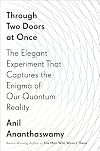
Anil tries gamely to give the reader an overview of the many schools of thought currently extant in QM through the lens (hah) of the double slit experiment. I remember the experiment fondly because a variant (with the slits immersed in some kind of liquid) was a question in one of my entrance exams and which I knew how to solve. I followed along for the first few chapters but the complexity of it all and the need to follow stuff like entanglement without recourse to mathematics quickly show more overwhelmed me. I felt like most of these concepts are best explained interactively in a classroom setting and even then it is debatable how much of it can be grasped without the necessary math. Overall, I learned quite a few high level things about QM that I didn't know previously but my one take away is that I understand QM even less than I thought I did and I used to think I didn't understand it at all :) show less
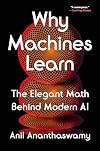
Why Machines Learn by Anil Ananthaswamy is a great book; here's why:
The book's pattern is that each chapter starts with a relevant story, an overview, some math foundations, and valuable examples. There are many equations, ~1000, but stick with it. Ignore Stephen Hawking's advice: "Someone told me that each equation I included in the book would halve the sales." An interested high school student can work through the book; Anil has exceptional explanations and examples.
My first pass through show more the book took a month; now, I want to do a second pass using Mathematica to build the equations into a framework. As Feynman said, "I understand what I build." I used a hybrid approach, listening to the book while making notes in a printed copy. This worked well for me, as I didn't want to skip anything.
The author brings out the personalities behind ML beyond the popular science level; their equations also speak for them. Humor throughout: "In high dimensional space, no one can hear you scream." Julie Delon
Favorites:
Story - Al-Hazen & vision science
Math - Optimization & Lagrange Multipliers
Concept 2nd descent of bias-variance curve
Example Consciousness & Anesthesia EEG PCA
I wish the second half of the book had more examples. The author could expand the last chapters and epilogue into another book. There are good references and a helpful index. A bibliography and suggestions on What's Next would be beneficial.
This book has inspired me to delve deeper into understanding ML; I want to comprehend the changes ML brings to our world. Anil has helped me bootstrap myself. show less
The book's pattern is that each chapter starts with a relevant story, an overview, some math foundations, and valuable examples. There are many equations, ~1000, but stick with it. Ignore Stephen Hawking's advice: "Someone told me that each equation I included in the book would halve the sales." An interested high school student can work through the book; Anil has exceptional explanations and examples.
My first pass through show more the book took a month; now, I want to do a second pass using Mathematica to build the equations into a framework. As Feynman said, "I understand what I build." I used a hybrid approach, listening to the book while making notes in a printed copy. This worked well for me, as I didn't want to skip anything.
The author brings out the personalities behind ML beyond the popular science level; their equations also speak for them. Humor throughout: "In high dimensional space, no one can hear you scream." Julie Delon
Favorites:
Story - Al-Hazen & vision science
Math - Optimization & Lagrange Multipliers
Concept 2nd descent of bias-variance curve
Example Consciousness & Anesthesia EEG PCA
I wish the second half of the book had more examples. The author could expand the last chapters and epilogue into another book. There are good references and a helpful index. A bibliography and suggestions on What's Next would be beneficial.
This book has inspired me to delve deeper into understanding ML; I want to comprehend the changes ML brings to our world. Anil has helped me bootstrap myself. show less
Through Two Doors at Once: The Elegant Experiment That Captures the Enigma of Our Quantum Reality by Anil Ananthaswamy

I hold pop-sci books up to an extremely high standard, and was surprised at how much I liked this book.
First: the things I did not like. The author has many figures but never captions them or references them directly in the text. Also, the author includes a figure of an electromagnetic wave (twice) that uses a left-handed coordinate system. The EM wave also follows the left-handed convention (at least it's consistent with the coordinate system). Finally, the author mentions some "double show more slit" experiments without reference (because they were not actually performed as such, so there is no reference) early in the book without stating that they weren't actually performed through a double slit, but through an interferometer, until WAY later in the book. I found this to be confusing and misleading. (The interferometer experiments are referenced, thankfully.)
Second: the things I don't like but not anything against the book necessarily. I hate the many-worlds interpretation and while the author did a good job presenting it, I feel like there were not enough adequate counter-arguments, or even questions, posed to help balance it with other quantum mechanical approaches that the author introduced in the text.
Now: the things I did like. This was the first book that really got me to understand and appreciate (and possibly even agree with) the ontological interpretation of the wavefunction. I'm not sure why it never clicked before, and I'm not sure if this book is just brilliant or it finally clicked after reading about it so many times, but there it is. I understand now! My mind is suitably blown. I also appreciated the discussion of the pros and cons of the quantum models that have popped up since Copenhagen (with the obvious exception to many-worlds, which, I may have already pointed out, I think is stupid).
Definitely worth a read if you have any interest in quantum physics. I can't take a step back from my physics background to give an objective read, but I think it's suitable for laypeople. show less
First: the things I did not like. The author has many figures but never captions them or references them directly in the text. Also, the author includes a figure of an electromagnetic wave (twice) that uses a left-handed coordinate system. The EM wave also follows the left-handed convention (at least it's consistent with the coordinate system). Finally, the author mentions some "double show more slit" experiments without reference (because they were not actually performed as such, so there is no reference) early in the book without stating that they weren't actually performed through a double slit, but through an interferometer, until WAY later in the book. I found this to be confusing and misleading. (The interferometer experiments are referenced, thankfully.)
Second: the things I don't like but not anything against the book necessarily. I hate the many-worlds interpretation and while the author did a good job presenting it, I feel like there were not enough adequate counter-arguments, or even questions, posed to help balance it with other quantum mechanical approaches that the author introduced in the text.
Now: the things I did like. This was the first book that really got me to understand and appreciate (and possibly even agree with) the ontological interpretation of the wavefunction. I'm not sure why it never clicked before, and I'm not sure if this book is just brilliant or it finally clicked after reading about it so many times, but there it is. I understand now! My mind is suitably blown. I also appreciated the discussion of the pros and cons of the quantum models that have popped up since Copenhagen (with the obvious exception to many-worlds, which, I may have already pointed out, I think is stupid).
Definitely worth a read if you have any interest in quantum physics. I can't take a step back from my physics background to give an objective read, but I think it's suitable for laypeople. show less
Do No Harm: The People Who Amputate Their Perfectly Healthy Limbs, and the Doctors Who Help Them by Anil Ananthaswamy

Before I read this Kindle single I had never heard of Body Integrity Identity Disorder -- which causes people to believe that one of their limbs is not *really* their own, but somehow an alien appendage. This cause such profound psychological distress that many sufferers try to amputate the offending limb by themselves. When they seek medical help, most doctors refuse to help, since they do not see a medical reason to remove a health limb. But within the community of BIID sufferers, there show more are "gatekeepers" who screen for those who truly want the operation, and connect them with doctors who are willing to help them.
This is an amazing, thought-provoking read, definitely something which challenges the common assumptions of medical ethics. show less
This is an amazing, thought-provoking read, definitely something which challenges the common assumptions of medical ethics. show less
Lists
Awards


You May Also Like


Associated Authors
Statistics
- Works
- 7
- Also by
- 13
- Members
- 971
- Popularity
- #26,520
- Rating
- 3.9
- Reviews
- 19
- ISBNs
- 41
- Languages
- 6