
Paul Halpern (2) (1961–)
Author of Collider: The Search for the World's Smallest Particles
For other authors named Paul Halpern, see the disambiguation page.
About the Author
Paul Halpern is professor of physics at the University of the Sciences in Philadelphia and the author of fifteen popular science books. He is also a fellow of the American Physical Society. He lives near Philadelphia, Pennsylvania.
Image credit: By Smelter Mountain - https://www.flickr.com/photos/desert-sparrow/17123475737/, CC BY-SA 2.0, https://commons.wikimedia.org/w/index.php?curid=48919262
Works by Paul Halpern
The Quantum Labyrinth: How Richard Feynman and John Wheeler Revolutionized Time and Reality (2017) 175 copies, 6 reviews
Einstein's Dice and Schrödinger's Cat: How Two Great Minds Battled Quantum Randomness to Create a Unified Theory of Physics (2015) 175 copies, 5 reviews
What's Science Ever Done For Us: What the Simpsons Can Teach Us About Physics, Robots, Life, and the Universe (2007) 134 copies, 4 reviews
The Great Beyond: Higher Dimensions, Parallel Universes and the Extraordinary Search for a Theory of Everything (2004) 110 copies, 2 reviews
Synchronicity: The Epic Quest to Understand the Quantum Nature of Cause and Effect (2020) 61 copies, 2 reviews
Flashes of Creation: George Gamow, Fred Hoyle, and the Great Big Bang Debate (2021) 49 copies, 2 reviews
Tagged
Common Knowledge
- Birthdate
- 1961-01-15
- Gender
- male
- Nationality
- USA
- Associated Place (for map)
- USA
Members
Reviews
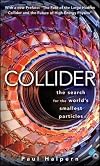
Good luck I say to anyone setting out to write a popular science book on particle physics. The concepts are weird, the math is hard; and on publishing timescales there’s not a whole lot of new stuff worth talking about.
Moreover, it’s a tall order that’s less about content and more about the way you tell it. Happily, in ‘Collider – the search for the world’s smallest particles’ – Paul Halpern tells it well.
Anchoring the core physics around a theme is helpful: whether it’s show more Brian Greene on string theory or Paul Davies on the search for extra terrestrial life or, as in Halpern’s case, the physics, technology and people that have advanced our understanding of the subatomic world.
Collider is a story of impressive people building big machines to smash small particles together to reveal big truths. With CERN’s Large Hadron Collider (LHC) limbering up under the Franco-Swiss countryside, the timing couldn’t be better.
At 232 pages before the notes, Collider is manageable without being superficial, and has sufficient pace and variety to engage even those for whom memories of high-school science induce a cold sweat (and for whom leptons is just another brand of tea).
Tracts of quantum weirdness interspersed with biographical vignettes and discussions on collider engineering should ensure a broad spectrum of readers stay the distance. Those led out of their depth, however gently, will find delightful pangs of (at least partial) understanding along the way. Personally, the engineer in me found particular joy in the mix of ethereal concept and enabling technology that particle physics, perhaps more than any other field, embodies. Halpern as a physicist clearly enjoys and respects all aspects of the endeavour. Indeed, Collider stylistically is quite polymathic, even poetic in a Saganish sort of way:
“Alas, summer’s heat sometimes shapes cruel mirages. After modifying its equipment and retesting its data, the HPWF team’s findings vanished amid the desert sands of statistical insignificance. Skeptics wondered if electroweak unity was simply a beautiful illusion.”
Poetry aside, the physics kicks in early with unification, theories of everything (TOE), and the limitations of an incomplete Standard Model.
The better known particles are introduced via their discoverers’ stories: Thompson’s electron, Roentgen’s X-Rays, Becquerel and the decomposition products of uranium, Rutherford’s proton, and Chadwick’s neutron.
By describing relatively simple experiments from the early era, like the measurement of alpha and beta particle size, Halpern gives his subject a tangibility, a graspable air that prepares the mental ground for later complexities.
Following the evolution of particle sources, accelerators, and detectors, Collider takes us through a chronology starting with unaccelerated decay products striking stationary targets, to linear accelerators, to the various circular synchrotron variants like Ernest Lawrence’s Bevatron and Cosmotron, ending with the contra-rotating particle streams and super-cooled magnets of the LHC.
As beam energies increased, detectors became more complex, sensitive, and selective, allowing the existence of myriad new particles to be confirmed or discovered. Cloud and bubble chambers joined hand-held scintillation detectors and Geiger counters in the particle physicists’ armory, and as the forerunners of the giant counters, traps and calorimeters stacked up today in CERN’s ATLAS and ALICE experiments.
Halpern devotes the last three chapters to a discussion of dark matter, dark energy and the possibility of higher dimensions in the context of string, brane and M-theory, where he underlines the mutuality of physics and cosmology in understanding the bang, whimper, crunch or (somewhat depressing) rip possibilities of an uncertain multiverse.
Looking to the future, Halpern suggests the fate of particle physics itself is less certain than current LHC excitement might lead us to believe. If the Higgs Boson, higher dimensions, or mini-blackholes show up, then fine; but if they don’t – where do we go next?’. Larger machines might be an answer, but with costs that were never pocket money now truly enormous, stakeholders, including the physics community, will need to look to their priorities. And as if to say ‘don’t say it will never happen’, Halpern dedicates a whole chapter to the last, some would say terminal, back-step in American particle physics: the 1992 cancellation of the Reagan era Superconducting Super Collider (SSC).
Something Collider really brought home for me is how the nature of particle physics as a discipline and a career has changed. Individual pioneers have been replaced by research groups working on projects staffed by thousands. As Halpern says, if the Higgs were discovered, they’d be no obvious single candidate for the inevitable Nobel prize (except Higgs himself of course). Data filtration and computation as disciplines have become as important as the collider itself: the LHC is served by a global network of computers. That creates the opportunity for remote distributed working and facilitates multi-national involvement, but also means young researchers need to think about the kind of experience, and resume, they’re building. At PhD level already, Halpern says the slow pace of fundamental revelations has required a force-put change in the definition of what qualifies for the degree in particle physics [we can't all split the atom for the first time, right?].
I’ve one critical note on the history, and maybe I’ve just been reading too many Cold War biographies of late, but I felt Halpern’s analysis underplayed the military motivation and sponsorship behind the adolescent years of particle physics. Given that the topic’s already well covered in works like Gregg Herken’s Brotherhood of the Bomb, and that I walked away from Collider feeling inspired rather than cynical, it’s a choice of emphasis I’m inclined to forgive.
So quibbles aside, Collider is a bit of a page turner – which by the timbre of my opening statements isn’t a bad endorsement. By presenting the obscure realities of particle physics in the context of the machines and people that revealed them, Halpern has for sure made an unfamiliar pill easier to swallow. show less
Moreover, it’s a tall order that’s less about content and more about the way you tell it. Happily, in ‘Collider – the search for the world’s smallest particles’ – Paul Halpern tells it well.
Anchoring the core physics around a theme is helpful: whether it’s show more Brian Greene on string theory or Paul Davies on the search for extra terrestrial life or, as in Halpern’s case, the physics, technology and people that have advanced our understanding of the subatomic world.
Collider is a story of impressive people building big machines to smash small particles together to reveal big truths. With CERN’s Large Hadron Collider (LHC) limbering up under the Franco-Swiss countryside, the timing couldn’t be better.
At 232 pages before the notes, Collider is manageable without being superficial, and has sufficient pace and variety to engage even those for whom memories of high-school science induce a cold sweat (and for whom leptons is just another brand of tea).
Tracts of quantum weirdness interspersed with biographical vignettes and discussions on collider engineering should ensure a broad spectrum of readers stay the distance. Those led out of their depth, however gently, will find delightful pangs of (at least partial) understanding along the way. Personally, the engineer in me found particular joy in the mix of ethereal concept and enabling technology that particle physics, perhaps more than any other field, embodies. Halpern as a physicist clearly enjoys and respects all aspects of the endeavour. Indeed, Collider stylistically is quite polymathic, even poetic in a Saganish sort of way:
“Alas, summer’s heat sometimes shapes cruel mirages. After modifying its equipment and retesting its data, the HPWF team’s findings vanished amid the desert sands of statistical insignificance. Skeptics wondered if electroweak unity was simply a beautiful illusion.”
Poetry aside, the physics kicks in early with unification, theories of everything (TOE), and the limitations of an incomplete Standard Model.
The better known particles are introduced via their discoverers’ stories: Thompson’s electron, Roentgen’s X-Rays, Becquerel and the decomposition products of uranium, Rutherford’s proton, and Chadwick’s neutron.
By describing relatively simple experiments from the early era, like the measurement of alpha and beta particle size, Halpern gives his subject a tangibility, a graspable air that prepares the mental ground for later complexities.
Following the evolution of particle sources, accelerators, and detectors, Collider takes us through a chronology starting with unaccelerated decay products striking stationary targets, to linear accelerators, to the various circular synchrotron variants like Ernest Lawrence’s Bevatron and Cosmotron, ending with the contra-rotating particle streams and super-cooled magnets of the LHC.
As beam energies increased, detectors became more complex, sensitive, and selective, allowing the existence of myriad new particles to be confirmed or discovered. Cloud and bubble chambers joined hand-held scintillation detectors and Geiger counters in the particle physicists’ armory, and as the forerunners of the giant counters, traps and calorimeters stacked up today in CERN’s ATLAS and ALICE experiments.
Halpern devotes the last three chapters to a discussion of dark matter, dark energy and the possibility of higher dimensions in the context of string, brane and M-theory, where he underlines the mutuality of physics and cosmology in understanding the bang, whimper, crunch or (somewhat depressing) rip possibilities of an uncertain multiverse.
Looking to the future, Halpern suggests the fate of particle physics itself is less certain than current LHC excitement might lead us to believe. If the Higgs Boson, higher dimensions, or mini-blackholes show up, then fine; but if they don’t – where do we go next?’. Larger machines might be an answer, but with costs that were never pocket money now truly enormous, stakeholders, including the physics community, will need to look to their priorities. And as if to say ‘don’t say it will never happen’, Halpern dedicates a whole chapter to the last, some would say terminal, back-step in American particle physics: the 1992 cancellation of the Reagan era Superconducting Super Collider (SSC).
Something Collider really brought home for me is how the nature of particle physics as a discipline and a career has changed. Individual pioneers have been replaced by research groups working on projects staffed by thousands. As Halpern says, if the Higgs were discovered, they’d be no obvious single candidate for the inevitable Nobel prize (except Higgs himself of course). Data filtration and computation as disciplines have become as important as the collider itself: the LHC is served by a global network of computers. That creates the opportunity for remote distributed working and facilitates multi-national involvement, but also means young researchers need to think about the kind of experience, and resume, they’re building. At PhD level already, Halpern says the slow pace of fundamental revelations has required a force-put change in the definition of what qualifies for the degree in particle physics [we can't all split the atom for the first time, right?].
I’ve one critical note on the history, and maybe I’ve just been reading too many Cold War biographies of late, but I felt Halpern’s analysis underplayed the military motivation and sponsorship behind the adolescent years of particle physics. Given that the topic’s already well covered in works like Gregg Herken’s Brotherhood of the Bomb, and that I walked away from Collider feeling inspired rather than cynical, it’s a choice of emphasis I’m inclined to forgive.
So quibbles aside, Collider is a bit of a page turner – which by the timbre of my opening statements isn’t a bad endorsement. By presenting the obscure realities of particle physics in the context of the machines and people that revealed them, Halpern has for sure made an unfamiliar pill easier to swallow. show less
The Quantum Labyrinth: How Richard Feynman and John Wheeler Revolutionized Time and Reality by Paul Halpern
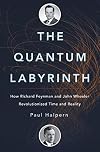
There are two natural divisions in quantum mechanics. The first focused in Europe, from Planck through Einstein to Heisenberg. The second was in the United States, with European refugees working around the likes of Richard Feynman and John Wheeler in the runup to the second world war. The Quantum Labyrinth is about this second era, from the late thirties onward. It is as much biography as science. Paul Halpern has pulled together the lives of numerous protagonists, giving them humanity and show more human foibles amidst the admittedly difficult and bizarre world of quantum mechanics. Feynman himself famously declared that no one understands quantum mechanics. And he was in the eye of the storm.
John Wheeler and Richard Feynman form the spine of the story. They encounter and work with literally everyone who mattered in the discipline. That they met is remarkable. Feymnan transferred to Princeton specifically to become a teaching assistant to Eugene Wigner. Instead, he was assigned to Wheeler. Wheeler turned out to be just seven years older than Feynman, and had a very similar sense of himself and science. The two of them hit it off immediately, and spent endless hours laughing at everything and nothing together. Eventually Wheeler became Feynman’s Phd advisor, and they worked together basically the rest of their lives. Their discoveries fill book shelves.
Nothing in quantum mechanics was too wild for Wheeler. He dreamed in Technicolor. Feynman, no slouch in the imagination department either, took Wheeler’s ideas and provided mathematical proof and justification (where possible), not a year later, but in hours. Not to put too fine a point on it, Feynman obtained his doctorate in three years. Together they assaulted the boundaries and pushed them off in new directions.
The book is at its best when Halpern tells stories showing the physicists’ human side. When Feynman gave his first public lecture at Princeton, “a collection of monster minds” attended. Names like Von Neumann, Wigner, Pauli and Einstein. Before it began, Einstein interrupted Feynman at the blackboard and asked where the tea was. Feynman said he was relieved to be able to answer at least one of Einstein’s questions.
Wheeler invented the wormhole, named Feynman’s method sum over histories, and promoted the term black hole in popular science. When the universe was not enough, he tackled information – the world of bits instead of subatomic particles. It was a Wheeler brainstorm that led to the theory there was just one electron, racing around the universe showing itself.
What weakness there is in The Quantum Labyrinth is in Halpern’s discussions of quantum mechanics. It’s his profession, and he doesn’t make it easy for readers. What usually happens is Wheeler or Feynman has made some huge discovery, and Halpern asks us to step back to understand the mechanics of it., right down to the fundamentals. There is no math, but it is still dense.
It turns out physicists are real people, with quirks as well as quarks. Bohr mumbled incoherently. Dirac was painfully introverted. Feynman was always up for adventure. He played bongos into the wee hours (it was cited in his divorce), acted in plays at Caltech and was the most entertaining lecturer anyone had ever experienced: “a magician of the highest caliber.”
The story has not ended, of course. There continue to be more questions than answers, and it gets worse with every discovery and every new theory. The labyrinth is of their own making. That no one can find the way out is a clear indication that much of what is claimed is simply wrong. The value of The Quantum Labyrinth is the real, human side of this voyage of discovery.
David Wineberg show less
John Wheeler and Richard Feynman form the spine of the story. They encounter and work with literally everyone who mattered in the discipline. That they met is remarkable. Feymnan transferred to Princeton specifically to become a teaching assistant to Eugene Wigner. Instead, he was assigned to Wheeler. Wheeler turned out to be just seven years older than Feynman, and had a very similar sense of himself and science. The two of them hit it off immediately, and spent endless hours laughing at everything and nothing together. Eventually Wheeler became Feynman’s Phd advisor, and they worked together basically the rest of their lives. Their discoveries fill book shelves.
Nothing in quantum mechanics was too wild for Wheeler. He dreamed in Technicolor. Feynman, no slouch in the imagination department either, took Wheeler’s ideas and provided mathematical proof and justification (where possible), not a year later, but in hours. Not to put too fine a point on it, Feynman obtained his doctorate in three years. Together they assaulted the boundaries and pushed them off in new directions.
The book is at its best when Halpern tells stories showing the physicists’ human side. When Feynman gave his first public lecture at Princeton, “a collection of monster minds” attended. Names like Von Neumann, Wigner, Pauli and Einstein. Before it began, Einstein interrupted Feynman at the blackboard and asked where the tea was. Feynman said he was relieved to be able to answer at least one of Einstein’s questions.
Wheeler invented the wormhole, named Feynman’s method sum over histories, and promoted the term black hole in popular science. When the universe was not enough, he tackled information – the world of bits instead of subatomic particles. It was a Wheeler brainstorm that led to the theory there was just one electron, racing around the universe showing itself.
What weakness there is in The Quantum Labyrinth is in Halpern’s discussions of quantum mechanics. It’s his profession, and he doesn’t make it easy for readers. What usually happens is Wheeler or Feynman has made some huge discovery, and Halpern asks us to step back to understand the mechanics of it., right down to the fundamentals. There is no math, but it is still dense.
It turns out physicists are real people, with quirks as well as quarks. Bohr mumbled incoherently. Dirac was painfully introverted. Feynman was always up for adventure. He played bongos into the wee hours (it was cited in his divorce), acted in plays at Caltech and was the most entertaining lecturer anyone had ever experienced: “a magician of the highest caliber.”
The story has not ended, of course. There continue to be more questions than answers, and it gets worse with every discovery and every new theory. The labyrinth is of their own making. That no one can find the way out is a clear indication that much of what is claimed is simply wrong. The value of The Quantum Labyrinth is the real, human side of this voyage of discovery.
David Wineberg show less
The Quantum Labyrinth: How Richard Feynman and John Wheeler Revolutionized Time and Reality by Paul Halpern
Topic seemed narrow at first - the collaboration of 2 physicists - yet the topics they handle, the discussion they have and their own lives (especially Feynman of course), makes it a great experience.
I liked the pointers to different books and topics along the way. Made me read Asimov "The Last Question" for example.
Great explanations of complex concepts too, it's not just biographical.
I liked the pointers to different books and topics along the way. Made me read Asimov "The Last Question" for example.
Great explanations of complex concepts too, it's not just biographical.
I know just enough about particle physics and cosmology to realize how little I know. Yeah, I know the basics of relativity and the skeleton of quantum concepts. But I have a degree in liberal arts.
When the Large Hadron Collider (LHC) went online (albeit briefly and abortively) not too long ago, I was fascinated. I wanted to know about the project and the specifics of what they were seeking. I have heard about Higgs bosons but wanted to understand better.
Unfortunately Halpern's approach is show more to cover everything from physics' first inculcation as a branch of science through approximately yesterday. To so he must do so at a gallop, glossing over Newtonian laws of motion and Einstein (fine, because I already know that) but also racing through complex quantum explanations of muons and Higgs bosons (precisely why I'm reading this book).
The conflict is that Halpern assumes his audience to be a lay audience (which is true) but also doesn't write the kindly, well-thought-out analogies to introduce concepts to non-scientists. This book doesn't know what it is: It vacillates between assuming too much of its readers and assuming too little, being baffling at times and slow or pedantic at others.
Sadly, I only made it 50 pages into a book that I was excited about--I really do want to know about the LHC and recent developments in quantum research and cosmology. I hope my friends can recommend a better title. show less
When the Large Hadron Collider (LHC) went online (albeit briefly and abortively) not too long ago, I was fascinated. I wanted to know about the project and the specifics of what they were seeking. I have heard about Higgs bosons but wanted to understand better.
Unfortunately Halpern's approach is show more to cover everything from physics' first inculcation as a branch of science through approximately yesterday. To so he must do so at a gallop, glossing over Newtonian laws of motion and Einstein (fine, because I already know that) but also racing through complex quantum explanations of muons and Higgs bosons (precisely why I'm reading this book).
The conflict is that Halpern assumes his audience to be a lay audience (which is true) but also doesn't write the kindly, well-thought-out analogies to introduce concepts to non-scientists. This book doesn't know what it is: It vacillates between assuming too much of its readers and assuming too little, being baffling at times and slow or pedantic at others.
Sadly, I only made it 50 pages into a book that I was excited about--I really do want to know about the LHC and recent developments in quantum research and cosmology. I hope my friends can recommend a better title. show less
Awards


You May Also Like


Statistics
- Works
- 19
- Members
- 1,231
- Popularity
- #20,853
- Rating
- 3.5
- Reviews
- 35
- ISBNs
- 97
- Languages
- 7