
Ellen Kushner
Author of Swordspoint
About the Author
Image credit: Flickr user jwa_org
Series
Works by Ellen Kushner
The Duke of Riverside 4 copies
A Wild And Wicked Youth 3 copies
The Witches of Lublin - Collectors Edition (includes The Devil's Brides Music) (2011) — Author — 2 copies
Playing With Fire [novelette] 2 copies
Charis {short story} 2 copies
Dolce Domum 2 copies
One Last, Great Adventure 1 copy
Night Laughter 1 copy
Onward: Tremontaine Season 4, Episode 12 — Author — 1 copy
The Hunt of the Unicorn 1 copy
History 1 copy
The House Of Nine Doors 1 copy
Lazarus 1 copy
Associated Works
Borderland: Between the Elflands and the World is a Place Where Magic Runs Amok (1986) — Contributor — 455 copies, 5 reviews
Queen Victoria's Book of Spells: An Anthology of Gaslamp Fantasy (2013) — Contributor — 399 copies, 18 reviews
Sirens and Other Daemon Lovers: Magical Tales of Love and Seduction (1998) — Contributor — 375 copies, 7 reviews
The Year's Best Fantasy and Horror: Seventh Annual Collection (1994) — Contributor — 285 copies, 3 reviews
The Year's Best Fantasy and Horror: Ninth Annual Collection (1996) — Contributor — 258 copies, 3 reviews
The Armless Maiden and Other Tales for Childhood's Survivors (1995) — Contributor — 256 copies, 4 reviews
Through a Brazen Mirror : The Famous Flower of Servingmen (1989) — Introduction, some editions — 232 copies, 6 reviews
The Best Science Fiction and Fantasy of the Year, Volume 5 (2011) — Contributor — 167 copies, 4 reviews
Beyond Binary: Genderqueer and Sexually Fluid Speculative Fiction (2012) — Author — 160 copies, 4 reviews
The Best Science Fiction and Fantasy of the Year, Volume 4 (2010) — Contributor — 143 copies, 2 reviews
Fantasy Magazine, Issue 59 (December 2015) - Queers Destroy Fantasy! Special Issue (2015) — Contributor — 49 copies
Heiresses of Russ 2011: The Year's Best Lesbian Speculative Fiction (2011) — Contributor — 41 copies
In Lands That Never Were: Tales of Swords and Sorcery from The Magazine of Fantasy & Science Fiction (2004) — Contributor — 36 copies
Last Drink Bird Head : A Flash Fiction Anthology for Charity (2009) — Contributor — 33 copies, 1 review
Wilde Stories 2012: The Year's Best Gay Speculative Fiction (2012) — Contributor — 25 copies, 1 review
Tagged
Common Knowledge
- Birthdate
- 1955-10-06
- Gender
- female
- Education
- Bryn Mawr College
Barnard College - Occupations
- radio host
fantasy novelist - Organizations
- Science Fiction and Fantasy Writers of America (SFWA)
- Agent
- Christopher Schelling (Selectric Artists)
- Relationships
- Sherman, Delia (spouse)
- Nationality
- USA
- Birthplace
- Washington, D.C., USA
- Places of residence
- New York, New York, USA
Cleveland, Ohio, USA - Associated Place (for map)
- USA
Members
Reviews
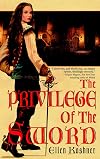
Summary: Katherine's family is well-bred but poor, and entangled in some complicated legal proceedings. When Katherine's uncle, the Duke, requests that Katherine come live with him in the city, there's really no way her family can refuse. But her uncle, Alec Campion, isn't called the Mad Duke Tremontaine for nothing, and he's decided to have his niece trained in the art of swordplay. Katherine, who was prepared for society and balls and meeting eligible suitors, chafes under the Duke's show more requirements, but the longer she lives in the Duke's house, the more she realizes that the city has more to it than she was expecting… and her Uncle seems to be involved in most of the secret and clandestine parts.
Review: I really enjoyed this book, much as I suspected I would. I loved the world of Riverside and the characters of Swordspoint, but I found the audio production really distracting. In paper, though, with nothing to get in my way, I had a much easier time. This book (like Swordspoint) is this interesting blend of swordplay and chivalry and political intrigue and the criminal underworld and high society, kind of a blend of the worlds (if not the styles) of Dumas and Austen and Dickens, all smooshed together. It's fantasy, but apart from a few oblique references to magic being used in the old days, it's much more historical fantasy (although drawing from a mishmash of periods) than anything else.
Actually, let's talk about the oblique references to the old days a bit, particularly in reference to Kushner's worldbuilding. I'm in a little bit of a conundrum with this book, as I can't quite figure out how Kushner manages to do her worldbuilding. It's very subtle - about the far end of the spectrum from info-dumping - so subtle, in fact, that sometimes I wasn't quite clear on how various political and societal systems worked, or whether I'd missed some crucial detail. That should have really bothered me, but at the same time that some of the "structural" worldbuilding was a little sparse, the cultural/environmental worldbuilding was very vivid - you can feel the difference going from Riverside to the Hill, see the dark corners and gilded furniture and grimy alleys and fancy fencing salons. And as a result, even if I occasionally felt a little lost, I still found it really easy to sink into Kushner's world.
The characterizations are done equally subtly. Kushner expects you to be paying attention - a lot of the emotional importance of some scenes is meant to be inferred… since it's certainly not explained. As an example: Alec sends Katherine to stay at his house in the country, and train with the odd, reclusive man that lives there. I don't think that that character is ever named outright - or at least not until much, much later - but there were parts of that section of the book that were absolutely emotionally devastating, if you knew. (And that part I did catch, and it broke my heart.) Even some of the secondary/tertiary characters were developed well enough to be intensely sympathetic - Marcus coming to terms with his past particularly touched me.
Other things I loved about this book was its nonchalant handling of bi- or fluid sexuality (reminiscent of Sing the Four Quarters), and its touches of humor amid the swashbuckling and pathos (Alec can be a snarky, snarky man when he wants to). Overall, I had a lot of fun with it, even when it occasionally tore my heart out, and will definitely be on the lookout for the third book. 4 out of 5 stars.
Recommendation: The Privilege of the Sword would work okay as a standalone, but the impact of some of what I thought were its best moments relied on having read Swordspoint first. These books remind me most of Galen Beckett's The Magicians and Mrs. Quent, but I think they'd be enjoyable for anyone who likes a healthy mix of swashbuckling and (seemingly) polite society. show less
Review: I really enjoyed this book, much as I suspected I would. I loved the world of Riverside and the characters of Swordspoint, but I found the audio production really distracting. In paper, though, with nothing to get in my way, I had a much easier time. This book (like Swordspoint) is this interesting blend of swordplay and chivalry and political intrigue and the criminal underworld and high society, kind of a blend of the worlds (if not the styles) of Dumas and Austen and Dickens, all smooshed together. It's fantasy, but apart from a few oblique references to magic being used in the old days, it's much more historical fantasy (although drawing from a mishmash of periods) than anything else.
Actually, let's talk about the oblique references to the old days a bit, particularly in reference to Kushner's worldbuilding. I'm in a little bit of a conundrum with this book, as I can't quite figure out how Kushner manages to do her worldbuilding. It's very subtle - about the far end of the spectrum from info-dumping - so subtle, in fact, that sometimes I wasn't quite clear on how various political and societal systems worked, or whether I'd missed some crucial detail. That should have really bothered me, but at the same time that some of the "structural" worldbuilding was a little sparse, the cultural/environmental worldbuilding was very vivid - you can feel the difference going from Riverside to the Hill, see the dark corners and gilded furniture and grimy alleys and fancy fencing salons. And as a result, even if I occasionally felt a little lost, I still found it really easy to sink into Kushner's world.
The characterizations are done equally subtly. Kushner expects you to be paying attention - a lot of the emotional importance of some scenes is meant to be inferred… since it's certainly not explained. As an example: Alec sends Katherine to stay at his house in the country, and train with the odd, reclusive man that lives there. I don't think that that character is ever named outright - or at least not until much, much later - but there were parts of that section of the book that were absolutely emotionally devastating, if you knew. (And that part I did catch, and it broke my heart.) Even some of the secondary/tertiary characters were developed well enough to be intensely sympathetic - Marcus coming to terms with his past particularly touched me.
Other things I loved about this book was its nonchalant handling of bi- or fluid sexuality (reminiscent of Sing the Four Quarters), and its touches of humor amid the swashbuckling and pathos (Alec can be a snarky, snarky man when he wants to). Overall, I had a lot of fun with it, even when it occasionally tore my heart out, and will definitely be on the lookout for the third book. 4 out of 5 stars.
Recommendation: The Privilege of the Sword would work okay as a standalone, but the impact of some of what I thought were its best moments relied on having read Swordspoint first. These books remind me most of Galen Beckett's The Magicians and Mrs. Quent, but I think they'd be enjoyable for anyone who likes a healthy mix of swashbuckling and (seemingly) polite society. show less
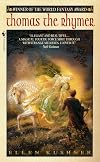
There's a lot to be said about a fantasy that is written WELL. In fact, one can argue that it is the only thing worth aiming for.
With tons of writers touching on this and that in the realm of the Fae, of wandering minstrels, of friendship, love, and loss, you'd think there would never be a way to STAND OUT from that crowd.
And then, this late in my career of hunting down all the best books on the Fae, I run across Thomas the Rhymer. There are no tricks in this telling.
It is, above all, a show more crisp, clear story about a minstrel who gets spirited away to the land of the Sidhe to live and love for the Queen, only to find the world changed when he returns.
I've read really great books about the fae, before, of course, but most of them are rich with side stories or buried within much bigger tellings. This book is ONLY about this one thing. And Kushner dives deep into these clear waters, only to bring back up one of the most beautiful, clear pearls of a story.
If I had to recommend just one perfect example of a man getting kidnapped by fairies, then this would have to be it. It's as shiny and beautiful as a crystal goblet. Or the plucking of a genius upon her harp. :) show less
With tons of writers touching on this and that in the realm of the Fae, of wandering minstrels, of friendship, love, and loss, you'd think there would never be a way to STAND OUT from that crowd.
And then, this late in my career of hunting down all the best books on the Fae, I run across Thomas the Rhymer. There are no tricks in this telling.
It is, above all, a show more crisp, clear story about a minstrel who gets spirited away to the land of the Sidhe to live and love for the Queen, only to find the world changed when he returns.
I've read really great books about the fae, before, of course, but most of them are rich with side stories or buried within much bigger tellings. This book is ONLY about this one thing. And Kushner dives deep into these clear waters, only to bring back up one of the most beautiful, clear pearls of a story.
If I had to recommend just one perfect example of a man getting kidnapped by fairies, then this would have to be it. It's as shiny and beautiful as a crystal goblet. Or the plucking of a genius upon her harp. :) show less

In a nameless city in a nameless country, the aristocratic rulers settle their disputes with one another by hiring professional swordsmen, a process involving complicated rules of honor and procedure. Richard St. Vier, considered the finest swordsman in the city, is much in demand, and finds himself embroiled in the various schemes and intrigues of the city's rulers in this work of fantasy from Ellen Kushner. Determined to protect his lover Alec, a sharp-tongued young man whose aristocratic show more origins are something of a mystery, Richard must also contend with the other residents of Riverside, the lawless section of the city in which he lives, and into which the City Watch does not come. Dark plans and serious plots are afoot, of which Richard knows little—will he be able to protect his lover and come out on top in a world where he has little power...?
The hardcover copy of Swordspoint that I read had a quote from Peter S. Beagle on the front dust-jacket flap, describing it as charming, and reading "as if Georgette Heyer had turned her hand to fantasy." I was struck by that quotation when first picking up the book, as I am a great admirer of Heyer's work. On the whole, I think it correct, as the customs of the upper crust in this story do have a kind of Regency feeling to them. The city setting on the other hand, with its lower and criminal class sections, reminded me a bit of The Lies of Locke Lamora. In any case, I enjoyed this one quite a bit, despite disliking many of the characters. I found myself at something of a loss to understand Alec's attraction for Richard for instance, given his unpleasant qualities, but that's love, I suppose. I don't think the strength here is really the emotional undercurrents, as I found many of the characters here opaque in that respect, and my heart untouched, but rather the swashbuckling adventure and complicated twists and turns of factions and plots. I would definitely read more in this series, although perhaps not right away. Recommended to those who enjoy adventure stories, and Ruritanian Romance—into which category I would place this, as it didn't really strike me as fantastical, in any magical sense—as well as those who enjoy Regency style manners in unusual settings. show less
The hardcover copy of Swordspoint that I read had a quote from Peter S. Beagle on the front dust-jacket flap, describing it as charming, and reading "as if Georgette Heyer had turned her hand to fantasy." I was struck by that quotation when first picking up the book, as I am a great admirer of Heyer's work. On the whole, I think it correct, as the customs of the upper crust in this story do have a kind of Regency feeling to them. The city setting on the other hand, with its lower and criminal class sections, reminded me a bit of The Lies of Locke Lamora. In any case, I enjoyed this one quite a bit, despite disliking many of the characters. I found myself at something of a loss to understand Alec's attraction for Richard for instance, given his unpleasant qualities, but that's love, I suppose. I don't think the strength here is really the emotional undercurrents, as I found many of the characters here opaque in that respect, and my heart untouched, but rather the swashbuckling adventure and complicated twists and turns of factions and plots. I would definitely read more in this series, although perhaps not right away. Recommended to those who enjoy adventure stories, and Ruritanian Romance—into which category I would place this, as it didn't really strike me as fantastical, in any magical sense—as well as those who enjoy Regency style manners in unusual settings. show less

It all started with pulling Ellen Kushner‘s Swordspoint off the shelf. It’s something I’ve thought about rereading now and then, but never did – till now. I found its sequel, The Privilege of the Sword, at Books & Co., happily, and ordered the third book, written with Delia Sherman: The Fall of the Kings. While I was waiting for the latter I reread something I knew was in a similar vein, except more steampunk: the two volumes of Carolus Rex, The Shadow of Albion and Leopard in Exile, show more by Andre Norton and Rosemary Edghill. Also in there was Shana Abe’s Smoke Thief, another Books & Co find which I had tried to start before unsuccessfully, and had better luck with this time. I am going to hate being done with these worlds, this sub-genre of alternate 1800′s England. (I could continue with the Regencies Sorcery and Cecilia/The Enchanted Chocolate Pot, but I need the sequel, The Grand Tour … There are also Wrede’s Mairelon the Magician and Magician’s Ward, which I read not so very long ago … Maybe after Saylor’s Roma, my Early Reviewer book…)
Swordspoint tells the tale of Richard St. Vier, who is a swordsman in a society where the nobles hire swordsmen to fight their duels for them, sometimes to the death. In fact, St. Vier is the pre-eminent swordsman, respected and not a little feared. He can be found living in the gilded slums of Riverside (where the nobles used to live before they crossed the river and raised the property values on The Hill) with his lover Alec, a somewhat mysterious scholar who is not quite dealing with a full deck. I don’t know exactly what a modern diagnosis would be; manic depression (or whatever it ought to be called), I suppose: he migrates with great speed and no warning from sharp and sardonic and relatively stable, to barely contained and horrifyingly reckless (in which state he taunts the most dangerous elements of a dangerous neighborhood until Richard has to defend him with steel), to a still and angry bleakness (in which state he cuts himself and destroys precious objects and fights, bitterly, with Richard). Those around him simply consider him mad.
The writing is frighteningly intelligent, as rich and dense and decadent as pure shortbread, with, perhaps, as deceptively few ingredients but with just the same complexity of flavor. And it seems just as bad for you. The story and the characters teem with vice, but God in heaven are they fun. The fantasy element of Swordspoint lies not in magic or even in its lack (as in the later book), but in its location in a fairy tale unnamed city, beginning with an image out of fairy tale and carrying the aura through.
The plot spirals inward and inward, with politics and sex and intrigue; everyone knows part of what’s going on, and no one knows everything. Including, sometimes, the reader. It’s complex and intricate, like lace made of steel mesh. And so good. The book is fantasy purely in the sense of an undefined setting, swords and swordsmen and horses and nobles. There is no magic, but it’s not that that makes this a fantasy either (unlike The Fall of Kings).
Well, and the writing. The writing is magic. show less
Swordspoint tells the tale of Richard St. Vier, who is a swordsman in a society where the nobles hire swordsmen to fight their duels for them, sometimes to the death. In fact, St. Vier is the pre-eminent swordsman, respected and not a little feared. He can be found living in the gilded slums of Riverside (where the nobles used to live before they crossed the river and raised the property values on The Hill) with his lover Alec, a somewhat mysterious scholar who is not quite dealing with a full deck. I don’t know exactly what a modern diagnosis would be; manic depression (or whatever it ought to be called), I suppose: he migrates with great speed and no warning from sharp and sardonic and relatively stable, to barely contained and horrifyingly reckless (in which state he taunts the most dangerous elements of a dangerous neighborhood until Richard has to defend him with steel), to a still and angry bleakness (in which state he cuts himself and destroys precious objects and fights, bitterly, with Richard). Those around him simply consider him mad.
The writing is frighteningly intelligent, as rich and dense and decadent as pure shortbread, with, perhaps, as deceptively few ingredients but with just the same complexity of flavor. And it seems just as bad for you. The story and the characters teem with vice, but God in heaven are they fun. The fantasy element of Swordspoint lies not in magic or even in its lack (as in the later book), but in its location in a fairy tale unnamed city, beginning with an image out of fairy tale and carrying the aura through.
The plot spirals inward and inward, with politics and sex and intrigue; everyone knows part of what’s going on, and no one knows everything. Including, sometimes, the reader. It’s complex and intricate, like lace made of steel mesh. And so good. The book is fantasy purely in the sense of an undefined setting, swords and swordsmen and horses and nobles. There is no magic, but it’s not that that makes this a fantasy either (unlike The Fall of Kings).
Well, and the writing. The writing is magic. show less
Lists
al.vick-series (1)
Faerie Mythology (1)
music to my eyes (1)
Antiheroes (1)
Which house? (1)
Five star books (1)
Youth: DEI (1)
Female Author (3)
Overdue Podcast (2)
Gaslamp Fantasy (2)
Swashbucklers (2)
Youth: Seasonal (1)
Awards


You May Also Like


Associated Authors
Statistics
- Works
- 54
- Also by
- 57
- Members
- 8,819
- Popularity
- #2,713
- Rating
- 3.8
- Reviews
- 278
- ISBNs
- 106
- Languages
- 8
- Favorited
- 51
