
Richard Ovenden
Author of Burning the Books: A History of Knowledge Under Attack
About the Author
Works by Richard Ovenden
The Bovadium Fragments, Together with The Origin of Bovadium (2025) — Contributor; Contributor — 91 copies, 2 reviews
Associated Works
Digital Forensics and Born-Digital Content in Cultural Heritage Collections (2010) — Author, some editions — 3 copies
1914, la mort des poètes [Exposition, Strasbourg, Bibliothèque nationale et universitaire de Strasbourg, 22 novembre 2014-1er février 2015] (2014) — Foreword, some editions — 2 copies
Tagged
Common Knowledge
- Canonical name
- Ovenden, Richard
- Birthdate
- 1964-03-25
- Gender
- male
- Education
- Sir Roger Manwood's School
St. Chad's College, Durham University
University College London
Deal Parochial School - Occupations
- librarian
- Organizations
- Durham University Library
House of Lords Library
National Library of Scotland
University of Edinburgh
Bodleian Library
Council of the Bibliographical Society - Awards and honors
- Fellow, Society of Antiquaries of London (2008)
- Nationality
- UK
- Associated Place (for map)
- UK
Members
Reviews

It is unreasonable of me to rate this 5⭐, and yet this is where we find ourselves! 🧐
Of the 144 pages, about 35 contain Tolkien's words, but they are interesting in being post-apocalyptic science fiction! Set hundreds of years in the future following an environmental catastrophe, archeologists/philologists draw comically inaccurate conclusions about mid-20th century Oxford based on fragmentary documents relating to the consumerist worship of motor vehicles, with consequent traffic show more congestion and its fatal ecological impact. The satire that starts out whimsically enough, rather like LotR, proceeds to a very dark place.
Given the story is written as a mock academic piece with fictitious footnotes, the editorial contributions of Tolkien Jr are not always easily distinguishable from the story, which actually nicely added to the meta-ness of it.
The bulk of the book, then, is Ovenden's social history of Oxford's mid 20th century industrial and urban development, and the town planning battles (with maps) that raged around motor infrastructure, as this forms the context for Tolkien's story.
It's unlikely I'd otherwise give a 5⭐ review to a local history essay about urban development, and yet as it relates to Prof. T., here, as I said, do we find ourselves 🤨 show less
Of the 144 pages, about 35 contain Tolkien's words, but they are interesting in being post-apocalyptic science fiction! Set hundreds of years in the future following an environmental catastrophe, archeologists/philologists draw comically inaccurate conclusions about mid-20th century Oxford based on fragmentary documents relating to the consumerist worship of motor vehicles, with consequent traffic show more congestion and its fatal ecological impact. The satire that starts out whimsically enough, rather like LotR, proceeds to a very dark place.
Given the story is written as a mock academic piece with fictitious footnotes, the editorial contributions of Tolkien Jr are not always easily distinguishable from the story, which actually nicely added to the meta-ness of it.
The bulk of the book, then, is Ovenden's social history of Oxford's mid 20th century industrial and urban development, and the town planning battles (with maps) that raged around motor infrastructure, as this forms the context for Tolkien's story.
It's unlikely I'd otherwise give a 5⭐ review to a local history essay about urban development, and yet as it relates to Prof. T., here, as I said, do we find ourselves 🤨 show less
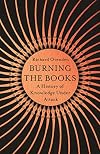
Deeply knowledgeable and fluently written, this is an extremely engaging book about libraries as repositories of knowledge, and the destruction of libraries through declining funding, religious or political conflict.
Richard Ovenden tells a fascinating and enjoyable story, including examples from history starting in Mesopotamia and Alexandria, taking us forward through medieval monastic and university libraries (including the Bodleian of which the author is the librarian), national libraries show more such as America’s Washington library, to personal libraries saved, or not, for posterity such as Byron’s, Kafka’s, Plath’s and Larkin’s.
The author then details the political destruction, or retention, of libraries in a broader sense, including records created or held by the state, such as the Stasi secret personnel records in East Germany in 1989 and the early 1990’s, political records in Iraq in 2003 and 2013, the country’s library and records in the targeted Serbian destruction of Bosnia’s national library in 1992, and the destruction or removal of colonial records when the colonies of European countries became independent mainly in the second half of the twentieth century.
Ovenden then considers the problems of retaining records now that so much is created online. This part of the book is optimistic in setting out the issues and suggesting an approach to dealing with the current shortfall in funding, especially due to austerity measures.
Highly recommended. show less
Richard Ovenden tells a fascinating and enjoyable story, including examples from history starting in Mesopotamia and Alexandria, taking us forward through medieval monastic and university libraries (including the Bodleian of which the author is the librarian), national libraries show more such as America’s Washington library, to personal libraries saved, or not, for posterity such as Byron’s, Kafka’s, Plath’s and Larkin’s.
The author then details the political destruction, or retention, of libraries in a broader sense, including records created or held by the state, such as the Stasi secret personnel records in East Germany in 1989 and the early 1990’s, political records in Iraq in 2003 and 2013, the country’s library and records in the targeted Serbian destruction of Bosnia’s national library in 1992, and the destruction or removal of colonial records when the colonies of European countries became independent mainly in the second half of the twentieth century.
Ovenden then considers the problems of retaining records now that so much is created online. This part of the book is optimistic in setting out the issues and suggesting an approach to dealing with the current shortfall in funding, especially due to austerity measures.
Highly recommended. show less
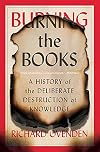
This book gives a history of libraries and archives that have been damaged or destroyed from ancient times to today. It is obviously not a complete history, but it tells the story of some of the most notable losses. It also reports on a couple of cases of personal papers or memoirs that were deliberately destroyed to prevent publication and/or protect reputations. Or in the case of governmental archives, to cover up the actions of colonial/government workers. The famous case of the Library show more of Alexandria is included. Although its destruction has variously been blamed on the Roman army, early Christians, and Muslims in the 7th century, Ovenden believes these are myths and that the library most likely disappeared due to slow decline, underfunding, and neglect.
A number of libraries were deliberately attacked and destroyed over the years, in attempts to suppress a religion or a specific culture. All the stories are heartbreaking to me, because of the loss of knowledge and history. And unfortunately it still continues today. Serbia's deliberate destruction of the National Library of Bosnia occurred only 30 years ago.
Ovenden also addresses the move to the digital world, and how much of current social discussion takes place online. He is greatly concerned about the loss of history for future research if what is online is not preserved. So much of it is currently under the control of a few large tech companies, whose purpose is to make money, not to preserve information for the future. Ovenden feels that libraries and archives need much better funding so that they can carry out the task of preserving this information for the future. At the end, he makes a plea to "the holders of power" to adequately fund libraries and archives.
I thought the book was interesting and very well written. Highly recommended. show less
A number of libraries were deliberately attacked and destroyed over the years, in attempts to suppress a religion or a specific culture. All the stories are heartbreaking to me, because of the loss of knowledge and history. And unfortunately it still continues today. Serbia's deliberate destruction of the National Library of Bosnia occurred only 30 years ago.
Ovenden also addresses the move to the digital world, and how much of current social discussion takes place online. He is greatly concerned about the loss of history for future research if what is online is not preserved. So much of it is currently under the control of a few large tech companies, whose purpose is to make money, not to preserve information for the future. Ovenden feels that libraries and archives need much better funding so that they can carry out the task of preserving this information for the future. At the end, he makes a plea to "the holders of power" to adequately fund libraries and archives.
I thought the book was interesting and very well written. Highly recommended. show less
The Bovadium Fragments: Together with The Origins of Bovadium [Illustrated] [Ribbon] by J. R. R. Tolkien

THE BOVADIUM FRAGMENTS is a previously unpublished comparatively minor Tolkien work in companionship with other short pieces like ROVERANDOM and MR. BLISS, yet less a traditional story than these and more a biting, satirical, cautionary tale of man's folly in unrestrained industrialism (represented by his unhinged passion for, and idolatry of, the automobile) to the detriment of nature that, ultimately, results in Man's extinction.
The story was inspired by actual post-War industrialism show more (e.g., the establishment of a large motor car manufacturer), the associated rapid doubling of the population, resulting in traffic, noise, and pollution in the heart of the bucolic university village of Tolkien's beloved Oxford (i.e. Bovadium) and the Gown (University) and Town (municipal leaders) heated debates for and against new roads through cherished village meadows to accomodate motorists and redirect traffic from the college village's center.
The history of this public, often cantankerous, debate is recounted in an accompanying essay by Oxford Librarian Richard Ovenden, and this composes the majority of the pages in the book, although well-illustrated with related maps and photographs.
Four of J.R.R.'s beautiful watercolor landscapes are also included and another serves as beautiful endpapers.
While not a polished work, and, as noted, fragmentary in its narrative, and replete with extensive passages in Latin -- blessedly translated and annotated by Tolkien's son, the late Professor Christopher Tolkien, THE BOVADIUM FRAGMENTS still radiates Tolkien's wit, charm, love of nature, insight (into man's innate folly), and, Bombadillian humor, if more a black exhaust humor. I believe students of Tolkien, in contrast to the casual fan, will enjoy this work.
It is cautionary tale that extends beyond the specific motor car obsession that, superficially, is the subject of this tale. show less
The story was inspired by actual post-War industrialism show more (e.g., the establishment of a large motor car manufacturer), the associated rapid doubling of the population, resulting in traffic, noise, and pollution in the heart of the bucolic university village of Tolkien's beloved Oxford (i.e. Bovadium) and the Gown (University) and Town (municipal leaders) heated debates for and against new roads through cherished village meadows to accomodate motorists and redirect traffic from the college village's center.
The history of this public, often cantankerous, debate is recounted in an accompanying essay by Oxford Librarian Richard Ovenden, and this composes the majority of the pages in the book, although well-illustrated with related maps and photographs.
Four of J.R.R.'s beautiful watercolor landscapes are also included and another serves as beautiful endpapers.
While not a polished work, and, as noted, fragmentary in its narrative, and replete with extensive passages in Latin -- blessedly translated and annotated by Tolkien's son, the late Professor Christopher Tolkien, THE BOVADIUM FRAGMENTS still radiates Tolkien's wit, charm, love of nature, insight (into man's innate folly), and, Bombadillian humor, if more a black exhaust humor. I believe students of Tolkien, in contrast to the casual fan, will enjoy this work.
It is cautionary tale that extends beyond the specific motor car obsession that, superficially, is the subject of this tale. show less
Lists
Awards


You May Also Like


Associated Authors
Statistics
- Works
- 6
- Also by
- 6
- Members
- 805
- Popularity
- #31,684
- Rating
- 4.0
- Reviews
- 19
- ISBNs
- 27
- Languages
- 6