

AJALT
Author of Japanese for Busy People I: Text
About the Author
Series
Works by AJALT
Japanese for Busy People III: The Workbook for the Third Revised Edition incl. 1 CD (2000) 24 copies
Japanese for Busy People I: Workbook; includes CD (Japanese for Busy People Series) (Bk. 1) 12 copies
Japanese For Young People I: Kana Workbook (Japanese for Young People Series) (Bk.1) (1998) 10 copies
PRACTICAL KANJI: An Introductory Kanji Textbook for Japanese Language Learners, Vol.1 w/ MP3 CD (2016) 6 copies
PRACTICAL KANJI: An Introductory Kanji Textbook for Japanese Language Learners, Vol.2 w/ MP3 CD (2016) 5 copies
Japanese for Busy People Book 1: The Workbook: Revised 4th Edition (free audio download) (2022) 2 copies
Japanese for Busy People Book 1: Kana: Revised 4th Edition (free audio download) (Japanese for Busy People Series-4th Edition) (2022) 2 copies
Japanese for Busy People Book 1: Romanized: Revised 4th Edition (free audio download) (Japanese for Busy People Series-4th Edition) (2022) 2 copies
Japanese for Busy People II (Enhanced with Audio): Revised 3rd Edition (Japanese for Busy People Series) (2021) 1 copy
Japanese for busy people. I 1 copy
Japanese for busy people. II 1 copy
新聞の経済面を読む 1 copy
Japanese for Busy People Book 1: Kana: Revised 4th Edition (Japanese for Busy People Series) (2022) 1 copy
Japanese for Busy People 1 copy
Japanese for Busy People Book 1: The Workbook: Revised 4th Edition (Japanese for Busy People Series) (2022) 1 copy
Tagged
Common Knowledge
Members
Reviews
http://pixxiefishbooks.blogspot.com/2...
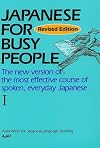
When I first started wanting to learn Japanese over a year ago, Randal lent me his old text, Japanese for Busy People (Book 1), that he'd used when he'd started Japanese lessons many years before. So I was quite pleased when the Japanese course that I took at Algonquin turned out to use the same text as well!
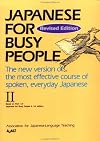
Book 1 is really well-organized. It has short, concise lessons that introduce a few grammar points and some vocabulary, then many exercises to get show more you using, learning and really remembering what you have learnt. Book 2 is slightly more unwieldy, but still good. It has more grammar and vocab in each lesson, and I find the order in which it is all introduced - thematically (eg., At Work, At the Health Club, etc.) rather than by grammar topic - to not always be intuitive. Plus, I bought the kana version, which is good for practicing my hiragana and katakana practice, of course, but makes reading slow! That will improve with practice, I know.
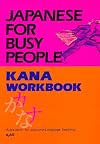
I also picked up, somewhere along the way, the Kana Workbook for the Japanese for Busy People series. It was VERY useful for practicing katakana and hiragana and really getting them to stick in my head. Now if only they produced a book to teach me, equally simply and painlessly, the 1,945 kanji designated necessary by the Japanese government. show less
When I first started wanting to learn Japanese over a year ago, Randal lent me his old text, Japanese for Busy People (Book 1), that he'd used when he'd started Japanese lessons many years before. So I was quite pleased when the Japanese course that I took at Algonquin turned out to use the same text as well!
Book 1 is really well-organized. It has short, concise lessons that introduce a few grammar points and some vocabulary, then many exercises to get show more you using, learning and really remembering what you have learnt. Book 2 is slightly more unwieldy, but still good. It has more grammar and vocab in each lesson, and I find the order in which it is all introduced - thematically (eg., At Work, At the Health Club, etc.) rather than by grammar topic - to not always be intuitive. Plus, I bought the kana version, which is good for practicing my hiragana and katakana practice, of course, but makes reading slow! That will improve with practice, I know.
I also picked up, somewhere along the way, the Kana Workbook for the Japanese for Busy People series. It was VERY useful for practicing katakana and hiragana and really getting them to stick in my head. Now if only they produced a book to teach me, equally simply and painlessly, the 1,945 kanji designated necessary by the Japanese government. show less
http://pixxiefishbooks.blogspot.com/2...
When I first started wanting to learn Japanese over a year ago, Randal lent me his old text, Japanese for Busy People (Book 1), that he'd used when he'd started Japanese lessons many years before. So I was quite pleased when the Japanese course that I took at Algonquin turned out to use the same text as well!
Book 1 is really well-organized. It has short, concise lessons that introduce a few grammar points and some vocabulary, then many exercises to get show more you using, learning and really remembering what you have learnt. Book 2 is slightly more unwieldy, but still good. It has more grammar and vocab in each lesson, and I find the order in which it is all introduced - thematically (eg., At Work, At the Health Club, etc.) rather than by grammar topic - to not always be intuitive. Plus, I bought the kana version, which is good for practicing my hiragana and katakana practice, of course, but makes reading slow! That will improve with practice, I know.
I also picked up, somewhere along the way, the Kana Workbook for the Japanese for Busy People series. It was VERY useful for practicing katakana and hiragana and really getting them to stick in my head. Now if only they produced a book to teach me, equally simply and painlessly, the 1,945 kanji designated necessary by the Japanese government. show less
When I first started wanting to learn Japanese over a year ago, Randal lent me his old text, Japanese for Busy People (Book 1), that he'd used when he'd started Japanese lessons many years before. So I was quite pleased when the Japanese course that I took at Algonquin turned out to use the same text as well!
Book 1 is really well-organized. It has short, concise lessons that introduce a few grammar points and some vocabulary, then many exercises to get show more you using, learning and really remembering what you have learnt. Book 2 is slightly more unwieldy, but still good. It has more grammar and vocab in each lesson, and I find the order in which it is all introduced - thematically (eg., At Work, At the Health Club, etc.) rather than by grammar topic - to not always be intuitive. Plus, I bought the kana version, which is good for practicing my hiragana and katakana practice, of course, but makes reading slow! That will improve with practice, I know.
I also picked up, somewhere along the way, the Kana Workbook for the Japanese for Busy People series. It was VERY useful for practicing katakana and hiragana and really getting them to stick in my head. Now if only they produced a book to teach me, equally simply and painlessly, the 1,945 kanji designated necessary by the Japanese government. show less
http://pixxiefishbooks.blogspot.com/2...
When I first started wanting to learn Japanese over a year ago, Randal lent me his old text, Japanese for Busy People (Book 1), that he'd used when he'd started Japanese lessons many years before. So I was quite pleased when the Japanese course that I took at Algonquin turned out to use the same text as well!
Book 1 is really well-organized. It has short, concise lessons that introduce a few grammar points and some vocabulary, then many exercises to get show more you using, learning and really remembering what you have learnt. Book 2 is slightly more unwieldy, but still good. It has more grammar and vocab in each lesson, and I find the order in which it is all introduced - thematically (eg., At Work, At the Health Club, etc.) rather than by grammar topic - to not always be intuitive. Plus, I bought the kana version, which is good for practicing my hiragana and katakana practice, of course, but makes reading slow! That will improve with practice, I know.
I also picked up, somewhere along the way, the Kana Workbook for the Japanese for Busy People series. It was VERY useful for practicing katakana and hiragana and really getting them to stick in my head. Now if only they produced a book to teach me, equally simply and painlessly, the 1,945 kanji designated necessary by the Japanese government. show less
When I first started wanting to learn Japanese over a year ago, Randal lent me his old text, Japanese for Busy People (Book 1), that he'd used when he'd started Japanese lessons many years before. So I was quite pleased when the Japanese course that I took at Algonquin turned out to use the same text as well!
Book 1 is really well-organized. It has short, concise lessons that introduce a few grammar points and some vocabulary, then many exercises to get show more you using, learning and really remembering what you have learnt. Book 2 is slightly more unwieldy, but still good. It has more grammar and vocab in each lesson, and I find the order in which it is all introduced - thematically (eg., At Work, At the Health Club, etc.) rather than by grammar topic - to not always be intuitive. Plus, I bought the kana version, which is good for practicing my hiragana and katakana practice, of course, but makes reading slow! That will improve with practice, I know.
I also picked up, somewhere along the way, the Kana Workbook for the Japanese for Busy People series. It was VERY useful for practicing katakana and hiragana and really getting them to stick in my head. Now if only they produced a book to teach me, equally simply and painlessly, the 1,945 kanji designated necessary by the Japanese government. show less

This was a textbook for a class in Japanese that I took. It was a good textbook, I did well in the class and had a good time. Unfortunately, it was a long time ago and I don't remember much of it. Konnichiwa. Shitsurei shimasu. I can't blame the book for my lack of practice.
You May Also Like


Statistics
- Works
- 76
- Members
- 1,872
- Popularity
- #13,755
- Rating
- 3.7
- Reviews
- 7
- ISBNs
- 109
- Languages
- 2