

John Patrick Shanley
Author of Doubt: A Parable
About the Author
Image credit: Courtesy of Pulitzer.org.
Works by John Patrick Shanley
Brooklyn Laundry 3 copies
Zweifel 1 copy
Associated Works
The Actor's Book of Contemporary Stage Monologues: More Than 150 Monologues from More Than 70 Playwrights (1987) — Contributor — 193 copies
The Actor's Book of Scenes from New Plays: 70 Scenes for Two Actors, from Today's Hottest Playwrights (1988) — Contributor — 88 copies, 1 review
Tagged
Common Knowledge
- Birthdate
- 1950-10-03
- Gender
- male
- Education
- New York University
- Organizations
- US Marine Corps
- Awards and honors
- American Academy of Arts and Letters Academy Award (Literature, 2006)
- Nationality
- USA
- Associated Place (for map)
- USA
Members
Reviews
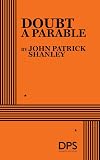
This play addresses an issue straight out of the headlines - priest accused of sexually abusing a young boy in his care. But the play is set in 1964, when such things were rarely spoken of, and the church was struggling to figure out whether it was going to settle into the reforms of Vatican II or fight back. So this play builds in many levels of conflict: nun vs. priest in a world where all the power was clearly distributed on one side; doubt vs. belief in a world that was rapidly show more secularizing and the magazines were proclaiming God dead; truth vs. illusion; tradition vs. modernity; and, of course, innocence vs. guilt. The playwright manages to keep all these balls in the air so smoothly you don't really see the separate threads; they are all woven into a single tapestry. He doesn't make the mistake of giving away the show; even if you are genetically predisposed to distrust priests, you can't be sure he's guilty; even if you find rigid, unbending nuns who have no warmth of human feeling untrustworthy, you suspect she might be right. You end up conflicted - who is right? And in the end, all the author has done is what he promised with the title - he's created doubt. show less
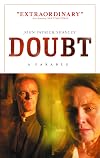
This is the story of a catholic school where the principal (Sister Aloysius) suspects that Father Flynn is abusing one of the students. The characters are so finely drawn that I was able to feel the emotional impact the Sister's suspicions had on everyone involved. Simply amazing that such deep characters can be developed in a play format -- the author couldn't rely on descriptions or an all-seeing narrator to build his characters. Instead, we get to know them as we do in life: largely by show more what they say.
What do we do when we aren't sure? What is the impact of acting in sptie of doubt? Or in doing nothing because of it? These are some of the powerful questions raised by this play. I would love to see it performed! show less
What do we do when we aren't sure? What is the impact of acting in sptie of doubt? Or in doing nothing because of it? These are some of the powerful questions raised by this play. I would love to see it performed! show less
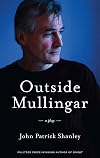
Last year I saw the film version, but if left me wanting to read the play that it inspired it. There’s something that was lost on the big screen and I found it in the quiet conversations between these four people. Steeped in loneliness and love of the land, the strange story somehow works. I particularly enjoyed reading the author's essay about his own trip to Ireland that inspired the show. It's Irish to its core and hit the notes of grief I'm feeling right now.
“The middle is the best show more part. The middle of anything is the heart of the thing.”
"All those years wasted."
"Who knows the way things should be? There's beauty in this." show less
“The middle is the best show more part. The middle of anything is the heart of the thing.”
"All those years wasted."
"Who knows the way things should be? There's beauty in this." show less
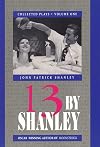
Sometimes it's hard to know how to rate something. I mean, it's tempting to compare this to his masterpiece, Doubt, but that is hardly fair to expect every play to come to the same standard. Still, it is difficult to like these works. I'm not sure why. Perhaps it's the fact that there is not a single likeable character in any of these 13 plays. And many of them do their absolute best to ensure they are unlikeable. No, it's not that. These plays were depressing, not because of their subject show more matter which was not that new or insightful, at least not in the current world. After all, these were standard 1980s plays, where the system is bad and we must tear it down. Now, from a standpoint of the future where we managed to keep what was broken and break what worked, it's easy to look on these plays as part of the problem, not the solution. Still, I think my biggest problem was the casual sexism that coursed through these plays like a snake in the grass; no, that wasn't the worst. The worst was that I got the sense he thought he wasn't being sexist, that he was somehow making a stand for women's equality. But these plays perpetuate every stereotype of both men and women, and even if they were masterpieces, I think I might have been unable to get past that in an anthology of this size. Overall, I found it very disappointing, though there were some very good moments in the works, as well. show less
Lists
Awards


You May Also Like


Associated Authors
Statistics
- Works
- 53
- Also by
- 5
- Members
- 2,552
- Popularity
- #10,058
- Rating
- 3.9
- Reviews
- 37
- ISBNs
- 96
- Languages
- 5
- Favorited
- 1

