
E. Fuller Torrey
Author of Surviving Schizophrenia: A Family Manual
About the Author
E. Fuller Torrey, M.D., is a research psychiatrist specializing in schizophrenia and bipolar disorder. He is the research director of the Stanley Medical Research Institute, the founder of the Treatment Advocacy Center, and a professor of psychiatry at the Uniformed Services University of the show more Health Sciences. He is also the author and editor of twenty books, including The Roots of Treason: Ezra Pound and the Secret of St. Elizabeths, which was nominated by the National Book Critics Circle as one of the five best biographies of 1983. He has lectured extensively and has appeared on Oprah, 60 Minutes, and 20/20. Dr. Torrey lives in the Washington, D.C., area. show less
Works by E. Fuller Torrey
American Psychosis: How the Federal Government Destroyed the Mental Illness Treatment System (2013) 87 copies, 7 reviews
Evolving Brains, Emerging Gods: Early Humans and the Origins of Religion (2017) 84 copies, 4 reviews
Surviving Manic Depression: A Manual on Bipolar Disorder for Patients, Families, and Providers (2002) 81 copies, 2 reviews
The Insanity Offense: How America's Failure to Treat the Seriously Mentally Ill Endangers Its Citizens (2008) 56 copies, 3 reviews
Witchdoctors and Psychiatrists: The Common Roots of Psychotherapy and Its Future/Revised Edition of "the Mind Game" (1986) 51 copies
Freudian Fraud: The Malignant Effect of Freud's Theory on American Thought and Culture (1992) 49 copies
The Invisible Plague: The Rise of mental Illness from 1750 to the Present (2002) 37 copies, 2 reviews
The Death of Psychiatry 1 copy
Tagged
Common Knowledge
- Legal name
- Torrey, Edwin Fuller
- Birthdate
- 1937-09-06
- Gender
- male
- Education
- Princeton University (BA magna cum laude)
McGill University (MD)
Stanford University (MA ∙ Anthropology) - Occupations
- physician
psychiatrist - Organizations
- National Alliance for the Mentally Ill
Treatment Advocacy Center
Stanley Medical Research Institute - Awards and honors
- National Alliance for the Mentally Ill Special Family Award (1984)
U.S. Public Health Service Commendation Medal
National Caring Award (1991) - Nationality
- USA
- Places of residence
- Washington, D.C., USA
- Associated Place (for map)
- D.C., USA
Members
Reviews

This book, written in part by a psychiatrist with expert knowledge of schizophrenia, addresses the question of why mental illness has become increasingly pervasive since 1750. Starting with this date and proceeding towards the present, Torrey and Miller make a commanding case that the prevalence of mental illness has increased steadily since the age of Enlightenment, at least in English-speaking countries. The argument is forceful.
They argue against the common argument - pushed forward by show more many in prominence like Michel Foucault - that the diagnosis of insanity/psychosis is merely a way of pushing away societal nonconformists into asylums. The finding of MRI changes in those with bipolar disorder or schizophrenia, for one, argues for some kind of biology of disease, not merely a sociology. Further, the contention that genetics provides a key does not answer the question: What in modernity has led to the spread of mental diseases? Why did we not see this prior to 1750?
The authors propose a wide variety of possible (but unconfirmed) causes, all centered around the hypothesis that urbanization plays a key role. This case is well-argued and deserves attention and research. show less
They argue against the common argument - pushed forward by show more many in prominence like Michel Foucault - that the diagnosis of insanity/psychosis is merely a way of pushing away societal nonconformists into asylums. The finding of MRI changes in those with bipolar disorder or schizophrenia, for one, argues for some kind of biology of disease, not merely a sociology. Further, the contention that genetics provides a key does not answer the question: What in modernity has led to the spread of mental diseases? Why did we not see this prior to 1750?
The authors propose a wide variety of possible (but unconfirmed) causes, all centered around the hypothesis that urbanization plays a key role. This case is well-argued and deserves attention and research. show less

In psychiatry, “serious mental illness” is substitute language for bipolar disorder and schizophrenia. These two difficult diseases account for much of the homelessness that American cities see. Thus, these two diseases also account for much of where tax dollars go. The utterly tragic part, however, is that decent biomedical treatments exist for these diseases; in America, the infrastructure to treat them does not. Why? And what can be improved? This book, originally published in 1988 show more but readapted to 2025 in a second edition, attempts to answer those questions.
The author Dr. E. Fuller Torrey spent a lot of his career at the National Institute for Mental Health (NIMH), a part of the National Institutes of Health (NIH). Thus, he had a high-level view of America’s mental healthcare system. He’s spent most of his professional life advocating that serious mental illness receive a larger share of the mental healthcare financial pie. He does so not by tugging at one’s heart strings but rather by presenting overwhelming data that we’ve misappropriated governmental spending going back to JFK’s time.
We indeed can combat homelessness, he maintains, by building a better mental healthcare system that addresses these difficult, yet treatable, conditions. We might even be able to save money in the long run! Starting with Great Society reforms in the 1960s, attempts to create a mental healthcare system shut down state mental institutions. Most of those “freed” were unable to keep a steady job and simply entered the trap of homelessness. He argues that freedom from mental institutions without “freedom from psychosis” is a mirage.
Homelessness continues to tax urban infrastructures, but few politicians offer any real solutions other than sweeping them under the rug. To his credit, Torrey offers two handfuls of specific ways to improve our policy. He shows how mental health expenditures went to surface-level psychological topics instead of research to address the most difficult of problems.
Policy wonks and mental health workers will benefit the most from this work. Its offerings focus on systemic answers rather than individual ones. It offers a deep history of how we got here and why we got here. It also begs the question of when will we get the collective will to confront these problems. I’m concerned that the stigma of mental illness – still so pervasive – limits constructive conversations. If we’d only be able to fund treating serious mental illness as much as we fund other serious but common diseases, we might be able to build a better society and a more productive country. show less
The author Dr. E. Fuller Torrey spent a lot of his career at the National Institute for Mental Health (NIMH), a part of the National Institutes of Health (NIH). Thus, he had a high-level view of America’s mental healthcare system. He’s spent most of his professional life advocating that serious mental illness receive a larger share of the mental healthcare financial pie. He does so not by tugging at one’s heart strings but rather by presenting overwhelming data that we’ve misappropriated governmental spending going back to JFK’s time.
We indeed can combat homelessness, he maintains, by building a better mental healthcare system that addresses these difficult, yet treatable, conditions. We might even be able to save money in the long run! Starting with Great Society reforms in the 1960s, attempts to create a mental healthcare system shut down state mental institutions. Most of those “freed” were unable to keep a steady job and simply entered the trap of homelessness. He argues that freedom from mental institutions without “freedom from psychosis” is a mirage.
Homelessness continues to tax urban infrastructures, but few politicians offer any real solutions other than sweeping them under the rug. To his credit, Torrey offers two handfuls of specific ways to improve our policy. He shows how mental health expenditures went to surface-level psychological topics instead of research to address the most difficult of problems.
Policy wonks and mental health workers will benefit the most from this work. Its offerings focus on systemic answers rather than individual ones. It offers a deep history of how we got here and why we got here. It also begs the question of when will we get the collective will to confront these problems. I’m concerned that the stigma of mental illness – still so pervasive – limits constructive conversations. If we’d only be able to fund treating serious mental illness as much as we fund other serious but common diseases, we might be able to build a better society and a more productive country. show less
American Psychosis: How the Federal Government Destroyed the Mental Illness Treatment System by E. Fuller Torrey

“Throughout history the problem of the mentally ill has been dodged. We have continually avoided mentally ill patients—we have segregated them, ostracized them, turned our back on them, tried to forget about them. We have allowed intolerable conditions to exist for the mentally ill through our ignorance and indifference. We can no longer afford to ignore their needs, to turn a deaf ear to their calls for help. We must come face to face with the facts.”
This one is tough. I'm going to show more just split up evenly into positive and negative.
POSITIVE: While some might have felt the author spent too long on JFK, I thought it was incredibly interesting. It helped create historical depth and context for a book that is largely about analysis of modern policy. While I'm not necessarily a Kennedy fanatic, I had never heard of Rosemary Kennedy and found her story profound. I'm not sure how much relevancy all of the details had (I really don't need to know how hard the Kennedys tried to keep her from having sex), but all in all it was a compelling section.
In general, the message of the book is concise and positive. As shown by the quote I shared above, the author feels that this country has a system (or lack thereof) for mental healthcare based on a simple ideology: keep them out of our view. In the name of this mission, we have allowed our mentally ill to rot on the streets and in our prisons. People die very day from suicide, and immeasurable suffering is caused by psychiatric disorders, especially among today's youth. Talking about how damaged our mental healthcare is must continue, it's not only important but it's literally a matter of life and death(s). So good on that.
NEGATIVE: The approach to the book can be questionable. The consequences of deinstitutionalization are often outlined by listing off violent crimes perpetuated by the mentally unstable, which perpetuates stigma and stereotypes that the author himself refutes later on. The author looks down his nose on certain existing programs, and in general he doesn't seem to be super on board with the idea of casual, low-level treatment such as in-home help and community programs. These might not stop someone in severe need of help, but they do provide plenty of good to society and I thought it was strange how he would talk about them sometime. Just in general, you can tell this book was written by a Psychiatrist and not a therapist, or for that matter an actual person with mental illness.
It's the classic trope that I've complained about on here before: Stories of the mentally ill and how they need our help, Written by Concerned Parent, or Concerned Expert, or Anyone Besides A Person With An Actual Illness. Those that live with mental disorders are not given a platform to talk, instead they must allow people to speak on their behalf through whatever lens their "ally" might prefer.
The book was frustrating at times, and insightful at times. I learned a lot but also kind of got mad at the author a lot. Solid 3 stars. show less
This one is tough. I'm going to show more just split up evenly into positive and negative.
POSITIVE: While some might have felt the author spent too long on JFK, I thought it was incredibly interesting. It helped create historical depth and context for a book that is largely about analysis of modern policy. While I'm not necessarily a Kennedy fanatic, I had never heard of Rosemary Kennedy and found her story profound. I'm not sure how much relevancy all of the details had (I really don't need to know how hard the Kennedys tried to keep her from having sex), but all in all it was a compelling section.
In general, the message of the book is concise and positive. As shown by the quote I shared above, the author feels that this country has a system (or lack thereof) for mental healthcare based on a simple ideology: keep them out of our view. In the name of this mission, we have allowed our mentally ill to rot on the streets and in our prisons. People die very day from suicide, and immeasurable suffering is caused by psychiatric disorders, especially among today's youth. Talking about how damaged our mental healthcare is must continue, it's not only important but it's literally a matter of life and death(s). So good on that.
NEGATIVE: The approach to the book can be questionable. The consequences of deinstitutionalization are often outlined by listing off violent crimes perpetuated by the mentally unstable, which perpetuates stigma and stereotypes that the author himself refutes later on. The author looks down his nose on certain existing programs, and in general he doesn't seem to be super on board with the idea of casual, low-level treatment such as in-home help and community programs. These might not stop someone in severe need of help, but they do provide plenty of good to society and I thought it was strange how he would talk about them sometime. Just in general, you can tell this book was written by a Psychiatrist and not a therapist, or for that matter an actual person with mental illness.
It's the classic trope that I've complained about on here before: Stories of the mentally ill and how they need our help, Written by Concerned Parent, or Concerned Expert, or Anyone Besides A Person With An Actual Illness. Those that live with mental disorders are not given a platform to talk, instead they must allow people to speak on their behalf through whatever lens their "ally" might prefer.
The book was frustrating at times, and insightful at times. I learned a lot but also kind of got mad at the author a lot. Solid 3 stars. show less
The Insanity Offense: How America's Failure to Treat the Seriously Mentally Ill Endangers Its Citizens by E. Fuller Torrey
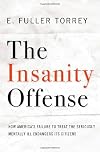
In the 1960s there were two big things happening in US society. First, there were civil rights movements, and second, states and the government needed money. There began one of the largest problems seen on the streets of America today. Though most experts at the time believed that deinstitutionalization was the right way to go, no one seemed to think of the long term consequences this movement might have. Civil rights advocates argued that involuntary commitment was inhumane and that the show more laws should be changed, and so they were. Thousands of state funded hospitals for those with serious mental illnesses were closed, and most of the individuals living in them were left with no where to go.
The Insanity Offense is an accounting of the deinstitutionalization of America and the profound effect it has had on society. E. Fuller Torrey, a research psychiatrist, has followed many cases of mentally ill individuals that have been left without proper care only to cause harm. He puts a light on the real picture of what’s happening. The mentally ill have no where to turn, those who need treatment the most cannot get it because the laws say that an involuntary commitment to a facility cannot happen until the individual has actually acted in violence, not just threatened it. In many cases even if someone is taken in, they will be released after a few days, and chances are they will repeat the cycle again.
Mentally ill peoples are being left homeless, they turn violent and hurt themselves and others, they are victimized because other criminals think of them as weak and defenseless, and they are being incarcerated at higher rates than ever before, left in prisons that don’t have the resources to treat them as needed. Is that more inhumane than involuntarily committing them to get the treatment they need?
Reading this book broke my heart and infuriated me at the same time. The blindness of those with the power to change the circumstances is inexcusable. This book is a true eye-opener and it is something I can see myself referring back to in the future. Honestly, I would have to call it a “must read” because everyone should know what is really happening to the mentally ill of America. show less
The Insanity Offense is an accounting of the deinstitutionalization of America and the profound effect it has had on society. E. Fuller Torrey, a research psychiatrist, has followed many cases of mentally ill individuals that have been left without proper care only to cause harm. He puts a light on the real picture of what’s happening. The mentally ill have no where to turn, those who need treatment the most cannot get it because the laws say that an involuntary commitment to a facility cannot happen until the individual has actually acted in violence, not just threatened it. In many cases even if someone is taken in, they will be released after a few days, and chances are they will repeat the cycle again.
Mentally ill peoples are being left homeless, they turn violent and hurt themselves and others, they are victimized because other criminals think of them as weak and defenseless, and they are being incarcerated at higher rates than ever before, left in prisons that don’t have the resources to treat them as needed. Is that more inhumane than involuntarily committing them to get the treatment they need?
Reading this book broke my heart and infuriated me at the same time. The blindness of those with the power to change the circumstances is inexcusable. This book is a true eye-opener and it is something I can see myself referring back to in the future. Honestly, I would have to call it a “must read” because everyone should know what is really happening to the mentally ill of America. show less
Lists
Awards


You May Also Like


Associated Authors
Statistics
- Works
- 31
- Members
- 1,273
- Popularity
- #20,146
- Rating
- 3.9
- Reviews
- 24
- ISBNs
- 83
- Languages
- 3
- Favorited
- 2