
Elizabeth Grosz
Author of Volatile Bodies: Toward a Corporeal Feminism
About the Author
Elizabeth Grosz is a professor of women's and gender studies at Rutgers University.
Image credit: Rutgers University
Works by Elizabeth Grosz
Associated Works
Undutiful Daughters: New Directions in Feminist Thought and Practice (Breaking Feminist Waves) (2012) — Contributor — 6 copies
Tagged
Common Knowledge
- Canonical name
- Grosz, Elizabeth
- Legal name
- Grosz, Elizabeth Anne
- Birthdate
- 1952
- Gender
- female
- Education
- University of Sydney (BA|MA|Ph.D|1981)
- Occupations
- philosopher
feminist theorist
professor - Organizations
- Duke University
Rutgers University
State University of New York, Buffalo
Monash University - Awards and honors
- Gleebooks Prize for Critical Writing (1995)
- Short biography
- Elizabeth A. Grosz is an Australian feminist academic living and working in the USA. She is known for philosophical interpretations of the work of French philosophers Jacques Lacan, Jacques Derrida, Michel Foucault and Gilles Deleuze, as well as her readings of the works of French feminists, Luce Irigaray, Julia Kristeva and Michele Le Doeuff. She has mainly written on questions of corporeality and their relations to the sciences and the arts.
- Nationality
- Australia
- Birthplace
- Sydney, New South Wales, Australia
- Places of residence
- Durham, North Carolina, USA
- Associated Place (for map)
- Australia
Members
Reviews
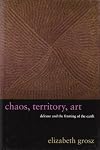
Chaos, Territory, Art: Deleuze and the Framing of the Earth (The Wellek Library Lectures) by Elizabeth Grosz
Impressions follow:
Pretty thin stuff after reading in object-oriented philosophy over the last few days. Via Deleuze, Grosz thinks in binaries: inside/outside, alive/notalive, 'primary forces' and the 'primitive' (which, in a typically psychoanalytic manner, are more revelatory, because earlier), and art as framing 'chaos' (which is out there) (and where neither 'framing' nor 'life' have any of the ethical force that they do in Butler's Frames of War); discussions of music as rhythmic and show more ordered work only so long as she doesn't discuss any particular music and just brackets off various postmodern, postrhythmic, and postmelodic soundmaking (indeed it's the automatic pop music so disdained by Deleuze that is most rhythmic and refrain-y) (and if she wants to discuss primitive and bodily aesthetics of sensation, EATING would have been a better site for investigation than music); her references to science use Darwin in the same way one might use a philosopher, as a site for thinking, when she might have done better, both in her references to birds and in her many vague references to 'the world', 'the universe', and even the 'vibrations' of sub-atomic particles, to engage with contemporary science. Certainly once we get "down" (if we want to think in these spatial metaphors) to sub-atomic particles, it's no longer suitable to distinguish between life and nonlife.
Useful for a good discussion of Von Uexküll and for the inevitable excess and 'mal-adaption' of sexual attraction, whether in birds, fish, or humans. show less
Pretty thin stuff after reading in object-oriented philosophy over the last few days. Via Deleuze, Grosz thinks in binaries: inside/outside, alive/notalive, 'primary forces' and the 'primitive' (which, in a typically psychoanalytic manner, are more revelatory, because earlier), and art as framing 'chaos' (which is out there) (and where neither 'framing' nor 'life' have any of the ethical force that they do in Butler's Frames of War); discussions of music as rhythmic and show more ordered work only so long as she doesn't discuss any particular music and just brackets off various postmodern, postrhythmic, and postmelodic soundmaking (indeed it's the automatic pop music so disdained by Deleuze that is most rhythmic and refrain-y) (and if she wants to discuss primitive and bodily aesthetics of sensation, EATING would have been a better site for investigation than music); her references to science use Darwin in the same way one might use a philosopher, as a site for thinking, when she might have done better, both in her references to birds and in her many vague references to 'the world', 'the universe', and even the 'vibrations' of sub-atomic particles, to engage with contemporary science. Certainly once we get "down" (if we want to think in these spatial metaphors) to sub-atomic particles, it's no longer suitable to distinguish between life and nonlife.
Useful for a good discussion of Von Uexküll and for the inevitable excess and 'mal-adaption' of sexual attraction, whether in birds, fish, or humans. show less
Time Travels: Feminism, Nature, Power (Next Wave: New Directions in Women's Studies) by Elizabeth Grosz
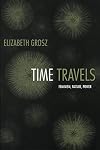
made me think differently about Darwin. also TIME.
the conclusion especially made me feel kind of ecstatic!
"History produces not only the forces of domination but also the forces of resistance that press up against and are often the objects of such domination. Which is another way of saying that history, the past, is larger than the present, and is the ever-growing and ongoing possibility of resistance to the present’s imposed values, the possibility of futures not unlike the present, futures that resist and transform what dominates the show more present" (237).
“The resources of the previously oppressed - of women under patriarchy, of slaves under slavery, of minorities under racism, colonialism, or nationalism, of workers under capitalism, and so on -are not lost or wiped out through the structures of domination that helped to define them: they are preserved somewhere, in the past itself, with effects and traces that can be animated in a number of different contexts and terms in the present" (240). show less
"History produces not only the forces of domination but also the forces of resistance that press up against and are often the objects of such domination. Which is another way of saying that history, the past, is larger than the present, and is the ever-growing and ongoing possibility of resistance to the present’s imposed values, the possibility of futures not unlike the present, futures that resist and transform what dominates the show more present" (237).
“The resources of the previously oppressed - of women under patriarchy, of slaves under slavery, of minorities under racism, colonialism, or nationalism, of workers under capitalism, and so on -are not lost or wiped out through the structures of domination that helped to define them: they are preserved somewhere, in the past itself, with effects and traces that can be animated in a number of different contexts and terms in the present" (240). show less

"Pleasure is a crucial hinge, a bodily resource, that is of enormous strategic utility in the ongoing interplay and transformations of power and resistance. Pleasure is that which induces bodies to participate in power; pleasure is that which provides power with some of its techniques for the extraction of information or knowledge, and for imposing discipline through the subject’s very complicity in speaking and acting according to requirements of disciplinary regimes. But if pleasure can show more function in the service of power, as a means and end of power’s operations, so too pleasure is that wedge which serves and consolidates resistance" (191). show less
Awards

You May Also Like


Associated Authors
Statistics
- Works
- 12
- Also by
- 3
- Members
- 1,078
- Popularity
- #23,855
- Rating
- 4.0
- Reviews
- 5
- ISBNs
- 54