
Donald Hoffman
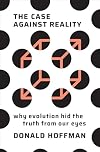
Author of The Case Against Reality: Why Evolution Hid the Truth from Our Eyes
Works by Donald Hoffman
Tagged
Common Knowledge
- Canonical name
- Hoffman, Donald
- Gender
- male
- Short biography
- Donald Hoffmann is an author known for his work on architecture, particularly his book "Frank Lloyd Wright's Fallingwater: The House and Its History." This book provides a comprehensive account of the iconic Fallingwater house designed by Frank Lloyd Wright, detailing its architectural innovations and historical significance.
- Nationality
- USA
- Map Location
- USA
Members
Reviews

Our picture of the world—the way it appears, for example, if you glance up for a moment from this book review and look around at wherever it is you happen to be right now—is plainly very different from the way it actually is. I think I was around twelve years old when I first realised this myself, at school just looking at one of those wall-posters with radio waves at one end, gamma rays at the other and that narrow coloured band of “visible light” arbitrarily set in the middle: show more first, just how little of what there is, how thin a sliver, we see; and then, that much the same is true for sounds, scents, touch and all the rest. The “world” as we experience it is an accurate, but severely reduced, simplification.
The Case Against Reality is an odd book. For a start, reading it I had the feeling that Donald Hoffman is setting up a straw man here, then knocking it down, setting it back up, knocking it down again… His claim is that most people think their picture of reality is a true one (“veridical” is the word he uses endlessly), then he can demolish this and tell us how wildly wrong we all are. But how many of us believe this in the first place? The overwhelming majority of human beings are not reflective enough (or far too busy more like, feeding the kids, doing a day’s work, worrying about the bills, their health, the planet) to have ever given the matter any thought. And of those who have, do any of us believe we’re experiencing things exactly as they are?
Then there’s the conclusion the book turns out to be heading towards (in perhaps the final ten pages or so out of two hundred). This is something he calls “conscious realism”, which as best as I can understand it seems to be a form of idealism (in the Bishop Berkeley meaning of that word): “consciousness, not spacetime and its objects, is fundamental reality and is properly described as a network of conscious agents”.
Finally, there’s the endless repetition, which soon gets pretty tedious. I may be quite wrong about this, but it crossed my mind that, his ideas having already been savaged by fellow academics, this book was aimed at convincing them rather than the rest of us. The repetition also had me wondering whether he fully believes his own ideas; it almost sounded as if he was trying to convince himself as well. He didn’t convince me. show less
The Case Against Reality is an odd book. For a start, reading it I had the feeling that Donald Hoffman is setting up a straw man here, then knocking it down, setting it back up, knocking it down again… His claim is that most people think their picture of reality is a true one (“veridical” is the word he uses endlessly), then he can demolish this and tell us how wildly wrong we all are. But how many of us believe this in the first place? The overwhelming majority of human beings are not reflective enough (or far too busy more like, feeding the kids, doing a day’s work, worrying about the bills, their health, the planet) to have ever given the matter any thought. And of those who have, do any of us believe we’re experiencing things exactly as they are?
Then there’s the conclusion the book turns out to be heading towards (in perhaps the final ten pages or so out of two hundred). This is something he calls “conscious realism”, which as best as I can understand it seems to be a form of idealism (in the Bishop Berkeley meaning of that word): “consciousness, not spacetime and its objects, is fundamental reality and is properly described as a network of conscious agents”.
Finally, there’s the endless repetition, which soon gets pretty tedious. I may be quite wrong about this, but it crossed my mind that, his ideas having already been savaged by fellow academics, this book was aimed at convincing them rather than the rest of us. The repetition also had me wondering whether he fully believes his own ideas; it almost sounded as if he was trying to convince himself as well. He didn’t convince me. show less

Donald Hoffman's The Case Against Reality is the best popular science book I have read in many years. It discusses evolution, human perception, theoretical physics, and other fundamental topics on the way to an alternative scientific ontology that Hoffman calls conscious realism. Important elements in his argument include the abysmal failure to account for consciousness on the basis of physicalism, the "Fitness Beats Truth theorem," the bankruptcy of perceivable spacetime as a basis for show more physics, an "interface theory of perception," and ultimately the Conscious Agent Thesis.
The prose is lively and not at all condescending. With the exception of a brief appendix, Hoffman avoids dry technical detail and pursues unorthodox concepts in judicious ways that intelligent readers should be able to follow.
In a few passages of the book, Hoffman comes off as a tad evil, as when he describes his mercenary expert testimony on behalf of T-Mobile in a trademark lawsuit asserting their exclusive ownership of a color (147-8), or when he talks about "hacking" perceptual processes for "marketing and product design" (172). I'm willing to allow that these elements made the book more creditable to the commercial press, but ick.
On a related note, he observes that, "evolutionary psychology ... has been accused of ... justifying unsavory moral and political ideas," an accusation he finds "misguided" (50). While I agree with him that the core concepts and inquiry of evolutionary psychology do not actually justify pernicious ideologies, it is true that attempts have repeatedly been made to use them thus--a difficulty that might have been addressed in an explanatory end note. This omission by Hoffman fits awkwardly with his repeated use of tropes from The Matrix--notably "the red pill"--that have been adopted as banners of misogynist and paranoid subcultures. (Sorry they perverted your gnostic metaphor, Wachowskis.)
I only point out these failings because I think they should be disregarded in light of the book's larger accomplishment. "No mystery of science offers greater intrigue, or greater perplexity, than the provenance of quotidian experiences" (178), and Hoffman's proposal for a way to clear the perplexity is a valuable one. He observes that while his ontological postulates buck the intellectual trends in his field of cognitive science, they are "not radically new," and he instances philosophical and mystical precursors from antiquity and modern thought (195-6). And I would add that both the Interface Theory of Perception and the Conscious Agent Thesis comport strongly with psychedelically-informed intuition.
Hoffman also rejects the non-overlapping magisteria of Stephen Jay Gould, who promotes a crypto-dualism by erecting an epistemological wall between science and religion (197). Instead, Hoffman suggests that his own ideas may help to contribute to "an uneasy truce and eventual rapprochement" between spirituality and disciplined inquiry (199). I agree that this provocative book can be a paving stone of the path by which the method of science might pursue the aim of religion. show less
The prose is lively and not at all condescending. With the exception of a brief appendix, Hoffman avoids dry technical detail and pursues unorthodox concepts in judicious ways that intelligent readers should be able to follow.
In a few passages of the book, Hoffman comes off as a tad evil, as when he describes his mercenary expert testimony on behalf of T-Mobile in a trademark lawsuit asserting their exclusive ownership of a color (147-8), or when he talks about "hacking" perceptual processes for "marketing and product design" (172). I'm willing to allow that these elements made the book more creditable to the commercial press, but ick.
On a related note, he observes that, "evolutionary psychology ... has been accused of ... justifying unsavory moral and political ideas," an accusation he finds "misguided" (50). While I agree with him that the core concepts and inquiry of evolutionary psychology do not actually justify pernicious ideologies, it is true that attempts have repeatedly been made to use them thus--a difficulty that might have been addressed in an explanatory end note. This omission by Hoffman fits awkwardly with his repeated use of tropes from The Matrix--notably "the red pill"--that have been adopted as banners of misogynist and paranoid subcultures. (Sorry they perverted your gnostic metaphor, Wachowskis.)
I only point out these failings because I think they should be disregarded in light of the book's larger accomplishment. "No mystery of science offers greater intrigue, or greater perplexity, than the provenance of quotidian experiences" (178), and Hoffman's proposal for a way to clear the perplexity is a valuable one. He observes that while his ontological postulates buck the intellectual trends in his field of cognitive science, they are "not radically new," and he instances philosophical and mystical precursors from antiquity and modern thought (195-6). And I would add that both the Interface Theory of Perception and the Conscious Agent Thesis comport strongly with psychedelically-informed intuition.
Hoffman also rejects the non-overlapping magisteria of Stephen Jay Gould, who promotes a crypto-dualism by erecting an epistemological wall between science and religion (197). Instead, Hoffman suggests that his own ideas may help to contribute to "an uneasy truce and eventual rapprochement" between spirituality and disciplined inquiry (199). I agree that this provocative book can be a paving stone of the path by which the method of science might pursue the aim of religion. show less
Despite centuries of unrelenting scientific progress, the problem of consciousness remains unsolved. How subjective experience can arise from the electrochemical irritation of nervous tissue remains one of the deepest mysteries of the universe.
But according to Donald Hoffman, we have yet to solve the problem of consciousness—not because we lack data or the intellectual capacity—but because our conception of reality is entirely wrong. Once we come to grips with the true nature of reality, show more the problem of consciousness can be solved.
The first thing to note is that, while this book may entirely transform the way you see reality, the ideas are not new. Hoffman’s “Interface Theory of Perception” is in many ways a re-statement—supported by research in cognitive science—of Imannuel Kant’s transcendental idealism (Hoffman does give appropriate credit to Kant). In the Critique of Pure Reason, Kant claimed to have achieved a “Copernican revolution” in thought by inverting the traditional relationship between subject and object.
According to Kant, objects in the world (things-in-themselves) provide the sense data that the mind uses to construct its perceptions and ideas of those objects in pre-configured ways. However, the ideas of the objects are not the objects themselves, and since we can only experience the world through our perceptions and ideas, we can never get outside of our own minds to discover the true nature of those objects. Our minds are not passive observers of an external reality but are actively involved in the construction of our own reality.
Hoffman is essentially claiming that the latest research in cognitive science and perception—and even in quantum physics—vindicates Kant. Hoffman, of course, provides details from cognitive science that Kant could not have had access to, but the larger point remains the same—that what we perceive is a construction of the mind and that objective reality, which must exist for the mind to perceive anything at all, is fundamentally different from what we directly perceive. Hoffman introduces the evolutionary concept of “Fitness Beats Truth” to show that evolution almost certainly sculpted our minds for fitness, not to accurately represent reality, thus creating the mismatch between “things-in-themselves” and our perceptions of them.
Hoffman uses the analogy of a computer desktop. Our computer files may be represented by icons that occupy space and take certain shapes and colors, but the files themselves do not sit in the middle of our screens or have any shape or color. The files are, at bottom, bits of information and electrical currents in our computer’s memory; the icons allow us to work with the files in an intuitive way but do not represent the underlying reality of the file.
In the same way, consciousness is a three-dimensional virtual desktop that allows us to interact with the world in useful ways but does not accurately represent the underlying reality, whatever that reality is. Hoffman uses convincing examples throughout the book to demonstrate that things like color are not inherent in objects themselves but are active constructions by the mind in response to certain wavelengths of light. In an interesting case study, Hoffman shows us that if the area of the brain that processes colors is damaged, color can disappear entirely from conscious awareness.
The implications of this—if Hoffman (and Kant) is right—are huge. It means that all natural science is essentially reduced to psychology. A deeper understanding of the material world—including both macro-level objects (including brains and neurons) and quantum particles—are simply icons and pixels in the interface of our consciousness. They tell us nothing about objective reality, only about our interface.
Here’s another way to think about it: an expert Minecraft player that is very good at manipulating and controlling the Minecraft world remains entirely ignorant of the underlying computer code and hardware running the game. Likewise, scientists may have expert knowledge of our virtual interface of the world, but, like the Minecraft player, they have no access to the underlying reality that makes the world of conscious perception possible. This inversion of subject and object also explains why quantum experiments are so dependent and influenced by observation—quantum particles are not the deepest components of objective reality, they are the pixels of our conscious interface that the mind creates.
Kant would agree with all of this, but Hoffman wants to go further than Kant. Kant would see the Interface Theory of Perception as defining the limits of human understanding, in that we simply can’t transcend the limits of perception to see the ultimate cause of our perceptions. Stated in another way, the fundamental nature of reality is about as discoverable as a new color you’ve never seen.
But Hoffman, for some reason, refuses to accept this. He thinks that the ultimate nature of reality can be discovered scientifically and that it is essentially composed of conscious agents. According to Hoffman, we have yet to solve the mystery of consciousness—not because we’re awaiting new scientific discoveries or have reached the limit of human understanding—but because our entire conception of reality is wrong. Once we understand that the world is composed of conscious agents that ultimately create spacetime and all the objects contained within it, we can finally solve the hard problem of consciousness.
I’ll admit that I found this argument to be less persuasive. I think that Hoffman has discovered, like Kant, the boundaries and limits of human understanding. We can investigate the world scientifically as its presented to us, but we have no conceivable way to transcend the limits of our own virtual conscious interface. The things-in-themselves, the objective reality that must exist to provide sense data to our minds, cannot be investigated directly because whatever data we acquire will always be filtered through perceptual systems that we can’t control or transcend. It’s like being born blind and trying to understand what it’s like to see color.
Some readers may be persuaded by Hoffman’s argument, but I don’t see a way around this. If perception is created by the mind based on an objective reality that is different, then we simply have no way to access to this objective reality. It’s what Wittgenstein meant when he said that what can be said can be said clearly, and “whereof one cannot speak, thereof one must be silent.” We can speak about our conscious interface (science and human behavior and experience), but when we attempt to transcend the interface the result is always nonsense. As Kant said long ago, this is precisely the point where we’ve reached the limit of human understanding. Hoffman thinks otherwise; who is ultimately right the reader is left to decide. show less
But according to Donald Hoffman, we have yet to solve the problem of consciousness—not because we lack data or the intellectual capacity—but because our conception of reality is entirely wrong. Once we come to grips with the true nature of reality, show more the problem of consciousness can be solved.
The first thing to note is that, while this book may entirely transform the way you see reality, the ideas are not new. Hoffman’s “Interface Theory of Perception” is in many ways a re-statement—supported by research in cognitive science—of Imannuel Kant’s transcendental idealism (Hoffman does give appropriate credit to Kant). In the Critique of Pure Reason, Kant claimed to have achieved a “Copernican revolution” in thought by inverting the traditional relationship between subject and object.
According to Kant, objects in the world (things-in-themselves) provide the sense data that the mind uses to construct its perceptions and ideas of those objects in pre-configured ways. However, the ideas of the objects are not the objects themselves, and since we can only experience the world through our perceptions and ideas, we can never get outside of our own minds to discover the true nature of those objects. Our minds are not passive observers of an external reality but are actively involved in the construction of our own reality.
Hoffman is essentially claiming that the latest research in cognitive science and perception—and even in quantum physics—vindicates Kant. Hoffman, of course, provides details from cognitive science that Kant could not have had access to, but the larger point remains the same—that what we perceive is a construction of the mind and that objective reality, which must exist for the mind to perceive anything at all, is fundamentally different from what we directly perceive. Hoffman introduces the evolutionary concept of “Fitness Beats Truth” to show that evolution almost certainly sculpted our minds for fitness, not to accurately represent reality, thus creating the mismatch between “things-in-themselves” and our perceptions of them.
Hoffman uses the analogy of a computer desktop. Our computer files may be represented by icons that occupy space and take certain shapes and colors, but the files themselves do not sit in the middle of our screens or have any shape or color. The files are, at bottom, bits of information and electrical currents in our computer’s memory; the icons allow us to work with the files in an intuitive way but do not represent the underlying reality of the file.
In the same way, consciousness is a three-dimensional virtual desktop that allows us to interact with the world in useful ways but does not accurately represent the underlying reality, whatever that reality is. Hoffman uses convincing examples throughout the book to demonstrate that things like color are not inherent in objects themselves but are active constructions by the mind in response to certain wavelengths of light. In an interesting case study, Hoffman shows us that if the area of the brain that processes colors is damaged, color can disappear entirely from conscious awareness.
The implications of this—if Hoffman (and Kant) is right—are huge. It means that all natural science is essentially reduced to psychology. A deeper understanding of the material world—including both macro-level objects (including brains and neurons) and quantum particles—are simply icons and pixels in the interface of our consciousness. They tell us nothing about objective reality, only about our interface.
Here’s another way to think about it: an expert Minecraft player that is very good at manipulating and controlling the Minecraft world remains entirely ignorant of the underlying computer code and hardware running the game. Likewise, scientists may have expert knowledge of our virtual interface of the world, but, like the Minecraft player, they have no access to the underlying reality that makes the world of conscious perception possible. This inversion of subject and object also explains why quantum experiments are so dependent and influenced by observation—quantum particles are not the deepest components of objective reality, they are the pixels of our conscious interface that the mind creates.
Kant would agree with all of this, but Hoffman wants to go further than Kant. Kant would see the Interface Theory of Perception as defining the limits of human understanding, in that we simply can’t transcend the limits of perception to see the ultimate cause of our perceptions. Stated in another way, the fundamental nature of reality is about as discoverable as a new color you’ve never seen.
But Hoffman, for some reason, refuses to accept this. He thinks that the ultimate nature of reality can be discovered scientifically and that it is essentially composed of conscious agents. According to Hoffman, we have yet to solve the mystery of consciousness—not because we’re awaiting new scientific discoveries or have reached the limit of human understanding—but because our entire conception of reality is wrong. Once we understand that the world is composed of conscious agents that ultimately create spacetime and all the objects contained within it, we can finally solve the hard problem of consciousness.
I’ll admit that I found this argument to be less persuasive. I think that Hoffman has discovered, like Kant, the boundaries and limits of human understanding. We can investigate the world scientifically as its presented to us, but we have no conceivable way to transcend the limits of our own virtual conscious interface. The things-in-themselves, the objective reality that must exist to provide sense data to our minds, cannot be investigated directly because whatever data we acquire will always be filtered through perceptual systems that we can’t control or transcend. It’s like being born blind and trying to understand what it’s like to see color.
Some readers may be persuaded by Hoffman’s argument, but I don’t see a way around this. If perception is created by the mind based on an objective reality that is different, then we simply have no way to access to this objective reality. It’s what Wittgenstein meant when he said that what can be said can be said clearly, and “whereof one cannot speak, thereof one must be silent.” We can speak about our conscious interface (science and human behavior and experience), but when we attempt to transcend the interface the result is always nonsense. As Kant said long ago, this is precisely the point where we’ve reached the limit of human understanding. Hoffman thinks otherwise; who is ultimately right the reader is left to decide. show less
This was a weird book, in a way that I've seen before. Start with an introduction that doesn't really say where the book is going. Add a giant heap of data, some of it potentially fascinating in itself. Sprinkle lightly with US right-wing tells. Eventually conclude something that runs against common belief, and perhaps common sense. A non-alert reader - or one made more comfortable and trusting by right-wing tells - is likely to conclude the conclusion must in fact be valid, as the heaps of show more data wouldn't have been emphasized unless they supported the conclusion.
My capsule summary of the book's arguments:
1) Human perception is not veridical. (The author likes this word. The way he uses it, it's presumably a cross between "accurate" and "true", with extra connotations.)
2) Evolution tells us that whatever perceptions we have got that way because of usefulness at creating copies of our genes, not accuracy per se.
3) Therefore our perceptions have no more connection with reality than icons on a computer screen are connected with the details of the apps inside.
4) Therefore the universe is really built from consciousness, not matter.
5) And since consciousness can combine in layers, they do so combine, giving rise to the existence of god; at least this god is unlikely to have all the more paradoxical attributes commonly attributed to the Christian God.
We get chapter after chapter of examples establishing #1. These discuss every optical illusion he could think of, weird reactions to super-stimuli in animals as well as people, and lists of things we can't perceive directly but other creatures can.
On the way from #1 to #3 we have something he calls the Fitness-Beats-Truth Theorem, which he usually refers to as the FBT theorem, and treats like a fundamental truth. The initial form is unobjectionable, if a tad odd; in some cases, it makes sense for an organism that thrives in a middle state (e.g. of salinity) to perceive this in terms of worse-for-me and better-for-me rather than "too little", "more but still too little" etc. I don't recall now whether he produced any examples of organisms that do this, but it makes sense in computer modelling. But from this we get "it's all rubbish" rather than "there's plenty we can't perceive, some we simplify extremely, and some where we apply heuristics that get it wrong". He does discuss the transition, trying to motivate it, and did such a bad job of convincing me that I can't remember his argument.
Steps #4 and #5 come all at once, in pretty much the last chapter, and the bit about god is more like a throw-away comment than like his usual lengthy attempts to motivate his beliefs.
I gave this a 3.5 rather than a 3 because it at least appears to be an original offering, though I'd be inclined to place its author somewhere in philosophy, not cognitive science. (He is, however, a professor of cognitive science, not philosophy.)
Moreover, it has real footnotes. I did find a couple of oddities there, such as footnotes to articles with titles that suggested they didn't support the sentence they were on, but did support other parts of the paragraph. (They were not on the last sentence of the paragraph, so should have supported the specific sentence.) But I was unable to read the works cited - far too much peer-reviewed science is pay-walled - and as we've seen with this book itself, sometimes titles don't indicate everything in the work cited.
On the negative side:
- chapter 2 basically conflates "beauty", "attractiveness", and "amount of lust this object provokes right now in the critter judging it as more or less beautiful"
- chapter 9 mostly consists of an extended paean to advertisers creatively using wired-in human tendencies to get the general public to mis-perceive the value of the merchandise - and divert attention to it, complete with suggestions for additional ways to accomplish this highly desirable feat.
- there were plenty of examples of perceptual illusions printed in the book, complete with text telling the reader what they would see. Some of these illusions fell flat with me. That functioned as an instant visceral argument against the veridicality of the entire book. Though like as not they failed (a) because I'm familiar with the illusions (b) I'm on the autistic spectrum (c) the printer did a bad job of rendering the illusions properly.
- The author affects a style where he pronounces The Truth. He rarely or never phrases anything in a way that suggests "this is our current best understanding, based on research". When he mentions alternatives that disagree with him, it's always a prelude to arguing against them, in terms that he might well refer to as "demonstrating that they are false". The only time I recall him expressing uncertainty was (a) the actual nature of the space-time we don't perceive accurately (b) the attributes of the god he conjured up in the final chapter. (There may well have been more, though.) And he walked back (a) later, explaining that because the true reality is consciousness, anything he'd previously said about space-time was merely a kind of place holder.)
Also, FWIW, the whole thing smelled of net.argument. This is a book written to convince, and probably informed by debate - either on-line discussion or formal debating. Admitting uncertainty just isn't done in that context. Apparently most people believe better if the source pretends omniscience, at least on the topic at hand. Or at least people writing to convince others tend to believe that method works. show less
My capsule summary of the book's arguments:
1) Human perception is not veridical. (The author likes this word. The way he uses it, it's presumably a cross between "accurate" and "true", with extra connotations.)
2) Evolution tells us that whatever perceptions we have got that way because of usefulness at creating copies of our genes, not accuracy per se.
3) Therefore our perceptions have no more connection with reality than icons on a computer screen are connected with the details of the apps inside.
4) Therefore the universe is really built from consciousness, not matter.
5) And since consciousness can combine in layers, they do so combine, giving rise to the existence of god; at least this god is unlikely to have all the more paradoxical attributes commonly attributed to the Christian God.
We get chapter after chapter of examples establishing #1. These discuss every optical illusion he could think of, weird reactions to super-stimuli in animals as well as people, and lists of things we can't perceive directly but other creatures can.
On the way from #1 to #3 we have something he calls the Fitness-Beats-Truth Theorem, which he usually refers to as the FBT theorem, and treats like a fundamental truth. The initial form is unobjectionable, if a tad odd; in some cases, it makes sense for an organism that thrives in a middle state (e.g. of salinity) to perceive this in terms of worse-for-me and better-for-me rather than "too little", "more but still too little" etc. I don't recall now whether he produced any examples of organisms that do this, but it makes sense in computer modelling. But from this we get "it's all rubbish" rather than "there's plenty we can't perceive, some we simplify extremely, and some where we apply heuristics that get it wrong". He does discuss the transition, trying to motivate it, and did such a bad job of convincing me that I can't remember his argument.
Steps #4 and #5 come all at once, in pretty much the last chapter, and the bit about god is more like a throw-away comment than like his usual lengthy attempts to motivate his beliefs.
I gave this a 3.5 rather than a 3 because it at least appears to be an original offering, though I'd be inclined to place its author somewhere in philosophy, not cognitive science. (He is, however, a professor of cognitive science, not philosophy.)
Moreover, it has real footnotes. I did find a couple of oddities there, such as footnotes to articles with titles that suggested they didn't support the sentence they were on, but did support other parts of the paragraph. (They were not on the last sentence of the paragraph, so should have supported the specific sentence.) But I was unable to read the works cited - far too much peer-reviewed science is pay-walled - and as we've seen with this book itself, sometimes titles don't indicate everything in the work cited.
On the negative side:
- chapter 2 basically conflates "beauty", "attractiveness", and "amount of lust this object provokes right now in the critter judging it as more or less beautiful"
- chapter 9 mostly consists of an extended paean to advertisers creatively using wired-in human tendencies to get the general public to mis-perceive the value of the merchandise - and divert attention to it, complete with suggestions for additional ways to accomplish this highly desirable feat.
- there were plenty of examples of perceptual illusions printed in the book, complete with text telling the reader what they would see. Some of these illusions fell flat with me. That functioned as an instant visceral argument against the veridicality of the entire book. Though like as not they failed (a) because I'm familiar with the illusions (b) I'm on the autistic spectrum (c) the printer did a bad job of rendering the illusions properly.
- The author affects a style where he pronounces The Truth. He rarely or never phrases anything in a way that suggests "this is our current best understanding, based on research". When he mentions alternatives that disagree with him, it's always a prelude to arguing against them, in terms that he might well refer to as "demonstrating that they are false". The only time I recall him expressing uncertainty was (a) the actual nature of the space-time we don't perceive accurately (b) the attributes of the god he conjured up in the final chapter. (There may well have been more, though.) And he walked back (a) later, explaining that because the true reality is consciousness, anything he'd previously said about space-time was merely a kind of place holder.)
Also, FWIW, the whole thing smelled of net.argument. This is a book written to convince, and probably informed by debate - either on-line discussion or formal debating. Admitting uncertainty just isn't done in that context. Apparently most people believe better if the source pretends omniscience, at least on the topic at hand. Or at least people writing to convince others tend to believe that method works. show less
Lists
Awards

You May Also Like


Associated Authors
Statistics
- Works
- 2
- Members
- 417
- Popularity
- #58,442
- Rating
- 3.8
- Reviews
- 11
- ISBNs
- 11
- Languages
- 2