
Daniel Berrigan (1921–2016)
Author of The Raft Is Not the Shore: Conversations Toward a Buddhist-Christian Awareness
About the Author
Daniel Berrigan was born in Virginia, Minnesota on May 9, 1921. He received a bachelor's degree in 1946 from St. Andrew-on-Hudson, a Jesuit seminary in Hyde Park, New York, and a master's degree from Woodstock College in Baltimore in 1952. He was ordained as a Jesuit priest that year. He spent a show more year of study and ministerial work in France, then taught theology and French at the Jesuits' Brooklyn Preparatory School. He taught or ran programs at Union Seminary, Loyola University New Orleans, Columbia University, Cornell University, and Yale University before settling into a long tenure at Fordham University. In the 1960s, he held defiant protests that helped shape the tactics of opposition to the Vietnam War. These protest included burning of Selective Service draft records in Catonsville, Maryland for which he was convicted of destroying government property and sentenced to three years in the federal prison. He served from 1970 to 1972. He was arrested several more times for taking part in the Plowshares raid on a General Electric missile plant in King of Prussia, Pennsylvania in 1980 and for blocking the entrance to the Intrepid naval museum in Manhattan in 2006. He wrote more than 50 books during his lifetime including 15 volumes of poetry. His works included To Dwell in Peace and Daniel Berrigan: Essential Writings. Time Without Number won the Lamont Poetry Prize (now known as the James Laughlin Award), in 1957. He died on April 30, 2016 at the age of 94. (Bowker Author Biography) show less
Image credit: Credit: Kevin Ksen, 2005, College of the Holy Cross, Worcester, Mass.
Works by Daniel Berrigan
The Raft Is Not the Shore: Conversations Toward a Buddhist-Christian Awareness (1975) 168 copies, 5 reviews
The Geography of Faith : Underground Conversations on Religious, Political, and Social Change, Expanded Anniversary Edition (1971) 122 copies, 2 reviews
Daniel Berrigan: Essential Writings (Modern Spiritual Masters Series) (2009) — Author — 47 copies, 2 reviews
Steadfastness of the Saints: A Journal of Peace and War in Central and North America (1985) 39 copies
Daniel Berrigan: Absurd Convictions, Modest Hopes: Conversations After Prison With Lee Lockwood (1972) — Author — 17 copies
Time without number 10 copies
May All Creatures Live. 2 copies
UNKNOWN 2 copies
The Hammer Has To Fall 1 copy
St. John in Exile VHS 1 copy
Associated Works
The Long Loneliness: The Autobiography of the Legendary Catholic Social Activist (1952) — Introduction, some editions — 1,438 copies, 17 reviews
Against Forgetting: Twentieth-Century Poetry of Witness (1993) — Contributor — 377 copies, 2 reviews
War No More: Three Centuries of American Antiwar and Peace Writing (2016) — Contributor — 111 copies, 2 reviews
A Lifetime of Peace: Essential Writings by and about Thich Nhat Hanh (2003) — Contributor — 32 copies, 1 review
Swords Into Plowshares - A Chronology of Plowshares Disarmament Actions 1980-2003 (2003) — Foreword — 10 copies
Unmuzzled Ox 13 — Contributor — 7 copies
Tagged
Common Knowledge
- Birthdate
- 1921-05-09
- Date of death
- 2016-04-30
- Gender
- male
- Education
- Woodstock College, Baltimore (MA|1952)
St. Andrew on Hudson (BA|1946) - Occupations
- Catholic priest
poet
peace activist
teacher - Organizations
- Roman Catholic Church
Society of Jesus
Fordham University
Brooklyn Preparatory School
Le Moyne College - Awards and honors
- Lamont Award, American Academy of Poets (1957)
Campion Award (1998) - Relationships
- Berrigan, Philip (brother)
- Nationality
- USA
- Birthplace
- Virginia, Minnesota, USA
- Place of death
- Bronx, New York, USA
- Associated Place (for map)
- USA
Members
Reviews
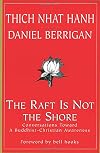
I have come to really enjoy Thích Nhất Hạnh's writings. Unfortunately, the coauthor is Daniel Berrigan, who has a loathsome background. The book is essentially a transcript of a recording of the two discussing their perspectives on how politics and the state have usurped religion for their agenda. The talk was held after the Vietnam war, but still pose some thoughts in light of radical ISIS today. Berrigan, in my opinion is so full of himself, that he pontificates throughout the book show more (discussion) to where he states clearly that any 'state' that identifies itself with a specific religion does so only to use that religion to justify its existence as a state, and rationalize its use of war and death. He makes several broad-brushed comments so off-putting that I couldn't decide if I wanted to invest further in the book. "All prison chaplains", "all of the Jews in Israel"... Odd coming from a Jesuit, though excommunicated, to be so myopic, narrow minded, prejudiced, and resentful, quite literally to the very end of the book.
I read the book anyways, even with my 10 years in the Marine Corps, and years as a minister, for a hunger of what the title and slipcover suggested. Common ground of Buddhism and Christianity. Instead I sadly found a book mostly of political negativity, stereotyping, resentment and bitterness.
Nhat Hanh's content made the read worth while none the less, particularly in the last two chapters.
If you can muddle past Berrigan, who shockingly misses Thich's points to where Thich has to repeat them and re-direct Berrigan, there are some very challenging, unsettling things I have to sort through in my beliefs about war, conflict, and religion.. and that is why I read the book, and that is why I return to Nhat Hanh's writings.
If you bought the book to read more wisdom from Nhat Hanh, pass on this one. Berrian seems so caught up in himself that he seems to miss the point or moves on to what he thinks is more important many times throughout the book. It is also shocking when he compares his own life as as difficult at times in the context of exile, as what Nhat Hanh and generations of Buddhists have faced, and only to use the Garden of Eden as a theological comparrison, as if it would be too difficult for him to use the story of the Jews and the 40 years in the dessert.
Sadly, the entire book can be summed up in the context of Berrigan, as what he is against, and as usual for Thick Nhat Hanh as what he is for.
"To be constantly active is the only thing that is considered meaningful by some people. Actions need energy, you get energy where? From the dissatisfaction, from hatred. The more you hate, the more you become strong, much stronger than you were.
But when you are angry, you are not lucid enough for your action to make sense. Even in violent revolutionary doctrine, they talk of the calmness needed for making decisions. So, if you have to be calm in order to make a decision, you must guard against anger." show less
I read the book anyways, even with my 10 years in the Marine Corps, and years as a minister, for a hunger of what the title and slipcover suggested. Common ground of Buddhism and Christianity. Instead I sadly found a book mostly of political negativity, stereotyping, resentment and bitterness.
Nhat Hanh's content made the read worth while none the less, particularly in the last two chapters.
If you can muddle past Berrigan, who shockingly misses Thich's points to where Thich has to repeat them and re-direct Berrigan, there are some very challenging, unsettling things I have to sort through in my beliefs about war, conflict, and religion.. and that is why I read the book, and that is why I return to Nhat Hanh's writings.
If you bought the book to read more wisdom from Nhat Hanh, pass on this one. Berrian seems so caught up in himself that he seems to miss the point or moves on to what he thinks is more important many times throughout the book. It is also shocking when he compares his own life as as difficult at times in the context of exile, as what Nhat Hanh and generations of Buddhists have faced, and only to use the Garden of Eden as a theological comparrison, as if it would be too difficult for him to use the story of the Jews and the 40 years in the dessert.
Sadly, the entire book can be summed up in the context of Berrigan, as what he is against, and as usual for Thick Nhat Hanh as what he is for.
"To be constantly active is the only thing that is considered meaningful by some people. Actions need energy, you get energy where? From the dissatisfaction, from hatred. The more you hate, the more you become strong, much stronger than you were.
But when you are angry, you are not lucid enough for your action to make sense. Even in violent revolutionary doctrine, they talk of the calmness needed for making decisions. So, if you have to be calm in order to make a decision, you must guard against anger." show less
Powerful, forgotten book. Well known peace activist, recently released from prison, Jesuit priest, self-exiled in Paris, meets with unknown Vietnames monk, exiled by his government for his peace activities, making him suspect. At the time, Daniel Berrigan is quite well known, and Thich Nhat Hanh little known.
They meet evenings in a Paris suburb, Spring 1974, and talk. Someone has the idea to bring a tape recorder, and their late-night thoughts are published in 1975, and quickly forgotten. show more Someone decides to bring this book back into life in October 2000 (with a 2001 publication date).
A powerful, moving, deep sharing between these two, who have more in common than either suspected.
What a teaching on war, suffering, life, death, community, religion.
Please let me know your take on this book! show less
They meet evenings in a Paris suburb, Spring 1974, and talk. Someone has the idea to bring a tape recorder, and their late-night thoughts are published in 1975, and quickly forgotten. show more Someone decides to bring this book back into life in October 2000 (with a 2001 publication date).
A powerful, moving, deep sharing between these two, who have more in common than either suspected.
What a teaching on war, suffering, life, death, community, religion.
Please let me know your take on this book! show less
The Geography of Faith : Underground Conversations on Religious, Political and Social Change by Daniel Berrigan

A good portion of this book consists of an introduction by Robert Coles that conveys the context in which the transcribed conversations between himself and Daniel Berrigan, SJ, happened. Since they happened in 1970, while Fr. Berrigan was living underground, that context will be absolutely necessary so many years later. The discussion between the activist priest and the activist psychiatrist is always meaningful and frequently profound. I was particularly taken by the section on "Twice Born show more Men(sic)" and by the back and forth about pride and humility. I was inspired by this book and others will be similarly moved. show less

Finally realized no one is compelling me to finish this thing, so I'm giving it up. It's less Berrigan's style than the essentially unchanging theme of his poetry that made me lose interest.
Lists
Awards


You May Also Like


Associated Authors
Statistics
- Works
- 75
- Also by
- 16
- Members
- 1,923
- Popularity
- #13,388
- Rating
- 4.1
- Reviews
- 26
- ISBNs
- 132
- Languages
- 3
- Favorited
- 2
