
Jim Wallis
Author of God's Politics: Why the Right Gets It Wrong and the Left Doesn’t Get It
About the Author
Jim Wallis was born in Detroit, Michigan on June 4, 1948. He graduated from Michigan State University and Trinity Evangelical Divinity School. He is an evangelical Christian writer and political activist, best known as the founder and editor of Sojourners Magazine and of the Washington, D.C.-based show more Christian community of the same name. He has written numerous books including The Great Awakening; Reviving Faith and Politics in a Post-Religious Right America (2008), God's Politics: Why the Right Gets It Wrong and the Left Doesn't Get It (2005), Faith Works: How Faith Based Organizations Are Changing Lives, Neighborhoods, and America (2000), The Soul of Politics: Beyond Religious Right and Secular Left (1995) and The Call to Conversion (1981). (Bowker Author Biography) show less
Works by Jim Wallis
God's Politics: Why the Right Gets It Wrong and the Left Doesn’t Get It (2005) 2,328 copies, 30 reviews
America's Original Sin: Racism, White Privilege, and the Bridge to a New America (2016) — Author — 457 copies, 7 reviews
The Great Awakening: Reviving Faith & Politics in a Post-Religious Right America (2008) 389 copies, 6 reviews
On God's Side: What Religion Forgets and Politics Hasn't Learned about Serving the Common Good (2013) 201 copies, 4 reviews
The False White Gospel: Rejecting Christian Nationalism, Reclaiming True Faith, and Refounding Democracy (2024) 117 copies, 2 reviews
Faith Works: How Faith-Based Organizations are Changing Lives, Neighborhoods and America (2001) 60 copies
The Rise of Christian Conscience: The Emergence of a Dramatic Renewal Movement in the Church Today (1987) 50 copies, 1 review
Why You Should Care about the Person Who Made Your Cell Phone (Ebook Shorts) (2013) 23 copies, 1 review
Justice for the Poor Participant's Guide: Love God. Serve People. Change the World. (2010) 19 copies
Sojourners : Magazine 2 copies
God's Politics - 6 CD SET 1 copy
Associated Works
The Irresistible Revolution: Living as an Ordinary Radical (2006) — Foreword — 2,170 copies, 41 reviews
From the Margins: A Celebration of the Theological Work of Donald W. Dayton (Princeton Theological Monograph) (2007) — Contributor — 8 copies
Tagged
Common Knowledge
- Canonical name
- Wallis, Jim
- Legal name
- Wallis, James E., Jr.
- Birthdate
- 1948-06-04
- Gender
- male
- Education
- Michigan State University (BA)
Trinity International University - Occupations
- political activist
theologian
writer
convener (Call to Renwal) - Organizations
- Georgetown University Center on Faith and Justice
Plymouth Brethren
Sojourners Community
Call to Renwal (convener) - Relationships
- Wallis, Joy Carroll (spouse)
- Nationality
- USA
- Birthplace
- Detroit, Michigan, USA
- Places of residence
- Washington, D.C., USA
- Map Location
- Michigan, USA
Members
Reviews
On God's Side: What Religion Forgets and Politics Hasn't Learned about Serving the Common Good by Jim Wallis
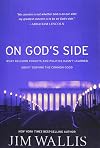
Has Christianity been derailed from serving the common good to mandating bipartisan stances? If Christian principles mean standing up for God, then in the myriad of complex political issues—from same-sex marriage to immigration reform—how do we know which side to take? Which side is God’s side?
Wallis asserts we can find God on the side of compassion. The common good. Throw out your gospels of self-help, personal enhancement, prosperity, and parochial nationalism, and instead look to show more the story of the Good Samaritan. Until Christianity returns to a “neighbor ethic,” it will not recover its credibility. To this end, Wallis writes a “biblical and theological defense of the common good.” Wallis is neither liberal nor conservative, and calls for both factions to meet in the middle.
I do confess, the title of the book gives me pause. A call to be “on God’s side,” as if the author speaks for God, evokes in my mind an image of a holy war. And to some extent, it is; Wallis sees this as war against a broken political system.
On that note, I would have preferred that the book was broken in two … one book about church, and another about state. But Wallis doesn’t separate the two. Says he, “If worth and equality are values derived from the belief that human beings are made in the image of God, then respecting both should be a primary task of democratic political systems.” He describes how in June of 2012 nearly 150 evangelical leaders banded together and signed the “Evangelical Statement of Principles for Immigration Reform.” Sojourners stood side by side in Washington D.C. with the Southern Baptists and Focus on the Family to draw attention to the plight of millions who have been caught up in our broken immigration system. These issues were seen as “fundamental moral issues and biblical imperatives.” The president listened and acted. Mission accomplished.
Problem is, I’m not sure Wallis grasps that our democratic system will be no less broken if it caves under the weight of organized religion. Nevertheless, if you are able to separate church and state in your mind as you read– learning about seeking the common good according to the example of Jesus, and learning also of our needed political reform–then you will find thought-provoking conversation on both fronts.
Before you read the book you might want to read Matthew 25:31-46. show less
Wallis asserts we can find God on the side of compassion. The common good. Throw out your gospels of self-help, personal enhancement, prosperity, and parochial nationalism, and instead look to show more the story of the Good Samaritan. Until Christianity returns to a “neighbor ethic,” it will not recover its credibility. To this end, Wallis writes a “biblical and theological defense of the common good.” Wallis is neither liberal nor conservative, and calls for both factions to meet in the middle.
I do confess, the title of the book gives me pause. A call to be “on God’s side,” as if the author speaks for God, evokes in my mind an image of a holy war. And to some extent, it is; Wallis sees this as war against a broken political system.
On that note, I would have preferred that the book was broken in two … one book about church, and another about state. But Wallis doesn’t separate the two. Says he, “If worth and equality are values derived from the belief that human beings are made in the image of God, then respecting both should be a primary task of democratic political systems.” He describes how in June of 2012 nearly 150 evangelical leaders banded together and signed the “Evangelical Statement of Principles for Immigration Reform.” Sojourners stood side by side in Washington D.C. with the Southern Baptists and Focus on the Family to draw attention to the plight of millions who have been caught up in our broken immigration system. These issues were seen as “fundamental moral issues and biblical imperatives.” The president listened and acted. Mission accomplished.
Problem is, I’m not sure Wallis grasps that our democratic system will be no less broken if it caves under the weight of organized religion. Nevertheless, if you are able to separate church and state in your mind as you read– learning about seeking the common good according to the example of Jesus, and learning also of our needed political reform–then you will find thought-provoking conversation on both fronts.
Before you read the book you might want to read Matthew 25:31-46. show less
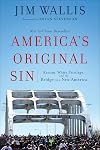
If it were up to me, I would require every American, especially every white American to read this book now and talk about it. I'll have the talking opportunity in a couple of weeks when my local reading group gets together.
Jim Wallis is a hero of mine. He is the founder of Sojourners, an evangelical Christian who understands that the faith is about how we treat each other. His springboard for this little book is the fact that by 2045 the United States will no longer be a country with a white show more majority. The European American population will be a minority among minorities. The trouble comes when this white minority continues to cling to its white privilege, which benefits us every day in ways that we white people are ignorant of.
Wallis chooses statistics carefully and notes when they are not available. (For example, nobody is keeping a total of the number of men of color killed annually by police officers in this country.) He then analyzes what he sees and offers the beginnings of solutions. Chapter titles give an overview of the contents:
Race Is a Story; The Parables of Ferguson and Baltimore; The Original Sin and Its Legacy; Repentance Means More than Just Saying You're Sorry; Dying To Whiteness; A Segregated Church or a Beloved Community?; From Warriors to Guardians; The New Jim Crow and Restorative Justice; Welcoming the Stranger; Crossing the Bridge to a New America.
White parents may be able to guess the content of the talk that all black parents have with their young sons about police officers. This white woman was incredibly naive about the effect of the War Against Drugs on the black community. The arguments grow out of Wallis's faith, but people of all faiths and no faith will be welcomed and challenged by reading this book. show less
Jim Wallis is a hero of mine. He is the founder of Sojourners, an evangelical Christian who understands that the faith is about how we treat each other. His springboard for this little book is the fact that by 2045 the United States will no longer be a country with a white show more majority. The European American population will be a minority among minorities. The trouble comes when this white minority continues to cling to its white privilege, which benefits us every day in ways that we white people are ignorant of.
Wallis chooses statistics carefully and notes when they are not available. (For example, nobody is keeping a total of the number of men of color killed annually by police officers in this country.) He then analyzes what he sees and offers the beginnings of solutions. Chapter titles give an overview of the contents:
Race Is a Story; The Parables of Ferguson and Baltimore; The Original Sin and Its Legacy; Repentance Means More than Just Saying You're Sorry; Dying To Whiteness; A Segregated Church or a Beloved Community?; From Warriors to Guardians; The New Jim Crow and Restorative Justice; Welcoming the Stranger; Crossing the Bridge to a New America.
White parents may be able to guess the content of the talk that all black parents have with their young sons about police officers. This white woman was incredibly naive about the effect of the War Against Drugs on the black community. The arguments grow out of Wallis's faith, but people of all faiths and no faith will be welcomed and challenged by reading this book. show less
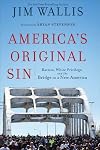
Summary: Explores our nation's deeply ingrained history of racism and particularly the challenges facing white Christians in bridging these racial divides.
"The United States of America was established as a white society, founded upon the near genocide of another race and then the enslavement of yet another."
The author of this book contends that this sentence, in a 1987 issue of Sojourners, was the most controversial sentence he ever wrote. The controversy behind that statement supports the show more thesis of this book, that racism is America's "original sin," a part of our beginnings as a nation that we have wrestled with throughout our national existence, but never truly repented of.
Wallis begins with his own story of growing up in Detroit and working with Butch, a black man who opened his eyes to two very different Detroits and two different realities--for example "the talk" that all black parents have with their children when they learn to drive that white parents do not have with theirs. This concerns how to act if stopped by the police, where to put one's hands and so forth. He considers Ferguson, and Baltimore, two cities riven with turmoil after police-involved shootings of black men as parables revealing the racial fault lines in the American story. He then reviews our past history and current demographics and events to show that our attitudes around race are indeed our national "original sin" that only profound repentance can heal.
The next chapters explore the nature of true, rather than superficial, repentance, and that this means for the white community to which he writes a "dying" to our whiteness as we recognize the "white privilege" we have enjoyed. I suspect that for many this may be some of the most controversial material. I find this language uncomfortable. I grew up in a working class neighborhood and didn't feel terribly "privileged" compared to more affluent people in the suburbs ringing my city. It was not until later years that I understood blacks had been red-lined out of our area of the city and I had the benefit of attending one of the best city schools with over 95 percent of the students being white. I began to realize the privilege that I had enjoyed in a racialized society. It also separated me from blacks in my city, made them an "other" who were treated differently in retail establishments, by the police and more. Real repentance means, even though I didn't choose this "privilege," to acknowledge that I have benefited from a sinful division of people, to not hold onto or idolize "whiteness" and to begin to intentionally seek a very different future.
The place, Wallis contends, where we begin, is the church, still a highly segregated entity. It means listening to different ethnic voices, and submitting to leadership from ethnicity other than one's own. Another important place to begin is in the policing of our communities, where police move from being warriors to guardians and where police become integral part of the communities they protect and serve so that both they and their communities affirm both that black lives matter and that blue lives matter. It begins with advocating for restorative justice rather than a new form of Jim Crow justice with differential incarceration rates for the same crimes depending on one's race.
Dealing with the sin of race extends to our immigration policies. Until our recent election cycle, there was a growing conversation in the evangelical community supporting immigration reform. Reading this post-election seemed like reading from a different world. Even the chapter title, "Welcoming the Stranger" seems foreign. Wallis then concludes the book talking about "crossing the bridge to a new America." One of the most compelling passages for me was the interaction Wallis had with a group of fifth graders in a Washington, DC public school, who asked Wallis why Congress seemed afraid to change the immigration system. He writes:
"I paused to consider their honest question and looked around the room--the classroom of a public school fifth-grade class in Washington DC. I looked at their quizzical and concerned faces, a group of African American, Latino, Asian American, Native American, and European American children. Then it hit me.
'They are afraid of you,' I replied
'Why would they be afraid of us?' the shocked students asked, totally perplexed. I had to tell them.
'They are afraid you are the future of America. They're afraid their country will someday look like this class--that you represent what our nation is becoming.'"
Re-reading this passage, I think of a Sunday School song I grew up with, admittedly one that indulged in some stereotypes about skin color for which I apologize, and yet that represented the underlying gospel values of my white evangelical congregation:
"Jesus loves the little children; all the children of the world.
Red and yellow, black and white, all are precious in his sight.
Jesus loves the little children of the world."
Wallis's quote challenged me with the reality of whether we will love all the children of the world that God is gathering in our country, or fear them. Will we see that fifth-grade classroom as the realization of our deep gospel values, and strive for churches that reflect this in our love and our life. Or will we remain racially separate, hiding behind walls of fear, saying that it is OK for Jesus to love these children as long as they are somewhere else in the world.
Wallis contends we stand at the approach to a bridge between the racist America of the past and a different America that values "all the children of the world" in our midst. His book is an invitation for white evangelical America to walk the way of repentance and cross that bridge rather than walk away from it. I'm reminded that God does not forbear forever. If we miss this chance, dare we presume there will be another? show less
"The United States of America was established as a white society, founded upon the near genocide of another race and then the enslavement of yet another."
The author of this book contends that this sentence, in a 1987 issue of Sojourners, was the most controversial sentence he ever wrote. The controversy behind that statement supports the show more thesis of this book, that racism is America's "original sin," a part of our beginnings as a nation that we have wrestled with throughout our national existence, but never truly repented of.
Wallis begins with his own story of growing up in Detroit and working with Butch, a black man who opened his eyes to two very different Detroits and two different realities--for example "the talk" that all black parents have with their children when they learn to drive that white parents do not have with theirs. This concerns how to act if stopped by the police, where to put one's hands and so forth. He considers Ferguson, and Baltimore, two cities riven with turmoil after police-involved shootings of black men as parables revealing the racial fault lines in the American story. He then reviews our past history and current demographics and events to show that our attitudes around race are indeed our national "original sin" that only profound repentance can heal.
The next chapters explore the nature of true, rather than superficial, repentance, and that this means for the white community to which he writes a "dying" to our whiteness as we recognize the "white privilege" we have enjoyed. I suspect that for many this may be some of the most controversial material. I find this language uncomfortable. I grew up in a working class neighborhood and didn't feel terribly "privileged" compared to more affluent people in the suburbs ringing my city. It was not until later years that I understood blacks had been red-lined out of our area of the city and I had the benefit of attending one of the best city schools with over 95 percent of the students being white. I began to realize the privilege that I had enjoyed in a racialized society. It also separated me from blacks in my city, made them an "other" who were treated differently in retail establishments, by the police and more. Real repentance means, even though I didn't choose this "privilege," to acknowledge that I have benefited from a sinful division of people, to not hold onto or idolize "whiteness" and to begin to intentionally seek a very different future.
The place, Wallis contends, where we begin, is the church, still a highly segregated entity. It means listening to different ethnic voices, and submitting to leadership from ethnicity other than one's own. Another important place to begin is in the policing of our communities, where police move from being warriors to guardians and where police become integral part of the communities they protect and serve so that both they and their communities affirm both that black lives matter and that blue lives matter. It begins with advocating for restorative justice rather than a new form of Jim Crow justice with differential incarceration rates for the same crimes depending on one's race.
Dealing with the sin of race extends to our immigration policies. Until our recent election cycle, there was a growing conversation in the evangelical community supporting immigration reform. Reading this post-election seemed like reading from a different world. Even the chapter title, "Welcoming the Stranger" seems foreign. Wallis then concludes the book talking about "crossing the bridge to a new America." One of the most compelling passages for me was the interaction Wallis had with a group of fifth graders in a Washington, DC public school, who asked Wallis why Congress seemed afraid to change the immigration system. He writes:
"I paused to consider their honest question and looked around the room--the classroom of a public school fifth-grade class in Washington DC. I looked at their quizzical and concerned faces, a group of African American, Latino, Asian American, Native American, and European American children. Then it hit me.
'They are afraid of you,' I replied
'Why would they be afraid of us?' the shocked students asked, totally perplexed. I had to tell them.
'They are afraid you are the future of America. They're afraid their country will someday look like this class--that you represent what our nation is becoming.'"
Re-reading this passage, I think of a Sunday School song I grew up with, admittedly one that indulged in some stereotypes about skin color for which I apologize, and yet that represented the underlying gospel values of my white evangelical congregation:
"Jesus loves the little children; all the children of the world.
Red and yellow, black and white, all are precious in his sight.
Jesus loves the little children of the world."
Wallis's quote challenged me with the reality of whether we will love all the children of the world that God is gathering in our country, or fear them. Will we see that fifth-grade classroom as the realization of our deep gospel values, and strive for churches that reflect this in our love and our life. Or will we remain racially separate, hiding behind walls of fear, saying that it is OK for Jesus to love these children as long as they are somewhere else in the world.
Wallis contends we stand at the approach to a bridge between the racist America of the past and a different America that values "all the children of the world" in our midst. His book is an invitation for white evangelical America to walk the way of repentance and cross that bridge rather than walk away from it. I'm reminded that God does not forbear forever. If we miss this chance, dare we presume there will be another? show less
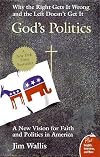
Someone had brought Jim Wallis to my attention before I read this book, but I didn't remember. (You can Google him yourself to find out his historical support for problematic causes.) Nor was I familiar with Sojourners. I'd like to think this gave me an objective stance in reading this book.
I find Wallis to be a Leftish version of what he criticizes on the Right -- someone who wants to impose his interpretation of Scripture on everyone else in America. Wallis criticizes the evangelical show more church for forgetting Jesus' words about providing for the poor and making peace. But rather than focus on changing the American church, Wallis devotes his attention to changing American government. He attacks the Pat Robertsons and G.W. Bushes of the Right for confusing the American Church with America the nation, but doesn't see that he does the exact same thing by calling for government policies to essentially replace and emulate the church's traditional role of supporting family, peace, and helping the poor.
Wallis argues that faith-based non-profits can't do their jobs unless better funded by taxpayers. The shortcoming of Bush's Faith-Based Initiative was its lack of taxpayer funding. Rather than focus on increasing the voluntary giving of American Christians, Wallis wants to increase the forced redistribution from all Americans to non-profits through taxes.
Wallis doesn't argue from a historical theological or philosophical perspective. Abraham Lincoln is about the oldest source as he draws from. Martin Luther King is held up as an ideal at least a dozen times because "He held his Constitution in one hand and his Bible in the other," we are told at least three times. Wallis rather annoyingly repeats his talking points over and again, making many pages superfluous.
Wallis argues that the government should keep policies in line with what the majority of Christian denominations put out official stances on. The Iraq war was immoral because every denomination (except Southern Baptists) spoke out against it. Budgets are "moral documents," and all legislation should follow the prescription of the ecumenical Church-- increased taxes on the wealthy, increased transfers to the poor, higher minimum wage laws, "fair trade" instead of "free trade," funding "real education," debt forgiveness to poor countries, more environmental regulations, and a two-state solution for Israel and Palestine, etc. Not as much ink is given to why those causes are correct scripturally or what the historical stances of the Church has been. Jim Wallis agrees with it, therefore it's right.
He accuses the Religious Right of "prooftexting," twisting Scripture out of context to support their ideals. But Wallis engages in his own prooftexting. For example, he uses quotes from prophets like Micah to argue for debt relief for poor countries. But in the very next chapter in dealing with capital punishment, which Wallis opposes as immoral, he ignores that the same prophets both advocated and carried out capital punishment as God's will. (I'm not saying we should interpret OT Israel as prescriptive for today, just pointing out that Wallis wants to use some prescriptions for today while ignoring others-- prooftexting.)
In a chapter dealing with the global economy, Wallis decries "free trade" practices of the West/North as putting undue restrictions on the South. Any trade agreement that includes restrictions shouldn't be called or understood as "free trade." The best thing America could do for trade with the poor countries Wallis wants to help would be to immediately unilaterally eliminate all tariffs and quotas to give them unfettered access to U.S. markets. But Wallis doesn't point this out. Probably because it would be heavily opposed by the trade unions Wallis ironically supports as many American workers in those formerly protected industries would eventually lose their jobs. While painful for those workers who must find new occupations, the truly poor people-- those earning $2 a day or less-- would greatly benefit. Wallis wants to have it both ways.
There are some really vague prescriptions, like promoting "real education." What is "real" education? Wallis never says, just decries the American government for not supporting it better. On trade and labor economics, Wallis seems really ignorant of the data. He prescribes raising the minimum wage as a poverty-reduction strategy without pointing out that most minimum wage workers aren't trying to support a family on it, a large number are teenagers and college students who are still dependents on their fairly well-off parents. How high should minimum wage be? Why not just raise the minimum wage to $1,000 an hour? Wallis doesn't think about it.
Wallis spends much of the book arguing for Jubilee-style income redistribution and decrying how the highest-income Americans have seen incomes rise much higher and faster than everyone else. But rather than encouraging Christians to give more and spend less, or to be more conscientious of what products they are buying and lifestyles they are supporting, he simply advocates for government to tackle the problem. Wallis' shallow thinking shows up disappointingly in one of the final chapters, where he talks of his love for the NBA. Wallis doesn't point out that most NBA players are among the top 1% of the American income earners who have seen disproportionate income increases. It's apparently okay if an NBA player makes $10 million a year, so long as he is a "nice guy," and isn't a "slasher" or a "thug" like "Allen Iverson." Wallis apparently doesn't see any contradiction in supporting those salaries by purchasing tickets to NBA games or merchandise, nor does he call on the church to reevaluate its thinking about why entertainers and athletes are among the highest-paid in America. Because we need "fun and diversions." This is hypocrisy.
I give this book 1 star out of 5. I was hoping for M. Douglas Meeks and got the Left's version of Jerry Falwell. I'm not sure who is more dangerous to have advising a President. show less
Lists
Awards


You May Also Like


Associated Authors
Statistics
- Works
- 47
- Also by
- 4
- Members
- 5,966
- Popularity
- #4,133
- Rating
- 3.9
- Reviews
- 68
- ISBNs
- 116
- Languages
- 3
- Favorited
- 11


