
Marcus J. Borg (1942–2015)
Author of Meeting Jesus Again for the First Time: The Historical Jesus and the Heart of Contemporary Faith
About the Author
Marcus J. Borg was born on March 11, 1942 in Minnesota. He majored in philosophy and political science at Concordia College. He did graduate work at Union Theological Seminary in New York City and at Oxford University. He taught at various Midwest universities before joining the faculty at Oregon show more State University in 1979. He taught religion there until his retirement in 2007. During his lifetime, he wrote or co-wrote 21 books including Jesus: A New Vision, The Meaning of Jesus: Two Visions with N. T. Wright, and Convictions: How I Learned What Matters Most. He died after a prolonged illness on January 21, 2015 at the age of 72. (Bowker Author Biography) show less
Disambiguation Notice:
Marcus J(oel) Borg
Works by Marcus J. Borg
Meeting Jesus Again for the First Time: The Historical Jesus and the Heart of Contemporary Faith (1994) 1,998 copies, 21 reviews
Reading the Bible Again For the First Time: Taking the Bible Seriously But Not Literally (2001) — Author — 1,438 copies, 16 reviews
The Last Week: What the Gospels Really Teach About Jesus's Final Days in Jerusalem (2006) 1,101 copies, 15 reviews
The God We Never Knew: Beyond Dogmatic Religion to a More Authentic Contemporary Faith (1997) 925 copies, 7 reviews
Jesus: Uncovering the Life, Teachings, and Relevance of a Religious Revolutionary (2006) 678 copies, 6 reviews
The First Christmas: What the Gospels Really Teach About Jesus's Birth (2007) 590 copies, 15 reviews
The First Paul: Reclaiming the Radical Visionary Behind the Church's Conservative Icon (2009) 561 copies, 11 reviews
Speaking Christian: Why Christian Words Have Lost Their Meaning and Power - And How They Can Be Restored (2011) — Author — 481 copies, 14 reviews
Evolution of the Word: The New Testament in the Order the Books Were Written (2012) 258 copies, 4 reviews
Living the Heart of Christianity: A Guide to Putting Your Faith into Action (2004) 117 copies, 1 review
Conversations with Scripture - The Gospel of Mark (Anglican Association of Biblical Scholars Study) (2009) 95 copies
Embracing an Adult Faith Participant's Workbook: Marcus Borg on What it Means to Be Christian - A 5-Session Study (2010) 78 copies, 1 review
QUI ETAIT JESUS ? Chamanisme et prophétisme : une nouvelle approche historique (1998) 3 copies, 1 review
"Taking further steps with Jesus" 2 copies
God at 2000 (8 VHS) 1 copy
Five Lectures by Marcus Borg 1 copy
"Jesus and Paul in dialogue" 1 copy
Sermons of Marcus Borg 1 copy
From Galilean Jew to the face of God : the pre-Easter and post-Easter Jesus [video recording] (1995) — Speaker — 1 copy
Jesus at 2000 : concluding panel: presentations and discussion [video recording] (1995) — Speaker, Conference Organizer — 1 copy
First United Methodist Church of Missoula Presents: An Inspirational Weekend with Marcus J. Borg, PhD 1 copy, 1 review
Speaking Christian c.2 1 copy
Associated Works
Will the Real Jesus Please Stand Up?: A Debate between William Lane Craig and John Dominic Crossan (1995) — Contributor — 279 copies, 3 reviews
Jesus and the Restoration of Israel: A Critical Assessment of N.T. Wright's Jesus and the Victory of God (1999) — Contributor — 217 copies
The Jesus summit the historical Jesus & contemporary faith [video recording] (1994) — Panelist — 1 copy
Tagged
Common Knowledge
- Canonical name
- Borg, Marcus J.
- Legal name
- Borg, Marcus Joel
- Other names
- 馬可士.伯格
- Birthdate
- 1942-03-11
- Date of death
- 2015-01-21
- Gender
- male
- Education
- Mansfield College, Oxford University (M.Th|D. Phil|1972)
Union Theological Seminary
Concordia College, Moorhead (BA) - Occupations
- writer
author
professor (Hundere Distinguished Professor of Religion and Culture ∙ Oregon State University)
columnist
canon theologian (Trinity Episcopal Cathedral ∙ Portland ∙ Oregon ∙ USA)
New Testament scholar - Organizations
- Oregon State University
Carleton College
South Dakota State University
Concordia College
American Academy of Religion
Westar Institute, Jesus seminar (show all 12)
Jesus Seminar
Trinity Episcopal Cathedral, Portland, Oregon
Historical Jesus Section of the Society of Biblical Literature (national chair)
International New Testament Program Committee (co-chair)
Anglican Association of Biblical Scholars (president)
Studiorum Novi Testamenti Societas - Cause of death
- idiopathic pulmonary fibrosis
- Nationality
- USA
- Birthplace
- Fergus Falls, Minnesota, USA
- Places of residence
- Powell Butte, Oregon, USA
Moorhead, Minnesota, USA - Place of death
- Powell Butte, Oregon, USA
- Disambiguation notice
- Marcus J(oel) Borg
- Associated Place (for map)
- USA
Members
Discussions
Marcus Borg has taken a stab at fiction in Progressive Christianity (May 2010)
Heart of Christianity in Progressive Christianity (January 2010)
Reviews
Speaking Christian: Why Christian Words Have Lost Their Meaning and Power - And How They Can Be Restored by Marcus J. Borg
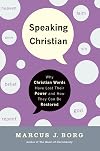
This book has languished on my bookshelf for a long time and finally found its day in the sun. It should be required reading for anyone even remotely interested in Christianity.
Borg is not afraid to look at tradition as a humanly determined set of practices, doctrines, interpretations, understandings and hence beliefs. His "liberal" view of Christian practices gives a practical and logical reason for those who cannot accept literal accounts of biblical historical writings to continue to be show more Christians in word, thought and deed. By putting biblical text into historical and linguistic context, he frees us from the need to accept ancient description at face value and allows us to follow the "will of God" as endorsed and practiced by His son, Jesus. Borg contrasts liberal and conservative interpretations and views of scripture and offers to both camps the inclusivity taught by Jesus himself. While this may make some conservative Christians uncomfortable, it should be required reading in a spirit of compassion and understanding. show less
Borg is not afraid to look at tradition as a humanly determined set of practices, doctrines, interpretations, understandings and hence beliefs. His "liberal" view of Christian practices gives a practical and logical reason for those who cannot accept literal accounts of biblical historical writings to continue to be show more Christians in word, thought and deed. By putting biblical text into historical and linguistic context, he frees us from the need to accept ancient description at face value and allows us to follow the "will of God" as endorsed and practiced by His son, Jesus. Borg contrasts liberal and conservative interpretations and views of scripture and offers to both camps the inclusivity taught by Jesus himself. While this may make some conservative Christians uncomfortable, it should be required reading in a spirit of compassion and understanding. show less
The last week : what the gospels really teach about Jesus's final days in Jerusalem by Marcus J. Borg
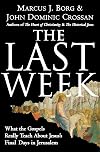
We read this book in Sunday school during Lent. It had been a while since I had read something this academic about the Bible. I fly through academic writing in my normal work, but since I wasn't quite as familiar with this type of writing, it took me quite a long time to read each chapter. That slowing down to think about things really deepened my understanding of Jesus' life and the Passion story.
I don't think of myself as a conservative christian, but this book was almost too liberal for show more me. It really pushed me to the edges of what I thought was permissible. Borg and Crossan bring up new issues that really changed my perspective on Holy Week. It's not about what happened at what time on Good Friday. It's not even whether or not the Resurrection is literal. Th ose questions that are so important to so many Christians and doubters are not the point. The point is the story, and what we are going to do about it.
How will the world change if we look beyond the historical facts and find the underlying truths? What should the world look like? How does God want us to act? How can we be Christians like the early church when we are not oppressed by the Romans, and, quite frankly, when we are the oppressors? This book pushes me to look beyond the academic questions and change my behavior to be more like Jesus. The book may be a bit further to one side than I am comfortable with, but that's the point. I am pushed in my own journey to explore questions I never thought to ask. show less
I don't think of myself as a conservative christian, but this book was almost too liberal for show more me. It really pushed me to the edges of what I thought was permissible. Borg and Crossan bring up new issues that really changed my perspective on Holy Week. It's not about what happened at what time on Good Friday. It's not even whether or not the Resurrection is literal. Th ose questions that are so important to so many Christians and doubters are not the point. The point is the story, and what we are going to do about it.
How will the world change if we look beyond the historical facts and find the underlying truths? What should the world look like? How does God want us to act? How can we be Christians like the early church when we are not oppressed by the Romans, and, quite frankly, when we are the oppressors? This book pushes me to look beyond the academic questions and change my behavior to be more like Jesus. The book may be a bit further to one side than I am comfortable with, but that's the point. I am pushed in my own journey to explore questions I never thought to ask. show less
Meeting Jesus Again for the First Time: The Historical Jesus and the Heart of Contemporary Faith by Marcus J. Borg
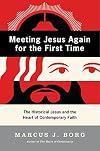
An exciting book that seeks to explain who Jesus actually was based on the gospels and scripture, stripping away the mythic superstructure that Christians built after Jesus' death, and demonstrating that what has become the dominant mode of understanding Jesus' life through scripture is only one of several metaphorical threads that are present in the Bible and understood by early Christians, and this narrowing of meaning has come at significant cost to the imaging of what religious life for show more the Christian should be.
Borg argues that Jesus never knew himself to be the Son of God in a unique sense, or as one whose mission was to die for the sins of the world. That picture comes out of the Gospel of John, which contains the great "I am" statements of Jesus, which are agreed by Biblical scholars to be ahistorical. John, the latest of the gospels, presents Jesus as he had come to be understood by Christians of that time. The earlier gospels do not show Jesus speaking in such a manner.
Rather, Borg sees Jesus as what he calls a "spirit person", one who has visions and direct experiences of the reality of God. People who have such experiences are found across cultures and times. Born into a culture whose social structure was rigidly based on a purity scheme, whose vision of religious life was to be as "pure" as God demanded, Jesus did not recognize his culture's social/religious constructs as consistent with his experience of God. His teaching sought to replace the "Be holy for I the Lord your God am holy" command of Leviticus with a "Be compassionate as God is compassionate" instruction (Luke).
His public life also contained an argument for moving from secondhand religion to firsthand religion: moving beyond secular and religious conventional wisdom, which is what we are taught to believe by others, to a subversive wisdom that comes from personal relationship and experience with God. The religious life is thus about relationship, not measuring up to a body of rules and regulations and expectations.
Borg brings out three main story narratives in the Bible, which originate with the experiences of the Hebrews but extend to have meaning for everyone in every time:
1)The Exodus story is saying that the human condition is bondage (to what? a great many things...) and the solution is liberation, which involves a journey through the wilderness, toward God and with God.
2)The Exile and Return story says that we feel separated from our true home and long to return. Exile is often marked by grief, and the religious life is a journey with God back home.
3)The Priestly story says that we are sinners who are guilty before God, in need of forgiveness. Religious life is not so much a journey as a story of sin, guilt, sacrifice and forgiveness.
All three of these stories were important to Jesus and early Christianity, but over time one of them came to dominate the popular understanding of Jesus and the Christian life. Obviously that would be the Priestly story.
Borg lays out six "severe distortions in our understanding of the Christian life" that result from the dominance of this priestly story:
1)Produces a static understanding of the Christian life, a repeated cycle of sin, guilt, and forgiveness.
2)Creates a passive understanding of the Christian life. Rather than seeking transformation, in ourselves and in our culture, we see that God has already done what needs to be done. It is a politically domesticating story... which suited the rulers of those societies where Christianity became the official religion quite well.
3)Tends to an understanding of Christianity as primarily a religion of the afterlife: better get right with God before you die!
4)Imagines God primarily as lawgiver and judge, whose forgiveness becomes conditional on our believing a certain dogma, that of Jesus' atoning death.
5)Creates a narrative that is very hard to believe: God's only and literal son came to this planet to sacrifice himself for the sins of humans, because God could not forgive us otherwise, and we are saved from damnation only by believing this. It's a powerful metaphor, but argued literally it alienates many people from Christianity.
6)Some people don't feel much guilt, for whatever reason. Yet they may recognize their state of bondage, or their feelings of alienation and estrangement. The priestly story offers them nothing, while the other Biblical narrative stories do.
In all, the book is a great popular level manuscript that demonstrates a less well known historical understanding of Jesus and his teachings, and offers an alternative to the dominant theological interpretations present in our culture. show less
Borg argues that Jesus never knew himself to be the Son of God in a unique sense, or as one whose mission was to die for the sins of the world. That picture comes out of the Gospel of John, which contains the great "I am" statements of Jesus, which are agreed by Biblical scholars to be ahistorical. John, the latest of the gospels, presents Jesus as he had come to be understood by Christians of that time. The earlier gospels do not show Jesus speaking in such a manner.
Rather, Borg sees Jesus as what he calls a "spirit person", one who has visions and direct experiences of the reality of God. People who have such experiences are found across cultures and times. Born into a culture whose social structure was rigidly based on a purity scheme, whose vision of religious life was to be as "pure" as God demanded, Jesus did not recognize his culture's social/religious constructs as consistent with his experience of God. His teaching sought to replace the "Be holy for I the Lord your God am holy" command of Leviticus with a "Be compassionate as God is compassionate" instruction (Luke).
His public life also contained an argument for moving from secondhand religion to firsthand religion: moving beyond secular and religious conventional wisdom, which is what we are taught to believe by others, to a subversive wisdom that comes from personal relationship and experience with God. The religious life is thus about relationship, not measuring up to a body of rules and regulations and expectations.
Borg brings out three main story narratives in the Bible, which originate with the experiences of the Hebrews but extend to have meaning for everyone in every time:
1)The Exodus story is saying that the human condition is bondage (to what? a great many things...) and the solution is liberation, which involves a journey through the wilderness, toward God and with God.
2)The Exile and Return story says that we feel separated from our true home and long to return. Exile is often marked by grief, and the religious life is a journey with God back home.
3)The Priestly story says that we are sinners who are guilty before God, in need of forgiveness. Religious life is not so much a journey as a story of sin, guilt, sacrifice and forgiveness.
All three of these stories were important to Jesus and early Christianity, but over time one of them came to dominate the popular understanding of Jesus and the Christian life. Obviously that would be the Priestly story.
Borg lays out six "severe distortions in our understanding of the Christian life" that result from the dominance of this priestly story:
1)Produces a static understanding of the Christian life, a repeated cycle of sin, guilt, and forgiveness.
2)Creates a passive understanding of the Christian life. Rather than seeking transformation, in ourselves and in our culture, we see that God has already done what needs to be done. It is a politically domesticating story... which suited the rulers of those societies where Christianity became the official religion quite well.
3)Tends to an understanding of Christianity as primarily a religion of the afterlife: better get right with God before you die!
4)Imagines God primarily as lawgiver and judge, whose forgiveness becomes conditional on our believing a certain dogma, that of Jesus' atoning death.
5)Creates a narrative that is very hard to believe: God's only and literal son came to this planet to sacrifice himself for the sins of humans, because God could not forgive us otherwise, and we are saved from damnation only by believing this. It's a powerful metaphor, but argued literally it alienates many people from Christianity.
6)Some people don't feel much guilt, for whatever reason. Yet they may recognize their state of bondage, or their feelings of alienation and estrangement. The priestly story offers them nothing, while the other Biblical narrative stories do.
In all, the book is a great popular level manuscript that demonstrates a less well known historical understanding of Jesus and his teachings, and offers an alternative to the dominant theological interpretations present in our culture. show less
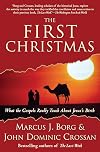
In this fascinating little book, Borg and Crossan explore the historical meaning behind the birth-of-Jesus story. They first point out the factual differences between Matthew's and Luke's versions of the birth story. Then they explain how, after the Enlightenment, many people want everything to be either literally true or false. Many Christians are in denial of the "factual inconsistencies" in the Bible, and the ones who are aware of the inconsistencies often feel a little uncomfortable and show more don't know quite what to think about them. Borg and Crossan point out that the stories are meant to be parables. They were not meant to be taken as literal truth. They explore a deeper truth within the limits of historical culture.
Borg and Crossan study (practically line-by-line at times) each birth story separately, explaining the cultural, literary, or mythological meaning of the Biblical text. For instance, in his story of the Magi and Herod, Matthew was bringing to mind parallels to the Moses story in his Gospel. Like Pharaoh, Herod wanted to kill all the baby boys because he'd heard that one was born who would overthrow him. As with the parents of Moses, Jesus' parents had divine inspiration to have a child despite great obstacles - in the case of Moses' parents, they had to have faith that their son wouldn't die; in the case of Joseph, he had to have faith that Mary was yet a virgin. Against all odds, both boys survived and became great leaders. Such parallels to the Moses story would help justify to first century Christians the divinely-inspired leadership of Jesus.
I really enjoyed learning about the cultural reasons for the choices Matthew and Luke made while writing their gospels. At times, I felt the book didn't translate well to audio, though, because the authors went into great detail in their lists of gospel references (for instance, every reference of to Jesus as "light," and what the word "light" meant in that sense). The lists didn't translate well to audio since they were something I would normally either skim over or use as a Bible study guide. Neither could be done in an audiobook. Regardless, I'm glad I had the chance to listen to this book, and I hope to read their first book The Last Week. I'll save that one for Easter, though. show less
Borg and Crossan study (practically line-by-line at times) each birth story separately, explaining the cultural, literary, or mythological meaning of the Biblical text. For instance, in his story of the Magi and Herod, Matthew was bringing to mind parallels to the Moses story in his Gospel. Like Pharaoh, Herod wanted to kill all the baby boys because he'd heard that one was born who would overthrow him. As with the parents of Moses, Jesus' parents had divine inspiration to have a child despite great obstacles - in the case of Moses' parents, they had to have faith that their son wouldn't die; in the case of Joseph, he had to have faith that Mary was yet a virgin. Against all odds, both boys survived and became great leaders. Such parallels to the Moses story would help justify to first century Christians the divinely-inspired leadership of Jesus.
I really enjoyed learning about the cultural reasons for the choices Matthew and Luke made while writing their gospels. At times, I felt the book didn't translate well to audio, though, because the authors went into great detail in their lists of gospel references (for instance, every reference of to Jesus as "light," and what the word "light" meant in that sense). The lists didn't translate well to audio since they were something I would normally either skim over or use as a Bible study guide. Neither could be done in an audiobook. Regardless, I'm glad I had the chance to listen to this book, and I hope to read their first book The Last Week. I'll save that one for Easter, though. show less
Lists
You May Also Like


Associated Authors
Statistics
- Works
- 65
- Also by
- 4
- Members
- 14,203
- Popularity
- #1,620
- Rating
- 4.0
- Reviews
- 178
- ISBNs
- 164
- Languages
- 9
- Favorited
- 26
