
Bart D. Ehrman
Author of Misquoting Jesus: The Story Behind Who Changed the Bible and Why
About the Author
New Testament scholar Bart D. Ehrman grew up in Lawrence, Kansas and graduated from Wheaton College in 1978. He earned his Masters of Divinity and PhD from Princeton Theological Seminary and has taught at Rutgers University and the University of North Carolina at Chapel Hill, where he is the James show more A. Gray Distinguished Professor. He has published more than 20 scholarly and popular books, including three New York Times bestsellers, plus numerous articles and book reviews. (Bowker Author Biography) show less
Image credit: photo by Dan Sears
Series
Works by Bart D. Ehrman
Lost Christianities: The Battles for Scripture and the Faiths We Never Knew (2003) — Author — 2,065 copies, 26 reviews
The New Testament: A Historical Introduction to the Early Christian Writings (1997) 1,223 copies, 8 reviews
God's Problem: How the Bible Fails to Answer Our Most Important Question--Why We Suffer (2008) 1,127 copies, 34 reviews
Forged: Writing in the Name of God — Why the Bible's Authors Are Not Who We Think They Are (2011) 721 copies, 18 reviews
Peter, Paul, and Mary Magdalene: The Followers of Jesus in History and Legend (2006) 708 copies, 11 reviews
The Lost Gospel of Judas Iscariot: A New Look at Betrayer and Betrayed (2006) 658 copies, 12 reviews
Truth and Fiction in The Da Vinci Code: A Historian Reveals What We Really Know about Jesus, Mary Magdalene, and Constantine (2004) 630 copies, 13 reviews
The Orthodox Corruption of Scripture: The Effect of Early Christological Controversies on the Text of the New Testament (1993) 414 copies, 3 reviews
Jesus Before the Gospels: How the Earliest Christians Remembered, Changed, and Invented Their Stories of the Savior (2016) 379 copies, 11 reviews
Lost Christianities: Christian Scriptures and the Battles Over Authentication (2002) 202 copies, 4 reviews
The Text of the New Testament in Contemporary Research: Essays on the Status Quaestionis (Studies & Documents) (1995) — Editor — 129 copies, 1 review
Journeys to Heaven and Hell: Tours of the Afterlife in the Early Christian Tradition (2022) 85 copies, 2 reviews
Lost Christianities: The Battles for Scripture and the Faiths We Never Knew and Lost Scriptures: Books that Did Not Make It into the New Testament: 2-Volume Set (2004) 54 copies, 1 review
Love Thy Stranger: How the Teachings of Jesus Transformed the Moral Conscience of the West (2026) 42 copies, 1 review
The Text of the Fourth Gospel in the Writings of Origen (The New Testament in the Greek Fathers) (English and Ancient Greek Edition) (1992) 21 copies
Lost Christianities: Christian Scriptures and the Battles over Authentication, Part 1 of 2 16 copies
Lost Christianities: Christian Scriptures and the Battles over Authentication, Part 2 of 2 (2002) 6 copies
Jesus and the Adulteress 2 copies
Early Christianities 1 copy
The Conversion of Paul 1 copy
Judaism in the Roman World 1 copy
Early Christian Apologists 1 copy
Misquoting Jesus c.2 1 copy
The Greco-Roman Context 1 copy
The Problem of Pseudonymity 1 copy
Jesus in His Context 1 copy
The Earliest Gospels 1 copy
The Pauline Epistles 1 copy
One Remarkable Life 1 copy
Infancy Gospels 1 copy
Cała prawda o Chrystusie 1 copy
Methodological Developments in the Analysis and Classification of New Testament Documentary Evidence 1 copy
The Many Faces of Jesus 1 copy
Scholars Look at the Gospels 1 copy
The Last Hours of Jesus 1 copy
The Afterlife of Jesus 1 copy
The Last Days of Jesus 1 copy
The Controversies of Jesus 1 copy
Jesus and Roman Rule 1 copy
The Early Life of Jesus 1 copy
More Historical Criteria 1 copy
Other Sources 1 copy
The Coptic Gospel of Thomas 1 copy
Some of the Other Gospels 1 copy
The Birth of the Gospels 1 copy
Associated Works
The Lost Gospel: The Quest for the Gospel of Judas Iscariot (2006) — Foreword, some editions — 571 copies, 10 reviews
Hearing the New Testament: Strategies for Interpretation (1995) — Contributor, some editions — 394 copies, 3 reviews
Biblical Hermeneutics in Historical Perspective: Studies in Honor of Karlfried Froehlich on His Sixtieth Birthday (1991) — Contributor — 39 copies
New Testament Greek and Exegesis: Essays in Honor of Gerald F. Hawthorne (2003) — Contributor — 34 copies
New Testament Textual Criticism, Exegesis and Church History A Discussion of Methods (Contributions to Biblical Exegesis & Theology) (1994) — Contributor, some editions — 10 copies
Tagged
Common Knowledge
- Canonical name
- Ehrman, Bart D.
- Legal name
- Ehrman, Bart Denton
- Birthdate
- 1955-10-05
- Gender
- male
- Education
- Princeton Theological Seminary (M.Div|1981|Ph.D|1985)
Wheaton College (BA|1978)
Moody Bible Institute - Occupations
- writer
author
professor - Organizations
- University of North Carolina at Chapel Hill
Rutgers University
North American Patristics Society
Society of Biblical Literature - Relationships
- Beckwith, Sarah (wife)
- Nationality
- USA
- Birthplace
- Lawrence, Kansas, USA
- Places of residence
- Durham, North Carolina, USA
- Associated Place (for map)
- USA
Members
Reviews
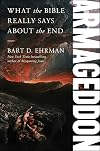
I'm a big fan of Bart Ehrman's writing and always glad to see a new title come out. I'll acknowledge that the quality of his books can vary, but they're always interesting—and Armageddon is among the very best.
In Armageddon, Ehrman sets out to explore the New Testament book of Revelations from multiple perspectives—
• The time in which the book was written and how it would likely have been originally understood
• Ways the book has been understood in subsequent historical periods
• The show more ways in which Revelations is most often understood within fundamentalist communities today
• The values espoused in Revelations
• A comparison with Revelations' values and those expressed in the gospels
• The places where contemporary culture and politics have been affected by Revelations
This is absolutely fascinating material. Ehrman talks readers through it clearly, with plenty of documentation, and a voice that never drifts into a tedious scholasticism. He closes the book with a brief final chapter that challenges readers to acknowledge the differences between the gospels and Revelations and to ponder which version of Christianity (if any) they currently practice.
Whether or not you identify as Christian (I don't), Armageddon offers a powerful read about about the values of our faiths and the consequences of those values.
I received a free electronic review copy of this title from the publisher via NetGalley; the opinions are my own. show less
In Armageddon, Ehrman sets out to explore the New Testament book of Revelations from multiple perspectives—
• The time in which the book was written and how it would likely have been originally understood
• Ways the book has been understood in subsequent historical periods
• The show more ways in which Revelations is most often understood within fundamentalist communities today
• The values espoused in Revelations
• A comparison with Revelations' values and those expressed in the gospels
• The places where contemporary culture and politics have been affected by Revelations
This is absolutely fascinating material. Ehrman talks readers through it clearly, with plenty of documentation, and a voice that never drifts into a tedious scholasticism. He closes the book with a brief final chapter that challenges readers to acknowledge the differences between the gospels and Revelations and to ponder which version of Christianity (if any) they currently practice.
Whether or not you identify as Christian (I don't), Armageddon offers a powerful read about about the values of our faiths and the consequences of those values.
I received a free electronic review copy of this title from the publisher via NetGalley; the opinions are my own. show less
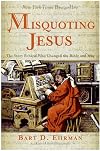
Reading this book was a long time in the works, as I've owned for many years but hadn't ginned up the courage to read it. I grew up in a Fundamentalist Christian family and church, where the Bible was taught as the all inspired inerrant word of God. I remember thinking as a young boy: maybe the original writers were inspired but the belief in the Bible's utter inerrancy would require every person over thousands of years to have been directly inspired, as well. Ehrman picked up on that same show more thread, and it led him to become a scholar in textual criticism.
He spends the early part of the book laying out the details of textual criticism and the latter half using the method to discuss several passages from the Bible and how they were altered by scribes over the millennia. This was an eye-opening read. And, while it didn't destroy my faith, it changed it in a fundamental way. I'm left, not with any disbelief in the Bible's message, but an understanding of how it's been shaped. It's a good place to start in looking more closely at the context of the Bible writing, as opposed to the Fundamentalist urge to use the writing as a weapon.
Ehrman haș his own critics, but that's part of the adventure in learning. You've got to be open to the information before you can sift through it toward an understanding.
5 bones!!!!!
Highly Recommended!!!!! show less
He spends the early part of the book laying out the details of textual criticism and the latter half using the method to discuss several passages from the Bible and how they were altered by scribes over the millennia. This was an eye-opening read. And, while it didn't destroy my faith, it changed it in a fundamental way. I'm left, not with any disbelief in the Bible's message, but an understanding of how it's been shaped. It's a good place to start in looking more closely at the context of the Bible writing, as opposed to the Fundamentalist urge to use the writing as a weapon.
Ehrman haș his own critics, but that's part of the adventure in learning. You've got to be open to the information before you can sift through it toward an understanding.
5 bones!!!!!
Highly Recommended!!!!! show less
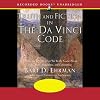
In his usual somewhat repetitive but detailed fashion, Ehrman goes about demolishing Dan Brown's claim of the truth of all the documents he based The Da Vinci Code on. It turns out Brown had no understanding of the documents his "experts" in the novel talk about, totally misrepresenting their content and meaning. For example, he claims that the Dead Sea Scrolls contains gospels, which they do not. The contents are all Jewish documents. He claims the word "companion" used to describe Mary show more Magdalene's relationship to Jesus meant spouse in Aramaic, again showing his ignorance of the non-canonical gospel he was using as his source, which only survives in a Coptic translation from Greek--not Aramaic. And the Coptic translation borrows the Greek word, which is quite common and quite clearly does not mean "spouse". The truth, of course, is that Brown stole the whole idea for his book from one published a few years earlier: The Holy Blood and the Holy Grail. Still, Ehrman's explanation is interesting and he does a good job as his own narrator in the audiobook version. show less
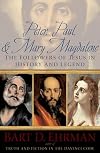
This is one of Ehrman's lesser known titles, but it's one of his better ones. He really shines and illuminates when discussing the very first moments of christianity and even though he's discussed the people around Jesus in his other books, it's never to this depth. With the actual scriptures giving only a rough sketch, we need to delve into supporting materials, apocrypha, historical research and plain speculation and interpretation, and that's where it gets really interesting. How much of show more the stories around these principal characters were later inventions? How do theological battles figure into how they're portrayed? Did alternative christianities exist that would have ranked them differently (the battle between Peter and Paul is of particular interest here)? Making it about the other people of the Bible experiencing and interpreting the events makes the questions it prompts much more relatable. show less
Lists
Awards


You May Also Like


Associated Authors
Statistics
- Works
- 137
- Also by
- 10
- Members
- 22,152
- Popularity
- #965
- Rating
- 3.9
- Reviews
- 424
- ISBNs
- 348
- Languages
- 15
- Favorited
- 55

