

Mario Salvadori (1907–1997)
Author of Why Buildings Stand Up: The Strength of Architecture
About the Author
Mario Salvadori (1907-1997) was James Renwick Professor Emeritus of Civil Engineering and Professor Emeritus of Architecture at Columbia University, an honorary member of the American Institute of Architects, and author of eighteen books, including (with Matthys Levy) Why Buildings Fall Down
Image credit: publicity photograph used for identification on press releases, etc. By Source, Fair use, https://en.wikipedia.org/w/index.php?curid=26677774
Works by Mario Salvadori
The Art of Construction: Projects and Principles for Beginning Engineers & Architects (Ziggurat Book) (1990) 313 copies, 2 reviews
Math Games for Middle School: Challenges and Skill-Builders for Students at Every Level (1998) 29 copies, 1 review
Architecture and Engineering: An Illustrated Teacher's Manual on Why Buildings Stand Up (Annals of the New York Academy (1983) 5 copies
Numerical methods in engineering 3 copies
Tagged
Common Knowledge
- Birthdate
- 1907-03-19
- Date of death
- 1997-06-25
- Gender
- male
- Education
- University of Rome (PhD x 2)
- Occupations
- professor emeritus
mathematician
engineer - Organizations
- Columbia University
- Nationality
- Italy
- Birthplace
- Rome, Italy
- Place of death
- Manhattan, New York, USA
- Associated Place (for map)
- Italy
Members
Reviews

"My name is Ozymandias, King of Kings: Look on my works, ye Mighty, and despair! Nothing beside remains: round the decay Of that colossal Wreck, boundless and bare, The lone and level sands stretch far away." This mystery tour of structural engineering presents numerous cases of failed buildings. The outstanding inked illustrations show the physical forces at work and help the lay reader understand the expert sleuthing of collapsing houses, towers, bridges and dams. Besides the well-known show more cases (Galloping Gertie, Johnstown, Pisa), the little cases are particularly fascinating. The appendices give a good non-mathematical introduction to the issues of structural engineering.
This book is the perfect present for your phobic friends. Having read this book, you will never feel completely at ease in a building or on a bridge. Any moment the structure might break down ... The main drivers of structural disasters are: a fast deployment of untested innovations, the lack of redundancies and the neglect of control and maintenance. The authors show that more planning, testing and control can prevent disasters and limit their financial and human cost. Structural disasters usually show a long history of neglected warning signs.
The awful chapter 17 where author Mario Salvadori has the psychological need to mention twice his two Italian doctorates and an American honoris causa (and belittle the general public) is not worthy of the rest of the book and should have been excised in the updated version (His ego must have been deeply wounded.). Although the claim "updated" is debatable: Many cases are still stuck in 1989. A truly updated version would have added some input resolving the cases. The changes made mostly concern the two attacks on the World Trade Center in New York. A further reading list would also have made a good addition as the field has a sharp divide between professional and amateur titles. Overall, highly recommended. show less
This book is the perfect present for your phobic friends. Having read this book, you will never feel completely at ease in a building or on a bridge. Any moment the structure might break down ... The main drivers of structural disasters are: a fast deployment of untested innovations, the lack of redundancies and the neglect of control and maintenance. The authors show that more planning, testing and control can prevent disasters and limit their financial and human cost. Structural disasters usually show a long history of neglected warning signs.
The awful chapter 17 where author Mario Salvadori has the psychological need to mention twice his two Italian doctorates and an American honoris causa (and belittle the general public) is not worthy of the rest of the book and should have been excised in the updated version (His ego must have been deeply wounded.). Although the claim "updated" is debatable: Many cases are still stuck in 1989. A truly updated version would have added some input resolving the cases. The changes made mostly concern the two attacks on the World Trade Center in New York. A further reading list would also have made a good addition as the field has a sharp divide between professional and amateur titles. Overall, highly recommended. show less
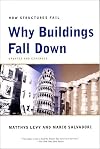
Why did the pyramid at Meidum shed 250,000 tons of limestone outer casings when few of the others have? Why is the pyramid shape a logical structure for a country where the only available building material is stone? Those and many other questions are answered in a fascinating book by Matthys Levy. The bottom blocks of a pyramid must support the weight of all the blocks above it; those on top support only their own weight, much like a mountain. The classical 52o angle was adopted only after show more it was understood that the foundation had to be laid on limestone. At Meidum, the bottom layers and foundation were supported by sand, and the casing blocks lay in horizontal layers and were not inclined inward, unlike in all the pyramids that followed.
The light, airy dome has replaced the pyramid as man's alternative to monolithic monuments. The dome originated thirty-three hundred years ago in Assyria. By 200 A.D., the Roman Pantheon represented the peak of the builders' skill. In 1420, Filippo Brunelleschi completed the dome over the Santa Maria de Fiore without using a scaffold. What gives domes their stability and permanence is their curved continuous shape. Unlike arches that require enormous buttresses, the dome shares the load among all its members. They are exceptionally strong and support gravity loads well. Their rigidity makes them susceptible to earthquakes and soil settlement, however. The advent of Christian liturgical requirements, i.e., the cross shape of many buildings, posed great difficulties for medieval builders who wished to incorporate the dome into religious structures. Eggshells, which are difficult to squash when pressed from the ends toward the middle, are really just two domes glued together. The ratio of an eggshell's span to thickness is about 30. That of a conservatively designed dome is usually at least 300, or about ten times stronger.
The book analyzes assorted structural failures. The collapse of the dome at the C.W. Post College of Long Island University provides an interesting example of how a dome that met and exceeded code standards could still collapse because of a failure to anticipate natural conditions. The assumption behind the design was that snow loads on the roof would be uniform. During the storm that collapsed the roof, an east wind blew snow in huge drifts on one side of the dome, stressing it beyond design limits. That, coupled with the natural lifting effect caused by wind passing over the top of a dome (much like a sail) caused the structural members to fail. So even though the total snow load was one-quarter the maximum, it was concentrated on less than one-third of the dome's structure, bringing it down.
A particularly interesting section describes how tuned, dynamic dampers work in large buildings and why they are necessary. All tall buildings oscillate because of the pressure of the wind. This movement, while not necessarily structurally dangerous — although it can be — can cause airsickness in the occupants. A huge tuned (set to the same frequency as the oscillations of the building) concrete block is set on a thin layer of oil at the top of the building. It is connected to the outer walls by enormous steel springs and shock absorbers. When the building begins to oscillate, the damper tends to stay put because of its large inertia and allows the building to slide under it on the layer of oil. The springs on one side of the damper become longer and literally pull the building back into shape. Those on the other side push it to its original position.
Thermal stresses must also be considered in building and bridge design. As steel beams in a bridge expand from the heat in summer, the bridge must be permitted to expand by using rollers, or the compression caused by the prevention of expansion would reduce the carrying capacity. Air-conditioned buildings pose unique problems because the outside beams may be expanding while the inside beams are contracting because of the temperature differential. This can cause unwanted bending unless structural reinforcement is present.
The chapter on dams is instructive. Many earthen dams, built centuries ago, have survived thousands of years. The Romans built numerous masonry dams on a base three to four times the width of the dam's height. It remained for a Scottish engineer in the 19th century to show that the base width need be no more than the height. Of 1,764 dams built in the United States before 1959, one in fifty failed for a variety of reasons, a rather high failure rate. The most famous collapse is that of the Johnstown dam in 1889, which killed more than three thousand people. It had been completed in 1853 and was intended to provide a steady source of water for a Pennsylvania canal. By 1860, the canal was already obsolete; railroads were taking over the hauling of freight. Soon the dam was in a state of disrepair. When it was sold to new owners they made dangerous modifications that reduced the spillway to less than one-third of its original capacity. The five-inch rainfall that was blamed for the dam's failure would never have destroyed the dam in its original configuration. show less
The light, airy dome has replaced the pyramid as man's alternative to monolithic monuments. The dome originated thirty-three hundred years ago in Assyria. By 200 A.D., the Roman Pantheon represented the peak of the builders' skill. In 1420, Filippo Brunelleschi completed the dome over the Santa Maria de Fiore without using a scaffold. What gives domes their stability and permanence is their curved continuous shape. Unlike arches that require enormous buttresses, the dome shares the load among all its members. They are exceptionally strong and support gravity loads well. Their rigidity makes them susceptible to earthquakes and soil settlement, however. The advent of Christian liturgical requirements, i.e., the cross shape of many buildings, posed great difficulties for medieval builders who wished to incorporate the dome into religious structures. Eggshells, which are difficult to squash when pressed from the ends toward the middle, are really just two domes glued together. The ratio of an eggshell's span to thickness is about 30. That of a conservatively designed dome is usually at least 300, or about ten times stronger.
The book analyzes assorted structural failures. The collapse of the dome at the C.W. Post College of Long Island University provides an interesting example of how a dome that met and exceeded code standards could still collapse because of a failure to anticipate natural conditions. The assumption behind the design was that snow loads on the roof would be uniform. During the storm that collapsed the roof, an east wind blew snow in huge drifts on one side of the dome, stressing it beyond design limits. That, coupled with the natural lifting effect caused by wind passing over the top of a dome (much like a sail) caused the structural members to fail. So even though the total snow load was one-quarter the maximum, it was concentrated on less than one-third of the dome's structure, bringing it down.
A particularly interesting section describes how tuned, dynamic dampers work in large buildings and why they are necessary. All tall buildings oscillate because of the pressure of the wind. This movement, while not necessarily structurally dangerous — although it can be — can cause airsickness in the occupants. A huge tuned (set to the same frequency as the oscillations of the building) concrete block is set on a thin layer of oil at the top of the building. It is connected to the outer walls by enormous steel springs and shock absorbers. When the building begins to oscillate, the damper tends to stay put because of its large inertia and allows the building to slide under it on the layer of oil. The springs on one side of the damper become longer and literally pull the building back into shape. Those on the other side push it to its original position.
Thermal stresses must also be considered in building and bridge design. As steel beams in a bridge expand from the heat in summer, the bridge must be permitted to expand by using rollers, or the compression caused by the prevention of expansion would reduce the carrying capacity. Air-conditioned buildings pose unique problems because the outside beams may be expanding while the inside beams are contracting because of the temperature differential. This can cause unwanted bending unless structural reinforcement is present.
The chapter on dams is instructive. Many earthen dams, built centuries ago, have survived thousands of years. The Romans built numerous masonry dams on a base three to four times the width of the dam's height. It remained for a Scottish engineer in the 19th century to show that the base width need be no more than the height. Of 1,764 dams built in the United States before 1959, one in fifty failed for a variety of reasons, a rather high failure rate. The most famous collapse is that of the Johnstown dam in 1889, which killed more than three thousand people. It had been completed in 1853 and was intended to provide a steady source of water for a Pennsylvania canal. By 1860, the canal was already obsolete; railroads were taking over the hauling of freight. Soon the dam was in a state of disrepair. When it was sold to new owners they made dangerous modifications that reduced the spillway to less than one-third of its original capacity. The five-inch rainfall that was blamed for the dam's failure would never have destroyed the dam in its original configuration. show less
Salvadori's dedication notes that his mother-in-law thought that his book "Why Buildings Stand Up," was nice, but she would be much more interested in why they fall down. She had a good point; I found this book more engaging than the other one. As well as covering structural theory in a way that I mostly was able to follow (there's an appendix in the back that covers things at a more basic and abstract level too), that theory is tied into specific instances of building collapse, both famous show more and relatively unknown. One of the authors has professional experience as a forensic engineer and has testified in court proceedings in that capacit. His discussion of those proceedings in the book adds some interest too.
More strongly and clearly than the other books on architecture and design I've read, Why Buildings Fall Down gives me a sense of awe at the number of different pieces, both literal and metaphorical, that must fit nicely together for a building to do what it's supposed to do safely. show less
More strongly and clearly than the other books on architecture and design I've read, Why Buildings Fall Down gives me a sense of awe at the number of different pieces, both literal and metaphorical, that must fit nicely together for a building to do what it's supposed to do safely. show less
The Art of Construction: Projects and Principles for Beginning Engineers and Architects by Mario Salvadori
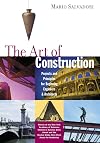
I would give this five stars except that I reserve that rating for books of more universal appeal. I have to admit, I did not read all of this. However, I did examine it carefully, and have decided that it is...
... *Wonderful* for the target audience. Any youngster interested in Lego blocks, toothpick bridges, the "World of Goo" video game, etc., would love this and learn a lot. Any teen considering a career in any field related to architecture, civil engineering, etc., would too. Artists, show more particularly sculptors, could refer to this, as could authors writing about the subjects.
Illustrations, index, and at least one project to try.
Best, I think, for ages 8-12? show less
... *Wonderful* for the target audience. Any youngster interested in Lego blocks, toothpick bridges, the "World of Goo" video game, etc., would love this and learn a lot. Any teen considering a career in any field related to architecture, civil engineering, etc., would too. Artists, show more particularly sculptors, could refer to this, as could authors writing about the subjects.
Illustrations, index, and at least one project to try.
Best, I think, for ages 8-12? show less
Lists
Awards

You May Also Like


Associated Authors
Statistics
- Works
- 22
- Members
- 1,909
- Popularity
- #13,484
- Rating
- 3.8
- Reviews
- 22
- ISBNs
- 46
- Languages
- 5