
Christopher Alexander (1) (1936–2022)
Author of A Pattern Language: Towns, Buildings, Construction
For other authors named Christopher Alexander, see the disambiguation page.
About the Author
Christopher Alexander, Fellow of the American Academy of Arts and Sciences, winner of the first medal for research ever awarded by the American Institute of Architects, is an architect, scientist and builder who has built in many countries. After thirty-eight years in the Department of Architecture show more at the University of California, Berkeley, he is now Emeritus Professor at the University, Director of the Center for Environmental Structure, and Chairman of the Board at PatternLanguage.com show less
Series
Works by Christopher Alexander
The Phenomenon of Life: An Essay on the Art of Building and the Nature of the Universe (2002) 325 copies, 5 reviews
The Process of Creating Life: An Essay on the Art of Building and the Nature of the Universe (2002) 214 copies
The Luminous Ground: An Essay on the Art of Building and the Nature of the Universe (2004) 203 copies
A Vision of a Living World: An Essay on the Art of Building and the Nature of the Universe (2005) 192 copies
The Battle for the Life and Beauty of the Earth: A Struggle Between Two World-Systems (Center for Environmental Structure) (2012) 52 copies
The Nature of Order: An Essay on the Art of Building and the Nature of the Universe (4 Volume Set) (2005) 51 copies, 1 review
A Foreshadowing of 21st Century Art: The Color and Geometry of Very Early Turkish Carpets (1993) 31 copies
La estructura del medio ambiente 5 copies
Associated Works
Tagged
Common Knowledge
- Canonical name
- Alexander, Christopher
- Legal name
- Alexander, Christopher Wolfgang John
Alexander, Wolfgang Christian Johann - Birthdate
- 1936-10-04
- Date of death
- 2022-03-17
- Gender
- male
- Education
- University of Cambridge (BA|MA - Trinity College)
Harvard University (PhD|1962) - Occupations
- architect
professor - Organizations
- University of California, Berkeley
Center for Environmental Structure - Awards and honors
- Swedish Royal Academy of Arts (1980)
Fellow, American Academy of Arts and Sciences (1996)
Athena Medal (2006)
Vincent Scully Prize (2009)
Global Award for Sustainable Architecture (2014)
Seaside Prize (1994) (show all 7)
AIA Gold Medal for Research (1970) - Cause of death
- pneumonia
- Nationality
- UK
USA
Austria (birth) - Birthplace
- Vienna, Austria
- Places of residence
- Arundel, Sussex, England, UK
Berekely, California, USA - Place of death
- Binsted, East Hampshire, England, UK
Members
Reviews

I came to Pattern Language with an eye toward theory and meaning, more than a specific architectural interest. How do wholes and parts relate? What ramifications follow from specific choices at one level, for preferences or objectives at another level? Primed with readings in Batesonian cybernetics, I was curious what Alexander would bring to the table.
Alexander found in bespoke building (artisanal craft) a distinction perhaps unexpected. It's not about higher or lower quality of show more custom-built pieces, in fact he implies at various points that modular / prefabricated pieces will be more precise and consistent in their construction. However, artisanal & modular approaches are very different, and yield distinct results at the scale of wholes, and when pieces interface. Alexander's "quality that cannot be named" or "timeless way" is essentially about coherence or integrity. He claims modular building often won't yield coherent results simply because the approach ignores the specifics of site and / or the remainder of the edifice in which one is building.
An example makes this clear. Pre-hung windows and doors are available in pre-set dimensions. One chooses where in the room they go, but precise placement is limited by the pre-set options. If the builder wants to set a window so as to frame a lake in the distance, but not intrude on either a radiator in the room or the branches of an oak tree just outside the house, nothing can be done but hope the dimensions work out. It's likely available windows will be too large or too small for the purpose, and the objective can only be partially achieved. The issue can be minimised with greater choice in standard sizes, but the inherent obstacle cannot be avoided. Bespoke windows allow the builder to determine precisely where the window should appear so as to balance the vista with the room's interior layout.
Characterised generally: modular building assumes a Cartesian grid, maps the specific site and structure upon that grid, and construction is undertaken in a modular fashion from prefabricated (and predefined) materials. That grid can be finer or grosser in its precision, but it remains a grid. Artisanal building assumes a scale specific to the project, fits the structure to the site, and construction is undertaken in a relational fashion: that is, driven by dynamic between pieces and wholes at varying scales. Alexander attempts to marshall the efficiencies and wisdom of modular design by applying patterns to typical situations. These patterns, at root, identify dynamics one can expect to recur, and suggests useful considerations ("rules of thumb") for solving these dynamics in specific instances.
In a discussion on coding design, a project manager noted the Agile framework exists predominantly as an abstract, with little evidence of success at scale. A major challenge is how to code for large projects, when detailed coding for specific modules and subroutines are developed weeks or months after the full project was mapped out as a whole. When interactions between modules encounter obstacles or conflict, the relevant teams are often deployed elsewhere and can't hash out specifics. I wonder if a Pattern Language approach would be fruitful in avoiding such problems. show less
Alexander found in bespoke building (artisanal craft) a distinction perhaps unexpected. It's not about higher or lower quality of show more custom-built pieces, in fact he implies at various points that modular / prefabricated pieces will be more precise and consistent in their construction. However, artisanal & modular approaches are very different, and yield distinct results at the scale of wholes, and when pieces interface. Alexander's "quality that cannot be named" or "timeless way" is essentially about coherence or integrity. He claims modular building often won't yield coherent results simply because the approach ignores the specifics of site and / or the remainder of the edifice in which one is building.
An example makes this clear. Pre-hung windows and doors are available in pre-set dimensions. One chooses where in the room they go, but precise placement is limited by the pre-set options. If the builder wants to set a window so as to frame a lake in the distance, but not intrude on either a radiator in the room or the branches of an oak tree just outside the house, nothing can be done but hope the dimensions work out. It's likely available windows will be too large or too small for the purpose, and the objective can only be partially achieved. The issue can be minimised with greater choice in standard sizes, but the inherent obstacle cannot be avoided. Bespoke windows allow the builder to determine precisely where the window should appear so as to balance the vista with the room's interior layout.
Characterised generally: modular building assumes a Cartesian grid, maps the specific site and structure upon that grid, and construction is undertaken in a modular fashion from prefabricated (and predefined) materials. That grid can be finer or grosser in its precision, but it remains a grid. Artisanal building assumes a scale specific to the project, fits the structure to the site, and construction is undertaken in a relational fashion: that is, driven by dynamic between pieces and wholes at varying scales. Alexander attempts to marshall the efficiencies and wisdom of modular design by applying patterns to typical situations. These patterns, at root, identify dynamics one can expect to recur, and suggests useful considerations ("rules of thumb") for solving these dynamics in specific instances.
In a discussion on coding design, a project manager noted the Agile framework exists predominantly as an abstract, with little evidence of success at scale. A major challenge is how to code for large projects, when detailed coding for specific modules and subroutines are developed weeks or months after the full project was mapped out as a whole. When interactions between modules encounter obstacles or conflict, the relevant teams are often deployed elsewhere and can't hash out specifics. I wonder if a Pattern Language approach would be fruitful in avoiding such problems. show less
The Nature of Order: An Essay on the Art of Building and the Nature of the Universe, Book 1 - The Phenomenon of Life (Center for Environmental Structure, Vol. 9) by Christopher Alexander
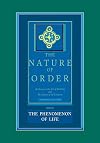
In 2002, architect Christopher Alexander published the first volume of his magnum opus, "The Nature of Order." It is a book that endeavors to answer the question: what is aliveness, and how can cultivate it in our built environment? Here's the review on the dust jacket: "Five hundred years is a long time, and I don't expect that many of the people I interview will be known in the year 2500. Alexander may be an exception," attributed to David Creeman.
Alexander begins by asking the question, show more why is contemporary architecture so terrible? "In the 20th century we have passed through a unique period, one in which architecture as a discipline has been in a state that is almost unimaginably bad." I too find myself musing on this question as I sit in the waiting room at a doctor's office, park my car in a garage, or go though airport security. How did we end up with a built environment that actively degrades our lives? Does it have to be this way? Alexander would suggest: no. Throughout history, cultures have established methods of architecture that enrich the human experience. He posits that this has been caused by a loss of the ability and desire to discern aliveness.
Alexander has a degree in mathematics, and approaches his subject matter systematically. When looking at aliveness, he establishes that aliveness is a property of space and matter, not only of biological organisms. Next, he establishes that aliveness exists on a spectrum: anything can be more or less alive. In the built environment, we have agency to influence where something—a door nob, and window, a room, and village, a region—falls on this spectrum.
So how do we discern aliveness? After decades of experimentation, Alexander has found that it is an objective property. Although it is a discipline requiring practice, the basic tenet is the somatic question, "which of these things, manifestations, etc. brings me more aliveness?" He describes this as the Mirror of the Self test; "which of the two things generates, in the observer, the most wholesome feeling?" It should be noted that this question is fundamentally different and divergent from the question, "which do I like better?" Alexander contextualizes this as a second kind of science. Whereas the first kind of science was Cartesian, founded by Descartes, was focused on mechanisms, this second kind of science is focused on wholeness. I’ve just reviewed another book, by Andrea Wulf, documenting the rich heritage in this second science of wholeness including the likes of Goethe, Humboldt, Jefferson, Thoreau, Marsh, Haekel, and Muir.
The core of Alexander's text is organized around fifteen Principles of Wholeness:
1. Levels of Scale: "the centers these objects are made of tend to have a beautiful range of sizes, and that these sizes exist at a series of well-marked levels, with definite jumps between them."
2. Strong Centers: "The field effect and the power of 'the' center are created by the sequence of other nearby centers leading up to it."
3. Boundaries: "focuses attention on the center... by forming the field of force which creates and intensified the center... [and] it unites the center which is being bounded with the world beyond the boundary."
4. Alternating Repetition: "focuses attention on the center... by forming the field of force which creates and intensified the center... [and] it unites the center which is being bounded with the world beyond the boundary."
5. Positive Space "occurs when every bit of space swells outward, is substantial in itself, is never the leftovers from an adjacent shape."
6. Good Shape: "a shape we see as good is a shape which is itself, as a shape, made up from multiple coherent centers."
7. Local Symmetries: "local symmetries work to create coherent, while overall symmetry rarely does... Indeed, perfect symmetry is often a mark of death in things, rather than life."
8. Deep Interlock & Ambiguity: "situations where centers are 'hooked' into their surroundings"
9. Contrast: "every center is made from discernible opposites, and intensified when the not-center, against which it is opposed, is clarified, and itself becomes a center."
10. Gradients: "must arise in the world when the world is in harmony with itself simply because conditions vary."
11. Roughness: "seemingly rough arrangement is more precise because it comes from a much more careful guarding of the essential centers in the design... roughness is always the product of abandon—it is created whenever a person is truly free... doing only whatever is essential."
12. Echoes: "there is a deep underlying similarity—a family resemblance—among the elements, so deep that everything seems to be related."
13. The Void: “in the most profound centers which have perfect wholeness, there is at the heart a void which is like water, infinite in depth, surrounded by and contrasted with the clutter of the stuff and fabric all around it."
14. Simplicity and Inner Calm: "the quality comes about when everything unnecessary is removed... It is essential that the great beauty and intricacy of the ornament go only just far enough to bring this calm into being, and not so far that it destroys it."
15. Not-Seperateness: "we experience a living whole as being at one with the world, and not separate from it.”
So these are Alexander's fifteen Principles of Wholeness. He then goes on to document these principles as they arise in nature, followed be a segment of case studies, illustrating how these principles have informed the design work of Alexander's firm. This culminates in a story of Alexander’s experience designing the Eishin school campus in Tokyo. For the 50th anniversary of the attack on Pearl Harbor, the Japanese National Television company produced a program showing five examples of Japanese-American collaboration since the war. The Eishin campus was one of the five. When beginning the project, Alexander asked the teachers at the school, "image a most wonderful place where you could dream of being a teacher... You are walking about there... What is it like, where you are walking?" At first, the teachers were frustrated, having trouble envisioning a campus in Tokyo being a place they could love being, but eventually they humored Alexander. "I am walking along by a stream, quietly thinking." Themes of water and quiet kept emerging. When building the school, they were able to turn a wetland in the middle of the site into a lake. A few years after the new campus opened, the students created a film about their experience at the school. It began with them running through the streets of Tokyo, panting like dogs. Eventually they run through the campus gates, find the lake, and dive in, clothes and all. Joy pervades their galavanting. Back in the documentary, they interviewed one of the students: "I grew up in Tokyo... I felt like I was in prison... When I came to... this campus... For the first time in my life, I felt that I was free." So this is one anecdote about Alexander's Principles of Wholeness in practice.
In reflecting on the book, I'm struck by the way in which the principles and practices he describes can be applied in any discipline—of course in the aesthetic fields of music, art, and writing—but also in fields like entrepreneurship. I have some sadness that Alexander—who was quite well-read—describes his objective somatic science of discerning wholeness as "new," and that he failed to realize the rich and storied heritage leading up to his authorship of this book. (Although, implicitly he acknowledges this heritage, by the wealth of imagery and cultures he cites in his illustrations of wholeness and aliveness.)
If you're curious to explore the somatic science described herein further, you might read the works of Andreas Weber and David Abram, as well as Charles Eisenstein's "The More Beautiful World Your Heart Knows Is Possible."
This review just covers the first ("The Phenomenon of Life") of four volumes in Alexander's series, "The Nature of Order." In coming months, I may write subsequent reviews documenting the three other volumes. show less
Alexander begins by asking the question, show more why is contemporary architecture so terrible? "In the 20th century we have passed through a unique period, one in which architecture as a discipline has been in a state that is almost unimaginably bad." I too find myself musing on this question as I sit in the waiting room at a doctor's office, park my car in a garage, or go though airport security. How did we end up with a built environment that actively degrades our lives? Does it have to be this way? Alexander would suggest: no. Throughout history, cultures have established methods of architecture that enrich the human experience. He posits that this has been caused by a loss of the ability and desire to discern aliveness.
Alexander has a degree in mathematics, and approaches his subject matter systematically. When looking at aliveness, he establishes that aliveness is a property of space and matter, not only of biological organisms. Next, he establishes that aliveness exists on a spectrum: anything can be more or less alive. In the built environment, we have agency to influence where something—a door nob, and window, a room, and village, a region—falls on this spectrum.
So how do we discern aliveness? After decades of experimentation, Alexander has found that it is an objective property. Although it is a discipline requiring practice, the basic tenet is the somatic question, "which of these things, manifestations, etc. brings me more aliveness?" He describes this as the Mirror of the Self test; "which of the two things generates, in the observer, the most wholesome feeling?" It should be noted that this question is fundamentally different and divergent from the question, "which do I like better?" Alexander contextualizes this as a second kind of science. Whereas the first kind of science was Cartesian, founded by Descartes, was focused on mechanisms, this second kind of science is focused on wholeness. I’ve just reviewed another book, by Andrea Wulf, documenting the rich heritage in this second science of wholeness including the likes of Goethe, Humboldt, Jefferson, Thoreau, Marsh, Haekel, and Muir.
The core of Alexander's text is organized around fifteen Principles of Wholeness:
1. Levels of Scale: "the centers these objects are made of tend to have a beautiful range of sizes, and that these sizes exist at a series of well-marked levels, with definite jumps between them."
2. Strong Centers: "The field effect and the power of 'the' center are created by the sequence of other nearby centers leading up to it."
3. Boundaries: "focuses attention on the center... by forming the field of force which creates and intensified the center... [and] it unites the center which is being bounded with the world beyond the boundary."
4. Alternating Repetition: "focuses attention on the center... by forming the field of force which creates and intensified the center... [and] it unites the center which is being bounded with the world beyond the boundary."
5. Positive Space "occurs when every bit of space swells outward, is substantial in itself, is never the leftovers from an adjacent shape."
6. Good Shape: "a shape we see as good is a shape which is itself, as a shape, made up from multiple coherent centers."
7. Local Symmetries: "local symmetries work to create coherent, while overall symmetry rarely does... Indeed, perfect symmetry is often a mark of death in things, rather than life."
8. Deep Interlock & Ambiguity: "situations where centers are 'hooked' into their surroundings"
9. Contrast: "every center is made from discernible opposites, and intensified when the not-center, against which it is opposed, is clarified, and itself becomes a center."
10. Gradients: "must arise in the world when the world is in harmony with itself simply because conditions vary."
11. Roughness: "seemingly rough arrangement is more precise because it comes from a much more careful guarding of the essential centers in the design... roughness is always the product of abandon—it is created whenever a person is truly free... doing only whatever is essential."
12. Echoes: "there is a deep underlying similarity—a family resemblance—among the elements, so deep that everything seems to be related."
13. The Void: “in the most profound centers which have perfect wholeness, there is at the heart a void which is like water, infinite in depth, surrounded by and contrasted with the clutter of the stuff and fabric all around it."
14. Simplicity and Inner Calm: "the quality comes about when everything unnecessary is removed... It is essential that the great beauty and intricacy of the ornament go only just far enough to bring this calm into being, and not so far that it destroys it."
15. Not-Seperateness: "we experience a living whole as being at one with the world, and not separate from it.”
So these are Alexander's fifteen Principles of Wholeness. He then goes on to document these principles as they arise in nature, followed be a segment of case studies, illustrating how these principles have informed the design work of Alexander's firm. This culminates in a story of Alexander’s experience designing the Eishin school campus in Tokyo. For the 50th anniversary of the attack on Pearl Harbor, the Japanese National Television company produced a program showing five examples of Japanese-American collaboration since the war. The Eishin campus was one of the five. When beginning the project, Alexander asked the teachers at the school, "image a most wonderful place where you could dream of being a teacher... You are walking about there... What is it like, where you are walking?" At first, the teachers were frustrated, having trouble envisioning a campus in Tokyo being a place they could love being, but eventually they humored Alexander. "I am walking along by a stream, quietly thinking." Themes of water and quiet kept emerging. When building the school, they were able to turn a wetland in the middle of the site into a lake. A few years after the new campus opened, the students created a film about their experience at the school. It began with them running through the streets of Tokyo, panting like dogs. Eventually they run through the campus gates, find the lake, and dive in, clothes and all. Joy pervades their galavanting. Back in the documentary, they interviewed one of the students: "I grew up in Tokyo... I felt like I was in prison... When I came to... this campus... For the first time in my life, I felt that I was free." So this is one anecdote about Alexander's Principles of Wholeness in practice.
In reflecting on the book, I'm struck by the way in which the principles and practices he describes can be applied in any discipline—of course in the aesthetic fields of music, art, and writing—but also in fields like entrepreneurship. I have some sadness that Alexander—who was quite well-read—describes his objective somatic science of discerning wholeness as "new," and that he failed to realize the rich and storied heritage leading up to his authorship of this book. (Although, implicitly he acknowledges this heritage, by the wealth of imagery and cultures he cites in his illustrations of wholeness and aliveness.)
If you're curious to explore the somatic science described herein further, you might read the works of Andreas Weber and David Abram, as well as Charles Eisenstein's "The More Beautiful World Your Heart Knows Is Possible."
This review just covers the first ("The Phenomenon of Life") of four volumes in Alexander's series, "The Nature of Order." In coming months, I may write subsequent reviews documenting the three other volumes. show less
Sets out to convince the reader that there is a quality called wholeness (sometimes life), that is objectively and quantifiably present in different degrees in different buildings. It was worthwhile to read, to see the arguments he made and how exhaustively he'd thought about it. However, because I was not convinced by the argument, I doubt I will go on to the other volumes due to the time commitment required.

This book isn't life changing so much as it expresses clearly and beautifully things which I know deep inside. And yet, since what is being described is itself so hard to describe, the truths of this book are sometimes more felt than explicitly learned.
On the surface, this book is about how to develop pattern languages and use them to guide building physical places which live. The patterns are all from the domain of architecture. Some elements, such as how to go about the processes of show more detailed design or building are deeply impractical in a culture where, for better and for worse, much of what it takes to build buildings has been professionalized. (That said, as a metaphor for software creation, which does depend on taking common components and contextualizing them, they are more applicable.)
However, none of that matters because what you really take away is the deeper sense of what it means for a system to be alive, whole, comfortable, free, exact, egoless, eternal — for it to have the quality without a name. The quality without a name is that deeply felt yet hard to describe sense of rightness that things sometimes have. It can be thought of as a sense of dynamic equilibrium where all forces are aligned and tensions resolved. Yet even that is a deceptive description because the forces in play are always changing and so while particular solution may embody the quality without a name for moment, for a system to have this quality, it must be always adapting.
Because there is so much great material in this book, I'll just highlight some of the ideas I loved best.
The world is made up of relationships, called patterns. These patterns arise from the events which happen repeatedly in a space. Patterns which help resolve the tensions that arise from these events are alive. Those patterns which create or increase tensions eventually make a space dead. Dead patterns cannot be isolated. They eventually leak out and contaminate the whole system, so it is important to try to resolve them, not just hide them. Living patterns reinforce each other.
Patterns together form a pattern language. A pattern language is made of patterns which relate to each other in a certain way: a pattern depends on the components which are needed to make it whole. In computer science terms, patterns form a directed acyclic graph. We each have our own pattern language which is built from the forces we've had to deal with in our lives. Yet our pattern languages are also shared. We learn patterns from each other and our own patterns evolve in response to what we learn. It is because these languages are largely shared that the application of a pattern language can lead to a common character over a larger set of design decisions.
Design works best when it is holistic. At each step of the design process, design should apply differentiation on a whole. Details should not be designed in isolation, without any concern for their context. Rather, the context should be defined to form a whole, then the parts within that refined to form a more detailed whole, and so on until a design is complete down to the details. If a design is whole at every step of the way, it minimizes the chance that a later detail will derail the big picture design. This process of refinement depends on having a properly structured order for design. In a pattern language, that is captured in the hierarchical relationship between patterns.
A shared pattern language can help a design to be coherent when applied to design decisions made in a community. Nested groups should be responsible for design, where the group that uses a pattern at a certain scale is responsible for designing their own solution. However, they are also responsible for making sure their solution fits coherently with the larger patterns it is encompassed in. The larger groups which the smaller groups are a part of are responsible for instantiating those larger patterns. When a pattern language is shared across a community, this process of delegating design to the smallest applicable group can create a coherent whole even while many independent decisions are being made.
All that just scratches the surface. This book has so much to offer, and I look forward to reading it again. show less
On the surface, this book is about how to develop pattern languages and use them to guide building physical places which live. The patterns are all from the domain of architecture. Some elements, such as how to go about the processes of show more detailed design or building are deeply impractical in a culture where, for better and for worse, much of what it takes to build buildings has been professionalized. (That said, as a metaphor for software creation, which does depend on taking common components and contextualizing them, they are more applicable.)
However, none of that matters because what you really take away is the deeper sense of what it means for a system to be alive, whole, comfortable, free, exact, egoless, eternal — for it to have the quality without a name. The quality without a name is that deeply felt yet hard to describe sense of rightness that things sometimes have. It can be thought of as a sense of dynamic equilibrium where all forces are aligned and tensions resolved. Yet even that is a deceptive description because the forces in play are always changing and so while particular solution may embody the quality without a name for moment, for a system to have this quality, it must be always adapting.
Because there is so much great material in this book, I'll just highlight some of the ideas I loved best.
The world is made up of relationships, called patterns. These patterns arise from the events which happen repeatedly in a space. Patterns which help resolve the tensions that arise from these events are alive. Those patterns which create or increase tensions eventually make a space dead. Dead patterns cannot be isolated. They eventually leak out and contaminate the whole system, so it is important to try to resolve them, not just hide them. Living patterns reinforce each other.
Patterns together form a pattern language. A pattern language is made of patterns which relate to each other in a certain way: a pattern depends on the components which are needed to make it whole. In computer science terms, patterns form a directed acyclic graph. We each have our own pattern language which is built from the forces we've had to deal with in our lives. Yet our pattern languages are also shared. We learn patterns from each other and our own patterns evolve in response to what we learn. It is because these languages are largely shared that the application of a pattern language can lead to a common character over a larger set of design decisions.
Design works best when it is holistic. At each step of the design process, design should apply differentiation on a whole. Details should not be designed in isolation, without any concern for their context. Rather, the context should be defined to form a whole, then the parts within that refined to form a more detailed whole, and so on until a design is complete down to the details. If a design is whole at every step of the way, it minimizes the chance that a later detail will derail the big picture design. This process of refinement depends on having a properly structured order for design. In a pattern language, that is captured in the hierarchical relationship between patterns.
A shared pattern language can help a design to be coherent when applied to design decisions made in a community. Nested groups should be responsible for design, where the group that uses a pattern at a certain scale is responsible for designing their own solution. However, they are also responsible for making sure their solution fits coherently with the larger patterns it is encompassed in. The larger groups which the smaller groups are a part of are responsible for instantiating those larger patterns. When a pattern language is shared across a community, this process of delegating design to the smallest applicable group can create a coherent whole even while many independent decisions are being made.
All that just scratches the surface. This book has so much to offer, and I look forward to reading it again. show less
Lists
Awards


You May Also Like


Associated Authors
Statistics
- Works
- 27
- Also by
- 2
- Members
- 6,467
- Popularity
- #3,801
- Rating
- 4.4
- Reviews
- 47
- ISBNs
- 67
- Languages
- 7
- Favorited
- 7
