
Paul Thagard
Author of Mind: Introduction to Cognitive Science
About the Author
Paul Thagard is Professor of Philosophy at the University of Waterloo, Ontario. He is the author of Mind: Introduction to Cognitive Science and Hot Thought: Mechanisms and Applications of Emotional Cognition, both published by the MIT Press other books.
Image credit: North American Conference on Computing and Philosophy
Works by Paul Thagard
Associated Works
Tagged
Common Knowledge
- Birthdate
- 1950-09-28
- Gender
- male
- Education
- University of Saskatchewan (B.A.)
University of Toronto (Ph.D., Philosophy)
University of Michigan (M.S., Computer Science) - Occupations
- Professor of Philosophy, University of Waterloo
- Awards and honors
- Molson Prize (2007)
Canada Council Killam Prize (1997) - Relationships
- Kunda, Ziva (wife)
- Nationality
- Canada
- Birthplace
- Yorkton, Saskatchewan, Canada
- Associated Place (for map)
- Saskatchewan, Canada
Members
Reviews
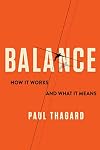
Balance: How It Works and What It Means, by Paul Thagard, presents balance in all its forms, from literal to metaphorical, and looks at its importance. This book is so much more than just informative, it makes the reader think about metaphors and related tools in a much more practical nature.
I should explain, I don't mean practical in the sense of being a perfect fit. I mean that many of us use metaphors as if they were analogies, which generally have a much closer alignment with what is show more being referred to. Yet we take a common metaphor and nitpick about the places where it is not applicable. Unfortunately, when one person does that, the tendency is for the next person to then debate those details rather than point out that the metaphor is not meant to have a direct one-to-one alignment, it is used to offer a loose-fitting stand-in that can make discussion better.
Thagard works from the literal, biological/physiological balance as illustrated by the imbalance of vertigo. Then, subject by subject he analyzes various balance metaphors. In doing so he highlights where many serve a very useful purpose while others are actually counterproductive and offer openings for pseudo-debate on the accuracy of the metaphor rather than on the topic at hand. These metaphors allow some to deflect the actual issue at hand by pretending the issue of the metaphor is what matters.
What, in a purely fun way, really makes this book a great read is just how many ways we use the idea of balance/imbalance in talking about almost everything. Even some of the ones I have used frequently have become so cliched that I had stopped thinking about how accurately they fit.
In addition to the body of the text there are plenty of good notes that support his comments. His list of references is extensive, and I plan to go through it more closely and pick out some reading in the areas I find most intriguing.
This is an accessible work, even when he is discussing abstract concepts. He keeps his explanations clear and his examples are usually spot-on. In addition to those with an interest in our use of language in general I would also recommend this to those who enjoy reading in that area where different fields meet and converse.
Reviewed from a copy made available by the publisher via NetGalley. show less
I should explain, I don't mean practical in the sense of being a perfect fit. I mean that many of us use metaphors as if they were analogies, which generally have a much closer alignment with what is show more being referred to. Yet we take a common metaphor and nitpick about the places where it is not applicable. Unfortunately, when one person does that, the tendency is for the next person to then debate those details rather than point out that the metaphor is not meant to have a direct one-to-one alignment, it is used to offer a loose-fitting stand-in that can make discussion better.
Thagard works from the literal, biological/physiological balance as illustrated by the imbalance of vertigo. Then, subject by subject he analyzes various balance metaphors. In doing so he highlights where many serve a very useful purpose while others are actually counterproductive and offer openings for pseudo-debate on the accuracy of the metaphor rather than on the topic at hand. These metaphors allow some to deflect the actual issue at hand by pretending the issue of the metaphor is what matters.
What, in a purely fun way, really makes this book a great read is just how many ways we use the idea of balance/imbalance in talking about almost everything. Even some of the ones I have used frequently have become so cliched that I had stopped thinking about how accurately they fit.
In addition to the body of the text there are plenty of good notes that support his comments. His list of references is extensive, and I plan to go through it more closely and pick out some reading in the areas I find most intriguing.
This is an accessible work, even when he is discussing abstract concepts. He keeps his explanations clear and his examples are usually spot-on. In addition to those with an interest in our use of language in general I would also recommend this to those who enjoy reading in that area where different fields meet and converse.
Reviewed from a copy made available by the publisher via NetGalley. show less

Instead of being about the computational philosophy of science, this book describes a data definition language and corresponding computer program for problem solving, but, as far as I can tell, neither are useful for anything. /Extremely/ contrived examples are used to showcase the power of the system, but the correlations drawn are completely arbitrary and would be indistinguishable from noise in a real application.
For more than half of the book the author writes about the view that we are mere chemical in action, the rest of the book he keeps repeating (perhaps like twenty times) that work, play and love are the columns upon which to create a meaningful life.
A quote from the book: "The fact that the universe doesn't care about you should not be horribly distressing as long as there are people who do".
I wonder if our society is actually favouring people to have meaningful jobs, forms of entertainment show more and relationships. I actually think Mr. Thagard is in a quite unique position in this respect, but that doesn't apply to 99% of people. show less
A quote from the book: "The fact that the universe doesn't care about you should not be horribly distressing as long as there are people who do".
I wonder if our society is actually favouring people to have meaningful jobs, forms of entertainment show more and relationships. I actually think Mr. Thagard is in a quite unique position in this respect, but that doesn't apply to 99% of people. show less
I read this because I had approached Thagard in an attempt to do research with him; he told me he wouldn't talk to me before I read his book. After reading his book, I decided I no longer wanted to do research with him.
You May Also Like


Associated Authors
Statistics
- Works
- 22
- Also by
- 3
- Members
- 778
- Popularity
- #32,713
- Rating
- 3.7
- Reviews
- 10
- ISBNs
- 86
- Languages
- 4