
Andy Clark (1) (1957–)
Author of Natural-Born Cyborgs: Minds, Technologies, and the Future of Human Intelligence
For other authors named Andy Clark, see the disambiguation page.
About the Author
Andy Clark is Professor of Logic and Metaphysics in the School of Philosophy, Psychology and Language Sciences, at Edinburgh University in Scotland. He is the author of Being There (1997), Mindware (2001), Natural-Born Cyborgs (Oxford, 2003), and Supersizing the Mind (Oxford, 2008). His interests show more include artificial intelligence, embodied cognition, robotics, and the predictive mind. In 2018, he was profiled in the New Yorker. show less
Works by Andy Clark
Natural-Born Cyborgs: Minds, Technologies, and the Future of Human Intelligence (2003) 252 copies, 2 reviews
Philosophy and Cognitive Science: Categories, Consciousness, and Reasoning (Philosophical Studies Series) (1996) — Editor — 5 copies
Cognitive Architectures in Artificial Intelligence: The Evolution of Research Programs (Artificial Intelligence and Cogn (1998) 2 copies
Associated Works
What Is Your Dangerous Idea? Today's Leading Thinkers on the Unthinkable (2007) — Contributor — 668 copies, 8 reviews
Tagged
Common Knowledge
- Canonical name
- Clark, Andy
- Legal name
- Clark, Andrew John
- Birthdate
- 1957-11-20
- Gender
- male
- Education
- University of Stirling (BA|1981|D.Phil|1984)
- Occupations
- philosopher
professor
artificial intelligence researcher - Organizations
- University of Edinburgh
University of Sussex - Awards and honors
- Royal Society of Edinburgh (Fellow, 2007)
British Academy (Fellow, 2015) - Nationality
- UK
- Birthplace
- London, England, UK
- Places of residence
- Edinburgh, Scotland, UK
Brighton, Sussex, England, UK - Associated Place (for map)
- England, UK
Members
Reviews

Andy Clark's The Experience Machine is an accessible book about cognitive psychology that focuses on "predictive processing." Clark is concerned with the scientifically demonstrable notion that what we experience is not an objective outer reality, but a construct intended to anticipate first and recognize second stimuli and events that will impact us. The thesis might be usefully read in tandem with Hoffman's Case Against Reality and its "interface theory of perception."
Clark works out a show more variety of interesting consequences from his central premise, to address external perceptions, self-evaluations, neurodiversity, and therapeutic possibilities. He considers this framework as a way of philosophically unifying cognition and action.
The theory of the "extended mind" is one that Clark has been espousing for over three decades, and it is the preoccupation of his penultimate chapter here. The idea that our "minds" include the tools that we use to obtain and evaluate information has perhaps become easier for people to appreciate in the context of 21st-century smartphones. (One of my early encounters with this understanding was in the opening section of Charles Stross' sf Accelerando, where a character is robbed of his wearable computer with its glasses interface, and he consequently suffers traumatic--though temporary--identity loss.) While I agree with Clark about the nature of mind in these scenarios, I am less blithe than he is about the ways in which our minds are incorporating the latest technologies, given the economic, ecological, and political positioning of those devices.
The book offers little discussion of religion in the context of this psychology, although it has some praise for traditional disciplines of meditation. Clark is a staunch naturalist who takes it as axiomatic that "supernatural beliefs" should be avoided and discouraged. He does, however present some of the most unflinching psychedelic boosterism I have encountered in a long while, when he declares in the context of the benefits of such drugs that "I suspect ... everyone ... might learn by experiencing their world--even for a short while--in a less entrenched and ego-driven way" (208). show less
Clark works out a show more variety of interesting consequences from his central premise, to address external perceptions, self-evaluations, neurodiversity, and therapeutic possibilities. He considers this framework as a way of philosophically unifying cognition and action.
The theory of the "extended mind" is one that Clark has been espousing for over three decades, and it is the preoccupation of his penultimate chapter here. The idea that our "minds" include the tools that we use to obtain and evaluate information has perhaps become easier for people to appreciate in the context of 21st-century smartphones. (One of my early encounters with this understanding was in the opening section of Charles Stross' sf Accelerando, where a character is robbed of his wearable computer with its glasses interface, and he consequently suffers traumatic--though temporary--identity loss.) While I agree with Clark about the nature of mind in these scenarios, I am less blithe than he is about the ways in which our minds are incorporating the latest technologies, given the economic, ecological, and political positioning of those devices.
The book offers little discussion of religion in the context of this psychology, although it has some praise for traditional disciplines of meditation. Clark is a staunch naturalist who takes it as axiomatic that "supernatural beliefs" should be avoided and discouraged. He does, however present some of the most unflinching psychedelic boosterism I have encountered in a long while, when he declares in the context of the benefits of such drugs that "I suspect ... everyone ... might learn by experiencing their world--even for a short while--in a less entrenched and ego-driven way" (208). show less
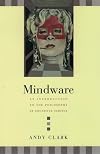
One must bear in mind that this book was published in 2001, while its subject has made leaps and bounds (though perhaps not towards the goal it seeks). As an introductory text, I feel that Clark's prose finds the right median between the colloquial and the lofty. It's a great overview of the history of philosophy of mind and the major debates. For me, the most intriguing debate is the one that found its launching pad in Descartes back in the early seventeenth century: there is a dualism that show more represents the material body and the immaterial body; but this also presents a problem regarding how the two are linked in such as a way as to effect causality.
The book is very much Andy Clark's interpretation and thoughts of the field, i.e. it makes no pretensions toward objectivity (could it?), and he seeks to trace the trajectory of thoughts and experiments leading up to the goal of presenting "mindware" as explaining the mind with nothing outside of the material world. In this vein, the only section of the book I considered worthwhile was the second appendix, "Consciousness and the Meta-Hard Problem," though the thoughts are at the forefront of philosophy today. Apart from that, Clark does a nice job breaking down some of Daniel Dennett's more opaque theories, especially from the latter's book [b:Consciousness Explained|2069|Consciousness Explained|Daniel C. Dennett|https://d2arxad8u2l0g7.cloudfront.net/books/1386924714s/2069.jpg|1860288]--a book that I still regard with trepidation (I've only managed the first few pages several different times).
Having read a lot in the area of philosophy of mind and in neuroscience, I looked to this book to bring some coherence to all the schools of thought and the history thereof. In the end, I find myself continuing to lean more and more away from philosophy. For the goal presented in the problem of mind-body dualism and in the explanation of qualia, I really don't see a fruitful explanation coming from the dialectical approach of philosophy or even the analytical approach of logic; I look more towards neuroscience. Which, actually, brings up another point regarding science and philosophy.
More and more I'm starting to view philosophy as nothing more than an analogy factory--at least, as regards metaphysics. I've been reading and enjoying philosophy for a while, including a subscription to Philosophy Now, but lately, as compared to science books and my other subscription to Scientific American, I am getting impatient with philosophy. Yet I cannot completely abandon it. I've read many times that philosophy's proper place is to help think the right way about a thing, to clarify thinking, which is a laudable goal since even scientific phenomena must be explained in language at some point. So, I agree that there must be some intellectual agency governing how to clearly think about and express a given thing in language.
In addition to language, there is of course the branch of philosophy that deals with ethics. And, as scientific discovery progresses (perhaps especially in the field of AI) I can see where it would be as equally prudent to steep ourselves in clear ethics as in clear thought and language. But--hey!--good luck finding that holy grail! What doesn't start unending debates is an equation.
Well, unless we're talking about quantum mechanics, of course. show less
The book is very much Andy Clark's interpretation and thoughts of the field, i.e. it makes no pretensions toward objectivity (could it?), and he seeks to trace the trajectory of thoughts and experiments leading up to the goal of presenting "mindware" as explaining the mind with nothing outside of the material world. In this vein, the only section of the book I considered worthwhile was the second appendix, "Consciousness and the Meta-Hard Problem," though the thoughts are at the forefront of philosophy today. Apart from that, Clark does a nice job breaking down some of Daniel Dennett's more opaque theories, especially from the latter's book [b:Consciousness Explained|2069|Consciousness Explained|Daniel C. Dennett|https://d2arxad8u2l0g7.cloudfront.net/books/1386924714s/2069.jpg|1860288]--a book that I still regard with trepidation (I've only managed the first few pages several different times).
Having read a lot in the area of philosophy of mind and in neuroscience, I looked to this book to bring some coherence to all the schools of thought and the history thereof. In the end, I find myself continuing to lean more and more away from philosophy. For the goal presented in the problem of mind-body dualism and in the explanation of qualia, I really don't see a fruitful explanation coming from the dialectical approach of philosophy or even the analytical approach of logic; I look more towards neuroscience. Which, actually, brings up another point regarding science and philosophy.
More and more I'm starting to view philosophy as nothing more than an analogy factory--at least, as regards metaphysics. I've been reading and enjoying philosophy for a while, including a subscription to Philosophy Now, but lately, as compared to science books and my other subscription to Scientific American, I am getting impatient with philosophy. Yet I cannot completely abandon it. I've read many times that philosophy's proper place is to help think the right way about a thing, to clarify thinking, which is a laudable goal since even scientific phenomena must be explained in language at some point. So, I agree that there must be some intellectual agency governing how to clearly think about and express a given thing in language.
In addition to language, there is of course the branch of philosophy that deals with ethics. And, as scientific discovery progresses (perhaps especially in the field of AI) I can see where it would be as equally prudent to steep ourselves in clear ethics as in clear thought and language. But--hey!--good luck finding that holy grail! What doesn't start unending debates is an equation.
Well, unless we're talking about quantum mechanics, of course. show less

Back in my other life as a philosophy student, this book was what got me interested in cognitive science. Clark was at Washington University at the time, and I had grand plans for driving to St. Louis and stalking him until he took me on as a grad student. Thankfully for my arrest record, this never happened. But I still think he's an important theorist--his work stands right at the gap between the meat-stuff and the mind-stuff. This book in particular, which looks at the way we use show more "off-board" computing--interacting with the world around us, then perceiving the results of that interaction--to augment the brain's own processing, has a lot of relevance to designing efficient robot manipulators. show less
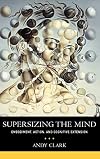
Clark builds on the (1998) extended mind thesis, incorporating additional evidence of the role of the body and external environment in cognitive processing. Clark stresses that this view doesn't discount traditional representation-based, internalist views of cognition, only widens the net to include the brain working in "soft assembled" partnership with the external world.
I struggled a bit with the later chapters which focus on addressing criticism of the extended mind approach and at times show more felt that there was some ?unproductive hair-splitting and language games going on, though by and large Clark is certainly systematic and seems to be very careful with his own choice of words.
The overall approach is that Clark is seeking a synthesis between "brainbound" views and radical embodied cognition, and I think he largely succeeds in finding the sweet spot. show less
I struggled a bit with the later chapters which focus on addressing criticism of the extended mind approach and at times show more felt that there was some ?unproductive hair-splitting and language games going on, though by and large Clark is certainly systematic and seems to be very careful with his own choice of words.
The overall approach is that Clark is seeking a synthesis between "brainbound" views and radical embodied cognition, and I think he largely succeeds in finding the sweet spot. show less
Lists
You May Also Like


Associated Authors
Statistics
- Works
- 18
- Also by
- 4
- Members
- 1,391
- Popularity
- #18,478
- Rating
- 3.8
- Reviews
- 8
- ISBNs
- 109
- Languages
- 5
- Favorited
- 2
