
Joe Clifford Faust
Author of Desperate Measures (Angel's Luck Series, Volume 1)
About the Author
Image credit: By Joe Clifford Faust - Joe Clifford Faust, CC BY-SA 3.0, https://commons.wikimedia.org/w/index.php?curid=20268944
Series
Works by Joe Clifford Faust
Associated Works
Tagged
Common Knowledge
- Birthdate
- 1957
- Gender
- male
- Occupations
- advertising copywriter
- Nationality
- USA
- Birthplace
- Williston, North Dakota, USA
- Places of residence
- Gillette, Wyoming, USA
Oklahoma, USA
Ohio, USA - Associated Place (for map)
- USA
Members
Reviews
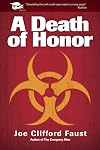
“As a private citizen who is a victim of a major crime as defined by the Carlton Act, you have the constitutional right to use your own personal facilities and talents to conduct an investigation into the circumstances surrounding said crime in the event that conventional law enforcement agencies cannot do so within a sixty-day period. In order to do so, you have the right to obtain from your employer a leave of absence not to exceed the draw time of said conventional law enforcement show more agency.
“ . . .
“During your investigation period you have rights, protections,and privileges similar to those given law enforcement officials. Any abuse of said coverage will result in immediate suspension of your rights under this amendment.
"At the end of said draw time, if your investigation is incomplete, you may turn your findings over to said conventional agencies for completion. You may also, in the event your investigation is completed before draw time, present your evidence in a court of law, which will then take appropriate action."
This novel’s future America is not doing well. After the Soviet Union invaded Europe and England, it became politically and economically isolated. Even Canada and Mexico have closed their borders to it. Blackouts are frequent, urban renovation slow, and emigration offices get bombed.
And, as our protagonist D A Payne finds out when he finds a dead woman he doesn’t know in his apartment, even police response to a dead body is slow. And homocide investigations? Backlogged for months.
But there is the Thirty-First Amendment to the Constitution which allows a private citizen the opportunity to investigate a crime.
At first, Payne doesn’t accept his “ticket” to be an investigator. He’s a busy man as a genetic engineer at Biotech Industries. But then a man breaks into Payne’s apartment while he’s with his new girlfriend Myra and almost kills them before being taken out by Payne. The man wanted the ticket, and, when his body later disappears, Payne takes the case.
While the government is so stretched it has privatized crime investigations, most of the government officials Payne deals with are willingly helpful. There’s Delgado, the police detective who responds to the homocide call, and Louis, the medical examiner. He’s overworked, and Payne feels sympathy for him. He once considered becoming an examiner himself. It’s Delgado that reveals the confidential information that a co-worker of Payne’s, an English ex-pat caught in America after the Soviet invasion of his homeland and who bought illegal transit tickets to Australia, is found robbed and with his head smashed in. And he’s not the first victim of a murderous emigration racket someone’s running.
The complications pile up throughout the novel for Payne, a methodical man who often answers questions with questions but who likes spontaneity. He finds Myra volatile and manipulative. He had hoped to help her, a disfigured, vulnerable woman his friend Bailey says is crazy.
Another emotional complication is news from his co-worker, superior, and one-time lover Trinina. Their son is visiting her, and that intitiates a crisis of emotion.
Because this future America society has a massive distortion at its heart: the clubs. These are no less than government sponsored sex clubs fueled with “house drugs” and liquor, sweaty dance floors, blaring music, and private chambers for coupling. All tastes are catered to: heterosexual, homosexual, sadism, bondage and discipline. You pay the cover charge, wear your color coded scarf to show your status and desires, and present an official government Bill of Health.
Pregnancy is the point. Payne himself is picking up a government stipend for each of the ten children he’s fathered.
Normal parental duties are not the point. Children are taken away to be raised by Government Child Rearing otherwise known as Mother America. Clubs exist, says Delgado, to pacify the poulation with sex and provide the government with workers and soldiers.
Payne did something rare. He stayed with Trinina when she was pregnant. Her despondcy at their son being taken by the government was why they broke up.
And things get a lot more complicated when Payne discovers what killed that woman and who she was. And Trinina has disappeared with their son. Now the enforcement arm of Government Child Rearing is after her and suspicion falls on Payne. And, unlike Delgado, the Feds doesn’t even pretend to honor the Constitution.
What follows is a well-done crime story, a plausible medical mystery, and, above all, a man finding out what he really cares about in the world. show less
“ . . .
“During your investigation period you have rights, protections,and privileges similar to those given law enforcement officials. Any abuse of said coverage will result in immediate suspension of your rights under this amendment.
"At the end of said draw time, if your investigation is incomplete, you may turn your findings over to said conventional agencies for completion. You may also, in the event your investigation is completed before draw time, present your evidence in a court of law, which will then take appropriate action."
This novel’s future America is not doing well. After the Soviet Union invaded Europe and England, it became politically and economically isolated. Even Canada and Mexico have closed their borders to it. Blackouts are frequent, urban renovation slow, and emigration offices get bombed.
And, as our protagonist D A Payne finds out when he finds a dead woman he doesn’t know in his apartment, even police response to a dead body is slow. And homocide investigations? Backlogged for months.
But there is the Thirty-First Amendment to the Constitution which allows a private citizen the opportunity to investigate a crime.
At first, Payne doesn’t accept his “ticket” to be an investigator. He’s a busy man as a genetic engineer at Biotech Industries. But then a man breaks into Payne’s apartment while he’s with his new girlfriend Myra and almost kills them before being taken out by Payne. The man wanted the ticket, and, when his body later disappears, Payne takes the case.
While the government is so stretched it has privatized crime investigations, most of the government officials Payne deals with are willingly helpful. There’s Delgado, the police detective who responds to the homocide call, and Louis, the medical examiner. He’s overworked, and Payne feels sympathy for him. He once considered becoming an examiner himself. It’s Delgado that reveals the confidential information that a co-worker of Payne’s, an English ex-pat caught in America after the Soviet invasion of his homeland and who bought illegal transit tickets to Australia, is found robbed and with his head smashed in. And he’s not the first victim of a murderous emigration racket someone’s running.
The complications pile up throughout the novel for Payne, a methodical man who often answers questions with questions but who likes spontaneity. He finds Myra volatile and manipulative. He had hoped to help her, a disfigured, vulnerable woman his friend Bailey says is crazy.
Another emotional complication is news from his co-worker, superior, and one-time lover Trinina. Their son is visiting her, and that intitiates a crisis of emotion.
Because this future America society has a massive distortion at its heart: the clubs. These are no less than government sponsored sex clubs fueled with “house drugs” and liquor, sweaty dance floors, blaring music, and private chambers for coupling. All tastes are catered to: heterosexual, homosexual, sadism, bondage and discipline. You pay the cover charge, wear your color coded scarf to show your status and desires, and present an official government Bill of Health.
Pregnancy is the point. Payne himself is picking up a government stipend for each of the ten children he’s fathered.
Normal parental duties are not the point. Children are taken away to be raised by Government Child Rearing otherwise known as Mother America. Clubs exist, says Delgado, to pacify the poulation with sex and provide the government with workers and soldiers.
Payne did something rare. He stayed with Trinina when she was pregnant. Her despondcy at their son being taken by the government was why they broke up.
And things get a lot more complicated when Payne discovers what killed that woman and who she was. And Trinina has disappeared with their son. Now the enforcement arm of Government Child Rearing is after her and suspicion falls on Payne. And, unlike Delgado, the Feds doesn’t even pretend to honor the Constitution.
What follows is a well-done crime story, a plausible medical mystery, and, above all, a man finding out what he really cares about in the world. show less

Nearly unreadable opening to the Angel's Luck trilogy. The book begins and is dominated by dialogue where the speakers go on and on, yet never listen, resulting in pages of frustrating passages where an important plot point is delayed until someone finally shuts up. This takes place in some far future, far from Earth, with spaceships plugged in for merchant trading ships, fast cars, and luxury liners, ad yakuza as villains. Details of how anything works, from the spaceships to business, is show more revealed only when the plot needs it, leading to an "anything can happen" destruction of all suspense. The opening suggests a comic adventure, but the characters are undeveloped, unsympathetic, and with no moral code. They end up being perfectly happy to engage in a major heist, with a major body count, including flooding an armored car with chlorine gas, with nary a trace of remorse anywhere.
Surprisingly, the next book is readable.
Strongly not recommended. show less
Surprisingly, the next book is readable.
Strongly not recommended. show less

The second book in the Angel's Luck trilogy is much better than the first. Though it follows directly from the first book, the first book is so bad that I recommend starting here. The critical plot points of recapped when needed. The parts not covered aren't worth the cost of reading the first book.
While still light adventure, there is some character development, an aspect completely missing before, and there are two acceptable female characters, given when the book appeared. There's an show more interesting and sympathetic alien culture developed. There's more action and less talk, with the stakes more clearly laid out. The main downside is that several of the main characters are whiny causes of their own problems.
Not essential reading but a readable adventure. show less
While still light adventure, there is some character development, an aspect completely missing before, and there are two acceptable female characters, given when the book appeared. There's an show more interesting and sympathetic alien culture developed. There's more action and less talk, with the stakes more clearly laid out. The main downside is that several of the main characters are whiny causes of their own problems.
Not essential reading but a readable adventure. show less

The final volume in the Angel's Luck trilogy is a step down from the second book but not as bad as the first one. There are several annoying points. First, like the first book, the action is dominated by a bullets-blazing raid. Yawn. Like the second book, much of the character arc is dominated by one character's internal battles with a xenophobic pilot personality. Unconvincing and repetitious. Finally, the third book adds a critical early plot point that depends on the characters as a group show more being idiots. Despite all that, there are enough smaller plot arcs to make this an acceptable though non-essential read.
Limited recommendation, for those who want to know how the second book plotlines wrap up. show less
Limited recommendation, for those who want to know how the second book plotlines wrap up. show less
Awards

You May Also Like


Associated Authors
Statistics
- Works
- 12
- Also by
- 3
- Members
- 643
- Popularity
- #39,229
- Rating
- 3.4
- Reviews
- 6
- ISBNs
- 20