
S. Andrew Swann
Author of The Dragons of the Cuyahoga
About the Author
Series
Works by S. Andrew Swann
A Time to Kill 2 copies
The Moreau Quartet 1 copy
The Long View 1 copy
The Heavens Fall 1 copy
Fealty 1 copy
The Historian's Apprentice 1 copy
Associated Works
Tagged
Common Knowledge
- Legal name
- Swiniarski, Steven
- Other names
- Swann, S. A.
Swiniarski, S. A.
Swann, S. Andrew - Birthdate
- 1966-09-01
- Gender
- male
- Nationality
- USA
- Birthplace
- Cleveland, Ohio, USA
- Places of residence
- Solon, Cleveland, Ohio, USA
- Associated Place (for map)
- Cleveland, Ohio, USA
Members
Reviews
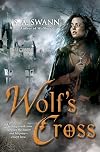
It’s 1353 in the dark woods of Eastern Europe, and things have changed since the events of Wolfbeed more than 114 years ago.
The Teutonic Knights have given up their use of werewolves as assassins and special soldiers. Indeed, this information is only available in manuscripts closely guarded by the Order. Now a special group of the knights, the Wolfjägers, hunt down the few remaining werwolves to kill them. The only clue to their mission is their wolfhead’s banners and silver edged show more weapons. Nor do the knights move with impunity across the land. The Kingdom of Poland and the buffer state of Masovia came into existence through a peace treaty with the Order ten years ago.
Brother Josef is a probationary member of the Order, and he doesn’t quite believe what he’s been told about the beasts they seek. But all that changes when, following the trail of the killers who stacked a church with the bodies of dead Christians, his group is ambushed by just a single werewolf. He is wounded, and many of his colleagues are killed.
The battered group goes into Moravia where they are given permission to rest and tend to their wounds – if they hand in their weapons. And the Duke of Masovia, away at the time, will have the ultimate say in the matter.
At the castle, Josef’s wounds will be tended to by a servant girl, Maria.
Maria is of the age where she is undergoing a sexual awakening. Indeed, we first meet her on the walk through the two miles of woods between her house and the castle as she sings a bawdy ballad. An affection for Josef begins to develop, and he begins to doubt his decision to take a vow of chastity to join the Order. He did so out of despair after the love of his life and his family died in the plague. Maria reminds him of that dead love.
But there are odd things about Maria. Her father is absolutely firm that she must wear a silver cross about her neck all the time. When he finds out about the death of the Teutonic Knights, he accusses her of taking it off.
Maria is attractive enough to receive some unwanted attention from a local aristocrat. And when he tries to rape her in the woods one night, she fends him off with incredible strength. But it’s not Maria who ends the struggle, but a man who suddenly emerges from the woods and beats the aristocrat senseless. He only introduces himself as Darien and asks for her silence about his presence.
And thus our love triangle is formed: Maria the innocent peasant girl, Josef the Teutonic Knight, and Darien the werewolf.
Darien is the one who killed the knights at the beginning, and he’s been conducting a 20 year vendetta against them after his community of werewolves, living in secret in the woods, was wiped out by the Knights with him as the only survivor.
And he knows right away Maria is a werewolf, the mate he has sought all these years.
Josef is a kind man who is the first to pay attention to Maria. But Darien initiates her into shapeshifting and sex. Darien wants her to join him, but she’s not sure she wants to leave her family and Josef.
But Josef begins to notice odd things about Maria. Why is her cross made of silver? Why do her wounds heal so fast? It all reminds him of the beasts the Wolfjägers seek. But Maria seems far from the soulless beasts he was told werewolves were.
Meanwhile, the locals have learned the Order’s secret past with the werewolves, and the leader of the Knights still wants to kill the werewolf he knows is out there.
And Darien isn’t going to leave until he’s done with the Order.
Even though the love triangle can be one of the most tedious of plot cliches, this is a suspenseful and pleasing story with characters easy to empathize with, even the implacable enemies of Darin and the leader of the Teutonic Knights. Like it’s predecessor, I found this a surprisingly enthralling read.
Torn limbs and tender feelings await the reader. show less
The Teutonic Knights have given up their use of werewolves as assassins and special soldiers. Indeed, this information is only available in manuscripts closely guarded by the Order. Now a special group of the knights, the Wolfjägers, hunt down the few remaining werwolves to kill them. The only clue to their mission is their wolfhead’s banners and silver edged show more weapons. Nor do the knights move with impunity across the land. The Kingdom of Poland and the buffer state of Masovia came into existence through a peace treaty with the Order ten years ago.
Brother Josef is a probationary member of the Order, and he doesn’t quite believe what he’s been told about the beasts they seek. But all that changes when, following the trail of the killers who stacked a church with the bodies of dead Christians, his group is ambushed by just a single werewolf. He is wounded, and many of his colleagues are killed.
The battered group goes into Moravia where they are given permission to rest and tend to their wounds – if they hand in their weapons. And the Duke of Masovia, away at the time, will have the ultimate say in the matter.
At the castle, Josef’s wounds will be tended to by a servant girl, Maria.
Maria is of the age where she is undergoing a sexual awakening. Indeed, we first meet her on the walk through the two miles of woods between her house and the castle as she sings a bawdy ballad. An affection for Josef begins to develop, and he begins to doubt his decision to take a vow of chastity to join the Order. He did so out of despair after the love of his life and his family died in the plague. Maria reminds him of that dead love.
But there are odd things about Maria. Her father is absolutely firm that she must wear a silver cross about her neck all the time. When he finds out about the death of the Teutonic Knights, he accusses her of taking it off.
Maria is attractive enough to receive some unwanted attention from a local aristocrat. And when he tries to rape her in the woods one night, she fends him off with incredible strength. But it’s not Maria who ends the struggle, but a man who suddenly emerges from the woods and beats the aristocrat senseless. He only introduces himself as Darien and asks for her silence about his presence.
And thus our love triangle is formed: Maria the innocent peasant girl, Josef the Teutonic Knight, and Darien the werewolf.
Darien is the one who killed the knights at the beginning, and he’s been conducting a 20 year vendetta against them after his community of werewolves, living in secret in the woods, was wiped out by the Knights with him as the only survivor.
And he knows right away Maria is a werewolf, the mate he has sought all these years.
Josef is a kind man who is the first to pay attention to Maria. But Darien initiates her into shapeshifting and sex. Darien wants her to join him, but she’s not sure she wants to leave her family and Josef.
But Josef begins to notice odd things about Maria. Why is her cross made of silver? Why do her wounds heal so fast? It all reminds him of the beasts the Wolfjägers seek. But Maria seems far from the soulless beasts he was told werewolves were.
Meanwhile, the locals have learned the Order’s secret past with the werewolves, and the leader of the Knights still wants to kill the werewolf he knows is out there.
And Darien isn’t going to leave until he’s done with the Order.
Even though the love triangle can be one of the most tedious of plot cliches, this is a suspenseful and pleasing story with characters easy to empathize with, even the implacable enemies of Darin and the leader of the Teutonic Knights. Like it’s predecessor, I found this a surprisingly enthralling read.
Torn limbs and tender feelings await the reader. show less
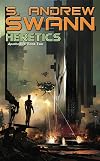
I like action. I like suspense. I like drama. And increasingly, I like S. Andrew Swann. He knows how to write all of these into his plot, and he does it deftly, smoothly, and never lets the writing get in the way of the story.
Heretics is the second book of Swann’s Apotheosis trilogy (apotheosis means “the exultation of a subject to divine level”). While facing the risk of succumbing to “middle book syndrome,” Swann manages to keep the action on the edge, heighten the danger, and show more pull out an ending that, while appropriately leaving the situation more grave than at the beginning and tee-ing off the starting point for book three (the appropriately named Messiah), still follows a story arc that makes the read a satisfactory experience.
Nevertheless, Heretics still is a middle book, and at the end, its main function is to move the plot to the dénouement, and it just barely stays away from middle book syndrome. We are introduced to a few new characters, learn more about our antagonist Adam, and watch the known universe crumble before his claim as the one true god. Adam, the nanobot entity possessed of a more than slightly insane artificial intelligence, has assumed divine status. He begins each planetary invasion with a perfunctory demand of its inhabitants that they worship him by joining in his restructuring of the universe on a molecular level. “Live forever,” he promises, “or be destroyed.” Using technological powers that mankind universally considers “heretical,” he swoops through the universe remaking worlds in his own image, an image that is composed of entirely nanobots and networked artificial intelligence. It is Terminator, Battlestar Galactica, and Michael Crichton’s Prey all in one, and on a scale spanning many galaxies. It is horrifying, a destruction by our own creation, and Swann pulls no punches.
Adam never develops far beyond the villain and with good reason. He’s just the bad guy, and we readily accept that he is arrogant, evil, and non-human. The people we care about—our heroes—are who we begin to see grow and develop in the furnace of their fight for survival. In Heretics, Swann shows his characters begin to step out of themselves, grow, and connect with each other. That said, it is important to note, that Swann writes with more focus on action and plot than on internal character development. Even as the characters grow, brood, agonize, and struggle, the struggle is more against the larger than life threat to humanity, the caricatured Adam, not the inner man’s transcendence of himself. Rather, their transcendence emerges as self sacrifice for the greater good of human survival, not unlike Joseph Cambell’s “Hero of a Thousand Faces.” We don’t get too close to them—just close enough to care, to see what we expect of a hero, and then it’s back to the action. And you know what? It works great. It’s space opera, and it’s exactly what I expected when I picked up the novel.
With a villain everyone can hate and fear, heroes that everyone can empathize with, and a dire situation that pits both heroes and villains in a “Hail Mary” fight to the death, I enjoyed flipping the pages of Swann’s novel. I finished the last page of Heretics, set it down, and immediately picked up Messiah (book three, which came out just this year) and started reading. I had no desire to put off the conclusion to the Apotheosis, and I look forward to seeing the finish of the story.
A cautionary comment on content: One scene in the book bothered me. At one point, the mutant tiger begins a relationship with one of the humans (also mutated, but not quite like him) characters. While there is only brief description, there is foreplay and reference to a sexual relationship. This is science-fiction, and perhaps interspecies romance has a place there, but it was the sexual description that was a bridge too far for me. I just didn’t buy the interspecies love affair thing. Fortunately, the scene is brief, short, and not reoccurring. show less
Heretics is the second book of Swann’s Apotheosis trilogy (apotheosis means “the exultation of a subject to divine level”). While facing the risk of succumbing to “middle book syndrome,” Swann manages to keep the action on the edge, heighten the danger, and show more pull out an ending that, while appropriately leaving the situation more grave than at the beginning and tee-ing off the starting point for book three (the appropriately named Messiah), still follows a story arc that makes the read a satisfactory experience.
Nevertheless, Heretics still is a middle book, and at the end, its main function is to move the plot to the dénouement, and it just barely stays away from middle book syndrome. We are introduced to a few new characters, learn more about our antagonist Adam, and watch the known universe crumble before his claim as the one true god. Adam, the nanobot entity possessed of a more than slightly insane artificial intelligence, has assumed divine status. He begins each planetary invasion with a perfunctory demand of its inhabitants that they worship him by joining in his restructuring of the universe on a molecular level. “Live forever,” he promises, “or be destroyed.” Using technological powers that mankind universally considers “heretical,” he swoops through the universe remaking worlds in his own image, an image that is composed of entirely nanobots and networked artificial intelligence. It is Terminator, Battlestar Galactica, and Michael Crichton’s Prey all in one, and on a scale spanning many galaxies. It is horrifying, a destruction by our own creation, and Swann pulls no punches.
Adam never develops far beyond the villain and with good reason. He’s just the bad guy, and we readily accept that he is arrogant, evil, and non-human. The people we care about—our heroes—are who we begin to see grow and develop in the furnace of their fight for survival. In Heretics, Swann shows his characters begin to step out of themselves, grow, and connect with each other. That said, it is important to note, that Swann writes with more focus on action and plot than on internal character development. Even as the characters grow, brood, agonize, and struggle, the struggle is more against the larger than life threat to humanity, the caricatured Adam, not the inner man’s transcendence of himself. Rather, their transcendence emerges as self sacrifice for the greater good of human survival, not unlike Joseph Cambell’s “Hero of a Thousand Faces.” We don’t get too close to them—just close enough to care, to see what we expect of a hero, and then it’s back to the action. And you know what? It works great. It’s space opera, and it’s exactly what I expected when I picked up the novel.
With a villain everyone can hate and fear, heroes that everyone can empathize with, and a dire situation that pits both heroes and villains in a “Hail Mary” fight to the death, I enjoyed flipping the pages of Swann’s novel. I finished the last page of Heretics, set it down, and immediately picked up Messiah (book three, which came out just this year) and started reading. I had no desire to put off the conclusion to the Apotheosis, and I look forward to seeing the finish of the story.
A cautionary comment on content: One scene in the book bothered me. At one point, the mutant tiger begins a relationship with one of the humans (also mutated, but not quite like him) characters. While there is only brief description, there is foreplay and reference to a sexual relationship. This is science-fiction, and perhaps interspecies romance has a place there, but it was the sexual description that was a bridge too far for me. I just didn’t buy the interspecies love affair thing. Fortunately, the scene is brief, short, and not reoccurring. show less

Well, I finally finished Swann’s Terran Confederation series and its last installment, the Apotheosis trilogy. It was almost as good as I hoped with a bit of a wobble in the final part, titled “Deus Ex Machina”, and all that implies.
We start on Earth with Rebecca Tsoravitch delivering would-be messiah and all-around insane AI Adam’s ultimatum to Vatican City: join him, lose your individuality and body, and live forever. Naturally, most don’t accept.
But one man does. His name is show more Jonah Dacham, the pivotal figure in Swann’s Hostile Takeover series. But, by this point, he’s no longer a man but merely an ambassador of the Proteus Commune. Like Adam, they command fearsome nanotechnology. Unlike Adam, they will only let volunteers join. The Vatican accepts the alliance Proteus proposes: renounce their stance that the Proteus Commune is a heretical technology and Proteus will aid in the fight against Adam.
A massive battle of nanotech forces ensues in Earth’s solar system. Adam is shaken out of his illusions of omniscience.
But the real battle will take place on, above, and below Bakunin, the anarchic planet at the center of the Hostile Takeover series. There Father Mallory, an ex-military man before he became a priest and Vatican secret agent, and the Tonis from Heretics, using an orbital resort above Bakunin, cobble together an alliance of ships that have fled Adam’s onslaught elsewhere.
Mallory is aided by Rebecca. She’s a survivor who once lived under a police state, so she’s not about to rebel openly against Adam. But she has a fragment of Mosasa’s mind. He’s sort of Adam’s one-time brother whom we thought he destroyed in Heretics. However, he’s managed to distribute bits of his mind throughout Adam’s nanocloud. Rebecca also has access to Proteus by having absorbed Jonah’s mind. (In keeping with the religious themes of the trilogy, she uses a rather Trinity-like metaphor of three vintages poured into one wine bottle.)
But Adam has his agents too which include the executives of the Prodhoun Spaceport Development Corporation. In a repeat of the events almost 200 hundred years in the past, they’ve decided to take over Bakunin given they have more military resources on the planet than anyone else.
And then there’s Stefan Stavros. His and his father’s ship was pirated by the Tonis when they escaped Styx as Adam’s forces arrived in the previous book. But he’s not at all onboard, unlike his father, with aiding Mallory’s cause.
But treachery doesn’t go in just one direction. Another Prodhoun executive, the extremely clever and ruthless Alexi Lubikov, decides maybe Adam is not looking as invincible as he did. Maybe it’s time to change sides.
The Proteus Commune doesn’t really think Adam can be beaten at Bakunin. Their battle with Adam in Earth’s solar system was just a delaying action. They plan on seeding copies of their Commune on other worlds, and, when Adam shows up, launch sort of a high-tech, nanotechnology guerilla action against him then. But maybe there’s a chance. Maybe the caves below Bakunin hold some kind of weapon left by the Dolbrians, the alien race whose disappearance, after leaving several ruins and terraformed planets behind, has been a subject of speculation over several books.
So moreau Nickolai, his frank girlfriend Kugara, and other survivors of Mosasa’s ill-fated expedition to Xi Virginis are sent down to Bakunin.
Swann ends his series strongly with plenty of action – and plenty of philosophizing about religion and morality.
Swann’s Terran Confederation is one of the best science fiction series I’ve read, and I recommend it strongly. show less
We start on Earth with Rebecca Tsoravitch delivering would-be messiah and all-around insane AI Adam’s ultimatum to Vatican City: join him, lose your individuality and body, and live forever. Naturally, most don’t accept.
But one man does. His name is show more Jonah Dacham, the pivotal figure in Swann’s Hostile Takeover series. But, by this point, he’s no longer a man but merely an ambassador of the Proteus Commune. Like Adam, they command fearsome nanotechnology. Unlike Adam, they will only let volunteers join. The Vatican accepts the alliance Proteus proposes: renounce their stance that the Proteus Commune is a heretical technology and Proteus will aid in the fight against Adam.
A massive battle of nanotech forces ensues in Earth’s solar system. Adam is shaken out of his illusions of omniscience.
But the real battle will take place on, above, and below Bakunin, the anarchic planet at the center of the Hostile Takeover series. There Father Mallory, an ex-military man before he became a priest and Vatican secret agent, and the Tonis from Heretics, using an orbital resort above Bakunin, cobble together an alliance of ships that have fled Adam’s onslaught elsewhere.
Mallory is aided by Rebecca. She’s a survivor who once lived under a police state, so she’s not about to rebel openly against Adam. But she has a fragment of Mosasa’s mind. He’s sort of Adam’s one-time brother whom we thought he destroyed in Heretics. However, he’s managed to distribute bits of his mind throughout Adam’s nanocloud. Rebecca also has access to Proteus by having absorbed Jonah’s mind. (In keeping with the religious themes of the trilogy, she uses a rather Trinity-like metaphor of three vintages poured into one wine bottle.)
But Adam has his agents too which include the executives of the Prodhoun Spaceport Development Corporation. In a repeat of the events almost 200 hundred years in the past, they’ve decided to take over Bakunin given they have more military resources on the planet than anyone else.
And then there’s Stefan Stavros. His and his father’s ship was pirated by the Tonis when they escaped Styx as Adam’s forces arrived in the previous book. But he’s not at all onboard, unlike his father, with aiding Mallory’s cause.
But treachery doesn’t go in just one direction. Another Prodhoun executive, the extremely clever and ruthless Alexi Lubikov, decides maybe Adam is not looking as invincible as he did. Maybe it’s time to change sides.
The Proteus Commune doesn’t really think Adam can be beaten at Bakunin. Their battle with Adam in Earth’s solar system was just a delaying action. They plan on seeding copies of their Commune on other worlds, and, when Adam shows up, launch sort of a high-tech, nanotechnology guerilla action against him then. But maybe there’s a chance. Maybe the caves below Bakunin hold some kind of weapon left by the Dolbrians, the alien race whose disappearance, after leaving several ruins and terraformed planets behind, has been a subject of speculation over several books.
So moreau Nickolai, his frank girlfriend Kugara, and other survivors of Mosasa’s ill-fated expedition to Xi Virginis are sent down to Bakunin.
Swann ends his series strongly with plenty of action – and plenty of philosophizing about religion and morality.
Swann’s Terran Confederation is one of the best science fiction series I’ve read, and I recommend it strongly. show less
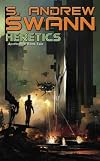
It’s 2526, and there’s a religious war raging across the worlds of human space. It’s messiah is Adam. Initially, he announces his presence with a quote from the Book of Revelations and by sounding like Lucifer in the Garden of Eden:
"I am Adam. I am the Alpha, the first in the new epoch of your evolution. I will hand you the universe. Follow me and you will become as gods."
But Adam is no man despite the form he cloaks himself in. He is an insane alien AI, the last of the machines built show more by the alien Race to manipulate human affairs. But his builders destroyed themselves after humanity confined to them to their home planet in the Genocide War. Seeing the ruins of the Race, Adam became obsessed with eliminating “stasis, entropy, and death”. Armed with powerful nanotechnology, he took apart a sun and the colony world of Xi Virgis orbiting it.
That act was a deliberate provocation, the inititiation of Adam’s elaborate plan of sabotage, suborned agents in various governments, using an ancient wormhole network to launch surprise attacks with his nanotech cloud, and setting the worlds of the Caliphate and Roman Catholic Church against each other. But, first up, he kills Mosasa, the other remaining AI of the race and leader of an expedition to investigate the mystery of Xi Virgis disappearing that was the center of the preceding novel in the trilogy, Prophets.
Above the nearest human settlement to Xi Virgis, Salmagundi, Adam makes his announcement. Join him or become dust. And then the black rain falls, altering and absorbing people and buildings. Those who accept Adam’s offer have their bodies, souls, minds, and personalities, absorbed into his cloud.
But there are other competing religious visions to Adam’s and not just the Caliphate and Catholic Church. There is the faith of the St. Rajasthan of the Fifteen Worlds settled by moreaus (animals altered to become intelligent warriors) and franks (genetically altered humans), both products of 21st science. It holds humanity is Fallen, damned by God for its presumptions, at one time, of creating the heretical technologies of nanotech, genetic engineering, and artificial intelligence. There is the Proteus Commune, the benign equivalent of Adam, which offers its own version of immortality to absorbed minds – but only those who volunteer. And there is the curious Hall of Minds native to Salmagundi. It records the personalities and memories of the Salmagundians and uploads them into future colony members.
On Salmagundi, a Protean egg, one of many copies of its archive of minds, lands, its records damaged by an attack by Adam. Knowing humanity’s hatred of nanotechnology, a member of the governing Grand Triad, Alexander Shane, fears the Protean presence will bring unwanted attention from other human worlds. Besides muted personalities, the effect of Salmagundians having so memories and personalities in their head is a certain indecisiveness. Shane takes over the government in a coup perhaps inspired by the mutinous marine Kathy Shane, one of the founders of the colony almost 200 hundred years ago and a major character in Swann’s Hostile Takeover trilogy. He has access to her memories. When the survivors of Mosasa’s expedition, their ship shot up by the advanced Caliphate fleet Adam lured to Xi Virgis, fall into his hands, he “mind rapes” them, a coercive uploading of their memories and personalities.
Also landing in lifeboats on Salmagundi are Kurata and Nickolai, mercs hired by Mosasa, a frank and moreau respectively. Nickolai, suborned by an agent of Mosasa, has disgraced himself by sabotaging Moasa’s ship, and he’ll find that Adam has implanted dangerous compulsions in him.
And then there’s Parvi, a Hindu and leader of Mosasa’s mercs who finds herself throwing in with Moslems who won’t accept Adam’s offer and who want to make a desperate attempt to get to Salmagundi.
But not every member of Mosasa’s crew rejects Adam. Data analyst Rebecca Tsoravitch accepts and her trained mind begins to see Adam’s limitations. She and Nickolai are types that often show up in Swann’s fiction: those who come to reject the morality of an institution they’ve aligned themselves with.
In orbit around the planet Styx, Lieutenant Toni Valentine is startled when her “ghost”, a duplicate produced by going through a wormhole in the wrong direction, shows up to warn her of Adam’s future onslaught against the planet.
And at the heart of the Caliphate and in Earth’s system, Adam arrives to deliver his ultimatum.
Besides Mosasa, the manipulator behind the events of the Hostile Takeover books, we have other characters from them showing up in very altered form.
Adam has his vulnerabilities but are they enough? The damaged Proteus archive on Salmagundi suggests the answer lies with some alien ruins on the planet at the heart of so much in Swann’s Terran Confederation series: the anarchy of Bakunin.
Swann’s space opera is superb and has got everything: superscience, sabotage, espionage, piracy, firefights, space battles, planetary destruction, a story where the impulses of religion still very much shape human society, and that ponders questions of identity, the “soul” if you will.
There’s a lot of moving parts in this trilogy, and Swann’s narrative gears mesh cleanly to deliver a fast and powerful narrative. show less
"I am Adam. I am the Alpha, the first in the new epoch of your evolution. I will hand you the universe. Follow me and you will become as gods."
But Adam is no man despite the form he cloaks himself in. He is an insane alien AI, the last of the machines built show more by the alien Race to manipulate human affairs. But his builders destroyed themselves after humanity confined to them to their home planet in the Genocide War. Seeing the ruins of the Race, Adam became obsessed with eliminating “stasis, entropy, and death”. Armed with powerful nanotechnology, he took apart a sun and the colony world of Xi Virgis orbiting it.
That act was a deliberate provocation, the inititiation of Adam’s elaborate plan of sabotage, suborned agents in various governments, using an ancient wormhole network to launch surprise attacks with his nanotech cloud, and setting the worlds of the Caliphate and Roman Catholic Church against each other. But, first up, he kills Mosasa, the other remaining AI of the race and leader of an expedition to investigate the mystery of Xi Virgis disappearing that was the center of the preceding novel in the trilogy, Prophets.
Above the nearest human settlement to Xi Virgis, Salmagundi, Adam makes his announcement. Join him or become dust. And then the black rain falls, altering and absorbing people and buildings. Those who accept Adam’s offer have their bodies, souls, minds, and personalities, absorbed into his cloud.
But there are other competing religious visions to Adam’s and not just the Caliphate and Catholic Church. There is the faith of the St. Rajasthan of the Fifteen Worlds settled by moreaus (animals altered to become intelligent warriors) and franks (genetically altered humans), both products of 21st science. It holds humanity is Fallen, damned by God for its presumptions, at one time, of creating the heretical technologies of nanotech, genetic engineering, and artificial intelligence. There is the Proteus Commune, the benign equivalent of Adam, which offers its own version of immortality to absorbed minds – but only those who volunteer. And there is the curious Hall of Minds native to Salmagundi. It records the personalities and memories of the Salmagundians and uploads them into future colony members.
On Salmagundi, a Protean egg, one of many copies of its archive of minds, lands, its records damaged by an attack by Adam. Knowing humanity’s hatred of nanotechnology, a member of the governing Grand Triad, Alexander Shane, fears the Protean presence will bring unwanted attention from other human worlds. Besides muted personalities, the effect of Salmagundians having so memories and personalities in their head is a certain indecisiveness. Shane takes over the government in a coup perhaps inspired by the mutinous marine Kathy Shane, one of the founders of the colony almost 200 hundred years ago and a major character in Swann’s Hostile Takeover trilogy. He has access to her memories. When the survivors of Mosasa’s expedition, their ship shot up by the advanced Caliphate fleet Adam lured to Xi Virgis, fall into his hands, he “mind rapes” them, a coercive uploading of their memories and personalities.
Also landing in lifeboats on Salmagundi are Kurata and Nickolai, mercs hired by Mosasa, a frank and moreau respectively. Nickolai, suborned by an agent of Mosasa, has disgraced himself by sabotaging Moasa’s ship, and he’ll find that Adam has implanted dangerous compulsions in him.
And then there’s Parvi, a Hindu and leader of Mosasa’s mercs who finds herself throwing in with Moslems who won’t accept Adam’s offer and who want to make a desperate attempt to get to Salmagundi.
But not every member of Mosasa’s crew rejects Adam. Data analyst Rebecca Tsoravitch accepts and her trained mind begins to see Adam’s limitations. She and Nickolai are types that often show up in Swann’s fiction: those who come to reject the morality of an institution they’ve aligned themselves with.
In orbit around the planet Styx, Lieutenant Toni Valentine is startled when her “ghost”, a duplicate produced by going through a wormhole in the wrong direction, shows up to warn her of Adam’s future onslaught against the planet.
And at the heart of the Caliphate and in Earth’s system, Adam arrives to deliver his ultimatum.
Besides Mosasa, the manipulator behind the events of the Hostile Takeover books, we have other characters from them showing up in very altered form.
Adam has his vulnerabilities but are they enough? The damaged Proteus archive on Salmagundi suggests the answer lies with some alien ruins on the planet at the heart of so much in Swann’s Terran Confederation series: the anarchy of Bakunin.
Swann’s space opera is superb and has got everything: superscience, sabotage, espionage, piracy, firefights, space battles, planetary destruction, a story where the impulses of religion still very much shape human society, and that ponders questions of identity, the “soul” if you will.
There’s a lot of moving parts in this trilogy, and Swann’s narrative gears mesh cleanly to deliver a fast and powerful narrative. show less
Lists
Awards


You May Also Like


Associated Authors
Statistics
- Works
- 36
- Also by
- 6
- Members
- 2,463
- Popularity
- #10,404
- Rating
- 3.6
- Reviews
- 57
- ISBNs
- 74
- Languages
- 3
- Favorited
- 4