
Anthony John Patrick Kenny
Author of A New History of Western Philosophy
About the Author
Image credit: Anthony Kenny Photograph © Russell Sach By Photograph © Russell Sach - mind, method, and morality, Edited by John Cottingham, Oxford pub. 2010, CC BY-SA 4.0, https://commons.wikimedia.org/w/index.php?curid=82152516
Works by Anthony John Patrick Kenny
The Cambridge History of Later Medieval Philosophy: From the Rediscovery of Aristotle to the Disintegration of Scholasticism, 1100-1600 (1982) — Editor; Editor — 115 copies
The five ways: Saint Thomas Aquinas' proofs of God's existence (Studies in ethics and the philosophy of religion) (1969) 54 copies
The Aristotelian Ethics: A Study of the Relationship between the Eudemian and Nicomachean Ethics of Aristotle (1978) — Author — 26 copies
Life, Liberty, and the Pursuit of Utility: Happiness in Philosophical and Economic Thought (St. Andrews Studies in Philo (2006) — Editor — 14 copies
The computation of style : an introduction to statistics for students of literature and humanities (1982) 9 copies
Rationalism, empiricism, and idealism : British Academy lectures on the history of philosophy (1986) 8 copies
The Eudemian Ethics 1 copy
Anthony Kenny 1 copy
تامس مور 1 copy
Associated Works
The Great Philosophers: An Introduction to Western Philosophy (1987) — Contributor — 476 copies, 2 reviews
Modern thinkers and ancient thinkers : the Stanley Victor Keeling Memorial Lectures at University College, London (1993) — Contributor — 2 copies
Biographical studies, 1534-1829, vol. 1, no. 4, part 1, July 1952. Additions and corrections (1952) — Contributor — 1 copy
Tagged
Common Knowledge
- Birthdate
- 1931-03-16
- Gender
- male
- Nationality
- England
- Map Location
- England
Members
Discussions
Anthony Kenny: An Illustrated Brief History of Western Philosophy in Book talk (June 2020)
Reviews
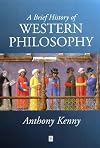
This is essentially Sophie's World for grown-ups, a useful compact (well, fairly compact - 400 pages) outline of the development of philosophy as a discipline from the Greeks to Wittgenstein with enough history to let us understand the context in which the main figures were working, and at least a critical outline of their most important work. Some of the most important get a reasonably detailed discussion - Plato, Aristotle, Aquinas, Descartes, Kant, Bentham/Mill and Wittgenstein all get show more chapters to themselves, lesser figures have to squash in with their neighbours.
It's a fairly anglocentric book - from the middle ages on, Kenny generally alternates chapters on "British" and "foreign" philosophers, and a neutral observer might also suspect that there's a certain Oxford bias involved - until we get to Russell and Wittgenstein there's absolutely no mention of any universities that might have existed in the East of England, and even Hume and Berkeley seem to suffer a bit from their status as remote provincials. Kenny's background seems to creep in in other ways as well - there's a lot more about Augustine and Aquinas than about any Reformation figure. Kenny clearly doesn't approve of the Reformation - he sees the hardening of doctrinal attitudes on both sides as a step backwards from the "patient subtlety which characterised the best scholastics". Erasmus and Grotius are only mentioned in passing, and even Thomas More gets more space than Luther and Calvin.
However, that little bit of personal bias is also one of the real strengths of the book - this isn't merely a neutral account of the subject designed to cram you with information, but it's a critical discussion in which the author doesn't hesitate to point out the strengths and weaknesses of his distinguished predecessors' arguments. As philosophers do, he's trying to provoke the reader into doing some actual thinking. I'm not sure how well that worked for me - there were several points where I found myself promising that I would come back and have another go at that chapter later, especially when it came to Kant.
The stress seems to be on the core subject areas of metaphysics and philosophical logic - other areas like ethics and political philosophy are there, but are covered in rather less detail. Obviously something has to give if you want to make a book that is both accessible and of a manageable size.
But I did come out of the struggle with a few pointers about where I'd like to go next in exploring philosophy, and with a clearer idea of what "philosophy" is and how it's evolved over the last two-and-a-half millennia. So a success, I think! show less
It's a fairly anglocentric book - from the middle ages on, Kenny generally alternates chapters on "British" and "foreign" philosophers, and a neutral observer might also suspect that there's a certain Oxford bias involved - until we get to Russell and Wittgenstein there's absolutely no mention of any universities that might have existed in the East of England, and even Hume and Berkeley seem to suffer a bit from their status as remote provincials. Kenny's background seems to creep in in other ways as well - there's a lot more about Augustine and Aquinas than about any Reformation figure. Kenny clearly doesn't approve of the Reformation - he sees the hardening of doctrinal attitudes on both sides as a step backwards from the "patient subtlety which characterised the best scholastics". Erasmus and Grotius are only mentioned in passing, and even Thomas More gets more space than Luther and Calvin.
However, that little bit of personal bias is also one of the real strengths of the book - this isn't merely a neutral account of the subject designed to cram you with information, but it's a critical discussion in which the author doesn't hesitate to point out the strengths and weaknesses of his distinguished predecessors' arguments. As philosophers do, he's trying to provoke the reader into doing some actual thinking. I'm not sure how well that worked for me - there were several points where I found myself promising that I would come back and have another go at that chapter later, especially when it came to Kant.
The stress seems to be on the core subject areas of metaphysics and philosophical logic - other areas like ethics and political philosophy are there, but are covered in rather less detail. Obviously something has to give if you want to make a book that is both accessible and of a manageable size.
But I did come out of the struggle with a few pointers about where I'd like to go next in exploring philosophy, and with a clearer idea of what "philosophy" is and how it's evolved over the last two-and-a-half millennia. So a success, I think! show less
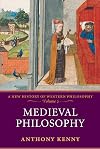
Now I know why I don't read too many books on philosophy: they can be so damn difficult to understand.
I read this as part of my continuing interest in late medieval literature. Another avenue to explore in my search to discover how educated people of the 14th century viewed their world. Anthony Kenny has organised his material by subject matter and so there are chapters on; Philosophy and Faith, The Schoolmen, Logic and language, Knowledge, Physics, Metaphysics, Mind and Soul, Ethics and show more God. In each chapter he uses Augustine as his starting point and moves chronologically through the development of thoughts taking in those of; the Islamic school, Thomas Aquinus, Duns Scottus and Ockham. He will also stop to pick up on the way, where appropriate ideas from; Boethius, Wycliff, Abelard, Bonaventure and Anselm. I found this approach very useful in assisting my understanding of each subject and the chronological development of the arguments through the various philosophers meant that by the time I arrived at the final chapter I had a pretty good idea of what they would say on the subject of God.
Some of the chapters tested my grasp of the subject matter to the limit. At times I felt I was in very deep water struggling to find a foothold. This was no doubt because of my unfamiliarity with some of the technical language and terms used. After all this is a book subtitled the History of Western Philosophy and so the reader should not be surprised by some of the content. Kenny does his best to explain many of the terms used and provides plenty of examples. There was enough here to hold my interest and keep me going through some of the more demanding chapters. It is a book I will come back to. It is a splendid reference tool. It is nicely presented with some very good illustrations.
One LT reviewer has said "I finally finished this book! I'm ready for the agent intellect to beam me up" I know what he/she means, its not a book to be read quickly, it does require patience and perseverance, but if the subject interests you, it is well worth the time and effort. I can understand why some readers rate this a 5 star book. show less
I read this as part of my continuing interest in late medieval literature. Another avenue to explore in my search to discover how educated people of the 14th century viewed their world. Anthony Kenny has organised his material by subject matter and so there are chapters on; Philosophy and Faith, The Schoolmen, Logic and language, Knowledge, Physics, Metaphysics, Mind and Soul, Ethics and show more God. In each chapter he uses Augustine as his starting point and moves chronologically through the development of thoughts taking in those of; the Islamic school, Thomas Aquinus, Duns Scottus and Ockham. He will also stop to pick up on the way, where appropriate ideas from; Boethius, Wycliff, Abelard, Bonaventure and Anselm. I found this approach very useful in assisting my understanding of each subject and the chronological development of the arguments through the various philosophers meant that by the time I arrived at the final chapter I had a pretty good idea of what they would say on the subject of God.
Some of the chapters tested my grasp of the subject matter to the limit. At times I felt I was in very deep water struggling to find a foothold. This was no doubt because of my unfamiliarity with some of the technical language and terms used. After all this is a book subtitled the History of Western Philosophy and so the reader should not be surprised by some of the content. Kenny does his best to explain many of the terms used and provides plenty of examples. There was enough here to hold my interest and keep me going through some of the more demanding chapters. It is a book I will come back to. It is a splendid reference tool. It is nicely presented with some very good illustrations.
One LT reviewer has said "I finally finished this book! I'm ready for the agent intellect to beam me up" I know what he/she means, its not a book to be read quickly, it does require patience and perseverance, but if the subject interests you, it is well worth the time and effort. I can understand why some readers rate this a 5 star book. show less

This work is something of a seminal piece in the understanding of the philosophy of human action. It starts with Descartes (or to some extent with Aristotle) and looks at how following philosophers have approached issues such as motive, emotion, will and such like.
The book critiques the ideas it surveys and builds a new theory of human action.
My one disappointment was that it did not fulfill its promise to look at the emerging findings of psychology in formulating the new theory. Perhaps in show more places it did so, but I think psychology has added a great deal of flesh on those bones - although much of that was long after this book was first published in 1963, so it would be wrong to be overly critical on this point.
A very interesting review of the subject. show less
The book critiques the ideas it surveys and builds a new theory of human action.
My one disappointment was that it did not fulfill its promise to look at the emerging findings of psychology in formulating the new theory. Perhaps in show more places it did so, but I think psychology has added a great deal of flesh on those bones - although much of that was long after this book was first published in 1963, so it would be wrong to be overly critical on this point.
A very interesting review of the subject. show less
Many think that the medieval times were really evil. It might be so in few areas of life but in the realm of thoughts it was not at all so stagnating and hair splitting as we think. Professor Kenny gives a strong proof for other kind of medieval times – the time of checking and rechecking of assessing and reassessing of philosophical ideas. All this is told in a calm, intelligent and benevolent voice of Professor Kenny. A must book for all lovers of the history of philosophy
Lists
You May Also Like


Associated Authors
Statistics
- Works
- 74
- Also by
- 15
- Members
- 4,413
- Popularity
- #5,673
- Rating
- 3.8
- Reviews
- 16
- ISBNs
- 264
- Languages
- 13