
Steven R. Schepp
Author of The Family Creative Workshop Sets
About the Author
Series
Works by Steven R. Schepp
The Family Creative Workshop Volume 10 Marmalades and Preserves to Mosaics (1975) 58 copies, 1 review
The Family Creative Workshop Volume 07 Glass Working to Hot-Pot Cookery (1975) — Editor — 49 copies, 1 review
The Family Creative Workshop Volume 21 Traditional Knitting Motifs to Vegetable Dyes (1976) — Editor — 46 copies, 1 review
Our Great Heritage---from the Beginning; Westward Ho 1829-1848 (Our Great Heritage--from the beginning, 5) (1975) 3 copies
Associated Works
The Great Book of Magic, Including 150 Mystifying Tricks You Can Perform (1976) — Editor, some editions — 26 copies, 1 review
Tagged
Common Knowledge
- Birthdate
- 20th Century
- Gender
- male
Members
Reviews
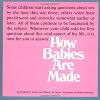
Inevitably, children will ask the question. Where do babies come from? How are babies made?
About the time we expected to hear the question, we found a book that we couldn’t resist. It answered their questions before they thought to ask them. We read it to them as an interesting picture book (a daily occurrence in our house). “This is a story about you. Have you ever thought about how babies grow? Have you ever wondered how you were born?”
That’s the way How Babies Are Made (Time-Life show more Books, 1968) begins. Of course, we had to stop reading right there. There are interesting stories about the birth of each of our children: the time and place, the trip to the hospital, the obstetrician, their mother’s memories, their father’s first reaction, the first few days, coming home—and, especially, the name: how it was chosen, what it means, why it’s special.
“This is a story about you.” So we told that story right away. Then we proceeded with the science lesson, for that’s what the rest of the book is, a well-planned, thoughtfully organized science lesson.
But, before I go further in describing the book, I need to explain why we found it so attractive. You see, it’s a picture book, and from the beginning we chose picture books for our children in which the art work was special. Almost from the cradle on we brought to their attention the collages of Ezra Jack Keats, the impressionistic painting of Brian Wildsmith (q.v.), the cartoonish characters of Maurice Sendak, the wood blocks of Once a Mouse, water colors, line drawings, charcoal sketches, photographs—you name it, our children saw it. If they wanted to, they talked about it and maybe even tried it on their own.
The art work for How Babies Are Made is paper sculpture; in other words, three-dimensional, full-page collages—very colorful, very simple, just detailed enough with no background distractions, elegant, a bit childlike but not childish, superbly crafted (by Blake Hampton). And, for this topic, the bonus is that the illustrations can be perfectly accurate but just impersonal enough to keep it scientific. The information is accurate, focusing on important, relevant details, but not the least bit suggestive. So the first page, from which I quoted above, shows five happy children, of different ethnic backgrounds, with different faces, different kinds of hair, and interestingly different clothing—all of paper sculpture, realistic but stylized.
“When your life began, you were very, very small—even smaller than a dot made by a pencil.” And the full-page collage shows a three-dimensional, realistic paper sculpture of a pencil and the dot it has made. There follow four distinct sequences of several pages each, developed in detail: (1) a beautifully sculpted flower with pollen and ovary labeled, a honey bee, the seed, then a clever design with sun, rain, earth, seed, sprout, and blossom; (2) chickens, hen and rooster, egg and sperm, sexual connection, nesting, hatching, chick, and some unfertilized eggs in a grocery carton; (3) dogs, with penis and testicle, vagina, ovary, and uterus, and the process from conception to birth; and finally (4) humans, again with appropriate detail. The loving couple are embracing under a bright bedspread; the sperm swim up toward the egg; the baby grows in the uterus and is born; the umbilical cord is removed; and the proud parents nurse and admire their child in its bassinet.
End of science lesson. End of story. “This is how families begin.”
We have kept the book all these years, partly for sentimental reasons off course, but also because we still admire the artist’s craft in constructing the paper sculptures and we think the design of the book is exemplary. And if grandchildren were to ask us the question . . . . show less
About the time we expected to hear the question, we found a book that we couldn’t resist. It answered their questions before they thought to ask them. We read it to them as an interesting picture book (a daily occurrence in our house). “This is a story about you. Have you ever thought about how babies grow? Have you ever wondered how you were born?”
That’s the way How Babies Are Made (Time-Life show more Books, 1968) begins. Of course, we had to stop reading right there. There are interesting stories about the birth of each of our children: the time and place, the trip to the hospital, the obstetrician, their mother’s memories, their father’s first reaction, the first few days, coming home—and, especially, the name: how it was chosen, what it means, why it’s special.
“This is a story about you.” So we told that story right away. Then we proceeded with the science lesson, for that’s what the rest of the book is, a well-planned, thoughtfully organized science lesson.
But, before I go further in describing the book, I need to explain why we found it so attractive. You see, it’s a picture book, and from the beginning we chose picture books for our children in which the art work was special. Almost from the cradle on we brought to their attention the collages of Ezra Jack Keats, the impressionistic painting of Brian Wildsmith (q.v.), the cartoonish characters of Maurice Sendak, the wood blocks of Once a Mouse, water colors, line drawings, charcoal sketches, photographs—you name it, our children saw it. If they wanted to, they talked about it and maybe even tried it on their own.
The art work for How Babies Are Made is paper sculpture; in other words, three-dimensional, full-page collages—very colorful, very simple, just detailed enough with no background distractions, elegant, a bit childlike but not childish, superbly crafted (by Blake Hampton). And, for this topic, the bonus is that the illustrations can be perfectly accurate but just impersonal enough to keep it scientific. The information is accurate, focusing on important, relevant details, but not the least bit suggestive. So the first page, from which I quoted above, shows five happy children, of different ethnic backgrounds, with different faces, different kinds of hair, and interestingly different clothing—all of paper sculpture, realistic but stylized.
“When your life began, you were very, very small—even smaller than a dot made by a pencil.” And the full-page collage shows a three-dimensional, realistic paper sculpture of a pencil and the dot it has made. There follow four distinct sequences of several pages each, developed in detail: (1) a beautifully sculpted flower with pollen and ovary labeled, a honey bee, the seed, then a clever design with sun, rain, earth, seed, sprout, and blossom; (2) chickens, hen and rooster, egg and sperm, sexual connection, nesting, hatching, chick, and some unfertilized eggs in a grocery carton; (3) dogs, with penis and testicle, vagina, ovary, and uterus, and the process from conception to birth; and finally (4) humans, again with appropriate detail. The loving couple are embracing under a bright bedspread; the sperm swim up toward the egg; the baby grows in the uterus and is born; the umbilical cord is removed; and the proud parents nurse and admire their child in its bassinet.
End of science lesson. End of story. “This is how families begin.”
We have kept the book all these years, partly for sentimental reasons off course, but also because we still admire the artist’s craft in constructing the paper sculptures and we think the design of the book is exemplary. And if grandchildren were to ask us the question . . . . show less

Still a good book. I remember coming into my room one day to find this book on my bed. I was 10, so it was a bit late, but I have shared it with my children. There are no moralizing or injunctions for sex or abstinence. It starts with flowers, then chickens, dogs & people.
You will love this book, and when you or teachers use it with 5-10 year olds, the kids will love it and gain an incredible amount of info re the basic facts of life. Get it and use it. It's an oldie but still the best ever done dealing with this difficult subect.
Family Creative Workshop [UK Edition] : Quilling, Quill Pens, Quilting, Raffia and Straw, Rag Dolls, Re-cycling Clothes, Repoussé and Chased Metal, Reverse Appliqué, Ribboncraft, Rockers and Cradles, Rope Knotting by Steven R. Schepp

Review of the U.K. edition only:
This is part 13 of one of the best craft partworks ever produced. In this (the UK version) you will find:
Quilling
Quill Pens
Quilting
Raffia and Straw
Rag Dolls
Re-cycling Clothes
Repoussé and Chased Metal
Reverse Appliqué
Ribboncraft
Rockers and Cradles
Rope Knotting
This is part 13 of one of the best craft partworks ever produced. In this (the UK version) you will find:
You May Also Like


Associated Authors
Statistics
- Works
- 38
- Also by
- 1
- Members
- 1,520
- Popularity
- #16,915
- Rating
- 4.0
- Reviews
- 30
- ISBNs
- 52
- Languages
- 3
