
David S. Goyer
Author of Man of Steel [2013 film]
About the Author
Image credit: David Goyer at the 2013 San Diego Comic-Con International - photo by Sue Lukenbaugh
Series
Works by David S. Goyer
Zig Zag 6 copies
JSA #52 3 copies
JSA 23 2 copies
JSA #6 2 copies
JSA 51 2 copies
JSA 9 2 copies
JSA 7 2 copies
JSA #49 2 copies
JSA #43 2 copies
A Burning Hate 2 copies
JSA #42 1 copy
JSA #45 1 copy
JSA #46 1 copy
JSA #41 1 copy
JSA #47 1 copy
JSA #24 1 copy
JSA #48 1 copy
JSA #44 1 copy
JSA #21 1 copy
JSA - Monster Edition 1 copy
Heaven's War 1 copy
the unborn 1 copy
JSA #39 1 copy
JSA #22 1 copy
JSA #50 1 copy
JSA #20 1 copy
JSA #19 1 copy
Blade - La serie 1 copy
Blade Trinity [and] End of Days [Videorecording] — Director — 1 copy
Blade: House Of Chthon 1 copy
Foundation — Executive Producer — 1 copy
The Autopsy [2022 Guillermo del Toro's Cabinet of Curiosities TV episode] — Screenwriter — 1 copy
JSA #18 1 copy
Batman Unburied 1 copy
JSA #15 1 copy
JSA #13 1 copy
JSA #17 1 copy
JSA Annual #1 1 copy
JSA #10 1 copy
JSA #11 1 copy
JSA #12 1 copy
JSA #16 1 copy
JSA #40 1 copy
JSA #14 1 copy
Associated Works
9-11: The World's Finest Comic Book Writers & Artists Tell Stories to Remember (2002) — Author — 256 copies, 1 review
Tagged
Common Knowledge
- Canonical name
- Goyer, David S.
- Legal name
- Goyer, David Samuel
- Birthdate
- 1965-12-22
- Gender
- male
- Nationality
- USA
- Birthplace
- Ann Arbor, Michigan, USA
- Associated Place (for map)
- Michigan, USA
Members
Reviews

Access a version of the below that includes illustrations on my blog.
The title of this volume would seem to indicate that it's about a triumphant return of the Justice Society of America. This is only kind of true. This isn't a "return" in the narrative; the JSA (which had disbanded in Zero Hour) was still moribund in the present-day of the DC Universe (though that was about to change), it was a return out of the narrative, in that 1999 gave us a JSA title for the first time since the end of show more its short-lived only ongoing back in 1993. But if you were to look at my list of titles below, it's slightly deceptive: it would imply no JSA-adjacent titles from the end of Damage in 1996 until now. But in fact one had been steadily chugging along since 1994: James Robinson's Starman. This was about the most recent inheritor of the Starman mantle, but it had played a lot with the history of the character, including his JSA ties. That title was primarily written by James Robinson, often co-plotted by David Goyer, and it's those two that primarily guide this storyline.
The Justice Society Returns! is set in 1945, as it seems World War II is coming to an end, and one could imagine it as a story arc in All-Star Squadron if the series had made it that far along; like that series, it weaves the superheroics in and out of real war to good effect. It is structured like a typical Golden Age JSA storyline: the characters as a group discover some issue, then they split up into groups to handle different aspects of it, then they come back together as a group to finish it off. Except, instead of having just a single issue to do all of this, JSA Returns takes nine issues, two of which are double-sized!
This turns out to really work. I usually dislike the typical JSA structure because everything is rushed and you don't get much genuine character interaction—which is surely what you want out of a team book! But with one issue apiece for each pair of heroes, you can really dig into them. The individual stories, like All-Star Squadron did, do neat stuff by placing these superheroes in wartime, exploring what makes them tick, and delving into the war itself at the same time. Goyer and Robinson write the two framing issues (All Star Comics vol. 2 #1-2, more on them later), while a variety of writers pen the ones in between; each issue has its own artist.
Highlights included "Cold Heart" (All-American Comics vol. 2 #1), which is about Green Lantern and Johnny Thunder protecting the Yalta Conference, but is mostly told from the perspective of an ordinary American soldier trying to do the same without superpowers: a strong sense of tone, time, and character make this an effective tale. It might be the best Ron Marz script I've ever read, and Eduardo Barreto is a great penciller who I am surprised not to know more of given this quality of work.
I also really liked "Stars and Atoms" (Adventure Comics vol. 2 #1), which sends Starman and the Atom to Los Alamos to protect the atom bomb test site. Robinson and Goyer themselves provide a great focus on one of my favorite JSAers, the eternal underdog the Atom, and Peter Snejbjerg (is he an underrated talent? I always like him but can't remember seeing him get much high-profile stuff) also turns in some atmospheric pencils, backed up by great coloring from John Kalisz. The debt that this whole series owes to A-SS is most clear here, as it picks up on some stuff Roy Thomas established about how the Atom developed superpowers and changed costumes (though I think that "really" didn't happen until 1948).
It would probably surprise no one to know that Mark Waid's story is also one of the collection's greats. "Fair Play" (National Comics vol. 2 #1) is set in Dresden during the Dresden bombing, focusing on the Flash and Mr. Terrific. The story is narrated by the Flash, but focuses on Mr. Terrific, whose sense of fair play is undermined by the horrific events he witnesses... perpetrated by his own side! The ending is a little pat, though, as the story kind of punts responsibility for the bombing onto war itself rather than, you know, the people who make these decisions.
Probably the only misfire is "Womanly Deeds & Manly Words" (Sensation Comics vol. 2 #1). The writing here from Robinson & Goyer is fine, teaming up Wonder Woman and Hawkgirl, but it is pretty typical superhero comics that clearly someone involved went, "Well, why would people read a comic about two women unless it had a lot of panels with gratuitous focuses on tits, asses, and panties in it?" I don't know this Scott Benefiel guy, and I am not encouraged to do so. The Wonder Woman here is Diana's mother, Queen Hippolyta, having travelled back in time (I think this happened in John Byrne's Wonder Woman comics, which I haven't read), but the story mostly shies away from that; aside from Johnny Thunder calling her "Polly" in one issue, I don't think there's a reference. (Roy Thomas established back in All-Star Squadron/Secret Origins that Miss America filled Wonder Woman's role in the JSA in the post-Crisis timeline, but later writers don't seem to have been very interested in that idea.)
I also was not very taken by the wrap-up issue, "Time's Arrow" (All Star Comics vol. 2 #2), which becomes a confusing muddle involving time travel for no evident reason. It felt like the writers ran out of space... but they only ran out of space because they added a bunch of unnecessary stuff! But the first issue, "Time's Keeper" (All Star Comics vol. 2 #1), was a strong one; it's essentially two one-issue stories combined: first an Hourman solo story, then a big JSA fight. I can't claim to love Hourman (I would be very happen to never read another ham-fisted Miraclo addiction storyline), but he can work well in some cases, and this is one of them. Michael Lark, better known for his work on Gotham Central, is just as adept with traditional superheroics.
Overall, this is great, doing what the "retroactive continuity"–based JSA comics have done at their best since the days of All-Star Squadron, and I am glad I spent the money to track down a physical copy.
The Justice Society and Earth-Two: « Previous in sequence | Next in sequence » show less
The title of this volume would seem to indicate that it's about a triumphant return of the Justice Society of America. This is only kind of true. This isn't a "return" in the narrative; the JSA (which had disbanded in Zero Hour) was still moribund in the present-day of the DC Universe (though that was about to change), it was a return out of the narrative, in that 1999 gave us a JSA title for the first time since the end of show more its short-lived only ongoing back in 1993. But if you were to look at my list of titles below, it's slightly deceptive: it would imply no JSA-adjacent titles from the end of Damage in 1996 until now. But in fact one had been steadily chugging along since 1994: James Robinson's Starman. This was about the most recent inheritor of the Starman mantle, but it had played a lot with the history of the character, including his JSA ties. That title was primarily written by James Robinson, often co-plotted by David Goyer, and it's those two that primarily guide this storyline.
The Justice Society Returns! is set in 1945, as it seems World War II is coming to an end, and one could imagine it as a story arc in All-Star Squadron if the series had made it that far along; like that series, it weaves the superheroics in and out of real war to good effect. It is structured like a typical Golden Age JSA storyline: the characters as a group discover some issue, then they split up into groups to handle different aspects of it, then they come back together as a group to finish it off. Except, instead of having just a single issue to do all of this, JSA Returns takes nine issues, two of which are double-sized!
This turns out to really work. I usually dislike the typical JSA structure because everything is rushed and you don't get much genuine character interaction—which is surely what you want out of a team book! But with one issue apiece for each pair of heroes, you can really dig into them. The individual stories, like All-Star Squadron did, do neat stuff by placing these superheroes in wartime, exploring what makes them tick, and delving into the war itself at the same time. Goyer and Robinson write the two framing issues (All Star Comics vol. 2 #1-2, more on them later), while a variety of writers pen the ones in between; each issue has its own artist.
Highlights included "Cold Heart" (All-American Comics vol. 2 #1), which is about Green Lantern and Johnny Thunder protecting the Yalta Conference, but is mostly told from the perspective of an ordinary American soldier trying to do the same without superpowers: a strong sense of tone, time, and character make this an effective tale. It might be the best Ron Marz script I've ever read, and Eduardo Barreto is a great penciller who I am surprised not to know more of given this quality of work.
I also really liked "Stars and Atoms" (Adventure Comics vol. 2 #1), which sends Starman and the Atom to Los Alamos to protect the atom bomb test site. Robinson and Goyer themselves provide a great focus on one of my favorite JSAers, the eternal underdog the Atom, and Peter Snejbjerg (is he an underrated talent? I always like him but can't remember seeing him get much high-profile stuff) also turns in some atmospheric pencils, backed up by great coloring from John Kalisz. The debt that this whole series owes to A-SS is most clear here, as it picks up on some stuff Roy Thomas established about how the Atom developed superpowers and changed costumes (though I think that "really" didn't happen until 1948).
It would probably surprise no one to know that Mark Waid's story is also one of the collection's greats. "Fair Play" (National Comics vol. 2 #1) is set in Dresden during the Dresden bombing, focusing on the Flash and Mr. Terrific. The story is narrated by the Flash, but focuses on Mr. Terrific, whose sense of fair play is undermined by the horrific events he witnesses... perpetrated by his own side! The ending is a little pat, though, as the story kind of punts responsibility for the bombing onto war itself rather than, you know, the people who make these decisions.
Probably the only misfire is "Womanly Deeds & Manly Words" (Sensation Comics vol. 2 #1). The writing here from Robinson & Goyer is fine, teaming up Wonder Woman and Hawkgirl, but it is pretty typical superhero comics that clearly someone involved went, "Well, why would people read a comic about two women unless it had a lot of panels with gratuitous focuses on tits, asses, and panties in it?" I don't know this Scott Benefiel guy, and I am not encouraged to do so. The Wonder Woman here is Diana's mother, Queen Hippolyta, having travelled back in time (I think this happened in John Byrne's Wonder Woman comics, which I haven't read), but the story mostly shies away from that; aside from Johnny Thunder calling her "Polly" in one issue, I don't think there's a reference. (Roy Thomas established back in All-Star Squadron/Secret Origins that Miss America filled Wonder Woman's role in the JSA in the post-Crisis timeline, but later writers don't seem to have been very interested in that idea.)
I also was not very taken by the wrap-up issue, "Time's Arrow" (All Star Comics vol. 2 #2), which becomes a confusing muddle involving time travel for no evident reason. It felt like the writers ran out of space... but they only ran out of space because they added a bunch of unnecessary stuff! But the first issue, "Time's Keeper" (All Star Comics vol. 2 #1), was a strong one; it's essentially two one-issue stories combined: first an Hourman solo story, then a big JSA fight. I can't claim to love Hourman (I would be very happen to never read another ham-fisted Miraclo addiction storyline), but he can work well in some cases, and this is one of them. Michael Lark, better known for his work on Gotham Central, is just as adept with traditional superheroics.
Overall, this is great, doing what the "retroactive continuity"–based JSA comics have done at their best since the days of All-Star Squadron, and I am glad I spent the money to track down a physical copy.
The Justice Society and Earth-Two: « Previous in sequence | Next in sequence » show less
Though it may not appear obvious by a lot of my recent reviews, I actually don't like giving a negative review. I read for pleasure. I read to be entertained. I read to experience wonder. I read to provoke thought. Science fiction, or speculative fiction, is the perfect vehicle for that. In my opinion, with the possible exception of Fantasy, there's no better genre.
And in the hands of masters...Clarke, Asimov, Bradbury, Herbert...it often does just that. In the hands of someone of lesser show more talent, it's just painful.
This book was painful. I can't tell you how many times I considered abandoning it. At the end of virtually each section for the first third. Most of the time in the first half. Occasionally in the second half, including right up to the final pages. Yet, for some reason, I stuck it out. And was not rewarded.
There's so much wrong with this novel, which is distressing, because Goyer is responsible for some of the scripts to movies I truly enjoyed. I truly believe his entire contribution to this novel was to provide a series of quickly-scribbled notes on a napkin to Cassutt, along with a contract that places his name above Cassutt's for marketing purposes and the promise of a fat fee. Because if he's in any way more responsible for this plodding pile of crap, I seriously question his talents as well.
What problems are there? Pacing, characters, backstories, plot, storytelling style, and tell versus show.
As I said above, I read SF for the wonder, the entertainment and thought-provocation factors. So, when the authors set up a situation where 187 people are scooped off Earth and dropped on Keanu, I'm expecting a Ringworld or Rama type of story, lots of exploration (providing the wonder), lots of imagination-firing (and thought provoking) discoveries, lots of initial obstacles to overcome (providing the entertainment). When writing SF, any author is simply honour-bound to do so.
Instead, we're treated to characters wringing their hands, pointing out repeatedly that they don't understand what's happening, and, for most of the first third, if not first half, we're treated to such exciting events as: Organizing people into groups! Punishing a murderer by making him dig holes! Working about dying batteries! Electing a mayor!
Please.
On top of all this, as we meet each new member of this politically correct highly international cast of characters, any slight momentum the plot has managed to build up dies as we are dragged through that character's backstory in a giant tell, instead of showing the salient points through reveals during the forward narrative of the plot. But that would take more work.
Pretty much the first half takes place over the trip to Keanu and the first 48 hours once they arrive there. The second half, while still unbelievably slow, at least gets some things happening. Still, the big excitement pieces are another murder, some people returning from the dead (yeah, we got that in the first book, it's getting old), a ridiculously drawn out and incredibly boring First Meeting between humans and a Real! Live! Alien!
We're also treated to a lot more Tell, Don't Show here, as the authors bring in Revenants (dead characters brought briefly back to life) exactly when the other characters need them to provide information or direction. At the same time, all the really fun stuff (the stuff that could provide more entertainment, thought-provocation and wonder) happens off stage. The Reaver bugs' secrets are learned off-stage. The weapon to fight them is devised and created off-stage. The methods the survivors use to learn to use the alien technology and feed the masses is all done off-stage. I get the impression that the authors needed this handy plot device - technology that can create all the things they need, but it takes some thinking and manipulation and effort - but really don't know how to explain it satisfactorily, or show it in action, so they just say, screw it, write a scene where on of the politically correct highly international cast of characters walks up with the solution, and maybe some beads of sweat on his brow from the effort.
I also have problems with the actual voice of the narrative. The authors switch between several characters, male, female, young, old, gay, straight, American, Indian, etc. And yet, the storytelling voice never varies from the detached, plodding, semi-technical writer style. Sort of a slightly engaging technical writing with dialogue.
And finally, there was the epilogue. Don't worry, no spoilers. I'll just say that, instead of choosing one of the few slightly interesting endings, they decided to tack on an epilogue that was, again, in a mostly telling this-is-what-happened-after-that wrap up. Why not choose to simply provide an enigmatic view of the survivors that whets the appetite for book 3, and build it out in that book instead?
Because, in the end, that's one of the biggest issues of this book. It's like going on a trip to a foreign country you've never visited before. And, thinking it's the best way to take it all in, you book a tour with a crazed, socially-awkward, nerdy tourguide that rushes you from place to place, pointing at things, stating they're important, but only giving you a few words as to why, before scooting you to the next thing they think is interesting. All the while, you're left vaguely pointing to something else, saying, "but that looks interesting too," and being told it's really not (when you know it really is), before they tap their watch and tell you to sit down and shut up, we're on a schedule, lots of things to see, no time to explain. In the end, you're left with lackluster photos and no stories to bring back home.
Typically, when I'm two books into a trilogy, no matter how bad the book is, I'd still soldier on and complete the last one, just to see how it ends. But in this case, considering the story, the characters and where it's all headed? Frankly, Scarlet, I don't give a damn.
I'm done. Goyer and Cassutt won't steal any more of my time. show less
And in the hands of masters...Clarke, Asimov, Bradbury, Herbert...it often does just that. In the hands of someone of lesser show more talent, it's just painful.
This book was painful. I can't tell you how many times I considered abandoning it. At the end of virtually each section for the first third. Most of the time in the first half. Occasionally in the second half, including right up to the final pages. Yet, for some reason, I stuck it out. And was not rewarded.
There's so much wrong with this novel, which is distressing, because Goyer is responsible for some of the scripts to movies I truly enjoyed. I truly believe his entire contribution to this novel was to provide a series of quickly-scribbled notes on a napkin to Cassutt, along with a contract that places his name above Cassutt's for marketing purposes and the promise of a fat fee. Because if he's in any way more responsible for this plodding pile of crap, I seriously question his talents as well.
What problems are there? Pacing, characters, backstories, plot, storytelling style, and tell versus show.
As I said above, I read SF for the wonder, the entertainment and thought-provocation factors. So, when the authors set up a situation where 187 people are scooped off Earth and dropped on Keanu, I'm expecting a Ringworld or Rama type of story, lots of exploration (providing the wonder), lots of imagination-firing (and thought provoking) discoveries, lots of initial obstacles to overcome (providing the entertainment). When writing SF, any author is simply honour-bound to do so.
Instead, we're treated to characters wringing their hands, pointing out repeatedly that they don't understand what's happening, and, for most of the first third, if not first half, we're treated to such exciting events as: Organizing people into groups! Punishing a murderer by making him dig holes! Working about dying batteries! Electing a mayor!
Please.
On top of all this, as we meet each new member of this politically correct highly international cast of characters, any slight momentum the plot has managed to build up dies as we are dragged through that character's backstory in a giant tell, instead of showing the salient points through reveals during the forward narrative of the plot. But that would take more work.
Pretty much the first half takes place over the trip to Keanu and the first 48 hours once they arrive there. The second half, while still unbelievably slow, at least gets some things happening. Still, the big excitement pieces are another murder, some people returning from the dead (yeah, we got that in the first book, it's getting old), a ridiculously drawn out and incredibly boring First Meeting between humans and a Real! Live! Alien!
We're also treated to a lot more Tell, Don't Show here, as the authors bring in Revenants (dead characters brought briefly back to life) exactly when the other characters need them to provide information or direction. At the same time, all the really fun stuff (the stuff that could provide more entertainment, thought-provocation and wonder) happens off stage. The Reaver bugs' secrets are learned off-stage. The weapon to fight them is devised and created off-stage. The methods the survivors use to learn to use the alien technology and feed the masses is all done off-stage. I get the impression that the authors needed this handy plot device - technology that can create all the things they need, but it takes some thinking and manipulation and effort - but really don't know how to explain it satisfactorily, or show it in action, so they just say, screw it, write a scene where on of the politically correct highly international cast of characters walks up with the solution, and maybe some beads of sweat on his brow from the effort.
I also have problems with the actual voice of the narrative. The authors switch between several characters, male, female, young, old, gay, straight, American, Indian, etc. And yet, the storytelling voice never varies from the detached, plodding, semi-technical writer style. Sort of a slightly engaging technical writing with dialogue.
And finally, there was the epilogue. Don't worry, no spoilers. I'll just say that, instead of choosing one of the few slightly interesting endings, they decided to tack on an epilogue that was, again, in a mostly telling this-is-what-happened-after-that wrap up. Why not choose to simply provide an enigmatic view of the survivors that whets the appetite for book 3, and build it out in that book instead?
Because, in the end, that's one of the biggest issues of this book. It's like going on a trip to a foreign country you've never visited before. And, thinking it's the best way to take it all in, you book a tour with a crazed, socially-awkward, nerdy tourguide that rushes you from place to place, pointing at things, stating they're important, but only giving you a few words as to why, before scooting you to the next thing they think is interesting. All the while, you're left vaguely pointing to something else, saying, "but that looks interesting too," and being told it's really not (when you know it really is), before they tap their watch and tell you to sit down and shut up, we're on a schedule, lots of things to see, no time to explain. In the end, you're left with lackluster photos and no stories to bring back home.
Typically, when I'm two books into a trilogy, no matter how bad the book is, I'd still soldier on and complete the last one, just to see how it ends. But in this case, considering the story, the characters and where it's all headed? Frankly, Scarlet, I don't give a damn.
I'm done. Goyer and Cassutt won't steal any more of my time. show less
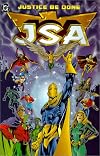
There's a tiny cameo by the Daniel Hall Dream (man he's been popping up a lot of late), and Hector Hall, who was the third Sandman (after Garrett Sandford) finally returns from the Dreaming in this story, but the main Sandman element in Justice Be Done, the first volume of the 1990s JSA series, is the legacy of Wesley Dodds, the original 1930s Sandman. Justice Be Done merges two previously distinct versions of the character: the Wesley Dodds here is characterized the way Matt Wagner wrote show more him in Sandman Mystery Theatre, especially as regards his romance with Dian Belmont, but he still participated in the more fanciful adventures of the Golden Age version of the character. His sidekick Sanderson Hawkins even has a big role in this story, even though Sandman Mystery Theatre took some pains to established that "Sandy" didn't exist.
Wesley's brief appearance here culminates in his death, but he goes out like a hero, and it works. Having him battling cosmic forces in the mountains of Tibet jars with the SMT Wesley's encounters with powerless psychopaths in New York sewers, but the SMT Wesley was written as so smart and well-intentioned that you've no doubt he could have handled such situations had he been pushed into him. The building of the JSA memorial is a little harder to buy, and the oft-referenced fact that Wesley once built a "silicoid gun" that turned Sandy into a sand monster doesn't really fit at all, but then again, Justice Be Done isn't a Sandman Mystery Theatre story, but a no-holds-barred nostalgic Justice Society one, uniting a hodgepodge of characters with ties to the organization, from founding members, to the children of other founding members, from an android reincarnation of Hourman (who actually appeared in Sandman Mystery Theatre), to Wonder Woman's mom.
Even if you take Justice Be Done on its own terms, Sandy, who declares himself "Sand" here with some ferociously bad dialogue, is one of the less convincing elements of the story. The writers seem desperate to give him relevant powers: he starts out with Wesley Dodds's legendary gas gun, and he picks up Wesley's bad dreams as well, but he soon also acquires the power to turn into sand at will, not to mention that he's "hyper-sensitized to seismic activity." For some reason. It's a disjointed powerset that reeks of an attempt to make something of this character, as does the hackneyed combination of man-out-of-time and trying-to-live-up-to-a-legacy characterizations, which try really hard to make him more than the most generic of sidekicks that he began as.
On a side note, I was amused by an introductory illustration of the new Justice Society, which labels illustrations of the characters to help the newbies. In this we see WILDCAT, STAR-SPANGLED KID, STARMAN, OBSIDIAN, BLACK CANARY, HOURMAN, and... AL ROTHSTEIN. Nice codename, dude.
Neil Gaiman's The Sandman Spin-Offs: « Previous in sequence | Next in sequence » show less
Wesley's brief appearance here culminates in his death, but he goes out like a hero, and it works. Having him battling cosmic forces in the mountains of Tibet jars with the SMT Wesley's encounters with powerless psychopaths in New York sewers, but the SMT Wesley was written as so smart and well-intentioned that you've no doubt he could have handled such situations had he been pushed into him. The building of the JSA memorial is a little harder to buy, and the oft-referenced fact that Wesley once built a "silicoid gun" that turned Sandy into a sand monster doesn't really fit at all, but then again, Justice Be Done isn't a Sandman Mystery Theatre story, but a no-holds-barred nostalgic Justice Society one, uniting a hodgepodge of characters with ties to the organization, from founding members, to the children of other founding members, from an android reincarnation of Hourman (who actually appeared in Sandman Mystery Theatre), to Wonder Woman's mom.
Even if you take Justice Be Done on its own terms, Sandy, who declares himself "Sand" here with some ferociously bad dialogue, is one of the less convincing elements of the story. The writers seem desperate to give him relevant powers: he starts out with Wesley Dodds's legendary gas gun, and he picks up Wesley's bad dreams as well, but he soon also acquires the power to turn into sand at will, not to mention that he's "hyper-sensitized to seismic activity." For some reason. It's a disjointed powerset that reeks of an attempt to make something of this character, as does the hackneyed combination of man-out-of-time and trying-to-live-up-to-a-legacy characterizations, which try really hard to make him more than the most generic of sidekicks that he began as.
On a side note, I was amused by an introductory illustration of the new Justice Society, which labels illustrations of the characters to help the newbies. In this we see WILDCAT, STAR-SPANGLED KID, STARMAN, OBSIDIAN, BLACK CANARY, HOURMAN, and... AL ROTHSTEIN. Nice codename, dude.
Neil Gaiman's The Sandman Spin-Offs: « Previous in sequence | Next in sequence » show less

Access a version of the below that includes illustrations on my blog.
The fourth (and final) volume of JSA by Geoff Johns finally catches events up to what was collected back in book two; in that book, Captain Marvel and the Rick Tyler Hourman were members of the team, and we finally see them join here! If you're making a definitive series of collections, I feel like you could make a much better effort at getting the order right.
Collecting issues aside, the series finally hit its groove for show more me in this collection. I've struggled with it up until now, but I enjoyed most every storyline in this volume. It opens with "Stealing Thunder," where the Ultra-Humanite has put his brain into Johnny Thunder's body in order to access the power of the Thunderbolt. First there's a pretty decent character-focused prologue (which nicely wrongfoots you about what has happened to Johnny), and the story itself does a good job of focusing on the personalities of individual JSA members. It jumps ahead several months, to when the Earth is an Ultra-Humanite-controlled dystopia, and a small group of heroes remains free of his control. So we follow the members of this group, and it's all handled pretty well. We even get an issue that focuses on former Injustice Society member Icicle, a villain who's immune to the Ultra-Humanite's control and becomes an uneasy ally of the JSA. It's nice to see Rick Tyler (formerly of Infinity, Inc.) again, and the thing about him being able to spend one last hour with his dad, the original Hourman, is pretty neat.
After this, we get some character-focused one-offs. A Father's Day story parallels Rick meeting with his father, and Jakeem Thunder trying to track down his. I enjoyed this one. Then there's a story about a villain lusting after Power Girl, and it's as bad as all Geoff Johns–penned Power Girl stories. But then there's a decent story about an old Dr. Mid-Nite villain getting his grandson to commit crimes, and the JSA working together to stop him.
Finally, there's a multi-part story about time travel. Some characters go back to the 1940s and meet the original Mr. Terrific; this I really liked, especially the way Mr. Terrific immediately cottoned on to what was happening. Some other characters end up in Ancient Egypt with the original Hawkman and Black Adam, and this I found much less interesting. It does seem like the series is moving back in the direction of having Hawkgirl hook up with Hawkman, which I find profoundly dull and kind of creepy. The stuff about Black Adam's tortured past I don't really care for, because I know it goes pretty unpleasant places in stories like World War III.
Also the Hector-Hall-looking-for-Lyta subplot continues to be dead dull. It's a succession of plot beats, not a story about characters.
But overall, this is an effective team comic at this point. It helps that Leonard Kirk is an absolutely solid artist. Not "flashy," but good personality and good storytelling and good action, the exact kind of artist a nuts-and-bolts team title like this needs. I've liked him ever since his Captain Britain and MI13 days for Marvel. The real shame is that this series of collections ended with this volume; even though DC did collect all of JSA and Justice Society of America vol. 3 in a set of three JSA by Geoff Johns Omnibuses, their "re-cutting" of the run as a series of trade paperbacks ended here, only partway through the contents of what had been JSA by Geoff Johns Omnibus, Volume Two. So having read issues #1-45 of this series via Hoopla, I am going to need to track down #46-87 some other way! (Also it seems clearly criminal that this series was called JSA by Geoff Johns when in the end, David Goyer wrote as many of the collected issues as Johns did... if not more!)
The Justice Society and Earth-Two: « Previous in sequence | Next in sequence » show less
The fourth (and final) volume of JSA by Geoff Johns finally catches events up to what was collected back in book two; in that book, Captain Marvel and the Rick Tyler Hourman were members of the team, and we finally see them join here! If you're making a definitive series of collections, I feel like you could make a much better effort at getting the order right.
Collecting issues aside, the series finally hit its groove for show more me in this collection. I've struggled with it up until now, but I enjoyed most every storyline in this volume. It opens with "Stealing Thunder," where the Ultra-Humanite has put his brain into Johnny Thunder's body in order to access the power of the Thunderbolt. First there's a pretty decent character-focused prologue (which nicely wrongfoots you about what has happened to Johnny), and the story itself does a good job of focusing on the personalities of individual JSA members. It jumps ahead several months, to when the Earth is an Ultra-Humanite-controlled dystopia, and a small group of heroes remains free of his control. So we follow the members of this group, and it's all handled pretty well. We even get an issue that focuses on former Injustice Society member Icicle, a villain who's immune to the Ultra-Humanite's control and becomes an uneasy ally of the JSA. It's nice to see Rick Tyler (formerly of Infinity, Inc.) again, and the thing about him being able to spend one last hour with his dad, the original Hourman, is pretty neat.
After this, we get some character-focused one-offs. A Father's Day story parallels Rick meeting with his father, and Jakeem Thunder trying to track down his. I enjoyed this one. Then there's a story about a villain lusting after Power Girl, and it's as bad as all Geoff Johns–penned Power Girl stories. But then there's a decent story about an old Dr. Mid-Nite villain getting his grandson to commit crimes, and the JSA working together to stop him.
Finally, there's a multi-part story about time travel. Some characters go back to the 1940s and meet the original Mr. Terrific; this I really liked, especially the way Mr. Terrific immediately cottoned on to what was happening. Some other characters end up in Ancient Egypt with the original Hawkman and Black Adam, and this I found much less interesting. It does seem like the series is moving back in the direction of having Hawkgirl hook up with Hawkman, which I find profoundly dull and kind of creepy. The stuff about Black Adam's tortured past I don't really care for, because I know it goes pretty unpleasant places in stories like World War III.
Also the Hector-Hall-looking-for-Lyta subplot continues to be dead dull. It's a succession of plot beats, not a story about characters.
But overall, this is an effective team comic at this point. It helps that Leonard Kirk is an absolutely solid artist. Not "flashy," but good personality and good storytelling and good action, the exact kind of artist a nuts-and-bolts team title like this needs. I've liked him ever since his Captain Britain and MI13 days for Marvel. The real shame is that this series of collections ended with this volume; even though DC did collect all of JSA and Justice Society of America vol. 3 in a set of three JSA by Geoff Johns Omnibuses, their "re-cutting" of the run as a series of trade paperbacks ended here, only partway through the contents of what had been JSA by Geoff Johns Omnibus, Volume Two. So having read issues #1-45 of this series via Hoopla, I am going to need to track down #46-87 some other way! (Also it seems clearly criminal that this series was called JSA by Geoff Johns when in the end, David Goyer wrote as many of the collected issues as Johns did... if not more!)
The Justice Society and Earth-Two: « Previous in sequence | Next in sequence » show less
Lists
Awards


You May Also Like


Associated Authors
Statistics
- Works
- 100
- Also by
- 15
- Members
- 3,876
- Popularity
- #6,539
- Rating
- 3.7
- Reviews
- 66
- ISBNs
- 106
- Languages
- 9
- Favorited
- 1