
Bill Henderson (1) (1941–)
Author of Rotten Reviews
For other authors named Bill Henderson, see the disambiguation page.
About the Author
Bill Henderson is the author of "The Kid That Could", a novel, & two memoirs, "His Son" & "Her Father". He is the founder & publisher of Pushcart Press & the editor of the acclaimed Pushcart Prize series. He lives on Long Island & in Maine. (Bowker Author Biography)
Image credit: Photograph by Lily Henderson
Series
Works by Bill Henderson
Minutes of the Lead Pencil Club: Second Thoughts on the Electronic Revolution (1996) — Editor — 87 copies, 1 review
The publish-it-yourself handbook: Literary tradition and how to without commercial or vanity publishers (1980) 35 copies
The Pushcart Prize XXXVIII: Best of the Small Presses 2014 Edition (The Pushcart Prize) (2013) 32 copies, 1 review
The Pushcart Prize XXVIII: Best of the Small Presses, 2004 Edition (2003) — Editor — 31 copies, 1 review
The Pushcart Prize XLlV: Best of the Small Presses 2020 Edition (The Pushcart Prize Anthologies, 44) (2018) 28 copies
The Pushcart Prize XXXIX: Best of the Small Presses 2015 Edition (The Pushcart Prize) (2014) 26 copies
The Pushcart Prize XLII: Best of the Small Presses 2018 Edition (2018 Edition) (The Pushcart Prize) (2017) 25 copies
The Pushcart Book of Short Stories: The Best Stories from a Quarter-Century of the Pushcart Prize (2002) 23 copies, 1 review
The Pushcart Prize XLI: Best of the Small Presses 2017 Edition (2017 Edition) (The Pushcart Prize) (2016) 23 copies
The Pushcart Prize XL: Best of the Small Presses 2016 Edition (2016 Edition) (The Pushcart Prize) (2015) 21 copies, 1 review
The Pushcart Prize XLVI: Best of The Small Presses 2022 Edition (The Pushcart Prize Anthologies, 46) (2021) 5 copies
The Pushcart Prize 1999: Best of the Small Presses (No 23) (The Pushcart Prize Anthologies, 23) 3 copies, 1 review
The Complete Literary Rot: Hundreds of Nasty Reviews and Ridiculous Rejections Great Authors and Classic Books (1991) 3 copies
Pushcart Prize 12, The 1 copy
Associated Works
Tagged
Common Knowledge
Members
Reviews

I first picked up this little book and thought I would glance through it. I flipped to a few random pages and read a few one-sentence reviews - mostly from 100 years ago. I decided this was rather boring and I would leave the book where I found it.
I'm here to tell you, don't just pick this book up and flip to a random page. You won't get very much out of it that way. Start from the beginning.
I wanted to take a book with me to read while I was waiting ond day. I picked this one because it is show more small enough to fit in a pocket. I read the intro and that's all it took. I was hooked. The intro mentions the history of book reviews, how being a reviewer is a thankless profession, and how negative reviews affected some of the most well-known authors.
There are no modern books reviewed here, most are classics. Some I had never heard of. Most I have never read. But I at least know enough about them to be able to find humor (or horror) in the words lobbed at the authors of these works. My favorite reviews were ones written by other authors or famous persons. John Quincy Adams believed Lord Byron's "verses would soon rank with forgotten things." Lord Byron calls Chaucer "obscene and contemptible." Edgar Allan Poe calls the writings of Ralph Waldo Emerson "twaddle." Charlotte Bronte throws shade at Jane Austen, there is no shortage of writers that Virginia Woolf dislikes, and it seems everyone hated Shakespeare.
Some of the reviews are laughable in hindsight. It can't feel good as a reviewer to predict that a work will fade into obscurity, but decades later it is being taught to students all over the world. Other reviews you might agree with. I mean, just because something is a classic doesn't necessarily mean that it's enjoyable to read.
But besides the reviews by other authors, the ones that most fascinated me were the reviews of female writers. Almost all reek of misogyny. No wonder so many women wrote under pseudonyms. How many female voices have we missed over the years because they weren't valued the way that male writers were?
Take for instance, what Emerson has to say about Austen: "I am at a loss to understand why people hold Miss Austen's novels at so high a rate, which seem to me.....imprisoned in the wretched conventions of English society, without genius, wit, or knowledge of the world. Never was life so pinched and narrow. The one problem in the mind of the writer.... is marriageableness....Suicide is more respectable." Obviously, Emerson missed the entire point of Jane Austen's novels and shows a distinct lack of understanding of what life was like for women of the time. He's so disgusted that marriage is top in mind of their worries -- that even suicide is a more worthwhile pursuit. Oh, if only women had the luxury to think about something else.
Hemingway's paragraph is so full of insults toward Gertrude Stein, but it's written with so much misogyny that I wonder if he actually thought he was being kind. "It's a shame you never knew her before she went to pot. You know a funny thing, she never could write dialogue. It was terrible. She learned how to do it from my stuff.... she was afraid people would notice it, ....so she had to attack me. It's a funny racket, really. But I swear she was damned nice before she got ambitious." Geez. Insulting her talent, but also claiming credit for her talent, then drawing attention to her seeming dislike of him, laughing it off as if she's a silly, petulant child, then throwing in a back-handed compliment to boot. All while making sure you know that women are much more pleasant to be around if they have no ambitions and wouldn't dare take on the same field as you. Ughhhhhhhhhhh.
I don't know where the author found all of these reviews. There's even one from 411 B.C.! But it's enlightening and is like reading an old gossip column or someone's diary. I love everything about this book show less
I'm here to tell you, don't just pick this book up and flip to a random page. You won't get very much out of it that way. Start from the beginning.
I wanted to take a book with me to read while I was waiting ond day. I picked this one because it is show more small enough to fit in a pocket. I read the intro and that's all it took. I was hooked. The intro mentions the history of book reviews, how being a reviewer is a thankless profession, and how negative reviews affected some of the most well-known authors.
There are no modern books reviewed here, most are classics. Some I had never heard of. Most I have never read. But I at least know enough about them to be able to find humor (or horror) in the words lobbed at the authors of these works. My favorite reviews were ones written by other authors or famous persons. John Quincy Adams believed Lord Byron's "verses would soon rank with forgotten things." Lord Byron calls Chaucer "obscene and contemptible." Edgar Allan Poe calls the writings of Ralph Waldo Emerson "twaddle." Charlotte Bronte throws shade at Jane Austen, there is no shortage of writers that Virginia Woolf dislikes, and it seems everyone hated Shakespeare.
Some of the reviews are laughable in hindsight. It can't feel good as a reviewer to predict that a work will fade into obscurity, but decades later it is being taught to students all over the world. Other reviews you might agree with. I mean, just because something is a classic doesn't necessarily mean that it's enjoyable to read.
But besides the reviews by other authors, the ones that most fascinated me were the reviews of female writers. Almost all reek of misogyny. No wonder so many women wrote under pseudonyms. How many female voices have we missed over the years because they weren't valued the way that male writers were?
Take for instance, what Emerson has to say about Austen: "I am at a loss to understand why people hold Miss Austen's novels at so high a rate, which seem to me.....imprisoned in the wretched conventions of English society, without genius, wit, or knowledge of the world. Never was life so pinched and narrow. The one problem in the mind of the writer.... is marriageableness....Suicide is more respectable." Obviously, Emerson missed the entire point of Jane Austen's novels and shows a distinct lack of understanding of what life was like for women of the time. He's so disgusted that marriage is top in mind of their worries -- that even suicide is a more worthwhile pursuit. Oh, if only women had the luxury to think about something else.
Hemingway's paragraph is so full of insults toward Gertrude Stein, but it's written with so much misogyny that I wonder if he actually thought he was being kind. "It's a shame you never knew her before she went to pot. You know a funny thing, she never could write dialogue. It was terrible. She learned how to do it from my stuff.... she was afraid people would notice it, ....so she had to attack me. It's a funny racket, really. But I swear she was damned nice before she got ambitious." Geez. Insulting her talent, but also claiming credit for her talent, then drawing attention to her seeming dislike of him, laughing it off as if she's a silly, petulant child, then throwing in a back-handed compliment to boot. All while making sure you know that women are much more pleasant to be around if they have no ambitions and wouldn't dare take on the same field as you. Ughhhhhhhhhhh.
I don't know where the author found all of these reviews. There's even one from 411 B.C.! But it's enlightening and is like reading an old gossip column or someone's diary. I love everything about this book show less
If you write, and are bold enough to scatter your prose to the four winds, you'll eventually get a bad review somehow, somewhere, from some schmuck. It's nice to prepare yourself for that day by nibbling on rotten reviews that have been lobbed at some of history's finest writers, and others.
I rather like this book. I pick it up once in a while and am always amused. It's not a tome to read cover-to-cover at one sitting. You might want to keep your copy in the loo or on the nightstand, so you show more can dip into it and be uplifted when you're feeling a trifle blue about your own mediocre reviews.
Maybe you'll get off more lightly than Shakespeare did when Pepys said of a "Midsummer Night's Dream": the most insipid, ridiculous play that I ever saw in my life. Pffft! And you wonder the thing is never performed any more. ;-) show less
I rather like this book. I pick it up once in a while and am always amused. It's not a tome to read cover-to-cover at one sitting. You might want to keep your copy in the loo or on the nightstand, so you show more can dip into it and be uplifted when you're feeling a trifle blue about your own mediocre reviews.
Maybe you'll get off more lightly than Shakespeare did when Pepys said of a "Midsummer Night's Dream": the most insipid, ridiculous play that I ever saw in my life. Pffft! And you wonder the thing is never performed any more. ;-) show less
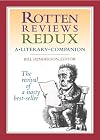
"Rotten Reviews Redux: A Literary Companion," edited by Bill Henderson, is a small book consisting of brief reviews of famous literature in which said literature is basically skewered by critics. For example, Mark Twain says of James Fenimore Cooper’s “The Deerslayer” that “In one place in Deerslayer, and in the restricted space of two-thirds of a page, Cooper has scored 114 offences against literary art out of a possible 115. It breaks the record.” Or Joseph Warton in 1754 says of show more Shakespeare’s “King Lear” that “this drama is chargeable with considerable imperfections.” A very slight, but fun, quick read, covering a wide range of books. show less
There are some good essays in this collection, but the emphasis here is on the "literary" aspect of publishing. It is less practical than I had hoped when I bought it. Many of the contributions are on journal publishing rather than book publishing, so my use of the book in a book publishing class was less than ideal. I did, however, enjoy the pieces by Saxe Commins and Maxwell Perkins on Horace Liveright and Thomas Wolfe, respectively.
Please note that this collection was originally published show more in 1980, then reissued in 1995. It contains some good material, but it you are looking for information on the contemporary publishing scene, this will help you only marginally. show less
Please note that this collection was originally published show more in 1980, then reissued in 1995. It contains some good material, but it you are looking for information on the contemporary publishing scene, this will help you only marginally. show less
Awards


You May Also Like


Associated Authors
Statistics
- Works
- 68
- Also by
- 1
- Members
- 1,691
- Popularity
- #15,190
- Rating
- 3.6
- Reviews
- 20
- ISBNs
- 154