
Anat Talshir
Author of About the Night
Works by Anat Talshir
Tagged
Common Knowledge
Members
Reviews

Retelling a love affair that mirrors the fate of a divided Jerusalem, Anat Talshir’s About the Night invites readers in a broken world filled with broken people and breaking hearts. Like Berlin, Jerusalem was divided by a wall. Just as in Berlin, people, families, friends and lovers were split when the wall went up. But what if love had only just grown, still standing on that cusp of enthralled certainty? What if love were frozen by a wall, then thawed into a different world when the wall show more comes down?
Jew and Arab, Lila and Elias, meet in the time of British rule. Neither knows the other’s history, but romance blooms like the scent of tea, well-brewed, gently breathed from a cup held between the palms. This is no fast torrid romance, nor love-at-first-sight; it’s no well-planned affair. But it’s a believable love, first love for a woman who’s never imagined such emotions could be hers.
There are religious barriers to this love, of course. But walls make real what hearts are striving to break. Wars make eternal what once might have passed in the night. And different expectations make for different results.
About the Night invites readers to ponder the meaning of love and family, how they are both created and sustained, and how they can break. It’s told against a backdrop of Jerusalem then and now, of religion here and there, and of survival and hope. It’s a haunting, beautiful tale, best read slowly over cups of well-brewed tea with warm steam filling the air.
Disclosure: I got it on a deal and I offer my honest review. show less
Jew and Arab, Lila and Elias, meet in the time of British rule. Neither knows the other’s history, but romance blooms like the scent of tea, well-brewed, gently breathed from a cup held between the palms. This is no fast torrid romance, nor love-at-first-sight; it’s no well-planned affair. But it’s a believable love, first love for a woman who’s never imagined such emotions could be hers.
There are religious barriers to this love, of course. But walls make real what hearts are striving to break. Wars make eternal what once might have passed in the night. And different expectations make for different results.
About the Night invites readers to ponder the meaning of love and family, how they are both created and sustained, and how they can break. It’s told against a backdrop of Jerusalem then and now, of religion here and there, and of survival and hope. It’s a haunting, beautiful tale, best read slowly over cups of well-brewed tea with warm steam filling the air.
Disclosure: I got it on a deal and I offer my honest review. show less
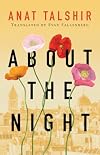
About the Night by Anat Talshir, translated by Evan Fallenberg This is a beautiful story. There's so much to love and appreciate here. This is one of those stories that really make me love historical fiction.
The setting as a big part of what I loved about the story. People try to do stories of this kind in made-up scenarios and though some work, using the events that transpired in Jerusalem in the middle of the last century is just genius. There were so many things that I never quite show more understood about that era that can't really be described in a typical history class type setting. It was so well addressed here while never allowing the events of the day to interfere with the story or seem like it existed solely to explain the conflict. It was just a part of the world, the way the tension was between the two groups, the way that lives were destroyed.
I loved the characters. I feel like I really understood them and their motives. They had a level depth that is rare in any story. I’m sure that this is in part due to that the reader knew most of their entire lives by the end, but none of that was delivered in a strained way. It just flowed naturally through the story. The writing was just amazing. It made the shifting points of view and times feel natural. I'm not a fan of frame type stories, and this one could have been written that way, but the style was just a bit different. Elias was telling the story to Nomi, but they're written as flashbacks and not one person explaining it to another, which I thought worked much better.
This was the first book I finished during this year’s Women in Translation month, and it’s actually my first translated fiction ever. I don’t quite know what I was expecting, but it never felt translated or like the language was forced in any way. Fallenberg, the translator, did a great job and he seems has done at least nine other translations. Check the out here. show less
The setting as a big part of what I loved about the story. People try to do stories of this kind in made-up scenarios and though some work, using the events that transpired in Jerusalem in the middle of the last century is just genius. There were so many things that I never quite show more understood about that era that can't really be described in a typical history class type setting. It was so well addressed here while never allowing the events of the day to interfere with the story or seem like it existed solely to explain the conflict. It was just a part of the world, the way the tension was between the two groups, the way that lives were destroyed.
I loved the characters. I feel like I really understood them and their motives. They had a level depth that is rare in any story. I’m sure that this is in part due to that the reader knew most of their entire lives by the end, but none of that was delivered in a strained way. It just flowed naturally through the story. The writing was just amazing. It made the shifting points of view and times feel natural. I'm not a fan of frame type stories, and this one could have been written that way, but the style was just a bit different. Elias was telling the story to Nomi, but they're written as flashbacks and not one person explaining it to another, which I thought worked much better.
This was the first book I finished during this year’s Women in Translation month, and it’s actually my first translated fiction ever. I don’t quite know what I was expecting, but it never felt translated or like the language was forced in any way. Fallenberg, the translator, did a great job and he seems has done at least nine other translations. Check the out here. show less
I just couldn't really manage to get interested in this story about the secret romance between a Palestinian man and a Turkish Jew in Jerusalem. It's very slow, and the story seems to meander a lot. The height of Elias and Lila's romance really happens early in the book, and then everything after that is about how hard their lives are, and how they can't even see each other for 19 years between 1948 and 1967. If anything, I found the character of Nomi a bit more interesting, and how she came show more from an utterly dysfunctional family to a (seemingly) rewarding career trying to place kids from the foster system with sympathetic families.
The other thing that kind of bothered me about this book is that it was very one-sided about the cultural background it sought to portray. The blurb and a number of reviews described this book as being told from Elias' perspective, but if so then why is Palestinian (oh sorry, “Arab”... I don't think this book uses the words “Palestine” or “Palestinian” even once) culture reduced to just tea and spiced foodand, apparently, going along with it when your parents arrange your marriage to someone you barely know ? Towards the end, Elias is all like, “I don't even believe in culture or religion,” and I have to wonder if that was mainly to make him more palatable to a largely-Jewish readership, because certainly none of the Jewish characters ever talk about Jewish culture or Judaism being meaningless. The book is, at least, critical of Israeli policies in Jerusalem (like the expropriation of all Palestinian-owned properties in West Jerusalem) as well as of the idea that Israelis and Palestinians can't live alongside one another (praising coexistence in Jaffa, for example). But that feels like the bare minimum that this book should've done, you know? It's almost like the author was implying that Israelis and Palestinians can coexist, just so long as Palestinians don't stand out or do anything too “Palestinian-y”. Maybe that wasn't the reason for the oversight, and rather it was just that Talshir didn't know very much about Palestinian culture (unlike her own, obviously) and either didn't want to do the research or didn't trust herself to depict it authentically or thought (since this book has been translated from Hebrew) depicting Elias' culture would set her readers against him. But eh. The imbalance was something that irked me pretty much throughout the book. show less
The other thing that kind of bothered me about this book is that it was very one-sided about the cultural background it sought to portray. The blurb and a number of reviews described this book as being told from Elias' perspective, but if so then why is Palestinian (oh sorry, “Arab”... I don't think this book uses the words “Palestine” or “Palestinian” even once) culture reduced to just tea and spiced food
This was a free book through Amazon Prime's First list. Romance is not my usual genre but having lived in the middle east as a child I enjoy historical fiction about this war torn area of the world. I absolutely loved this book and highly recommend it to anyone interested in the war between Arabs and Jews in Israel/Jordan. The author uses many different voices and points of view and makes you feel the love and hate, heartache and loss throughout. Her words paint a beautiful portrait of the show more area and I almost felt as though I was walking through the sand and desert ruins while enjoying this book. show less
You May Also Like


Associated Authors
Statistics
- Works
- 1
- Members
- 299
- Popularity
- #78,482
- Rating
- 3.6
- Reviews
- 11
- ISBNs
- 4
- Languages
- 1