

Earthworks Group
Author of 50 Simple Things You Can Do to Save the Earth
About the Author
Works by Earthworks Group
¡Los niños salvaremos la tierra! 2 copies
Gardening For the Earth 1 copy
Tagged
Common Knowledge
- Gender
- n/a
Members
Reviews
Review copy courtesy of the LT early Reviewers Program.
I really like this book. There are, of course, countless books around that exhort children to be good, but saving the planet is one thing that kids actually care about. Many of them feel frightened and helpless and deeply pessimistic, so it's really great to have a book like this that offers hope.
The book starts with kid-friendly explanations about what's wrong with the planet, and although some of the examples (such as Throwaways p18) show more are unique to American over-consumption, there are links to websites from around the world and the general message is universal. As the title says, however, this book is not about creating more doom and gloom, and the focus is firmly on what can be done, simply and now, by children.
Jargon is avoided by the use of intelligent metaphors. Non-renewable natural resources become 'Buried Treasures' and there are some simple strategies that kids can choose, all based on the Reduce, Reuse, Recycle philosophy, including my favourite, avoiding the use of bottled water. I was delighted to see that there is actually a Take Back the Tap campaign in the US, and I'd like to see this happen everywhere in places that have clean, hygienic water supplies.
The text is written in an easy conversational style. There is a cute quiz at the start of each section which draws attention to a solution to a problem:
Take a guess: what's the best way to take your lunch to school?
(a) In your pocket?
(b) On a leash?
(c) In a reusable container? (p44)
There are lots of ideas that will appeal to kids. In the chapter entitled Preserving our Oceans, Rivers, Lakes and Streams, kids are invited to become Water-leak Detectives who can set up patrols at school or measure their meters at home. I particularly like the links to videos with water-saving tips made by American students, and there is also one that shows Australian children in our parched country doing the same, though unfortunately the link is dead. (These things happen – the web is a dynamic place, and kids who read this book know that.)
I do like the way the authors have included links to sites from around the world. Although it is written with American children in mind, the book has an international feel to it. It's not patronising or dumbed-down, but it draws attention to the way little actions without thought can contribute to disasters like the Pacific Trash Vortex. The book invites kids to become active in addressing these problems both with changes in behaviour and with forms of activism that are manageable for their age group. The book also stresses collegiate action, within the family and at school, so kids don't feel that efforts to solve environmental problems are futile but rather, are a shared responsibility
Highly recommended, and I hope an Australian edition becomes available here.
Lisa Hill, ANZ LitLovers, Melbourne, Australia show less
I really like this book. There are, of course, countless books around that exhort children to be good, but saving the planet is one thing that kids actually care about. Many of them feel frightened and helpless and deeply pessimistic, so it's really great to have a book like this that offers hope.
The book starts with kid-friendly explanations about what's wrong with the planet, and although some of the examples (such as Throwaways p18) show more are unique to American over-consumption, there are links to websites from around the world and the general message is universal. As the title says, however, this book is not about creating more doom and gloom, and the focus is firmly on what can be done, simply and now, by children.
Jargon is avoided by the use of intelligent metaphors. Non-renewable natural resources become 'Buried Treasures' and there are some simple strategies that kids can choose, all based on the Reduce, Reuse, Recycle philosophy, including my favourite, avoiding the use of bottled water. I was delighted to see that there is actually a Take Back the Tap campaign in the US, and I'd like to see this happen everywhere in places that have clean, hygienic water supplies.
The text is written in an easy conversational style. There is a cute quiz at the start of each section which draws attention to a solution to a problem:
Take a guess: what's the best way to take your lunch to school?
(a) In your pocket?
(b) On a leash?
(c) In a reusable container? (p44)
There are lots of ideas that will appeal to kids. In the chapter entitled Preserving our Oceans, Rivers, Lakes and Streams, kids are invited to become Water-leak Detectives who can set up patrols at school or measure their meters at home. I particularly like the links to videos with water-saving tips made by American students, and there is also one that shows Australian children in our parched country doing the same, though unfortunately the link is dead. (These things happen – the web is a dynamic place, and kids who read this book know that.)
I do like the way the authors have included links to sites from around the world. Although it is written with American children in mind, the book has an international feel to it. It's not patronising or dumbed-down, but it draws attention to the way little actions without thought can contribute to disasters like the Pacific Trash Vortex. The book invites kids to become active in addressing these problems both with changes in behaviour and with forms of activism that are manageable for their age group. The book also stresses collegiate action, within the family and at school, so kids don't feel that efforts to solve environmental problems are futile but rather, are a shared responsibility
Highly recommended, and I hope an Australian edition becomes available here.
Lisa Hill, ANZ LitLovers, Melbourne, Australia show less
 This review was written for LibraryThing Early Reviewers.
This edition is now outdated to the point where it is almost quaint but that shouldn't take away from the profound impact it had it the 1990s. Recycling was not yet popular, water conservation was unheard of and laundry soap still contained phosphates. This little guide provided small steps consumers could make in their daily habits that actually moved the needle in helping the environment. Yes, of course, there's much to be done. But it would have been a lot worse today without the show more grassroots movements ordinary people used to change purchasing habits, make companies produce cleaner products and force municipalities to conserve resources.
It's nice to be reminded of the power we citizens can wield, plus the book includes some tips on larger-scale projects that are still needed today. It's worth keeping around. show less
It's nice to be reminded of the power we citizens can wield, plus the book includes some tips on larger-scale projects that are still needed today. It's worth keeping around. show less
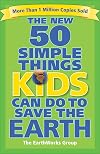
This is an updated edition of a book first published in the 1990's. I haven't read the original, so I can't compare them, but I was sure impressed with this little book, which I got through the early reviewer's program. It is in an attractive paperback format, with a nice bright cover. Charming line drawings illustrate almost every page, and true to its message, it is printed on recycled paper. The book starts off with some background information (What's Happening), then gets into the 50 show more things, broken down into 6 major groups. Each of the 50 things starts with a little quiz question and a bit of background information/teaser, followed by sections titled Did You Know, What You Can Do, Amaze Your Friends, and See for Yourself. These really are things most kids can do, (and most adults should do). I've never yet met a kid who didn't love the possibility of amazing their friends. The book finishes up with a section on Eco-Experiments, and one of Quick Quizzes. I thought it was well-written for its target audience, but not too juvenile for an adult to enjoy. This is full of practical and fun ideas for families to do together, and for teachers to get their classes involved. There are URLs to lots of interesting websites, and a website to go with the book. The stats (not referenced, but this is aimed at kids) and references are mainly American, with measurements in gallons, quarts, miles and degrees Fahrenheit, but the websites referred to are from all over the world. I really liked this book, and will recommend it to families and teachers I know. show less
This review was written for LibraryThing Early Reviewers.This book is my very first Early Reviewers book. What a delight! I have only bought one type of this book before (a how to save the planet book aimed at kids) and was sorely disappointed. I think this book is a better attempt to engage its audience. Its layout is more digestible. It's illustrated - if only simply with line drawings. And it gives action items i.e. it empowers the reader.
This book is a revised and updated version. It was originally written 20 years ago. More than 1 million show more copies were sold of the original book, so that has to be some kind of endorsement. If not of the book, at least that there are 1 million people out there who want to do something about saving the planet.
Lest readers become concerned for trees in the making, it has been printed on recycled paper with soy ink and has a SFI label affixed. I'm a bit ignorant about what soy ink means but I'm sure I'll be enlightened by some kind soul.
Will kids really read this book? I suspect grownups will read it and then encourage them to do the activities. I am happy to be persuaded otherwise. And my big question was - in this day and age of facebook,twitter and blogging, does a book even cut it? Well, the revised edition now refers you to the website www.50simplekids.com.
The authors set themselves their own litmus test of whether kids would be able to either read or engage with the text. They wanted to create tasks kids could do on their own and tasks that would have an immediate observable/comprehensible impact.
Changes in the new edition include replacing 20% of the Simple Things to do with new ones. There is a new feature called Amaze Your Friends. And the addition of relevant websites.
The book is structured as follows: a simple introduction to what is happening i.e. what effect human activity is having on the planet: climate change; water pollution; air pollution; disappearing animals etc. Then it launches into the 50 simple things kids can do across six areas: guarding buried treasures; preserving our oceans, rivers, lakes and streams; protecting animals; keeping the earth green; using energy wisely and spreading the word. There are some eco-experiments and quick quizzes listed at the back.
I am so inspired that I want to take a task each week and attempt to tackle it, reporting on my blog
http://luvviesmusings.blogspot.com/
If there are any criticisms of the book they seem somewhat churlish. It's published in the USA so tends to have ethnocentric idioms like "daipers" and "pail" rather than my ethnocentric preferences for "nappy" and "bucket". It refers to imperial measurement rather than metric. But I suspect kids these days are much more relaxed and cogniscent and accepting of difference than a boring old fart like me born in the 60s.
It is also heartening to read statements like "Find out if your town has curbside recyling." and to be able to smugly reply "Yes!". But we mustn't sit on our laurels in Brisbane...we must keep looking for more we can do. My first step this week was to order a recycling crate for our office at work. We already recycle paper but we don't have a recycling bin for bottles and cans.
There....see...the book has worked already ....well done Sharon, Sophie and Jess Javna and the Earthworks Group! show less
This book is a revised and updated version. It was originally written 20 years ago. More than 1 million show more copies were sold of the original book, so that has to be some kind of endorsement. If not of the book, at least that there are 1 million people out there who want to do something about saving the planet.
Lest readers become concerned for trees in the making, it has been printed on recycled paper with soy ink and has a SFI label affixed. I'm a bit ignorant about what soy ink means but I'm sure I'll be enlightened by some kind soul.
Will kids really read this book? I suspect grownups will read it and then encourage them to do the activities. I am happy to be persuaded otherwise. And my big question was - in this day and age of facebook,twitter and blogging, does a book even cut it? Well, the revised edition now refers you to the website www.50simplekids.com.
The authors set themselves their own litmus test of whether kids would be able to either read or engage with the text. They wanted to create tasks kids could do on their own and tasks that would have an immediate observable/comprehensible impact.
Changes in the new edition include replacing 20% of the Simple Things to do with new ones. There is a new feature called Amaze Your Friends. And the addition of relevant websites.
The book is structured as follows: a simple introduction to what is happening i.e. what effect human activity is having on the planet: climate change; water pollution; air pollution; disappearing animals etc. Then it launches into the 50 simple things kids can do across six areas: guarding buried treasures; preserving our oceans, rivers, lakes and streams; protecting animals; keeping the earth green; using energy wisely and spreading the word. There are some eco-experiments and quick quizzes listed at the back.
I am so inspired that I want to take a task each week and attempt to tackle it, reporting on my blog
http://luvviesmusings.blogspot.com/
If there are any criticisms of the book they seem somewhat churlish. It's published in the USA so tends to have ethnocentric idioms like "daipers" and "pail" rather than my ethnocentric preferences for "nappy" and "bucket". It refers to imperial measurement rather than metric. But I suspect kids these days are much more relaxed and cogniscent and accepting of difference than a boring old fart like me born in the 60s.
It is also heartening to read statements like "Find out if your town has curbside recyling." and to be able to smugly reply "Yes!". But we mustn't sit on our laurels in Brisbane...we must keep looking for more we can do. My first step this week was to order a recycling crate for our office at work. We already recycle paper but we don't have a recycling bin for bottles and cans.
There....see...the book has worked already ....well done Sharon, Sophie and Jess Javna and the Earthworks Group! show less
This review was written for LibraryThing Early Reviewers.Awards

You May Also Like


Associated Authors
Statistics
- Works
- 26
- Members
- 2,397
- Popularity
- #10,712
- Rating
- 3.7
- Reviews
- 43
- ISBNs
- 44
- Languages
- 6
