
David Caute
Author of The Great Fear: The Anti-Communist Purge under Truman and Eisenhower
About the Author
David Caute graduated with a First in Modern History from Wadham College, Oxford, and was subsequently a Scholar of St Antony's College, a Henry Fellow at Harvard, and a Fellow of All Souls College. He was visiting Professor at New York, Columbia, and Indiana universities, Regents' Lecturer at the show more University of California, Reader in Social and Political Theory at Brunel University, and Benjamin Meaker Visiting Professor at the University of Bristol. In recent years he has been visiting lecturer at Princeton, Rutgers and Brooklyn College in the USA, and the Universities of Metz and Nancy in France. He has been Literary and Arts Editor of the New Statesman and Co-Chairman of the Writers' Guild show less
Series
Works by David Caute
Associated Works
Tagged
Common Knowledge
- Other names
- Caute, John David
- Birthdate
- 1936-12-16
- Gender
- male
- Education
- Wadham College, Oxford (MA|Modern History)
St Antony's College, Oxford (DPhil|1963) - Occupations
- historian
university professor
journalist
novelist
playwright - Organizations
- Oxford University
Harvard University
Brunel University
The New Statesman
New York University
Columbia University (show all 9)
University of California, Irvine
Bristol University
Writers' Guild of Great Britain - Awards and honors
- Royal Society of Literature (Fellow)
- Nationality
- UK
- Birthplace
- Alexandria, Egypt
- Associated Place (for map)
- Alexandria, Egypt
Members
Reviews
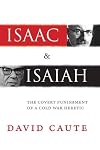
In doing research on the Cold War in the Bodleian Library, the author discovers correspondence of Isaiah Berlin blocking Isaac Deutscher's appointment in 1963 to a chair in Soviet studies at the University of Sussex. Intrigued by this story of personal animus (and by his own personal memory of allusions Berlin had made at the time without noting the name of the institution), the author uses the feud as a path for exploring Berlin and Deutscher's differing views on a wide range of Cold War show more and other controversies relating to, among others, Trotsky, Stalin, Pasternak, the People’s Democracies, Israel, and the Vietnam War. The author not only draws the contrast between them but also separately analyzes and critiques their different views. The result is a series of fascinating and illuminating discussions of these complex topics. While the book is occasioned by the blockage of the appointment, the author is fair to Berlin, and indeed is willing to entertain extenuating circumstances with respect to it. Despite this, Berlin comes off poorly in this book-- on the one hand, many of his public pronouncements and writings on the Cold War topics under consideration come across as Cold War ideology and, on the other, his involvement behind the scenes involving not only Deutscher but also other matters (including, interestingly, Hannah Arendt’s Eichmann in Jerusalem) comes across as scheming. One surprising tidbit is that while serving in the British Embassy in Washington, Berlin leaked to the US Jewish community on one occasion confidential information concerning the UK’s policies on Israel. There are not as many insights into Deutscher’s private life (for one thing, there appears to be no biography comparable to Michael Ignatieff's of Berlin to draw on) but the author nevertheless provides an interesting narrative of his actions and writings. Deutscher had a much larger body of work on Soviet history and related issues than did Berlin. While rejecting Berlin's views on Deutscher's qualifications for an academic post, the author agrees with many criticisms of Deutscher's political and historical positions including his tendency to excuse Soviet actions and policies in the expectation that in the future the Soviet Union would eventually become a better socialist society. show less
Most literate people are aware that there was a revolution in Seventeenth-century England, even if they call it a "civil war" or identify it in terms of Oliver Cromwell. Many people have heard of the various religious and political sects which flourished in that time, under such unlikely names as "Ranters", "Levellers", "Fifth Monarchists", "Muggletonians", and -- perhaps most notably, the "Diggers". But how many actually know anything about those brave, literate, and uncompromising early show more communists led by the redoubtableGerard Winstanley? Thier story is important, not merely for British history, but for the history of human liberation. Yet realistically, few people can or will read the various fine scholarly works on the subject, or Winstanley's own pasionate writings, most notably THE NEW LAW OF RIGHETEOUSNESS. Failing that, this film is a splendid introduction, not to mention being a fascinating piece of film-art in its own right. The film proper is supplemented in this tape by a documentary of the production of the feature. My only complaint about this film is that there isn't enough of it, or thatmore people haven't had the opportunity to see it. show less

interesting insights, given its age; distinguishes "political" from "economic" left

Reviewed in the June 1966 issue of the Socialist Standard:
http://socialiststandardmyspace.blogspot.com/2017/11/what-is-left-1966.html
http://socialiststandardmyspace.blogspot.com/2017/11/what-is-left-1966.html
Lists
Awards


You May Also Like


Associated Authors
Statistics
- Works
- 32
- Also by
- 4
- Members
- 782
- Popularity
- #32,554
- Rating
- 3.7
- Reviews
- 4
- ISBNs
- 82
- Languages
- 4