
Ellen Schrecker
Author of Age of McCarthyism: A Brief History With Documents
About the Author
Ellen Schrecker is Professor of History at Yeshiva University
Disambiguation Notice:
Ellen W. Schrecker, historian of McCarthyism, is co-author, with John E. Schrecker, historian of modern China, of Mrs. Chaing's Szechwan Cookbook, the recipes of Chiang Jung-feng, the cook they met in Taiwan.
Image credit: Ellen Schrecker [credit: Anthony Losquadro/The Hoot]
Works by Ellen Schrecker
Cold War Triumphalism: The Misuse of History After the Fall of Communism (2004) — Editor; Contributor — 41 copies
Associated Works
War and democracy : a comparative study of the Korean War and the Peloponnesian War (2000) — Contributor — 8 copies
Tagged
Common Knowledge
- Canonical name
- Schrecker, Ellen
- Legal name
- Schrecker, Ellen Wolf
- Other names
- Schrecker, Ellen W.
- Birthdate
- 1938-08-04
- Gender
- female
- Education
- Radcliffe College
Harvard University - Occupations
- historian
- Organizations
- Yeshiva University
Harvard University
Princeton University
New York University
New School for Social Research
Columbia University (show all 7)
American Civil Liberties Union - Relationships
- Schrecker, John E. (husband)
- Nationality
- USA
- Birthplace
- Philadelphia, Pennsylvania, USA
- Disambiguation notice
- Ellen W. Schrecker, historian of McCarthyism, is co-author, with John E. Schrecker, historian of modern China, of Mrs. Chaing's Szechwan Cookbook, the recipes of Chiang Jung-feng, the cook they met in Taiwan.
- Associated Place (for map)
- Pennsylvania, USA
Members
Reviews

Ellen Schreck has given us a vivid portrait of the dilemma many college professors faced during witch-hunts of the early fifties. She begins with an extensive history of the concept of academic freedom. No consensus has ever been reached on what exactly it is.
Usually it resulted in debate on campus in response to external threats rather than internal dissent. Leading members of the academic community wanted to control behavior which might lead to outside intervention. The 1st AAUP show more formulation of academic freedom in fact discouraged controversy and implored the teacher to teach all sides of an issue. Unfortunately, academic freedom meant nothing to those charged with being fellow travelers or communists. One of the great "catch-22s" of this era was that by definition anyone who denied being, a communist was by definition a communist. Simply pleading the Fifth Amendment became grounds for dismissal at many institutions, as did failure to rat on one's colleagues. Even though many academics were not ultimately charged by HUAC, simply the fact they were asked to testify became grounds enough for dismissal. It became virtually impossible to defend oneself, especially when college faculty, presidents and boards, sought to avoid any hint of controversy and found it was much easier to expel the accused than try to defend him. The vaguest hint that federal funds for research grants might be in jeopardy caused the faculty to quiver with anxiety and to throw ethics to the wind. Academic freedom was used to justify firings in many case~. The reasoning was that one could not be intellectually honest if one had had anything to do with communists. Academic freedom was defined from an institutional standpoint rather than and ideological one. Paranoid professors feared that if the academic community failed to purge itself, witch-hunts would organized from the outside. Tragically, Schreck's account shows how academia's self-enforcement of McCarthyism silenced an entire generation of radical intellectuals and stifled all opposition to the official version of the Cold War. Ironically many who suffered the most were teachers who, after becoming seriously disillusioned with communism, had abandoned the party. Many were also accused of communistic leanings for campus political ends. There are all to few examples of heroic faculty who, because of support from their colleagues and/or administration, were able to keep their jobs despite tremendous pressure.
A sad episode in the history of academic community. show less
Usually it resulted in debate on campus in response to external threats rather than internal dissent. Leading members of the academic community wanted to control behavior which might lead to outside intervention. The 1st AAUP show more formulation of academic freedom in fact discouraged controversy and implored the teacher to teach all sides of an issue. Unfortunately, academic freedom meant nothing to those charged with being fellow travelers or communists. One of the great "catch-22s" of this era was that by definition anyone who denied being, a communist was by definition a communist. Simply pleading the Fifth Amendment became grounds for dismissal at many institutions, as did failure to rat on one's colleagues. Even though many academics were not ultimately charged by HUAC, simply the fact they were asked to testify became grounds enough for dismissal. It became virtually impossible to defend oneself, especially when college faculty, presidents and boards, sought to avoid any hint of controversy and found it was much easier to expel the accused than try to defend him. The vaguest hint that federal funds for research grants might be in jeopardy caused the faculty to quiver with anxiety and to throw ethics to the wind. Academic freedom was used to justify firings in many case~. The reasoning was that one could not be intellectually honest if one had had anything to do with communists. Academic freedom was defined from an institutional standpoint rather than and ideological one. Paranoid professors feared that if the academic community failed to purge itself, witch-hunts would organized from the outside. Tragically, Schreck's account shows how academia's self-enforcement of McCarthyism silenced an entire generation of radical intellectuals and stifled all opposition to the official version of the Cold War. Ironically many who suffered the most were teachers who, after becoming seriously disillusioned with communism, had abandoned the party. Many were also accused of communistic leanings for campus political ends. There are all to few examples of heroic faculty who, because of support from their colleagues and/or administration, were able to keep their jobs despite tremendous pressure.
A sad episode in the history of academic community. show less

McCarthyism is often seen as an aberration in American society. It was a brief moment when hysteria and fear overcame the American ideal of fairness and due process. Ellen Schrecker works to overturn that idea by looking at McCarthyism as a phenomenon over the course of the Cold War. Schrecker, however, does not look at the causes of McCarthyism so much as the effects in personal terms. Her goal is to demonstrate how state oppression has a human and societal cost.
She does not paint American show more Communists as saints. She points out that many collaborated with the USSR and others lied about their affiliations. Nevertheless, thousands were driven from their professions and some ended in jail based on paranoid accusations. Even people who were eventually exonerated suffered such trauma that they sometimes never recovered.
Schrecker uses a great deal of case studies and tends to use McCarthyism as a trope for general repression in society. She emphasizes the human cost while avoiding looks at the larger causes. She has opened the door for research with a more sociological approach, although ten years later, no major work comes to mind that has built on her work. show less
She does not paint American show more Communists as saints. She points out that many collaborated with the USSR and others lied about their affiliations. Nevertheless, thousands were driven from their professions and some ended in jail based on paranoid accusations. Even people who were eventually exonerated suffered such trauma that they sometimes never recovered.
Schrecker uses a great deal of case studies and tends to use McCarthyism as a trope for general repression in society. She emphasizes the human cost while avoiding looks at the larger causes. She has opened the door for research with a more sociological approach, although ten years later, no major work comes to mind that has built on her work. show less
The McCarthy era was a tragic chapter in American history. Schrecker's book is one of the best I've read on this period. She reminds us that hundreds, maybe thousands, of lives were shattered by unfair or disingenuous accusations. Most affected were academics, union leaders, Hollywood writers, directors, and actors, and government workers. Many of them were chastised for trying to live their political ideals 20 years before, when the economy was in ruins and people were looking for more show more equitable solutions to poverty, not to mention racism and unfair labor practices. Communism, along with socialism and anarchism, was seen for a brief period of time by some as offering alternatives to what was then a very broken system.
There was never any threat to the American way of life, despite what Joe McCarthy and others said. As Schrecker points out, many of the loudest accusers knew this. Their real motive was breaking up union activity, protecting corporate power, and undermining many of the successes of the New Deal. In large part, they succeeded.
Worse still, and beyond all the lives and families it destroyed, McCarthyism had lasting negative effects on politics and culture that still hurt us. It destroyed the left. The damage done to the labor movement has never been recovered. McCarthyism hurt America's international relations by narrowing foreign policy, and thus intensifying the cold war. As Schrecker puts it, "The anticommunist purges wiped out the means through which it was possible to offer an alternative vision of the world." show less
There was never any threat to the American way of life, despite what Joe McCarthy and others said. As Schrecker points out, many of the loudest accusers knew this. Their real motive was breaking up union activity, protecting corporate power, and undermining many of the successes of the New Deal. In large part, they succeeded.
Worse still, and beyond all the lives and families it destroyed, McCarthyism had lasting negative effects on politics and culture that still hurt us. It destroyed the left. The damage done to the labor movement has never been recovered. McCarthyism hurt America's international relations by narrowing foreign policy, and thus intensifying the cold war. As Schrecker puts it, "The anticommunist purges wiped out the means through which it was possible to offer an alternative vision of the world." show less
The Lost Soul of Higher Education: Corporatization, the Assault on Academic Freedom, and the End of the American University by Ellen Schrecker
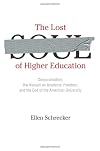
An important work on the higher education system and its discontents. Why are our schools operating as corporations, and what does this mean for the future of education? The author examines the history of academic freedom, then moves into the evolution of the school from an institution of higher learning directed in large part by the faculty to a corporation in the business of delivering degrees directed in large part by the administrators who are more interested in concrete measures of show more success, such as numbers of butts in seats, then in more nebulous ones, such as the quality of education delivered. Should be required reading for everyone who has been subjected to the ubiquitous propaganda machine that trumpets the evils of modern higher education; if you have ever bemoaned the "indoctrination" or snarked about the easy life of an academic, or asked why we need humanities education anyway, this book is just what you need. show less
Lists
You May Also Like


Associated Authors
Statistics
- Works
- 12
- Also by
- 3
- Members
- 623
- Popularity
- #40,414
- Rating
- 3.9
- Reviews
- 6
- ISBNs
- 27
- Languages
- 1


