
Frances Stonor Saunders
Author of Hawkwood: Diabolical Englishman
About the Author
Works by Frances Stonor Saunders
Associated Works
Tagged
Common Knowledge
- Legal name
- Saunders, Frances Hélène Jeanne Stonor
- Birthdate
- 1966
- Gender
- female
- Education
- University of Oxford (St Anne's College)
- Occupations
- journalist
historian
television filmmaker - Organizations
- New Statesman
- Relationships
- Stonor, Julia Camoys (mother)
- Nationality
- UK
- Birthplace
- UK
- Places of residence
- London, England, UK
- Associated Place (for map)
- England, UK
Members
Reviews

One thing is for sure: war is about money. Always has been and always will be. John Hawkwood was merely an excellent and unashamed practitioner of war as a revenue-generating activity. 1360, a treaty is signed and the Hundred Years War pauses, but people keep fighting, mostly English soldiers who stay in France to kill and burn and pillage because it beats going home and doing an honest day's work or dying of the plague. The soldiers coalesce into large companies who style themselves show more mercenaries, though instead of being paid to fight, they mostly just fight until they're paid to go away. Amongst the hordes laying waste to much of France is unassuming Essex man, John Hawkwood. They range far and wide until they finally threaten the pope, living in luxurious exile in Avignon. In sheer self-defence, the pope hires Hawkwood and tells him to go to Italy, and that's where Hawkwood goes, bringing an exciting new era of death and destruction with him.
Northern Italy is full of strong, prosperous city states like Milan, Florence and Siena, all of whom hate each other, a situation which Hawkwood coolly and calmly and ruthlessly exploits. Soon he and his men are killing peasants, raping women, burning crops, ransoming nobles and even defeating the odd army here and there, collecting vast sums from various signoria to go away and bother the other guy. Then the pope returns to Rome and tries to take charge and more people die and Hawkwood keeps raking it in.
Hawkwood, oddly enough, remains a cipher. We only know him through his actions, his clever maneuverings, his carefully controlled slaughtering and kidnapping and, oh yeah, that one really big massacre at Cesena. He left no writings behind to provide any sort of insight into his character or personality, and mostly he just kept soldiering and ransoming and robbing and threatening and killing because that's what he was good at. Instead we have walk-on parts by the likes of Chaucer, Boccaccio, Petrarch and Catherine of Siena to bring the age to life and illuminate the minds and souls of the players and the landscape they moved through: wealth, poverty, famine, plague, war, not to mention the obscene iniquity of holy mother church, outdoing all others in the atrocity stakes as it gropes for secular power, while its cardinals and prelates are ardent practitioners of the seven deadly sins.
This is a deeply interesting book, written with a cool, clear detachment that occasionally turns acerbic. It is an edifying and sobering piece of history, and if Hawkwood remains an enigma, it may be because we don't yet understand how much of history is carved out by cool, ruthless bastards doing whatever the hell they wanted. show less
Northern Italy is full of strong, prosperous city states like Milan, Florence and Siena, all of whom hate each other, a situation which Hawkwood coolly and calmly and ruthlessly exploits. Soon he and his men are killing peasants, raping women, burning crops, ransoming nobles and even defeating the odd army here and there, collecting vast sums from various signoria to go away and bother the other guy. Then the pope returns to Rome and tries to take charge and more people die and Hawkwood keeps raking it in.
Hawkwood, oddly enough, remains a cipher. We only know him through his actions, his clever maneuverings, his carefully controlled slaughtering and kidnapping and, oh yeah, that one really big massacre at Cesena. He left no writings behind to provide any sort of insight into his character or personality, and mostly he just kept soldiering and ransoming and robbing and threatening and killing because that's what he was good at. Instead we have walk-on parts by the likes of Chaucer, Boccaccio, Petrarch and Catherine of Siena to bring the age to life and illuminate the minds and souls of the players and the landscape they moved through: wealth, poverty, famine, plague, war, not to mention the obscene iniquity of holy mother church, outdoing all others in the atrocity stakes as it gropes for secular power, while its cardinals and prelates are ardent practitioners of the seven deadly sins.
This is a deeply interesting book, written with a cool, clear detachment that occasionally turns acerbic. It is an edifying and sobering piece of history, and if Hawkwood remains an enigma, it may be because we don't yet understand how much of history is carved out by cool, ruthless bastards doing whatever the hell they wanted. show less
The Devil's Broker: Seeking Gold, God, and Glory in Fourteenth- Century Italy by Frances Stonor Saunders
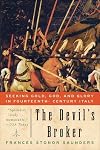
The Devil's Broker is a fascinating popular account of the life of infamous knight and mercenary commander John Hawkwood. One of the minor English warriors who participated in the 100 Years War under Edward III, after a truce he quit formal service and joined a mercenary company. The difference between royal service and mercenary work was rather theoretical. The English chevauchee was pure economic warfare, wide-ranging looting of the countryside that paid for itself. Mercenary work was much show more the same.
Hawkwood's company, the White Company, crossed into Italy, and there Hawkwood found his calling. His career was complex, to say the least, with Hawkwood fighting for Milan, Florence, and the Papacy at various points, although contrary to popular beliefs about mercenaries, Hawkwood did not suddenly switch sides on the eve of battle, or avoid battle entirely. Along with sacks and sudden assaults by storm and stealth, he was a master of the feigned retreat, luring his foes into vulnerable positions for a counter-charge. He participated in the brutal Massacre at Cesena while working for the papacy, and then switched to secular service.
Saunders makes the case for Hawkwood as an influential figure of the age. Aside from someone who executed the bloody intrigues of Italian politics, he also served as model for the protagonist of Chaucer's "The Knight's Tale" (the two met several times), and advanced English foreign policy in Italy, a vital market for English wool, and a strategic theater for apply leverage against the French from a second front.
Despite his long career and evident success in battle, Hawkwood died essentially broke, leaving his wife and children to make their own way in the world rather than establishing a major line. Dying in bed at the age of 71 or 72 is more than a lot of his contemporaries could say.
A Distant Mirror, this book, Mercenaries and Their Masters and
The Artist, the Philosopher, and the Warrior would make a solid survey of the era. show less
Hawkwood's company, the White Company, crossed into Italy, and there Hawkwood found his calling. His career was complex, to say the least, with Hawkwood fighting for Milan, Florence, and the Papacy at various points, although contrary to popular beliefs about mercenaries, Hawkwood did not suddenly switch sides on the eve of battle, or avoid battle entirely. Along with sacks and sudden assaults by storm and stealth, he was a master of the feigned retreat, luring his foes into vulnerable positions for a counter-charge. He participated in the brutal Massacre at Cesena while working for the papacy, and then switched to secular service.
Saunders makes the case for Hawkwood as an influential figure of the age. Aside from someone who executed the bloody intrigues of Italian politics, he also served as model for the protagonist of Chaucer's "The Knight's Tale" (the two met several times), and advanced English foreign policy in Italy, a vital market for English wool, and a strategic theater for apply leverage against the French from a second front.
Despite his long career and evident success in battle, Hawkwood died essentially broke, leaving his wife and children to make their own way in the world rather than establishing a major line. Dying in bed at the age of 71 or 72 is more than a lot of his contemporaries could say.
A Distant Mirror, this book, Mercenaries and Their Masters and
The Artist, the Philosopher, and the Warrior would make a solid survey of the era. show less

The Cultural Cold War is a deeply researched study of a tempest in a tea pot. In the immediate aftermath of WW2, several OSS associated American figures: Michael Josselson, Melvin Lasky, and Nicolas Nabokov (cousin of the famous writer), noticed that the Soviet Union was beating the pants off of the Western Allies in terms of propaganda and cultural prestige, and that this should be countered by every available means.
These arguments found an avid audience in the newly formed CIA, and the show more interlocking establishment apparat of WASPy Groton-Yale-Harvard types who formed the backbone of the American elite and the CIA's upper echelons. Under the aegis of the Congress for Cultural Freedom, the CIA funded a wide variety of anti-Soviet efforts, from showcases of composers banned as "decadent" under Soviet musical practice, to translations and distributions of books, and the organization of conferences and elite-centered journals. All of these organizations concealed their CIA ties, forming a means to organize the Non-Communist Left from pro-Communist attitudes towards neutrality and from neutrality to Atlanticism.
The deceit was probably necessary. An American Ministry of Culture, or "white propaganda" programs out of the State Department, would have attracted reflexive disdain from European intellectuals and know-nothing American conservatives. It also proved the fatal unravelling of the enterprise in the late 1960s, as sloppy finances made it obvious that the CIA paid pass-through foundations with funded the Congress and various magazines like Encounters.
As far as CIA activities went, this was all probably harmless. Saunders doesn't have complete figures, but the activities of the Congress must be far less expensive than the covert sabotage programs and coups of the Office of Policy Coordination, which were less expensive than stationing another armored division in Germany, which was less expensive than developing a supersonic nuclear bomber. If anyone died, it was a consequence of high living at one of the Congress' retreats; not assassination.
On the flip side, it's hard to see what this effort actually accomplished. The Congress never damaged the prestige of Sartre and Camus, who rejected Stalinism on their own after the 1956 Invasion of Hungary. The Red Scare and waves of McCarthy associated censorship put lie to the claim that America was a bastion of freedom. The escalating Vietnam War would have likely fractured the Non-Communist Left alliance eventually, even without the revelations about the CCF. And the ultimate cultural victory, the psychedelic exuberance of the Beats and the Hippies had nothing to do with any of the CIA's cultural programs (maybe something to do with MKULTRA and Timothy Leary, but that was hardly part of a master plan).
This book is comprehensively and deeply researched, and covers an interesting period in history, though from an angle without much relevance. Many figures regarded as intellectual and artistic giants were funded in part by the CIA without much damage to their current reputation. Conversely, CIA money couldn't keep many others from sinking into obscurity. Culture was a sideshow to the main action, be that in Moscow, Berlin, or Saigon. show less
These arguments found an avid audience in the newly formed CIA, and the show more interlocking establishment apparat of WASPy Groton-Yale-Harvard types who formed the backbone of the American elite and the CIA's upper echelons. Under the aegis of the Congress for Cultural Freedom, the CIA funded a wide variety of anti-Soviet efforts, from showcases of composers banned as "decadent" under Soviet musical practice, to translations and distributions of books, and the organization of conferences and elite-centered journals. All of these organizations concealed their CIA ties, forming a means to organize the Non-Communist Left from pro-Communist attitudes towards neutrality and from neutrality to Atlanticism.
The deceit was probably necessary. An American Ministry of Culture, or "white propaganda" programs out of the State Department, would have attracted reflexive disdain from European intellectuals and know-nothing American conservatives. It also proved the fatal unravelling of the enterprise in the late 1960s, as sloppy finances made it obvious that the CIA paid pass-through foundations with funded the Congress and various magazines like Encounters.
As far as CIA activities went, this was all probably harmless. Saunders doesn't have complete figures, but the activities of the Congress must be far less expensive than the covert sabotage programs and coups of the Office of Policy Coordination, which were less expensive than stationing another armored division in Germany, which was less expensive than developing a supersonic nuclear bomber. If anyone died, it was a consequence of high living at one of the Congress' retreats; not assassination.
On the flip side, it's hard to see what this effort actually accomplished. The Congress never damaged the prestige of Sartre and Camus, who rejected Stalinism on their own after the 1956 Invasion of Hungary. The Red Scare and waves of McCarthy associated censorship put lie to the claim that America was a bastion of freedom. The escalating Vietnam War would have likely fractured the Non-Communist Left alliance eventually, even without the revelations about the CCF. And the ultimate cultural victory, the psychedelic exuberance of the Beats and the Hippies had nothing to do with any of the CIA's cultural programs (maybe something to do with MKULTRA and Timothy Leary, but that was hardly part of a master plan).
This book is comprehensively and deeply researched, and covers an interesting period in history, though from an angle without much relevance. Many figures regarded as intellectual and artistic giants were funded in part by the CIA without much damage to their current reputation. Conversely, CIA money couldn't keep many others from sinking into obscurity. Culture was a sideshow to the main action, be that in Moscow, Berlin, or Saigon. show less

Violet Gibson was born into wealth and position, daughter of an influential Anglo-Irish peer, but died incarcerated in an English mental asylum, surviving, perhaps surprisingly, into her eightieth year. On page 285 (of the Faber paperback edition) the reader can see a 1935 photograph of Violet feeding birds in the grounds of the hospital. Her right hand is extended, palm up, with two of the birds eating from it and others on the lawn before her.
At first glimpse, the photo appears sad, an show more elderly lady in a heavily walled yard who wears a nondescript, full-length coat, finding what? A sense of compassionate value that gives her life meaning? As Frances Stonor Saunders writes, ‘Denied the spiritual comforts of her (adopted) Catholic liturgy… she spent more and more time outside… where she waited patiently for the little birds.’ One is left to wonder if, in her afflicted mind, she was attempting to fulfil some part of the life aspiration of Saint Francis?
The Honourable Violet Gibson underwent a dramatic change in fortune because of her beliefs. Born to Edward Gibson Ashbourne, one-time Lord Chancellor of Ireland and his wife, Lady Frances, her family was staunchly Protestant and republican. Violet suffered physical and mental illness both as a child and a young woman, her temper tantrums a case in point. In her late teens, she is also said to have lost an unnamed fiancee, but the who and the how remain obscure. It was a time in which she studied voraciously, drawing continually closer to Catholic teachings, a faith to which she converted in her mid-twenties.
In so doing, she was unable to garner from Lord Ashbourne the paternal sympathy or understanding she so craved.
Violet moved briefly to France to work for pacifist organisations in Paris, later moving to Italy with the intention of distributing largesse. It was at a time, a century past, when Benito Mussolini was garnering greater influence in Italian society, soon elevated to lead the fascisti into power as their Duce. Mussolini’s style and influence had great bearing on Hitler who planned and followed much the same path in Germany in the two decades ahead.
Violet Gibson carried a revolver. Conflicted by her study of the Scriptures, with Exodus stating clearly it is wrong to murder, yet with the command later given for the Israelites to kill, she had an avowed intent to ‘shoot someone,’ although there’s little to indicate whether the shooting would be for personal protection or for more ulterior reasons. At one time, as a clue, she even told family the Pope should be eliminated because of his indifference to Modernism and Christian socialism.
In the event, the ‘someone’ she shot took the form of Mussolini, and this only months after an attempt to suicide by firing a bullet into her chest! Irreligious himself, the dictator-to-be said that if the Vatican were to renounce its temporal dreams, his Italy would furnish the church with all the material aid at the country's disposal. This dictum, added to a distaste for the man himself, including his policy and political direction, greatly disturbed her.
Violet had the weapon with her one fateful day in April 1926 when, heading for Fascist Party Headquarters in Palazzo del Littorio, she was attracted to a crowd at the Palazzo dei Conservatori. People had thronged there for a glimpse of Mussolini as he left following an address to a congress of surgeons.
Somehow, the slight woman - she stood barely five foot one in the old scale - was able to push her way through the cheering mob, managing to approach within eight feet of the leader. Raising her weapon, she fired twice. The first shot grazed the bridge of Mussolini’s nose, while the second jammed in the elderly firearm. She was quickly brought down and disarmed, but taken away by police before the crowd could do her any serious injury.
The enigmatic Violet Gibson who so nearly assassinated one of history’s most repugnant modern dictators was whisked away to St Andrew’s Hospital, Northampton, with evident complicity between the British and Italian governments. Despite appeals, especially for transfer from a state-run to a Catholic institution, it was to remain her home for the final thirty years of her life.
There are cogent arguments to the effect Violet Gibson was mad. But so too might many of the same arguments be applied to her fellow protagonist…
History boring? Gosh no, especially when so brilliantly researched and written by someone with Stonor Saunders’ storytelling ability, and about such an intriguing chapter in twentieth century history. The Woman Who Shot Mussolini may be a relatively little known story, but is a book that deserves to be read by everyone with an interest in European developments of that time, and since.
Five stars for a captivating read! show less
At first glimpse, the photo appears sad, an show more elderly lady in a heavily walled yard who wears a nondescript, full-length coat, finding what? A sense of compassionate value that gives her life meaning? As Frances Stonor Saunders writes, ‘Denied the spiritual comforts of her (adopted) Catholic liturgy… she spent more and more time outside… where she waited patiently for the little birds.’ One is left to wonder if, in her afflicted mind, she was attempting to fulfil some part of the life aspiration of Saint Francis?
The Honourable Violet Gibson underwent a dramatic change in fortune because of her beliefs. Born to Edward Gibson Ashbourne, one-time Lord Chancellor of Ireland and his wife, Lady Frances, her family was staunchly Protestant and republican. Violet suffered physical and mental illness both as a child and a young woman, her temper tantrums a case in point. In her late teens, she is also said to have lost an unnamed fiancee, but the who and the how remain obscure. It was a time in which she studied voraciously, drawing continually closer to Catholic teachings, a faith to which she converted in her mid-twenties.
In so doing, she was unable to garner from Lord Ashbourne the paternal sympathy or understanding she so craved.
Violet moved briefly to France to work for pacifist organisations in Paris, later moving to Italy with the intention of distributing largesse. It was at a time, a century past, when Benito Mussolini was garnering greater influence in Italian society, soon elevated to lead the fascisti into power as their Duce. Mussolini’s style and influence had great bearing on Hitler who planned and followed much the same path in Germany in the two decades ahead.
Violet Gibson carried a revolver. Conflicted by her study of the Scriptures, with Exodus stating clearly it is wrong to murder, yet with the command later given for the Israelites to kill, she had an avowed intent to ‘shoot someone,’ although there’s little to indicate whether the shooting would be for personal protection or for more ulterior reasons. At one time, as a clue, she even told family the Pope should be eliminated because of his indifference to Modernism and Christian socialism.
In the event, the ‘someone’ she shot took the form of Mussolini, and this only months after an attempt to suicide by firing a bullet into her chest! Irreligious himself, the dictator-to-be said that if the Vatican were to renounce its temporal dreams, his Italy would furnish the church with all the material aid at the country's disposal. This dictum, added to a distaste for the man himself, including his policy and political direction, greatly disturbed her.
Violet had the weapon with her one fateful day in April 1926 when, heading for Fascist Party Headquarters in Palazzo del Littorio, she was attracted to a crowd at the Palazzo dei Conservatori. People had thronged there for a glimpse of Mussolini as he left following an address to a congress of surgeons.
Somehow, the slight woman - she stood barely five foot one in the old scale - was able to push her way through the cheering mob, managing to approach within eight feet of the leader. Raising her weapon, she fired twice. The first shot grazed the bridge of Mussolini’s nose, while the second jammed in the elderly firearm. She was quickly brought down and disarmed, but taken away by police before the crowd could do her any serious injury.
The enigmatic Violet Gibson who so nearly assassinated one of history’s most repugnant modern dictators was whisked away to St Andrew’s Hospital, Northampton, with evident complicity between the British and Italian governments. Despite appeals, especially for transfer from a state-run to a Catholic institution, it was to remain her home for the final thirty years of her life.
There are cogent arguments to the effect Violet Gibson was mad. But so too might many of the same arguments be applied to her fellow protagonist…
History boring? Gosh no, especially when so brilliantly researched and written by someone with Stonor Saunders’ storytelling ability, and about such an intriguing chapter in twentieth century history. The Woman Who Shot Mussolini may be a relatively little known story, but is a book that deserves to be read by everyone with an interest in European developments of that time, and since.
Five stars for a captivating read! show less
Lists
Awards


You May Also Like


Associated Authors
Statistics
- Works
- 13
- Also by
- 1
- Members
- 1,079
- Popularity
- #23,833
- Rating
- 3.8
- Reviews
- 28
- ISBNs
- 37
- Languages
- 7
- Favorited
- 2
