
Nathan O. Hatch
Author of The Democratization of American Christianity
About the Author
Image credit: via Alchetron
Works by Nathan O. Hatch
Associated Works
Colonial America: Essays in Politics and Social Development (1983) — Contributor, some editions — 178 copies, 1 review
Making Higher Education Christian: The History and Mission of Evangelical Colleges in America (1987) — Contributor — 24 copies
Mormons and Mormonism: An Introduction to an American World Religion (2001) — Contributor — 14 copies
The Mormon History Association's Tanner Lectures: The First Twenty Years (2006) — Contributor — 9 copies
Tagged
Common Knowledge
- Canonical name
- Hatch, Nathan O.
- Legal name
- Hatch, Nathan Orr
- Birthdate
- 1946-05-17
- Gender
- male
- Education
- Washington University in St. Louis (MA, PhD)
Wheaton College (BA) - Occupations
- professor (History)
university president - Organizations
- American Society of Church History
Johns Hopkins Society of Scholars
Wake Forest University
University of Notre Dame - Awards and honors
- Phi Beta Kappa
- Nationality
- USA
- Birthplace
- Columbia, South Carolina, USA
- Places of residence
- Columbia, South Carolina, USA
- Associated Place (for map)
- Columbia, South Carolina, USA
Members
Reviews
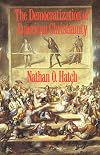
I purchased this book five years ago and unfortunately let it sit on my bookshelf, taking a backseat to others that I thought had a higher priority on my "to read" list. I now wish I read the book when I bought it.
Hatch's award winning book provides an excellent overview and analysis of the Christian Church (in its broadest sense) as it evolved from the influences of the "old world" and took on distinctives unique to the newly formed United States of America. The years following the end of show more the America Revolution saw the emergence of numerous populist and "restoration" movements, including Methodists, Baptists, Adventists, Disciples, Christians, and Later Day Saints.
Numerous characters associated with the development of the new churches in America are discussed in the book. Alexander Campbell (Disciples) and Barton Stone (Christians) are included among the early populist leaders, but discussion of the Stone-Campbell religious heritage is just a minor part of the book.
My favorite chapter, "The Sovereign Audience" (chapter five) covers the topics of vernacular preaching, the impact of print on the mass culture, and the inventing of American gospel music. I feel like I've been given a good introduction to these topics and my appetite is duly whetted. I hope to follow-up with further study of these topics, particularly within the Stone-Campbell heritage.
I conclude that the book is a good overview. It is well-researched and footnoted. The seventeen illustrations enhance the book as does the Appendix, "A Sampling of Anticlerical and Anti-Calvinist Christian Verse," of which 13 are included. The book includes an excellent index. A five-star rating is very much deserved in my opinion. show less
Hatch's award winning book provides an excellent overview and analysis of the Christian Church (in its broadest sense) as it evolved from the influences of the "old world" and took on distinctives unique to the newly formed United States of America. The years following the end of show more the America Revolution saw the emergence of numerous populist and "restoration" movements, including Methodists, Baptists, Adventists, Disciples, Christians, and Later Day Saints.
Numerous characters associated with the development of the new churches in America are discussed in the book. Alexander Campbell (Disciples) and Barton Stone (Christians) are included among the early populist leaders, but discussion of the Stone-Campbell religious heritage is just a minor part of the book.
My favorite chapter, "The Sovereign Audience" (chapter five) covers the topics of vernacular preaching, the impact of print on the mass culture, and the inventing of American gospel music. I feel like I've been given a good introduction to these topics and my appetite is duly whetted. I hope to follow-up with further study of these topics, particularly within the Stone-Campbell heritage.
I conclude that the book is a good overview. It is well-researched and footnoted. The seventeen illustrations enhance the book as does the Appendix, "A Sampling of Anticlerical and Anti-Calvinist Christian Verse," of which 13 are included. The book includes an excellent index. A five-star rating is very much deserved in my opinion. show less
Serious students of early nineteenth century American religious history will long have treasured this book; it is studded with intriguing observations and generalizations about the Great Awakening and the Second Great Awakening, but the author's focus is really on the activities and appeal of the mass movements represented by the Methodists, Campbellite/Christians, Baptists, the black churches, and the Mormons. He notes that "the fundamental religious quarrel of the late eighteenth century show more was not between Calvinist and Arminian . . . , evangelical and freethinker, but between radically different conceptions of the Christian ministry. As respectable clergymen in these turbulent years reiterated their confidence in learning and civility, potent strains of anticlericalism welled up with the bounds of the church, challenging the right of any special order to mediate the gospel." This was part of a pattern of Jeffersonian democracy, where even the unlettered considered their opinions were as good as those of the educated. One result was the multiplication of religious sects; another was that there was a shift in orientation from seeking conversions to building an organization from the ground up, which may be a persistent strain in the fundamentalist movements even today. Increasingly, he notes as an example, the core of Methodist leaders were professional organizers, sent out to call churches into existence rather than waiting for a call from a church to come to them. "These roving evangelists would go from house to house, if necessary, looking for anyone who would listen." Hatch closes his account with an epilogue that is highly relevant today—the recurring populist impulse in American Christianity which has deeply polarized not only religion, but also social and political affairs. An exceptional work of history. show less
How did American Christianity become what it is today? How did the formative years of our country shape Christianity? How did Christianity shape the formative years of our country? What part did mass movements from Baptists to Mormons play in the “democratization?” How did the “incarnation of the church into popular culture” help this movement along (9)? Dr. Nathan O. Hatch embarks on a journey to sift through the annals of early American history to attempt to answer those questions show more and more in his book, The Democratization of American Christianity.
Biographical Sketch of the Author
Dr. Hatch did not set out to write The Democratization of American Christianity without a wealth of experience and knowledge under his belt. In fact, when it was published, Hatch was the professor of history and vice president for Graduate Studies and Research at the University of Notre Dame. That was not by accident, but after a career of hard work through college and extensive graduate work, and amassing postdoctoral fellowships at prestigious universities like Harvard and Johns Hopkins. That alone would allow the reader of his work to assume the author has been well-vetted, well-studied, and has more than enough background in the history of American Christianity to endeavor to write a book surveying major events and developments therein, but that barely scratches the surface of Dr. Hatch’s background and experience.
Dr. Hatch graduated summa cum laude from Wheaton College in 1968 and earned his master’s (1972) and doctoral (1974) degrees from Washington University in St. Louis. He later became the associate dean of Notre Dame’s College of Arts and Letters from 1983 to 1988, and from 1988 to 1989 he was the college’s acting dean. Finally, in 1999, Dr. Hatch was appointed to be the Andrew V. Tackes Professor History at Notre Dame. An impressive career in history took off through hard work, patience, and an incredible amount of time and careful study.
Throughout his rise through the “ranks” at Notre Dame, Dr. Hatch was busy authoring influential, often-cited books on the history of religion in America. These included The Sacred Cause of Liberty: Republican Thought and the Millennium in Revolutionary New England in 1977, The Bible in America in 1981, the 1983 volume The Search for Christian America, and Jonathan Edwards and the American Experience, which was published the same year as the work being reviewed herein, 1989. Since the publishing of the aforementioned works, Dr. Hatch continued to have several more published works on American culture and history, and has since become the president of Wake Forest University, where he is affectionately known as “Natty O.”
Therefore, from Dr. Hatch’s extensive work in the area of church history, American history, and his well-vetted appointments into prestigious positions of influence, I believe this book to be written by someone well-versed and more than capable of speaking with authority on the subject at hand. While there is always the opportunity to agree or disagree with one’s ultimate findings, I believe all would most certainly agree he is a powerful voice to listen to attentively. Furthermore, as one who enjoys history, but has not delved much into the formative years of American democratization, which this book sets out to explore, I began reading this text with much interest, excitement, and careful consideration.
Summary of Contents
The best summary of The Democratization of American Christianity would be by Dr. Hatch himself, “This book is about the cultural and religious history of the early American republic and the enduring structures of American Christianity” (3). That is the thesis he expands upon throughout the 300 or so pages of the book, which he sets out to accomplish in four main units or sections, including; “Context,” which provides a thorough look at American Democracy and American Christianity and some of the crises over the various authorities in our culture, “Mass Movements,” which covers major movements such as the rise of the black church and Mormonism, to name two, within and without Orthodox Christianity in America, “Audience,” which had an enlightening and ultimately disheartening section on the raging fight against Calvinism,” and “Legacy,” which delves into a recurring populist theme we still see to this day, an enduring theme of selfism which continues to shackle American Christianity. Dr. Hatch ends the book with bonus material, so to speak, offering another look at the Second Great Awakening and some of the anti-Calvinism poems and songs largely covered or referenced in chapter six.
The best way one could summarize Hatch’s approach would say he explores the major American Christian movements by taking a microscope to the pivotal figures therein. In other words, he studies the “macro” or the overarching, major movements in American Christianity by looking closely at what was occurring on the “micro” level throughout many of the formative, catalytic events along the way. For example, Hatch notes, “Not since the crusading vigor of the early Puritans or of first-generation Methodists had an English-speaking culture produced a generation of so many rootless, visionary young preachers” (13). Without them, the major events would have never occurred. Some of these “rootless” men included Francis Asbury, Joseph Smith, Charles Finney, and Henry Alline.
And yet, a question continued to arise and aimed to be answered in chapter two about who was in charge in popular culture. It seemed many of the mass movements sought to bring equality and freedom to just about every area of life, top to bottom, as evidenced by their disdain for the elite leaders of society and promoting an egalitarian view of the home (22-29). The message that rang out through this time was the “primacy of the individual conscience” (35). Again, selfism was (and is) king.
While chapter two seemed to cover some of the more mainstream powers and the blurring of the lines within them all, chapter three took aim at American camp meetings, which were largely led by Francis Asbury, who said, “Camp meetings! Camp meetings!...The battle ax and weapon of war it will break down walls of wickedness, part of hell, superstition, and false doctrine” (49). Charismatic leaders largely led these and common citizens were given the reins, so to speak, to lead however they willed or wanted. This is the age when Presbyterians and Episcopalians largely lost their grasp on the reins of religious culture in America, especially as self and the common folk became king of all (61).
In chapter four, Dr. Hatch begins his interesting examination of five mass movements, which had similar styles but vastly different substances. This is when the phrase “No creed but the Bible!” began to emerge (81), and groups like the Baptists began to abandon their orthodox or Calvinistic roots. One of the mass movements, Mormonism, was also a key player in Hatch’s examinations, albeit totally unorthodox. Nevertheless, they were a force with which to be reckoned.
Chapter five takes a look at the importance of printed material which grew to be able to give common man access to theological truth on the common man’s level. As a Methodist journal noted, “A RELIGIOUS NEWSPAPER would have been a phenomenon not many years since…but now the groaning press throws them out in almost every direction” (125). This took the communication from covering things of interest for the movers and shakers, down to the masses, which gave them much more of a sense of entitlement to go against the grain of the elite. The appeal of the masses continues in the sixth chapter on the audience. Trust was given to the common people over the educated, and the acceptance of theology was on the whim of the culture at large (170-178).
The transformation that had begun and was covered in the previous chapters seemed to come to the figurative and literal head in chapter seven as the populist leaders were now gaining positions of authority in virtually every cultural arena. In the South, this was seen by the “evangelical quest for respectability…In many places, Baptist and Methodist churches became the very pillars of the establishment” (195). It is also in chapter seven where Finney offers this damning quote, “I gradually formed a view of my own mind, as revealed in consciousness,” as he argued nothing should stand between his mind and Scripture, leaning on his own reason (199). The rise of selfism was ultimately complete.
In chapter eight, Hatch begins to wrap up his work with an Epilogue on the recurring populist impulse with American Christianity, with the foundational understanding being, “the United States contains more citizens who value religion than other western industrial societies,” which defies logic (210). Hatch notes a Gallup poll comparing the importance of religion to young Americans and Europeans, 41 percent of Americans found religion to be important to the 10 percent in Europe (210). Therefore, Hatch reiterates his opening thesis that the power of American Christianity has behind it “a central force [that has] been its democratic or populist orientation” (213). Our love for “for freedom of expression” and a refusal to “bow to tradition or hierarchy” truly started “the world over again,” especially with the standard of, “no creed but the Bible” (213). Individualism or selfism was (and perhaps still is) king, because “American Christianity continues to be powered by ordinary people and by the contagious spirit of their efforts to storm heaven by the back door” (219).
The book concludes with a deeper look or another look at the Second Great Awakening, which Hatch noted was “a comparable period of religious upheaval” not witnessed “since the Reformation,” but was also a time when “many Americans divorced religious leadership from social position, completing a separation that had been building for a century,” because the “weak” were finally “confounding the mighty” (225-226). The final section of the book was a sampling of anticlerical and anti-Calvinist poems and songs, which translated “theological concepts into language of the marketplace,” or more accessible to the common man in society (227).
Critical Evaluation
First and foremost one should consider whether or not Dr. Hatch was successful and explaining and defending his thesis. His purpose to write a book on “the cultural and religious history of the early American republic and the enduring structures of American Christianity” was successfully achieved through his careful and thorough examination of the key figures during the early years of American history and their lasting, indelible impacts. He seemed clear, fair, and unbiased in his approach almost as a journalist chronicling a very intricate, detailed period of history for a documentary.
As a Calvinist, I was especially intrigued by the revolt against Calvinistic orthodoxy, especially against the Baptists’ roots therein (179). While the tide is beginning to turn back to our orthodox roots, Hatch’s examination reveals why we departed in the first place. Therefore, I also believe that charts the roadmap for how we continue to reform our way back to our historic roots.
There seems to be a clear reason The Democratization of American Christianity won a few prestigious awards like the “Albert C. Outler Prize in Ecumenical Church History,” as that is the strongest approach of this book. It is ecumenical in nature, certainly linking some unorthodox movements with Christianity in its broad swaft of American Christianity. This would make many orthodox Christians bristle, but Dr. Hatch seemed to write this book as unbiased as he could despite his background, which I think can be applauded, albeit necessary to keep in mind while reading.
Finally, I found this book exhausting and sometimes confusing to read, but filled with insightful information that was of interest to me, especially noting how we Baptists backslid from our roots as Calvinists. I find it a helpful; thorough read for those interested in finding the prevalent decay of American Christianity is not a recent phenomenon, but something a tidal wave that has been building for some time. And, should we learn from the building of the tidal wave, we may be able to thwart the crashing of it! show less
Biographical Sketch of the Author
Dr. Hatch did not set out to write The Democratization of American Christianity without a wealth of experience and knowledge under his belt. In fact, when it was published, Hatch was the professor of history and vice president for Graduate Studies and Research at the University of Notre Dame. That was not by accident, but after a career of hard work through college and extensive graduate work, and amassing postdoctoral fellowships at prestigious universities like Harvard and Johns Hopkins. That alone would allow the reader of his work to assume the author has been well-vetted, well-studied, and has more than enough background in the history of American Christianity to endeavor to write a book surveying major events and developments therein, but that barely scratches the surface of Dr. Hatch’s background and experience.
Dr. Hatch graduated summa cum laude from Wheaton College in 1968 and earned his master’s (1972) and doctoral (1974) degrees from Washington University in St. Louis. He later became the associate dean of Notre Dame’s College of Arts and Letters from 1983 to 1988, and from 1988 to 1989 he was the college’s acting dean. Finally, in 1999, Dr. Hatch was appointed to be the Andrew V. Tackes Professor History at Notre Dame. An impressive career in history took off through hard work, patience, and an incredible amount of time and careful study.
Throughout his rise through the “ranks” at Notre Dame, Dr. Hatch was busy authoring influential, often-cited books on the history of religion in America. These included The Sacred Cause of Liberty: Republican Thought and the Millennium in Revolutionary New England in 1977, The Bible in America in 1981, the 1983 volume The Search for Christian America, and Jonathan Edwards and the American Experience, which was published the same year as the work being reviewed herein, 1989. Since the publishing of the aforementioned works, Dr. Hatch continued to have several more published works on American culture and history, and has since become the president of Wake Forest University, where he is affectionately known as “Natty O.”
Therefore, from Dr. Hatch’s extensive work in the area of church history, American history, and his well-vetted appointments into prestigious positions of influence, I believe this book to be written by someone well-versed and more than capable of speaking with authority on the subject at hand. While there is always the opportunity to agree or disagree with one’s ultimate findings, I believe all would most certainly agree he is a powerful voice to listen to attentively. Furthermore, as one who enjoys history, but has not delved much into the formative years of American democratization, which this book sets out to explore, I began reading this text with much interest, excitement, and careful consideration.
Summary of Contents
The best summary of The Democratization of American Christianity would be by Dr. Hatch himself, “This book is about the cultural and religious history of the early American republic and the enduring structures of American Christianity” (3). That is the thesis he expands upon throughout the 300 or so pages of the book, which he sets out to accomplish in four main units or sections, including; “Context,” which provides a thorough look at American Democracy and American Christianity and some of the crises over the various authorities in our culture, “Mass Movements,” which covers major movements such as the rise of the black church and Mormonism, to name two, within and without Orthodox Christianity in America, “Audience,” which had an enlightening and ultimately disheartening section on the raging fight against Calvinism,” and “Legacy,” which delves into a recurring populist theme we still see to this day, an enduring theme of selfism which continues to shackle American Christianity. Dr. Hatch ends the book with bonus material, so to speak, offering another look at the Second Great Awakening and some of the anti-Calvinism poems and songs largely covered or referenced in chapter six.
The best way one could summarize Hatch’s approach would say he explores the major American Christian movements by taking a microscope to the pivotal figures therein. In other words, he studies the “macro” or the overarching, major movements in American Christianity by looking closely at what was occurring on the “micro” level throughout many of the formative, catalytic events along the way. For example, Hatch notes, “Not since the crusading vigor of the early Puritans or of first-generation Methodists had an English-speaking culture produced a generation of so many rootless, visionary young preachers” (13). Without them, the major events would have never occurred. Some of these “rootless” men included Francis Asbury, Joseph Smith, Charles Finney, and Henry Alline.
And yet, a question continued to arise and aimed to be answered in chapter two about who was in charge in popular culture. It seemed many of the mass movements sought to bring equality and freedom to just about every area of life, top to bottom, as evidenced by their disdain for the elite leaders of society and promoting an egalitarian view of the home (22-29). The message that rang out through this time was the “primacy of the individual conscience” (35). Again, selfism was (and is) king.
While chapter two seemed to cover some of the more mainstream powers and the blurring of the lines within them all, chapter three took aim at American camp meetings, which were largely led by Francis Asbury, who said, “Camp meetings! Camp meetings!...The battle ax and weapon of war it will break down walls of wickedness, part of hell, superstition, and false doctrine” (49). Charismatic leaders largely led these and common citizens were given the reins, so to speak, to lead however they willed or wanted. This is the age when Presbyterians and Episcopalians largely lost their grasp on the reins of religious culture in America, especially as self and the common folk became king of all (61).
In chapter four, Dr. Hatch begins his interesting examination of five mass movements, which had similar styles but vastly different substances. This is when the phrase “No creed but the Bible!” began to emerge (81), and groups like the Baptists began to abandon their orthodox or Calvinistic roots. One of the mass movements, Mormonism, was also a key player in Hatch’s examinations, albeit totally unorthodox. Nevertheless, they were a force with which to be reckoned.
Chapter five takes a look at the importance of printed material which grew to be able to give common man access to theological truth on the common man’s level. As a Methodist journal noted, “A RELIGIOUS NEWSPAPER would have been a phenomenon not many years since…but now the groaning press throws them out in almost every direction” (125). This took the communication from covering things of interest for the movers and shakers, down to the masses, which gave them much more of a sense of entitlement to go against the grain of the elite. The appeal of the masses continues in the sixth chapter on the audience. Trust was given to the common people over the educated, and the acceptance of theology was on the whim of the culture at large (170-178).
The transformation that had begun and was covered in the previous chapters seemed to come to the figurative and literal head in chapter seven as the populist leaders were now gaining positions of authority in virtually every cultural arena. In the South, this was seen by the “evangelical quest for respectability…In many places, Baptist and Methodist churches became the very pillars of the establishment” (195). It is also in chapter seven where Finney offers this damning quote, “I gradually formed a view of my own mind, as revealed in consciousness,” as he argued nothing should stand between his mind and Scripture, leaning on his own reason (199). The rise of selfism was ultimately complete.
In chapter eight, Hatch begins to wrap up his work with an Epilogue on the recurring populist impulse with American Christianity, with the foundational understanding being, “the United States contains more citizens who value religion than other western industrial societies,” which defies logic (210). Hatch notes a Gallup poll comparing the importance of religion to young Americans and Europeans, 41 percent of Americans found religion to be important to the 10 percent in Europe (210). Therefore, Hatch reiterates his opening thesis that the power of American Christianity has behind it “a central force [that has] been its democratic or populist orientation” (213). Our love for “for freedom of expression” and a refusal to “bow to tradition or hierarchy” truly started “the world over again,” especially with the standard of, “no creed but the Bible” (213). Individualism or selfism was (and perhaps still is) king, because “American Christianity continues to be powered by ordinary people and by the contagious spirit of their efforts to storm heaven by the back door” (219).
The book concludes with a deeper look or another look at the Second Great Awakening, which Hatch noted was “a comparable period of religious upheaval” not witnessed “since the Reformation,” but was also a time when “many Americans divorced religious leadership from social position, completing a separation that had been building for a century,” because the “weak” were finally “confounding the mighty” (225-226). The final section of the book was a sampling of anticlerical and anti-Calvinist poems and songs, which translated “theological concepts into language of the marketplace,” or more accessible to the common man in society (227).
Critical Evaluation
First and foremost one should consider whether or not Dr. Hatch was successful and explaining and defending his thesis. His purpose to write a book on “the cultural and religious history of the early American republic and the enduring structures of American Christianity” was successfully achieved through his careful and thorough examination of the key figures during the early years of American history and their lasting, indelible impacts. He seemed clear, fair, and unbiased in his approach almost as a journalist chronicling a very intricate, detailed period of history for a documentary.
As a Calvinist, I was especially intrigued by the revolt against Calvinistic orthodoxy, especially against the Baptists’ roots therein (179). While the tide is beginning to turn back to our orthodox roots, Hatch’s examination reveals why we departed in the first place. Therefore, I also believe that charts the roadmap for how we continue to reform our way back to our historic roots.
There seems to be a clear reason The Democratization of American Christianity won a few prestigious awards like the “Albert C. Outler Prize in Ecumenical Church History,” as that is the strongest approach of this book. It is ecumenical in nature, certainly linking some unorthodox movements with Christianity in its broad swaft of American Christianity. This would make many orthodox Christians bristle, but Dr. Hatch seemed to write this book as unbiased as he could despite his background, which I think can be applauded, albeit necessary to keep in mind while reading.
Finally, I found this book exhausting and sometimes confusing to read, but filled with insightful information that was of interest to me, especially noting how we Baptists backslid from our roots as Calvinists. I find it a helpful; thorough read for those interested in finding the prevalent decay of American Christianity is not a recent phenomenon, but something a tidal wave that has been building for some time. And, should we learn from the building of the tidal wave, we may be able to thwart the crashing of it! show less

Evangelical institutions are circling the wagons and withdrawing from wider discourse. Today we need bold, vigorous scholarship.
Awards


You May Also Like


Associated Authors
Statistics
- Works
- 10
- Also by
- 8
- Members
- 1,054
- Popularity
- #24,449
- Rating
- 4.1
- Reviews
- 8
- ISBNs
- 20
- Favorited
- 2