
About the Author
Works by Roger D. Masters
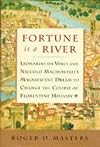
Fortune Is a River: Leonardo Da Vinci and Niccolò Machiavelli's Magnificent Dream to Change the Course of Florentine History (1998) 293 copies, 3 reviews
The Nation is Burdened 1 copy
Associated Works
Tagged
Common Knowledge
- Gender
- male
Members
Reviews
Fortune Is a River : Leonardo Da Vinci and Niccolo Machiavelli's Magnificent Dream to Change the Course of Florentine History by Roger D. Masters

Roger D Masters an academic has written a very readable book featuring a joint project undertaken by two of the most remarkable men living and working in early 16th century Florence. Leonardo Da Vinci and Niccolo Machiavelli planned to divert the River Arno away from Pisa in an effort to capture the town, however as was usual with Da Vinci, he didn't want to stop there, because he also had it in mind to create a direct access to the sea for the Florentines, so that they could function as a show more trading seaport with the opening up of the New World (The Americas). Nothing on such a scale had been attempted since classical times but this did not stop Niccolo and Leonardo embarking on what many of their contemporaries labelled a hare brained scheme.
The meeting of the two men and their project takes up just 60 pages of this 200 page book, but this book is aimed as much for the general public as it is for the student and so Masters spends much of the time giving a potted biography of them both. I think he has judged this rather well, because he brings out their characters and their environment, which helps the reader appreciate the risks they took and why they were ultimately unsuccessful. Leonardo and Niccolo were quick to try and shift the blame onto the hapless works manager Maestro Colombino and as usual there were disputes over the cost of labour and materials, but both men deemed it prudent to keep a low profile in the months following the collapse of the project. Taking on risky ventures in 16th century renaissance Florence could be fatal and Masters explains why this was so.
Leonardo was a notorious non finisher of projects, his brilliant mind always leading him on to other things and Niccolo according to Masters; learnt that "working with Leonardo was like a dream - a bad dream. They never worked together again Leonardo was intent on trying out new methods of fresco painting, but had to abandon these when paint started running on the ill-fated Battle of Anghiari, it was about this time also that his attempts to build a flying machine were unsuccessful. Niccolo turned towards setting up a Militia to defend his home town and although initially successful they were eventually overrun by Spanish veteran soldiers. Masters is on the whole sympathetic to both men admiring their individual genius and presenting them as men ahead of their times, who fought against the odds with some success and who both left lasting legacies.
Masters continues to map both men's lives after 1504 and so gives a rounded portrait of them and their achievements. I enjoyed this book very much and found plenty of facts and ideas to hold my interest. Masters does not let the project run away with him, avoiding much speculation. A good read 4 stars show less
The meeting of the two men and their project takes up just 60 pages of this 200 page book, but this book is aimed as much for the general public as it is for the student and so Masters spends much of the time giving a potted biography of them both. I think he has judged this rather well, because he brings out their characters and their environment, which helps the reader appreciate the risks they took and why they were ultimately unsuccessful. Leonardo and Niccolo were quick to try and shift the blame onto the hapless works manager Maestro Colombino and as usual there were disputes over the cost of labour and materials, but both men deemed it prudent to keep a low profile in the months following the collapse of the project. Taking on risky ventures in 16th century renaissance Florence could be fatal and Masters explains why this was so.
Leonardo was a notorious non finisher of projects, his brilliant mind always leading him on to other things and Niccolo according to Masters; learnt that "working with Leonardo was like a dream - a bad dream. They never worked together again Leonardo was intent on trying out new methods of fresco painting, but had to abandon these when paint started running on the ill-fated Battle of Anghiari, it was about this time also that his attempts to build a flying machine were unsuccessful. Niccolo turned towards setting up a Militia to defend his home town and although initially successful they were eventually overrun by Spanish veteran soldiers. Masters is on the whole sympathetic to both men admiring their individual genius and presenting them as men ahead of their times, who fought against the odds with some success and who both left lasting legacies.
Masters continues to map both men's lives after 1504 and so gives a rounded portrait of them and their achievements. I enjoyed this book very much and found plenty of facts and ideas to hold my interest. Masters does not let the project run away with him, avoiding much speculation. A good read 4 stars show less
Fortune Is a River : Leonardo Da Vinci and Niccolo Machiavelli's Magnificent Dream to Change the Course of Florentine Hi by Roger D. Masters
This book offers a totally different historical view of Machiavelli and Da Vinci. During the reading of this, they became very real, very human, to me.
Masters writes rather well, though he can't seem to make up his mind if he wants to call them by their surnames or their first names. The switching back and forth becomes distracting at times.
It was fascinating to read about two such powerful, influential figures working on such a doomed project. I recommend this book to anyone interested in show more Da Vinci or Machiavelli, or in the history of Florence. show less
Masters writes rather well, though he can't seem to make up his mind if he wants to call them by their surnames or their first names. The switching back and forth becomes distracting at times.
It was fascinating to read about two such powerful, influential figures working on such a doomed project. I recommend this book to anyone interested in show more Da Vinci or Machiavelli, or in the history of Florence. show less
Fortune is a river : Leonardo da Vinci and Niccolò Machiavelli's magnificent dream to change the course of Florentine h by Roger D. Masters
This was a very interesting concept, but unfortunately, the historical record is sketchy, so the actual bit about diverting the Arno takes up only about 20 pages in the middle of the book. The remaining 191 pages are biographical sketches of da Vinci and Machiavelli as their lives intersected and then drifted back apart. I would have liked to have learned more about the larger politics of the time. There is a lot on the personal intrigue (duke A opposed patrician B who isn't liked by pope C show more or king D), but little sense of the greater politics. The Arno was being diverted because Florence was at war with Pisa. Why? By focusing only on the relationship between da Vinci and Machiavelli and the people immediately around them, and not as much on the larger political climate of the time, this book provides a lot of trees, but no forest. show less
Fortune is a River: Leonardo Da Vinci and Niccolo Machiavelli's Magnificent Dream to Change the Course of Florentine History by Roger D. Masters
Da Vinci and Machiavelli cooperated on one project, diverting the Arno as part of a war with Pisa. The book traces the history of Florence, each of the two men, and then the project - which failed. Interesting book - but not one I'd recommend.
You May Also Like


Statistics
- Works
- 10
- Also by
- 2
- Members
- 380
- Popularity
- #63,550
- Rating
- 3.4
- Reviews
- 3
- ISBNs
- 18
- Languages
- 1