
Zachary Thomas Dodson
Author of Bats of the Republic: An Illuminated Novel
Works by Zachary Thomas Dodson
Tagged
Common Knowledge
- Birthdate
- 20th Century
- Gender
- male
- Education
- Art Institute of Chicago
- Occupations
- narrative designer
- Organizations
- Victoria University of Wellington
Aalto University - Short biography
- [from author's website]
Zach Dodson is a narrative designer interested in story-telling media. He is currently developing narrative games with Interactive Tragedy, LTD. He has designed books for many presses, notably featherproof books, which he founded in 2005. Contact him about design projects by putting “@gmail.com” after his name.
Texan Zachary Thomas is the author and designer of Bats of the Republic, an illuminated novel published by Doubleday in 2015. Zach Plague wrote and designed the hybrid image/text boring boring boring boring boring boring boring in 2008. Neither should be contacted, as they exist only speculatively.
A Prof. Zachary Dodson co-founded the Visual Narrative Lab at Victoria University of Wellington, New Zealand, and teaches in the MFA programme there. Previously, he did much the same at at Aalto University in Helsinki, Finland. He is available for guest lectures or workshops on design or visual narrative. - Nationality
- USA
- Birthplace
- Texas, USA
- Places of residence
- Helsinki, Finland
- Associated Place (for map)
- USA
Members
Reviews
Fiction
Zachary Thomas Dodson
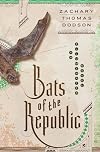
Bats of the Republic: An Illuminated Novel
Doubleday
Hardcover, 978-0-385-53983-8 (also available as an ebook), 448 pgs., $27.95
October 6, 2015
In 1843, naturalist Zadock Thomas sets out from Chicago on an urgent mission to deliver a letter from his employer to a general in the Republic of Texas. At the same time, sort of, in the post-Collapse, post-United States of 2143, Zeke Thomas’s grandfather, a senator, has just died and Zeke is next in line for the office, show more which is now determined by bloodline. Seven senators compose the governing body of the remaining seven City-States, a totalitarian surveillance regime where writing implements and private documents are illegal. Zeke’s grandmother gives him an old letter of his grandfather’s that has never been opened because the family is frightened the letter may cast doubt on the Thomas bloodline. Then the letter goes missing.
Bats of the Republic: An Illuminated Novel by Zachary Thomas Dodson, who also designed the book, is an inspired blend of historical fiction, dystopian science fiction, traditional mystery, spiritualism, love story, adventure, Texas history, and Mexican folk tales. History and the future come together in parallel narratives, the historical half rendered in sepia tones and hand-drawn illustrations, the future rendered in LED green and schematics. Dodson is skilled at switching between the two styles. The elaborate plot requires mental gymnastics and the pacing is sometimes uneven, but as the climax nears and the pacing accelerates, the two narratives race against the clock, facing each other on alternate pages with mini-cliffhangers skillfully placed at the end of each page.
Dodson creates imagery that is sometimes sweet, as when Zeke holds hands with his wife and her hand moves “around like a burrowing animal until it found a comfortable place,” and sometimes striking, as when he describes bats as “like little pieces broken out of the desert night sky.” Dodson engages in word play when Zeke refers to the City-State as “claustrotopia,” and in philosophy as Zeke asks, “Fight or flight or dream: How can I be free?”
Dodson could be addressing the current state of politics in the United States when Zeke’s father-in-law worries that “these city-states have begun to take on the air of a failed political experiment,” and Texas in particular with “fear-mongering” and the impression that “after its commissioning, this city-state was allowed to grow according to its own perverse idea of justice.” This is history as lesson and the future as a warning to mind the present.
Bats of the Republic is an astonishingly creative and beautifully bound and illustrated volume, complete with a traditional satin ribbon to mark your place. It puts me in mind of medieval monks creating codices that are works of art. There are hand-drawn maps, naturalist drawings of animals native (maybe) to the southwestern United States (including a jackalope and a chupacabra), family trees, identification cards, transcripts of phone calls, portraits, and a letter in a sealed envelope, to name but a few. I also learned that there are two kinds of people in the world: those who open the letter first and those who don’t.
While drawing inspiration from 1984, Fahrenheit 451, and Brave New World, Bats of the Republic may possibly be that rarest of treats — something new under the sun.
Originally published in Lone Star Literary Life. show less
Zachary Thomas Dodson
Bats of the Republic: An Illuminated Novel
Doubleday
Hardcover, 978-0-385-53983-8 (also available as an ebook), 448 pgs., $27.95
October 6, 2015
In 1843, naturalist Zadock Thomas sets out from Chicago on an urgent mission to deliver a letter from his employer to a general in the Republic of Texas. At the same time, sort of, in the post-Collapse, post-United States of 2143, Zeke Thomas’s grandfather, a senator, has just died and Zeke is next in line for the office, show more which is now determined by bloodline. Seven senators compose the governing body of the remaining seven City-States, a totalitarian surveillance regime where writing implements and private documents are illegal. Zeke’s grandmother gives him an old letter of his grandfather’s that has never been opened because the family is frightened the letter may cast doubt on the Thomas bloodline. Then the letter goes missing.
Bats of the Republic: An Illuminated Novel by Zachary Thomas Dodson, who also designed the book, is an inspired blend of historical fiction, dystopian science fiction, traditional mystery, spiritualism, love story, adventure, Texas history, and Mexican folk tales. History and the future come together in parallel narratives, the historical half rendered in sepia tones and hand-drawn illustrations, the future rendered in LED green and schematics. Dodson is skilled at switching between the two styles. The elaborate plot requires mental gymnastics and the pacing is sometimes uneven, but as the climax nears and the pacing accelerates, the two narratives race against the clock, facing each other on alternate pages with mini-cliffhangers skillfully placed at the end of each page.
Dodson creates imagery that is sometimes sweet, as when Zeke holds hands with his wife and her hand moves “around like a burrowing animal until it found a comfortable place,” and sometimes striking, as when he describes bats as “like little pieces broken out of the desert night sky.” Dodson engages in word play when Zeke refers to the City-State as “claustrotopia,” and in philosophy as Zeke asks, “Fight or flight or dream: How can I be free?”
Dodson could be addressing the current state of politics in the United States when Zeke’s father-in-law worries that “these city-states have begun to take on the air of a failed political experiment,” and Texas in particular with “fear-mongering” and the impression that “after its commissioning, this city-state was allowed to grow according to its own perverse idea of justice.” This is history as lesson and the future as a warning to mind the present.
Bats of the Republic is an astonishingly creative and beautifully bound and illustrated volume, complete with a traditional satin ribbon to mark your place. It puts me in mind of medieval monks creating codices that are works of art. There are hand-drawn maps, naturalist drawings of animals native (maybe) to the southwestern United States (including a jackalope and a chupacabra), family trees, identification cards, transcripts of phone calls, portraits, and a letter in a sealed envelope, to name but a few. I also learned that there are two kinds of people in the world: those who open the letter first and those who don’t.
While drawing inspiration from 1984, Fahrenheit 451, and Brave New World, Bats of the Republic may possibly be that rarest of treats — something new under the sun.
Originally published in Lone Star Literary Life. show less
Sorry everybody this book is my life now. I read an ARC and lost my mind and now I'm going to buy the hardcover and re-read it immediately, despite almost never rereading books, because the hardcover has details and colors the ARC doesn't have, and some kind of moebius-strip folding at the end that the ARC doesn't seem to have, and although I know the book doesn't have an ending I need to reread it over and over until I've memorized all the details and overlapping hints and every word of show more this stupid book. A lot of reviewers don't like the characters, and I often didn't either, but that's not the point. The point is the story. show less
This book doesn't have a story arc so much as a story circle. Okay, so ultimately the finer points of the plot sort of come unraveled in the "final" third of the book (you'll understand those quotation marks when you've read the book), but let's be honest: it's not about what actually happens in the plot. This book is about the way a story's beginning is its end is its beginning, across time and across people and across places.
Aside from having a really good time taking in this book, I found show more myself for the first time ever appreciating how a book's design can contribute to the experience of reading it. show less
Aside from having a really good time taking in this book, I found show more myself for the first time ever appreciating how a book's design can contribute to the experience of reading it. show less
'Bats of the Republic' is a piece of art. Possibly the best piece of book art I've ever seen. I can tell Dodson has thought out everything meticulously, everything down to the font colors, to what is placed on which page. There are diagrams, secret letters, maps, naturalist drawings, even written recordings from this dystopia's watchtowers. The plot is structured around two timelines 300 years apart: the 2143 dystopia city-state in Texas that is like Orwell's Big Brother trapped inside a show more world supposedly like Mad Max's world (or a combo of any of Margaret Atwood's dystopias) and the 1843 world of an employee at the Museum of Flying in Chicago on an adventure to Texas and the foibles of his unrequited love. The story of the adventuring naturalist and the arty layout of the book couldn't help but remind me of Reif Larsen's 'The Selected Works of T.S. Spivet' --even the importance of bats! The main characters from both timelines are related... and also very similar to the writer.
Each intricately designed page is a treasure to look at. (I'm just surprised there wasn't a mint green bookmark to match much of the ink instead of the blue bookmark.) The plot sounds amazing and intriguing enough. But I'm not sure if the art is extremely well thought out at the expense of the story OR if Dodson knew the weakness of the story and decided to make the layout more important. Interesting to note: even the pages with mostly normal novel-like font, the font fits all the way to end of the page, to the last line. Unlike most novels, where a chapter can end in the middle of a page, this book tried to fill each and every page with words. This tells me there was a lot of adding or removing of words just to get to the last line of the page. It's designed perfectly so that there is never a question which page features which character, between the font color or format. The book switches formats every couple of pages (like between a letter to someone or a watch tower report, so there should be a lot of empty space on half pages. So even just making sure the book fills up every line of font is doing a disservice to the story. There is no history of the Collapse to explain how the world is the way it is in 2143 and also too many loose ends at the finish, this is where the story falls short. I feel like the book focuses too much on the "middle" and not the before and after.
Fun coincidence: I watched the movie Dune for the first time while reading this and I thought "Wow, both Dune and this book feature the drinking of important life waters." ...and then I get to the end of the book and see a Dune epigraph. Pop culture coincidences happen to me much too often. However, there is also an epigraph that says "The outcome of any work of fiction is arbitrary". To my eyes, this explains away the faults in the story. Though this book will remain on my shelves as a piece of awesome book art, I wish the story level had matched the level of design. show less
Each intricately designed page is a treasure to look at. (I'm just surprised there wasn't a mint green bookmark to match much of the ink instead of the blue bookmark.) The plot sounds amazing and intriguing enough. But I'm not sure if the art is extremely well thought out at the expense of the story OR if Dodson knew the weakness of the story and decided to make the layout more important. Interesting to note: even the pages with mostly normal novel-like font, the font fits all the way to end of the page, to the last line. Unlike most novels, where a chapter can end in the middle of a page, this book tried to fill each and every page with words. This tells me there was a lot of adding or removing of words just to get to the last line of the page. It's designed perfectly so that there is never a question which page features which character, between the font color or format. The book switches formats every couple of pages (like between a letter to someone or a watch tower report, so there should be a lot of empty space on half pages. So even just making sure the book fills up every line of font is doing a disservice to the story. There is no history of the Collapse to explain how the world is the way it is in 2143 and also too many loose ends at the finish, this is where the story falls short. I feel like the book focuses too much on the "middle" and not the before and after.
Fun coincidence: I watched the movie Dune for the first time while reading this and I thought "Wow, both Dune and this book feature the drinking of important life waters." ...and then I get to the end of the book and see a Dune epigraph. Pop culture coincidences happen to me much too often. However, there is also an epigraph that says "The outcome of any work of fiction is arbitrary". To my eyes, this explains away the faults in the story. Though this book will remain on my shelves as a piece of awesome book art, I wish the story level had matched the level of design. show less
Lists
Awards

You May Also Like


Statistics
- Works
- 2
- Members
- 562
- Popularity
- #44,483
- Rating
- 3.5
- Reviews
- 25
- ISBNs
- 3
