
Arthur T. Benjamin
Author of The Secrets of Mental Math
About the Author
Image credit: The Teaching Company
Works by Arthur T. Benjamin
The Joy of Mathematics 11 copies
Associated Works
Tagged
Common Knowledge
- Birthdate
- 1961-03-19
- Gender
- male
- Education
- Carnegie Mellon University (BS ∙ Applied Mathematics ∙ 1983)
Johns Hopkins University (MS ∙ Mathematical Sciences ∙ 1985)
Johns Hopkins University (PhD ∙ Mathematical Sciences ∙ 1980) - Occupations
- professor
- Organizations
- American Mathematical Society
The Fibonacci Association
Mathematical Association of America
Harvey Mudd College - Awards and honors
- Beckenbach Book Prize (2006)
- Nationality
- USA
- Birthplace
- Cleveland, Ohio, USA
- Places of residence
- California, USA
- Associated Place (for map)
- USA
Members
Reviews
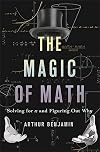
The book starts with some really amazing patterns with addition of integers - something I never knew, but then there are so many things in math that I'm new to. The author provides many tricks that I did during my school days. Some chapters begin with questions and the solution described in the book was simpler than the one I chose.
The discussion about Combinations and Permutations are very well explained. The author divulges the hidden magic among Pascal's triangle and Fibonacci series.
The show more interconnection between Pi, e, and i is illuminating - fantastically written Mr Benjamin. Reading about Trigonometry was refreshing and same with Calculus.
All in all, this is a book for the 'not-so-mathematical' person. For the math enthusiast, it will serve as a revival. show less
The discussion about Combinations and Permutations are very well explained. The author divulges the hidden magic among Pascal's triangle and Fibonacci series.
The show more interconnection between Pi, e, and i is illuminating - fantastically written Mr Benjamin. Reading about Trigonometry was refreshing and same with Calculus.
All in all, this is a book for the 'not-so-mathematical' person. For the math enthusiast, it will serve as a revival. show less
To say my math skills are severely limited (I wasn’t able to take classes beyond first year algebra and plain geometry) would be an understatement. But I have a nephew, Elijah, who recently turned nine who knows more than I ever did and, probably, more than most adults I know. When he goes to a friend’s house and brings something to play with, it’s usually a math book. When I saw a blurb for THE MAGIC OF MATH by Arthur Benjamin, I thought he might find it challenging and interesting. I show more don’t know about the challenging part, but he found it very interesting. One of his teachers told me he did one of the problems on the board and, when she had trouble keeping up with him, he brought the book to school to show it to her.
I recently visited him and interviewed him about what he thought of the book. These are his responses:
I think it is a really interesting book. It gives theorems and then proves them. It gives a number of math tricks and it tells you how it happened and why and why you always get the same answer.
It also has a thing called “asides.” They are aside from the real mathematics. They are words related to the topic and are really interesting.
I’d recommend this book to a person who likes math and wants to find out why.
I jumped around and looked at things that were interesting. I liked “See page.....”
I’d give it four stars because it’s not the best book I’ve ever read. It is good. I would have moved around the asides.
I’d be interested in reading other books by him. Of course, I would like for him to be my math teacher.
Elijah also said he’d be interested in going to Harvey Mudd. show less
I recently visited him and interviewed him about what he thought of the book. These are his responses:
I think it is a really interesting book. It gives theorems and then proves them. It gives a number of math tricks and it tells you how it happened and why and why you always get the same answer.
It also has a thing called “asides.” They are aside from the real mathematics. They are words related to the topic and are really interesting.
I’d recommend this book to a person who likes math and wants to find out why.
I jumped around and looked at things that were interesting. I liked “See page.....”
I’d give it four stars because it’s not the best book I’ve ever read. It is good. I would have moved around the asides.
I’d be interested in reading other books by him. Of course, I would like for him to be my math teacher.
Elijah also said he’d be interested in going to Harvey Mudd. show less
In 2010, I was intrigued and entertained by this author’s appearance and display of calculation gymnastics on The Colbert Report. In more recent years, I found his Joy of Mathematics course, a series of twenty-four half-hour lectures, rich source material for my lectures to first-year college students. I was immensely please to learn that elements of that course along with tricks of the stage used by this “mathemagician” (a title previously held by Benjamin’s inspiration Martin show more Gardner) were compiled into a book. The book delivers on all the promise of those two aspect of Benjamin’s talent: teacher and performer. Like Gardner, Benjamin telegraphs a joy of surprising mathematical stunts, like accurate estimates of e from one’s own phone number and the manifold discoveries waiting in Pascal’s Triangle...
[Look for my entire review at MAA Reviews] show less
[Look for my entire review at MAA Reviews] show less
Secrets of Mental Math: The Mathemagician's Guide to Lightning Calculation and Amazing Math Tricks by Arthur Benjamin
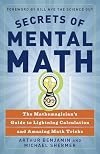
There are some fun tricks you can use to speed up your mental calculations. Depending on what you're using math for, you cherry-pick the ones that are most useful for you.
On the first-pass read through, I marked sections I wanted to invest time in learning. Then on the second-pass, I'm planning to practice those techniques. (but will probably procrastinate this)
There were moments of frustration however. So many of these tricks have exceptions. Things like:
If the first number ends in a 9 show more then do this, but if it's a factor then do something else—and you can remember this by remembering my dog chewed the couch Thursday.
It becomes a huge burden after awhile.
As the math scales to increasing difficulty, naturally the tricks start to get complicated. At some point you scratch your head and wonder "this is a shortcut???"
Mine this book for your preferred gems. show less
On the first-pass read through, I marked sections I wanted to invest time in learning. Then on the second-pass, I'm planning to practice those techniques. (but will probably procrastinate this)
There were moments of frustration however. So many of these tricks have exceptions. Things like:
If the first number ends in a 9 show more then do this, but if it's a factor then do something else—and you can remember this by remembering my dog chewed the couch Thursday.
It becomes a huge burden after awhile.
As the math scales to increasing difficulty, naturally the tricks start to get complicated. At some point you scratch your head and wonder "this is a shortcut???"
Mine this book for your preferred gems. show less
Awards


You May Also Like


Associated Authors
Statistics
- Works
- 24
- Also by
- 1
- Members
- 2,057
- Popularity
- #12,502
- Rating
- 4.0
- Reviews
- 23
- ISBNs
- 60
- Languages
- 6
- Favorited
- 1