

Paddy Chayefsky (1923–1981)
Author of Altered States
About the Author
Image credit: World-Telegram photo by Walter Albertin, 1958 (Library of Congress Prints and Photographs Division, LC-USZ62-121944)
Series
Works by Paddy Chayefsky
Quinto potere 4 copies
The screenplays 3 copies
Marty 2 copies
Television Plays by Paddy Chayefsky: The Bachelor Party, Printer's Measure, Holiday Dong, the Big Deal, The Mother, Marty (1955) 2 copies
The goddess; a screenplay 2 copies
דער טזענטער מאַן 1 copy
El décimo hombre 1 copy
The Mother 1 copy
Stati di allucinazione 1 copy
El décimo hombre 1 copy
The Big Deal 1 copy
Printer's Measure 1 copy
Holiday Song 1 copy
THE BACHELOR PARTY. 1 copy
Associated Works
Tagged
Common Knowledge
- Canonical name
- Chayefsky, Paddy
- Legal name
- Chayefsky, Sidney Aaron
- Birthdate
- 1923-01-29
- Date of death
- 1981-08-01
- Gender
- male
- Education
- City College of New York
Fordham University - Occupations
- playwright
screenwriter
printer's apprentice - Organizations
- United States Army (WWII)
- Awards and honors
- Purple Heart, US Armed Forces
Academy Award (Best Adapted Screenplay, 1955, 1971)
Academy Award (Best Original Screenplay, 1977)
British Academy of Film and Television Arts Award (Best Screenplay, 1972)
Golden Globe Award (Best Screenplay, 1972, 1977) - Nationality
- USA
- Birthplace
- The Bronx, New York, USA
- Place of death
- New York, New York, USA
- Burial location
- Sharon Gardens Cemetery, Valhalla, New York, USA
- Associated Place (for map)
- New York, USA
Members
Reviews
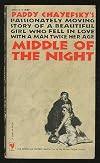
This play from Paddy Chayefsky examines the dynamic behind a May-December romance story in ways that must have seemed startingly refreshing when he wrote in 1957, and it still holds up today. The man in the story is 53, a manufacturing executive and a widower. The woman is 24, unhappily married to a musician, and works in his office.
The man faces the things many men in middle age face, melancholy, self-doubt, the growing betrayal of the body and mind, and a need to still feel attractive to show more women. The woman faces the things many people face in a marriage that’s unfulfilling. She and her husband are great in bed, but nowhere else. He travels regularly and doesn’t pay much attention to her thoughts or feelings, essentially taking her for granted. At the play’s outset, she’s left him and returned to her mother.
One of the strengths of the play is how frank it is in dealing with sexuality at various ages of life. The man’s 25-year-old daughter asks him “Pa, how’s your sex life?” and assures him that he’s a “vigorous man with normal appetites,” that is, before he begins seeing his new girlfriend, who’s a year younger than her. The mother of the girl says “a man, fifty-two, what the hell does he want with a kid like her except for you-know-what?” A friend of the family says “a lot of girls find older men attractive because they’re debonair and know a lot of tricks,” and knows one who was seeing an older man and had to have an abortion. She also asks the girl “do you think he’s going to be able to satisfy you sexually?” Lastly, the husband of the girl mentions a lonely army wife who would occasionally give him what amounts to a booty call, which was “just a physical thing.”
Despite all this talk about sex, the message is that a happy relationship is really about something else, and Chayefsky does good work in probing the psychology of these characters. “You just can’t imagine how naïve I was about marriage,” the young woman says, “…I wanted poor George to make up for everything I never had in my life.” Later she says, “I want him to love me. I want him to be pleased to see me.” With the man, it’s also not a sexual thing, it’s a need to feel appreciated, a need to have a considerate partner who will listen. Their families express their concerns and they themselves are worried about how many good years they’ll have together, leading to frank discussions and a difficult decision. Great stuff, and will have to seek out the 1959 movie with Frederic March and Kim Novak. show less
The man faces the things many men in middle age face, melancholy, self-doubt, the growing betrayal of the body and mind, and a need to still feel attractive to show more women. The woman faces the things many people face in a marriage that’s unfulfilling. She and her husband are great in bed, but nowhere else. He travels regularly and doesn’t pay much attention to her thoughts or feelings, essentially taking her for granted. At the play’s outset, she’s left him and returned to her mother.
One of the strengths of the play is how frank it is in dealing with sexuality at various ages of life. The man’s 25-year-old daughter asks him “Pa, how’s your sex life?” and assures him that he’s a “vigorous man with normal appetites,” that is, before he begins seeing his new girlfriend, who’s a year younger than her. The mother of the girl says “a man, fifty-two, what the hell does he want with a kid like her except for you-know-what?” A friend of the family says “a lot of girls find older men attractive because they’re debonair and know a lot of tricks,” and knows one who was seeing an older man and had to have an abortion. She also asks the girl “do you think he’s going to be able to satisfy you sexually?” Lastly, the husband of the girl mentions a lonely army wife who would occasionally give him what amounts to a booty call, which was “just a physical thing.”
Despite all this talk about sex, the message is that a happy relationship is really about something else, and Chayefsky does good work in probing the psychology of these characters. “You just can’t imagine how naïve I was about marriage,” the young woman says, “…I wanted poor George to make up for everything I never had in my life.” Later she says, “I want him to love me. I want him to be pleased to see me.” With the man, it’s also not a sexual thing, it’s a need to feel appreciated, a need to have a considerate partner who will listen. Their families express their concerns and they themselves are worried about how many good years they’ll have together, leading to frank discussions and a difficult decision. Great stuff, and will have to seek out the 1959 movie with Frederic March and Kim Novak. show less

This is an incredibly useful set of lessons from one of the finest writers Hollywood has ever employed. In fact, I think this is the only way one should read this book, as a set of lessons. The individual plays are a little dated (though not their internal dramatic mechanisms), and some of the commentary Paddy gives at the end of each script may not apply today, but that doesn't prevent this book from being a masterclass in writing technique.
This is an incredibly useful set of lessons from one of the finest writers Hollywood has ever employed. In fact, I think this is the only way one should read this book, as a set of lessons. The individual plays are a little dated (though not their internal dramatic mechanisms), and some of the commentary Paddy gives at the end of each script may not apply today, but that doesn't prevent this book from being a masterclass in writing technique.

C+ (Okay).
I loved the scenes with Marty and Clara together. The stuff with Marty's family and friends, especially the third act, gets kind of hard to watch.
(Nov. 2023)
I loved the scenes with Marty and Clara together. The stuff with Marty's family and friends, especially the third act, gets kind of hard to watch.
(Nov. 2023)
Lists
Awards


You May Also Like


Associated Authors
Statistics
- Works
- 41
- Also by
- 5
- Members
- 1,309
- Popularity
- #19,618
- Rating
- 3.8
- Reviews
- 21
- ISBNs
- 81
- Languages
- 5
- Favorited
- 5