
Richard V. Reeves
Author of Of Boys and Men: Why the Modern Male Is Struggling, Why It Matters, and What to Do about It
About the Author
Richard V. Reeves is a senior fellow in Economic Studies and codirector of the Center on Children and Families at the Brookings Institution.
Image credit: HBCO
Works by Richard V. Reeves
Of Boys and Men: Why the Modern Male Is Struggling, Why It Matters, and What to Do about It (2022) 339 copies, 7 reviews
Dream Hoarders: How the American Upper Middle Class Is Leaving Everyone Else in the Dust, Why That Is a Problem, and What to Do About It (2017) 271 copies, 10 reviews
Yes, Boys Can!: Inspiring Stories of Men Who Changed the World - He Can H.E.A.L. (2024) 7 copies, 1 review
Tagged
Common Knowledge
- Birthdate
- 1969-07-04
- Gender
- male
- Education
- University of Oxford
Warwick University - Organizations
- Center on Children and Families
- Nationality
- UK
- Birthplace
- Peterborough, Cambridgeshire, England, UK
- Associated Place (for map)
- England, UK
Members
Reviews
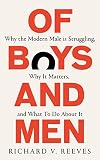
Of Boys and Men is a meticulously sourced and argued case that the guys are not alright, and that there are clear social, legal, political, and moral grounds for doing something about it. This book is truly centrist, in that it has something to annoy everybody, while also making a case for a series of eminently reasonable policy experiments to improve matters.
The Offspring - The Kids Aren't Alright
I knew, in a vague way from Liz Plank's For the Love of Men and Seligo's Who Gets in and Why, show more that my fellow men were having trouble, but I didn't know how bad it was. Men are overwhelmingly more likely to drop out of school, to suffer in economic transformations, be victims and perpetrators of violent crime, or to die deaths of despair or stupidity. The extensively footnoted sources hit like hammer blows. Black men in particular are doing extremely poorly, suffering from systematic racism and police brutality. They've seen almost no rise in income since 1970. Worse, every typical policy intervention: education, training, scholarships, basic income stipends and so on, benefit women but have no effect on men.
Reeves makes three major points in the introduction. The first is that policy and social science has become systematically biased towards women. While there are active efforts to track where women are falling short and various governmental panels and non-profits to remediate those gaps, there's no similar effort for men. Even the existence of poorer outcomes for men has to be reconstructed from various social science studies, because gender is frequently not a tracked variable. As an aside, Reeves is careful to note that he does not intend an attack on women or feminism, and that motherhood still places an exceptional burden on women which is not shared with men. He just wants more symmetry in gender-based policy. Second, while there are not explicit barriers to male success, in outcomes the situation for men is about as bad as it was for women in the 1960s, before the legal triumphs of second wave feminism. And finally, if men could be removed from the statistics, America might well be an actual utopia, along the lines of Herland or Whileaway from Russ's The Female Man.
As Reeves discusses, both progressives and conservatives have failed men, under the broad rubric that progressives think boys should be more like their sisters, and that conservatives think that boys should be more like their fathers. In a departure from typical searching for systematic causes, progressives tend to see male failures through the lens of individual weakness and toxic masculinity. Without harming women, progressives should use their traditional techniques to understand uniquely male challenges. Conservatives have been more attuned to male anxieties, but have abandoned any move towards better conditions in a cynical pursuit of grievance politics. The manosphere, from Donald Trump on down to Jordan Peterson and Andrew Tate, suggests an every escalating attitude of anger and social disconnection which just leads men to ever darker placers, finishing in an incel mass shooting.
What is most valuable about this book is that Reeves offers what seem to me eminently sensible policy prescriptions. The first one is focusing on education, since failures in education seem to lead into a lot of later problems. Reeves argues that biologically and neurologically, boys develop slower than girls, and the simplest policy prescription is to redshirt boys, delaying their entry into school by one year by having them do an additional year of pre-K. Redshirting is most common among upper middle class white boys who need the least assistance, and making this policy universal, along with more support for early childcare. Reeves is careful to note that biological differences between genders conceal a much greater overlap, but given how much of your life can be defined by the worst day, climbing a water tower, getting in a fist fight, being arrested for drugs, being attentive to the lowest extremes in behavior is important. This matches my own experiences. As an August birth, my parents had the option of having me be the youngest kid in the class or the oldest, and being the oldest definitely benefitted me. There was also that very weird couple of years around 6th grade where the girls had gone through puberty and were distinctly young women and the boys were mostly still little kids. And across the board, young women are more emotionally mature, more attentive, and more motivated to succeed. A second change in education is better vocational training in secondary schools and more opportunities to 'think with your hands'.
A second policy thrust is a focused policy effort to get more men into HEAL careers (Health, Education, Administration, and Literacy), similar to successful efforts to get more women into STEM (Science, Technology, Engineering, and Math) in recent decades. HEAL careers are both some of the fastest growing and most stable sectors of the economy, and there are vanishingly few men in entire fields like nursing and early childhood education for reasons which are entirely based on false cultural stereotypes. In particular, Black boys appear to benefit greatly from English classrooms with Black male teachers, and there are almost none. There should be focused efforts to recruit, train, hire, and retain men in HEAL jobs similar to how there are focused efforts for women in STEM.
And the third area is rethinking fatherhood. Both parents should get a full six months of paid parental leave. While mothers will perforce have more to with babies (I did none of the gestation or breastfeeding of my own son), fathers can take more of the lead with older children and may have an important role in teaching healthy approaches to new experiences, risk, and boundaries. Finally, while family courts have made massive strides in recognizing the rights of divorced fathers in the past few decades, unmarried fathers are still in a 1950s legal limbo of many obligations and few rights. Black men get one of their few accolades in this book, as Reeves notes that unmarried Black fathers are notably more involved than their n0n-Black unmarried counterparts.
I added this book to my list thanks to a provocative article in The Atlantic. Having read the full book, I am strongly persuaded by Reeves' arguments and evidence. Even if you disagree with his conclusions, the clear need for a better, evidence-driven discussion on masculinity and its discontents is a urgent scholarly, social and political issue. show less
The Offspring - The Kids Aren't Alright
I knew, in a vague way from Liz Plank's For the Love of Men and Seligo's Who Gets in and Why, show more that my fellow men were having trouble, but I didn't know how bad it was. Men are overwhelmingly more likely to drop out of school, to suffer in economic transformations, be victims and perpetrators of violent crime, or to die deaths of despair or stupidity. The extensively footnoted sources hit like hammer blows. Black men in particular are doing extremely poorly, suffering from systematic racism and police brutality. They've seen almost no rise in income since 1970. Worse, every typical policy intervention: education, training, scholarships, basic income stipends and so on, benefit women but have no effect on men.
Reeves makes three major points in the introduction. The first is that policy and social science has become systematically biased towards women. While there are active efforts to track where women are falling short and various governmental panels and non-profits to remediate those gaps, there's no similar effort for men. Even the existence of poorer outcomes for men has to be reconstructed from various social science studies, because gender is frequently not a tracked variable. As an aside, Reeves is careful to note that he does not intend an attack on women or feminism, and that motherhood still places an exceptional burden on women which is not shared with men. He just wants more symmetry in gender-based policy. Second, while there are not explicit barriers to male success, in outcomes the situation for men is about as bad as it was for women in the 1960s, before the legal triumphs of second wave feminism. And finally, if men could be removed from the statistics, America might well be an actual utopia, along the lines of Herland or Whileaway from Russ's The Female Man.
As Reeves discusses, both progressives and conservatives have failed men, under the broad rubric that progressives think boys should be more like their sisters, and that conservatives think that boys should be more like their fathers. In a departure from typical searching for systematic causes, progressives tend to see male failures through the lens of individual weakness and toxic masculinity. Without harming women, progressives should use their traditional techniques to understand uniquely male challenges. Conservatives have been more attuned to male anxieties, but have abandoned any move towards better conditions in a cynical pursuit of grievance politics. The manosphere, from Donald Trump on down to Jordan Peterson and Andrew Tate, suggests an every escalating attitude of anger and social disconnection which just leads men to ever darker placers, finishing in an incel mass shooting.
What is most valuable about this book is that Reeves offers what seem to me eminently sensible policy prescriptions. The first one is focusing on education, since failures in education seem to lead into a lot of later problems. Reeves argues that biologically and neurologically, boys develop slower than girls, and the simplest policy prescription is to redshirt boys, delaying their entry into school by one year by having them do an additional year of pre-K. Redshirting is most common among upper middle class white boys who need the least assistance, and making this policy universal, along with more support for early childcare. Reeves is careful to note that biological differences between genders conceal a much greater overlap, but given how much of your life can be defined by the worst day, climbing a water tower, getting in a fist fight, being arrested for drugs, being attentive to the lowest extremes in behavior is important. This matches my own experiences. As an August birth, my parents had the option of having me be the youngest kid in the class or the oldest, and being the oldest definitely benefitted me. There was also that very weird couple of years around 6th grade where the girls had gone through puberty and were distinctly young women and the boys were mostly still little kids. And across the board, young women are more emotionally mature, more attentive, and more motivated to succeed. A second change in education is better vocational training in secondary schools and more opportunities to 'think with your hands'.
A second policy thrust is a focused policy effort to get more men into HEAL careers (Health, Education, Administration, and Literacy), similar to successful efforts to get more women into STEM (Science, Technology, Engineering, and Math) in recent decades. HEAL careers are both some of the fastest growing and most stable sectors of the economy, and there are vanishingly few men in entire fields like nursing and early childhood education for reasons which are entirely based on false cultural stereotypes. In particular, Black boys appear to benefit greatly from English classrooms with Black male teachers, and there are almost none. There should be focused efforts to recruit, train, hire, and retain men in HEAL jobs similar to how there are focused efforts for women in STEM.
And the third area is rethinking fatherhood. Both parents should get a full six months of paid parental leave. While mothers will perforce have more to with babies (I did none of the gestation or breastfeeding of my own son), fathers can take more of the lead with older children and may have an important role in teaching healthy approaches to new experiences, risk, and boundaries. Finally, while family courts have made massive strides in recognizing the rights of divorced fathers in the past few decades, unmarried fathers are still in a 1950s legal limbo of many obligations and few rights. Black men get one of their few accolades in this book, as Reeves notes that unmarried Black fathers are notably more involved than their n0n-Black unmarried counterparts.
I added this book to my list thanks to a provocative article in The Atlantic. Having read the full book, I am strongly persuaded by Reeves' arguments and evidence. Even if you disagree with his conclusions, the clear need for a better, evidence-driven discussion on masculinity and its discontents is a urgent scholarly, social and political issue. show less
Dream Hoarders: How the American Upper Middle Class Is Leaving Everyone Else in the Dust, Why That Is a Problem, and What to Do About It by Richard V. Reeves

Disclaimer: I read the first half, skimmed the second half. I feel like the only earth-shaking reveal came in the beginning: the author defines "upper middle-class" much more broadly than is customary in popular usage. If you own a home and have a pension plan, guess what? That's the new upper class. The rest makes complete sense: legacy college admissions, internships, property-tax-based education--these are vehicles of enforcing the status quo (i.e., excluding other people). I plan to show more revisit this book later: the author is correct that the US is straying from the mobile society we TALK about having. Trouble is, the culprit is not the top one percent millionaires we publicly revile, the culprit is folks like me and you. show less
Dream Hoarders: How the American Upper Middle Class Is Leaving Everyone Else in the Dust, Why That Is a Problem, and What to Do About It by Richard V. Reeves
Yes, the 1% are awful, but Reeves argues that the 20% are also a big part of the problem, hoarding opportunity in college admissions (legacies, 529 plans 90% of whose benefits go to the already wealthy, and expensive prep activities) and housing (restrictive zoning, the mortgage interest deduction). The top 20% have taken off in wealth from the rest of the country, even though the benefits are even more concentrated at the top; tournament-type high wages for professionals and assortative show more mating have led the 20% to detach from the bottom. The top 20% have the human capital to thrive in a transnational economy; “[t]he cities we live in are zoned to protect our wealth, but deter the unskilled from sharing in it. Professional licensing and an immigration policy tilted toward the low-skilled shield us from the intense market competition faced by those in nonprofessional occupations.” We have a culture of entitlement, based on our current status and our belief that it results from our own merits. This is both wrong and inefficient (e.g., fund managers from poor backgrounds perform better than those from richer backgrounds, probably because of how much better they have to be in the first place to get into financial services).
We need downward mobility if we are to have upward mobility, but the 20% will resist that as fiercely as possible as long as downward mobility has such serious consequences for well-being. Right now we have a “glass floor” that often prevents less-meritorious children of the 20% from falling down—lower-scoring adolescents from that group are more likely to get a college degree, which protects them from downard mobility. Some fixes involve giving more to the 80%: better long-term contraception; home visits and support for new parents; better teachers at poorer schools; and equalizing college funding. The even harder lifts involve fighting exclusionary zoning and college legacy preferences, getting rid of the mortgage interest tax credit, equalizing taxation of income and capital gains, and creating a system to pay for unpaid internships—harder because they involve the 20% giving up advantages. (Apparently Oxford and Cambridge gave up legacy preferences without seeing a decrease in alumni giving; but I doubt we’ll see much of that in the US any time soon regardless.) On internships, power begets power, and favors those who don’t need to earn money while working towards furthering their later careers: My alma mater high school, an expensive private school in DC, produced more White House interns than Florida, Pennsylvania, or Illinois—but it’s also worth noting the reason we know that, since the high schools aren’t publicly listed—the reporter who published the analysis also went there, and two of her editors. For all these things, from admissions to zoning, practices that once served primarily racist goals (legacies against Jews, zoning against African-Americans) “have been softened, normalized, and subtly repurposed to help us sustain the upper middle-class status.” show less
We need downward mobility if we are to have upward mobility, but the 20% will resist that as fiercely as possible as long as downward mobility has such serious consequences for well-being. Right now we have a “glass floor” that often prevents less-meritorious children of the 20% from falling down—lower-scoring adolescents from that group are more likely to get a college degree, which protects them from downard mobility. Some fixes involve giving more to the 80%: better long-term contraception; home visits and support for new parents; better teachers at poorer schools; and equalizing college funding. The even harder lifts involve fighting exclusionary zoning and college legacy preferences, getting rid of the mortgage interest tax credit, equalizing taxation of income and capital gains, and creating a system to pay for unpaid internships—harder because they involve the 20% giving up advantages. (Apparently Oxford and Cambridge gave up legacy preferences without seeing a decrease in alumni giving; but I doubt we’ll see much of that in the US any time soon regardless.) On internships, power begets power, and favors those who don’t need to earn money while working towards furthering their later careers: My alma mater high school, an expensive private school in DC, produced more White House interns than Florida, Pennsylvania, or Illinois—but it’s also worth noting the reason we know that, since the high schools aren’t publicly listed—the reporter who published the analysis also went there, and two of her editors. For all these things, from admissions to zoning, practices that once served primarily racist goals (legacies against Jews, zoning against African-Americans) “have been softened, normalized, and subtly repurposed to help us sustain the upper middle-class status.” show less
Dream Hoarders: How the American Upper Middle Class Is Leaving Everyone Else in the Dust, Why That Is a Problem, and What to Do About It by Richard V. Reeves
Thought-provoking because it hits close to home. Am I aware of inequities in our social system? Absolutely! Am I willing to do something about it at personal cost? Ummm....Reeves (a British immigrant) argues that America has become so stratified that we really are a class-based society as much as we are based on not being one. Here are the factors that contribute: "exclusionary zoning in residential areas, unfair mechanisms influencing college admissions including legacy preferences, and the show more informal allocation of internships." He's right on the mark. With those three practices in place the "haves" get more and the "have nots" fall behind. He acknowledges that there are many more factors, but those are the ones he has chosen to focus on here. He's not a socialist, but as a transplant he is struck by the lack of equal opportunity in America. The lifestyle the upper middle class (defined here as household income over $112,000) has earned begets inherent privileges passed on to their children that create a growing divide between those he terms middle class ($54,000), not to mention the lowest fifth on the continuum. They have better access to education, health care, enrichment opportunities, social and business connections. As for hoarding: "Opportunity hoarding takes place when valuable, scarce opportunities are allocated in an anti-competitive manner, that is influenced by factors unrelated to an individual's performance" (internships and legacies make sense here - it's not what you know but who) To fix this he proposed ideas that will need to change not just minds, but hearts: 1. Reduce unintended pregnancies w/ better contraception 2. Increase home visiting to improve parenting 3. Get better teachers for unlucky kids 4. Fund college fairly 5. curb exclusionary zoning 6. end legacy admissions 7. Open up internships. All possible, all challenging, some already being chipped away at. Lots to think about. This was published in 2017, so could already be updated and is more germane as it inherently involves issues of race too. An interesting observation by Reeves: "to be American is to be free to make something of yourself." He is advocating that everyone be allowed to start with equal building blocks. show less
Lists
Awards


You May Also Like


Associated Authors
Statistics
- Works
- 14
- Members
- 840
- Popularity
- #30,424
- Rating
- 3.8
- Reviews
- 22
- ISBNs
- 44
- Languages
- 4