
Phil G. Goulding
Author of Classical Music: the 50 greatest composers and their 1,000 greatest works
About the Author
Works by Phil G. Goulding
Classical Music: the 50 greatest composers and their 1,000 greatest works (1992) 499 copies, 5 reviews
Tagged
Common Knowledge
- Gender
- male
Members
Reviews
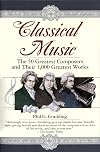
This is one of four general guides I own to classical music. I have other books specifically on orchestral, concerto, chamber, choral and opera, but this is one that covers all the different forms. The Miller Barnes and Noble Introduction to Music goes over such things as tone, rhythm, melody, etc. The Hurwitz Beethoven or Bust goes over the various forms (the concerto, for instance) and their various types. Goulding's Classical Music concentrates on the core repertory--"The 50 Greatest show more Composers and Their 1,000 Greatest Works."
The Vintage Guide to Classical Music also focuses more on the composers than the forms, but is more eclectic and comprehensive. Goulding includes very few Medieval or Renaissance or many Modern composers--while Swafford's Vintage Guide includes biographies and naming of the important pieces to know of de Machaut, Dufay, Desprez, di Lasso, Monteverdi, Ives, Schoenberg, Berg, Webern, Britten. But I do love how Goulding focuses on those chosen composers. The book doesn't just give an overview of their lives and works, but gives you a "Starter Kit" and then a "Top Ten" to jumpstart your collection. The composers appear what Goulding considers their order of greatness. This is his top ten:
1) Johann Sebastian Bach
2) Wolfgang Amadeus Mozart
3) Ludwig van Beethoven
4) Richard Wagner
5) Franz Joseph Haydn
6) Johannes Brahms
7) Franz Schubert
8) Robert Schumann
9) George Frideric Handel
10) Peter Ilyitch Tchaikovsky
For some composers you'll get listings for a "Master Collection." For the 3 "greatest" composers Bach, Mozart, Beethoven you'll get listings for a more extensive "Library" too. Obviously this is rather biased towards German/Austrian composers, but still makes a great introduction to classical music. show less
The Vintage Guide to Classical Music also focuses more on the composers than the forms, but is more eclectic and comprehensive. Goulding includes very few Medieval or Renaissance or many Modern composers--while Swafford's Vintage Guide includes biographies and naming of the important pieces to know of de Machaut, Dufay, Desprez, di Lasso, Monteverdi, Ives, Schoenberg, Berg, Webern, Britten. But I do love how Goulding focuses on those chosen composers. The book doesn't just give an overview of their lives and works, but gives you a "Starter Kit" and then a "Top Ten" to jumpstart your collection. The composers appear what Goulding considers their order of greatness. This is his top ten:
1) Johann Sebastian Bach
2) Wolfgang Amadeus Mozart
3) Ludwig van Beethoven
4) Richard Wagner
5) Franz Joseph Haydn
6) Johannes Brahms
7) Franz Schubert
8) Robert Schumann
9) George Frideric Handel
10) Peter Ilyitch Tchaikovsky
For some composers you'll get listings for a "Master Collection." For the 3 "greatest" composers Bach, Mozart, Beethoven you'll get listings for a more extensive "Library" too. Obviously this is rather biased towards German/Austrian composers, but still makes a great introduction to classical music. show less
I found this book to be quite enjoyable to leaf through and to read. Although somewhat for the beginner, this is a good guide for the more experienced to find out what they have missed in their listening, and to learn more about the "50" greatest composers.
The composers are listed by the presumed ranking of their greatness. Bach, Mozart, Beethoven, Wagner, Haydn, Brahms, and Schubert make up the first seven, and obvious bias to the classical period and all Germanic. His favorite non-Germanic show more composer, Antonin Dvoŕák (Czech), comes in at #12. Verdi, the top Italian composer comes in at 16th; the top French composer, Berlioz, comes in at 21st.
For each composer, Goulding prvodes a "Starter Kit", then puts in the "Top Ten", and finally lays out a fairly full "Master Collection." It's kind of fun to see how you might adjust these ranking based on what you have really appreciated.
Composers assoicated with minimalism, and those very recently well known, like Arvo Pärt, are not included. show less
The composers are listed by the presumed ranking of their greatness. Bach, Mozart, Beethoven, Wagner, Haydn, Brahms, and Schubert make up the first seven, and obvious bias to the classical period and all Germanic. His favorite non-Germanic show more composer, Antonin Dvoŕák (Czech), comes in at #12. Verdi, the top Italian composer comes in at 16th; the top French composer, Berlioz, comes in at 21st.
For each composer, Goulding prvodes a "Starter Kit", then puts in the "Top Ten", and finally lays out a fairly full "Master Collection." It's kind of fun to see how you might adjust these ranking based on what you have really appreciated.
Composers assoicated with minimalism, and those very recently well known, like Arvo Pärt, are not included. show less
Ticket to the Opera: Discovering and Exploring 100 Famous Works, History, Lore, and Singers, with Recommended Recordings by Phil G. Goulding
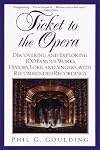
A Comprehensive layman's guide to the world of opera--Phil G. Goulding finally make the magic and mystique of opera accessible to all.
Ticket to the Opera: Discovering and Exploring 100 Famous Works, History, Lore, and Singers, with Recommended Recordings by Phil G. Goulding
A great introduction to opera and also a great reference work to the most popular operas.
You May Also Like


Statistics
- Works
- 6
- Members
- 680
- Popularity
- #37,180
- Rating
- 4.2
- Reviews
- 7
- ISBNs
- 15
- Languages
- 3
- Favorited
- 1