

Dean Acheson (1893–1971)
Author of Present at the Creation: My Years in the State Department
About the Author
Image credit: Portrait of Dean Acheson, from a series of color portraits of Truman cabinet members Turman Library Photographs
Works by Dean Acheson
The Pattern of Responsibility: Edited by McGeorge Bundy from the Record of Secretary of State Dean Acheson (1972) 5 copies
Strengthening the forces of freedom : selected speeches and statements of Secretary of State Acheson, February 1949-April 1950 (1950) 2 copies
Associated Works
Tagged
Common Knowledge
- Canonical name
- Acheson, Dean
- Legal name
- Acheson, Dean Gooderham
- Birthdate
- 1893-04-11
- Date of death
- 1971-11-12
- Gender
- male
- Education
- Yale University (1915)
Harvard Law School (1918) - Occupations
- U.S. Secretary of State (1949-1953)
diplomat
lawyer
author
United States Under Secretary of the Treasury (1933-1933)
United States Assistant Secretary of State (show all 7)
United States Under Secretary of State (1945-1949) - Organizations
- Covington & Burling
United States Department of the Treasury
United States Department of State
Scroll and Key
Delta Kappa Epsilon
American Academy of Arts and Sciences (show all 10)
Franklin D. Roosevelt administration (1933-1933)
Franklin D. Roosevelt administration (1941-1945)
Harry S. Truman administration (1945-1953)
Harry S. Truman's cabinet (1949-1953 ∙ Secretary of State) - Awards and honors
- Medal for Merit (1947)
Phi Beta Kappa
Presidential Medal of Freedom (1964) - Relationships
- Lewis, Sinclair (friend)
Acheson, David C. (son) - Nationality
- USA
- Birthplace
- Middletown, Connecticut, USA
- Places of residence
- Middletown, Connecticut, USA
Washington, D.C., USA
Sandy Spring, Maryland, USA - Place of death
- Sandy Spring, Maryland, USA
- Burial location
- Oak Hill Cemetery, Washington, D.C., USA
- Associated Place (for map)
- USA
Members
Reviews
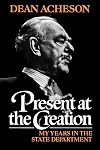
Those of you who know me, know that I am not much of a history person, and this book contains some quite heavy history (~740 pages of it). Despite my general aversion to history, I found the book quite interesting. This was aided, in part, by the engaging material. It was further aided by Acheson's writing style. The book was peppered with amusing anecdotes that made historical figures seem like real live people (wax earplugs are not to be eaten). The book was also very well organized. My show more favorite touch was that the year in which the action on a page takes place was printed on the inner section of the header of that page. Very nice. show less
I read this book after hearing the late U.S. Senator Daniel Patrick Moynihan describe Acheson as "the Great Man of American diplomacy." Moynihan went on to say that anyone who wanted to know about what American diplomacy stood for and was all about should read Acheson's Present at the Creation. I took Moynihan's advice, and have been a huge fan of this book and Acheson every since.
As Acheson himself puts it in the opening of the book, he wrote this work, about his experience from 1941 show more through 1952, in 1969 -- over 17 years since he had served as Secretary of State -- for the following reasons:
"The experiences of the years...have brought the country, particularly its young people, to a mood of depression, disillusion, and withdrawal from the effort to affect the world."
In response, Acheson wrote to: "tell a tale of large conceptions, great achievements...Its hero is the American people."
Clearly these Acheson ideas and ideals still apply now, and are a great reason to read this book today.
Acheson also writes clearly and beautifully, with great insight and wry wit. A few examples:
"Unfortunately, the hyperbole of the inaugural (President Truman's) outran the provision of the budget."
"President (Truman) observed (that) 'to assure the Arabs that they would be consulted (prior to official US recognition of Israel) was by no means inconsistent with my generally sympathetic attitudes toward Jewish aspirations.' The Arabs may be forgiven for believing that this did not exactly state the inconsistency as they saw it."
"Throughout the Near East lay rare tinder for anti-Western propaganda: a Moslem culture and history, bitter Arab nationalism galled by Jewish immigration under British protection and with massive American financial support, the remnants of a colonial status, and a sense of grievance that a vast natural resource was being extracted by foreigners under arrangements thought unfair to those living on the surface. This tinder could be, and was, lighted everywhere..." show less
As Acheson himself puts it in the opening of the book, he wrote this work, about his experience from 1941 show more through 1952, in 1969 -- over 17 years since he had served as Secretary of State -- for the following reasons:
"The experiences of the years...have brought the country, particularly its young people, to a mood of depression, disillusion, and withdrawal from the effort to affect the world."
In response, Acheson wrote to: "tell a tale of large conceptions, great achievements...Its hero is the American people."
Clearly these Acheson ideas and ideals still apply now, and are a great reason to read this book today.
Acheson also writes clearly and beautifully, with great insight and wry wit. A few examples:
"Unfortunately, the hyperbole of the inaugural (President Truman's) outran the provision of the budget."
"President (Truman) observed (that) 'to assure the Arabs that they would be consulted (prior to official US recognition of Israel) was by no means inconsistent with my generally sympathetic attitudes toward Jewish aspirations.' The Arabs may be forgiven for believing that this did not exactly state the inconsistency as they saw it."
"Throughout the Near East lay rare tinder for anti-Western propaganda: a Moslem culture and history, bitter Arab nationalism galled by Jewish immigration under British protection and with massive American financial support, the remnants of a colonial status, and a sense of grievance that a vast natural resource was being extracted by foreigners under arrangements thought unfair to those living on the surface. This tinder could be, and was, lighted everywhere..." show less
Weak history with lots of suggestion of causes without supporting evidence. It feels part of a propaganda campaign.
It contains some odd graphics but also some interesting historical footage and information.
It is way too long.
It contains some odd graphics but also some interesting historical footage and information.
It is way too long.

Dean Acheson was a high-ranking U.S. diplomat throughout the WW2 war years and into the years immediately afterwards. He was Assistant Secretary of State for Congressional Relations and International Conferences from December 1944 through August 1945, then Under Secretary of State until June 1947 and finally returned to government service to become Secretary of State in the Truman administration from 1949 through 1953. Acheson was Secretary of State between George Marshall and John Foster show more Dulles.
This book contains a series of reminiscences/portraits of the diplomats and politicians he worked with (or, in some cases, against) and/or under during his time in the diplomatic corps. The book opens with chapters about Ernest Bevin and Robert Shuman, Acheson's opposite numbers for England and France, respectively, during the years at the end of, and immediately after, the war, when the large Western democracies were figuring out how they wanted to administer Western Europe and how to negotiate with Soviet Russia and create a united front against what they saw as Soviet plans for further expansion. There is a chapter, also, on Acheson's dealing with several Russian diplomats and their negotiating tactics. The chapters cover negotiations around the establishment of the United Nations, the administration of the post-war occupation of Germany and the establishment of the western alliance that became NATO. Of particular interest to me were the deliberations that led to the decision to bring West Germany into the alliance (i.e., to rearm them, a development that was viewed with some alarm, as I've learned from other reading, in many parts of Europe). While there was serious reluctance to take this step in some quarters, in the end the West Germans were seen by the U.S. and the Western European powers as a pivotal member of any alliance that would be able to stand up to Stalin and his successors. show less
This book contains a series of reminiscences/portraits of the diplomats and politicians he worked with (or, in some cases, against) and/or under during his time in the diplomatic corps. The book opens with chapters about Ernest Bevin and Robert Shuman, Acheson's opposite numbers for England and France, respectively, during the years at the end of, and immediately after, the war, when the large Western democracies were figuring out how they wanted to administer Western Europe and how to negotiate with Soviet Russia and create a united front against what they saw as Soviet plans for further expansion. There is a chapter, also, on Acheson's dealing with several Russian diplomats and their negotiating tactics. The chapters cover negotiations around the establishment of the United Nations, the administration of the post-war occupation of Germany and the establishment of the western alliance that became NATO. Of particular interest to me were the deliberations that led to the decision to bring West Germany into the alliance (i.e., to rearm them, a development that was viewed with some alarm, as I've learned from other reading, in many parts of Europe). While there was serious reluctance to take this step in some quarters, in the end the West Germans were seen by the U.S. and the Western European powers as a pivotal member of any alliance that would be able to stand up to Stalin and his successors. show less
Lists
Awards


You May Also Like


Associated Authors
Statistics
- Works
- 28
- Also by
- 1
- Members
- 842
- Popularity
- #30,363
- Rating
- 3.7
- Reviews
- 10
- ISBNs
- 25
- Favorited
- 1

