
Anne Carson (1) (1950–)
Author of Autobiography of Red: A Novel in Verse
For other authors named Anne Carson, see the disambiguation page.
About the Author
Anne Carson was born December 16, 1950. Carson is a poet, an essayist, and a classicist. She is the director of the graduate program in Classics at McGill University, where she also teaches Latin and Greek. Carson is perhaps besst know for Autobiography of Red: A Novel in Verse, which won the 1998 show more QSPELL Prize for Poetry. Carson recently won the 2001 Griffin Poetry Prize for Men in the Off Hours. Carson also won the T.S. Eliot poetry prize for The Beauty of the Husband, the first woman to win the award in its nine-year history. She was awarded a Guggenheim Fellowship in 1998 and received a $500,000 MacArthur Fellowship in 2000. Carson is the author of seven books. (Bowker Author Biography) show less
Series
Works by Anne Carson
An Oresteia: Agamemnon by Aiskhylos; Elektra by Sophokles; Orestes by Euripides (2009) 300 copies, 6 reviews
The Glass Essay 5 copies
Elektra (NHB Classic Plays): the script of the West End production starring Oscar-winner Brie Larson (2025) 2 copies
La Caída de Roma 1 copy
Eros, o doce-amargo 1 copy
Albertine-æfingarnar 1 copy
Carson, Anne Archive 1 copy
Associated Works
Lost Classics: Writers on Books Loved and Lost, Overlooked, Under-read, Unavailable, Stolen, Extinct, or Otherwise Out of Commission (2000) — Contributor — 321 copies, 6 reviews
Touchstone Anthology of Contemporary Creative Nonfiction: Work from 1970 to the Present (2007) — Contributor — 219 copies, 3 reviews
Know the Past, Find the Future: The New York Public Library at 100 (2011) — Contributor — 133 copies, 4 reviews
The Best American Poetry 2014 (The Best American Poetry series) (2014) — Contributor — 89 copies, 1 review
Imaginarium 3: The Best Canadian Speculative Writing (The Imaginarium Series) (2015) — Contributor — 22 copies
Constructions of the Classical Body (The Body, In Theory: Histories of Cultural Materialism) (1999) — Contributor — 14 copies
Syracuse, the Fairest Greek City: Ancient Art from the Museo Archeologico Regionale 'Paolo Orsi' (Fonti per la storia della sanita) (1999) — Contributor — 10 copies
The Poetry Review - Volume 113:4 Winter 2023 — Contributor — 2 copies
Arethusa (vol 21 no 2) — Contributor — 1 copy
Antigone at the Barbican, with Juliette Binoche [Drama, 2015] — Translator — 1 copy
Tagged
Common Knowledge
- Canonical name
- Carson, Anne
- Legal name
- Carson, Anne Patricia
- Birthdate
- 1950-06-21
- Gender
- female
- Education
- University of Toronto (BA|1974|MA|1975|Ph.D|1981)
- Occupations
- poet
essayist
translator
professor
classicist - Organizations
- McGill University
- Awards and honors
- MacArthur Fellowship (2000)
Order of Canada (2005)
Lannan Literary Award (1996)
Griffin Poetry Prize (2001, 2014)
Princess of Asturias Award for Literature (2020)
American Academy of Arts and Sciences, International Honorary Member (1999) (show all 19)
American Academy of Arts and Letters, Foreign Honorary Member (2011)
PEN/Nabokov Award for Achievement in International Literature (2021)
Governor General's Literary Award (2020)
Manuel Acuña International Poetry Prize (2019)
Blue Metropolis International Literary Grand Prize for lifetime achievement (2016)
Criticos Prize (2012)
PEN Award for Poetry in Translation (2010)
Los Angeles Times Book Prize for Poetry (2001)
T. S. Eliot Prize (2001)
Pushcart Prize (1997)
QSPELL Award – A. M. Klein Prize for Poetry (1996, 1998, 2001)
Betty Colladay Award (1984)
Guggenheim Fellowship (1998) - Relationships
- Currie, Robert (husband)
- Nationality
- Canada
- Birthplace
- Toronto, Ontario, Canada
- Places of residence
- Toronto, Ontario, Canada
Ann Arbor, Michigan, USA
Montréal, Québec, Canada - Map Location
- Canada
Members
Reviews

Autobiography of Red is a novel written in verse with the exceptions of the beginning and ending chapters. We start with Homerian era characters and legend and then are brought into more modern times. It is clever, intricate, good humored, having a sense of play, and sometimes thought provoking. Would the author, Anne Carson, object to her work being described as being somewhere between Homer and Gertrude Stein? Both of whom she refers to often. It has been said of Stein that she was show more concerned with the process of writing at the expense of product and this criticism also applies to Carson. The Homeric of the story is weakened by its Steinying presentation. Those readers with a sense of adventure will be rewarded with this tale; especially with how it is told. The Steinying part can sparkle and amaze.
Quotes: (page 4) “What is an adjective? Nouns name the world. Verbs activate the names. Adjectives come from somewhere else. The word adjective (epitheton in Greek) is itself an adjective meaning 'placed on top,' 'added,' 'appended,' imported,' foreign.' These small imported mechanisms are in charge of attaching everything in the world to its place in particularity. They are the latches of being...(page 5) For no reason that anyone can name, Stesichoros began to undo the latches.”
(page 82) “There is no person without a world.
___________
The red monster sat at the corner table of Cafe Mitwelt writing bits of Heidegger
on the postcards he'd bought.”
(page 135)
“Ancash and his mother were speaking Quechua all the time now or else Spanish
with Herakles. Geryon kept
the camera in his hand and spoke little. I am disappearing, he thought
but the photographs were worth it.
A volcano is not a mountain like others. Raising a camera to one's face has effects
no one can calculate in advance.”
(page 141)
“Geryon what's wrong? Jesus I hate it when you cry. What is it?
Geryon thinks hard.
I once loved you, now I don't know you at all. He does not say this.
I was thinking about time-he gropes
you know how apart people are in time together and apart at the same time-stops
Herakles wipes tears from Geryon's face
with one hand. Can't you ever just fuck and not think? Herakles gets out of bed
and goes into the bathroom” show less
Quotes: (page 4) “What is an adjective? Nouns name the world. Verbs activate the names. Adjectives come from somewhere else. The word adjective (epitheton in Greek) is itself an adjective meaning 'placed on top,' 'added,' 'appended,' imported,' foreign.' These small imported mechanisms are in charge of attaching everything in the world to its place in particularity. They are the latches of being...(page 5) For no reason that anyone can name, Stesichoros began to undo the latches.”
(page 82) “There is no person without a world.
___________
The red monster sat at the corner table of Cafe Mitwelt writing bits of Heidegger
on the postcards he'd bought.”
(page 135)
“Ancash and his mother were speaking Quechua all the time now or else Spanish
with Herakles. Geryon kept
the camera in his hand and spoke little. I am disappearing, he thought
but the photographs were worth it.
A volcano is not a mountain like others. Raising a camera to one's face has effects
no one can calculate in advance.”
(page 141)
“Geryon what's wrong? Jesus I hate it when you cry. What is it?
Geryon thinks hard.
I once loved you, now I don't know you at all. He does not say this.
I was thinking about time-he gropes
you know how apart people are in time together and apart at the same time-stops
Herakles wipes tears from Geryon's face
with one hand. Can't you ever just fuck and not think? Herakles gets out of bed
and goes into the bathroom” show less
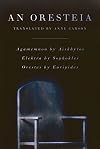
I intended to write about each of these plays individually, but the power of the famous stories and the language as rendered by Anne Carson's stunning translation job, meant that I devoured the whole volume in three sittings and never got the chance to sit down at my computer before the book was over. I've gushed about Carson's own work and her beautiful Sappho translation, and this alternate Oresteia lives up to all my high expectations of her offerings.
But first, a little background: the show more original Oresteia is a tri-play cycle—Agamemnon, The Libation Bearers, and The Eumenides—by ancient Greek playwright Aiskhylos (often transliterated Aeschylus), which chronicles the murderous fall of the house of Atreus after the Trojan War. Carson's alternate play cycle tells the same basic story and begins with the same play, Aiskhylos's Agamemnon (c. 458 BCE), but then diverges, offering a progression through time: the second installment of the cycle is Sophokles's Electra (c. 401-9 BCE), and the third is Euripides's Orestes (c. 408 BCE). Thus the reader can sense the shifting attitudes toward the same myths over the course of fifty-odd to a hundred years, as Athenian society became less optimistic, darker, more corrupt. Carson writes that the idea for the alternative cycle was originally brought to her by Brian Kulick, artistic director of the Classic Stage Company in New York City, who wrote:
Kulick makes a fascinating case, but I was concerned that, as a relative novice in ancient Greek literature, I wouldn't be able to pick up on the progression he outlines here. I needn't have worried. The stylistic differences among the three plays are so pronounced that, despite Agamemnon's messy end and Orestes's ostensible resolution, the reader is left feeling much surer of herself and the universe after finishing Aiskhylos's inferno of a play, than after making one's way through Euripides's altogether more ironic, darker offering.
For those not familiar with the famous story being told, it goes thusly: after Paris abducts Helen, her husband Menelaos and his brother Agamemnon, king of Argos, gather their forces to sail to Troy and get her back, beginning the Trojan War. But the goddess Artemis refuses to send the desired wind until Agamemnon sacrifices his own child, continuing a long history of child murder in his family. Agamemnon kills his daughter Iphigenia, earning the hatred of his wife (her mother) Klytaimestra, and the ships set sail. Fast forward ten years, and Klytaimestra receives word that Troy has fallen; she and her lover Aigisthos, both intent on revenge for their own reasons, murder the returned Agamemnon and his prophetess sex-slave Kassandra, planning to rule Argos themselves in Agamemnon's stead. These are the events of Aiskhylos's Agamemnon.
As I mentioned, despite the bloody murder that makes up the body of this play, Aiskylos's language as rendered into English by Carson is such a bonfire blast of virtuosity that I finished it feeling almost giddy. The sense of gut-clenching foreboding and inevitability is pitch-perfect. The malignant patrimony lurking in the House of Atreus is a force of nature, and all the stories anyone tries to tell—be they about the war, or an allegorical tale, or a supposedly happy homecoming—are infected by it. The Greek invaders at Troy "beached in blood"; the chorus claims of one man's pet lion "That thing was a priest of ruin Bred in the / house. Sent by god." When the Chorus tells the story of Paris and Helen, the image of a house cursed by a phantom resonates between Klytaimestra and Agamemnon:
The idea of infection, of seepage from one evil to another, is everywhere in Agamemnon. Klytaimestra, after she convinces Agamemnon to enter the house on a red carpet, against his wishes, gives this masterful speech suffused with rage and grief for the "roots and leaves" of her own family that will never return, a vision of a happy homecoming that is irrevocably perverted by Iphigenia's murder and the consequent murder Klytaimestra herself is planning; a vision of perfection that only infuriates by its distance from the truth.
There are so many amazing and exhilarating passages in Agamemnon that I could continue quoting them all day, but in brief: the predominant feelings are of white-hot fury and dread, and of conflicting, equally strong concepts of justice. Everyone in Agamemnon believes with absolute certainty that he or she knows what justice is, and the tragedy comes out of the clashes between these mutually exclusive justice concepts.
In Sophokles and especially Euripides, on the other hand, people struggle to decide what is just, or sometimes knowingly act in opposition to what is just. In a few cases, they even seem to stop caring about justice, or about the tragedy unfolding all around them. (In the second two plays of the cycle, Agamemnon and Klytaimestra's son Orestes returns from exile, and he and his sister Elektra murder their mother and her lover. The citizens of Argos then must decide what to do with the two siblings.) Elektra, for example, finds the title character arrested, unable to either marry out of her mother's household or avenge her father on her own, crippled by her never-ending grief, which she admits is excessive by any social definition. "There is no pity / but mine, / oh Father, / for the pity of your butchering rawblood death," she cries, and "Lament is a pattern cut and fitted around / my mind" Unlike her mother before her, she witnesses herself becoming the next tool of the curse of the house of Atreus, but cannot avert the coming disaster:
"Evil is a pressure that shapes us to itself," Elektra says. At the end of Agamemnon Klytaimestra believes she has ended the cycle of violence; she attempts to call a truce with the lineage's curse. But Elektra has no such illusions; part of her grief trap is that she recognizes she has been shaped to evil by the evil around her. The fact that Klytaimestra may deserve to die for the deeds she has committed, doesn't absolve Elektra and Orestes from their own guilt; there seems no escape from the cycle. But because the house's cycle of violence has become part of Elektra herself, to break it would be to go against her own selfhood; "I need one food," she says: "I must not violate Elektra." And to Klytaimestra:
Elektra's tragedy is that of someone who has been made into the wrong shape, but who cannot now act against her nature.
From Aiskhylos's cleansing fire and Sophokles's self-regenerating corruption, Euripedes's vision seems almost farcical in its irony. Instead of an Elektra wracked by grief, her opening monologue in Orestes seems almost bored:
We've heard it all before, she seems to say, and here we go again. Whereas Sophokles's Elektra is often sickened or horrified by the ways in which her evil situation has shaped her to itself, Euripides's Elektra is either too broken or too cynical to continue surprised at her family's bloodbath. Elektra and Orestes's tragedy in this last play seems, not so much that they have been sentenced to death for their mother's murder, but that the world in which they live is devoid of any overarching meaning or justice. Even the deus ex machina that saves them in the end seems ridiculous and almost random, much like the further murders they're attempting when Apollo arrives to sort them out, or the messenger's report on the democratic meeting called by the citizens of Argos to decide the siblings' fate. It's a far cry from the savage yet conflicting visions of justice held by the cast of Aiskhylos's Agamemnon.
There's far more in these three plays than I can do justice in a single blog entry, but suffice to say I fell utterly in love with the entire cycle, and can't wait to look into Carson's other Euripides translations, published in Grief Lessons. A note on her translation: as you can tell from the many excerpts above, it has a very modern feel, yet (I think) also gives the impression of agelessness. I've heard a few criticisms of places where people feel the language gets too modern, but I found it absolutely galvanizing; I could read Anne Carson's Aiskhylos all month and never wish myself elsewhere. That said, I believe in the usefulness of having multiple translations, especially of works as influential as these plays. If you love the excerpts above, you will love the whole book. If you prefer a different, more Victorian or Modernist feel, you have many translations to choose from. Personally, I only regret that Carson has not yet translated the rest of Aiskhylos's original Oresteia, as I would love to compare and contrast with this alternate version. show less
But first, a little background: the show more original Oresteia is a tri-play cycle—Agamemnon, The Libation Bearers, and The Eumenides—by ancient Greek playwright Aiskhylos (often transliterated Aeschylus), which chronicles the murderous fall of the house of Atreus after the Trojan War. Carson's alternate play cycle tells the same basic story and begins with the same play, Aiskhylos's Agamemnon (c. 458 BCE), but then diverges, offering a progression through time: the second installment of the cycle is Sophokles's Electra (c. 401-9 BCE), and the third is Euripides's Orestes (c. 408 BCE). Thus the reader can sense the shifting attitudes toward the same myths over the course of fifty-odd to a hundred years, as Athenian society became less optimistic, darker, more corrupt. Carson writes that the idea for the alternative cycle was originally brought to her by Brian Kulick, artistic director of the Classic Stage Company in New York City, who wrote:
In Aiskhylos' hands the story of the house of Atreus is designed to end in a valedictory celebration of Athenian democracy and its newborn sense of justice; when Sophokles takes over the tale it becomes more complex and contradictory; with Euripides the design is completely turned on its head. We follow a trajectory from myth to mockery. What happened to effect this? History happened. Aiskhylos composed his Oresteia shortly after Athens' victory at the battle of Marathon, which marked the height of Athenian military and cultural supremacy; Euripides finished his Orestes almost a hundred years later as Athens headed for ruin, due to her protracted involvement in the Peloponnesian War...The house of Atreus, for these tragedians, was a way of talking about the fate of Athens.
Kulick makes a fascinating case, but I was concerned that, as a relative novice in ancient Greek literature, I wouldn't be able to pick up on the progression he outlines here. I needn't have worried. The stylistic differences among the three plays are so pronounced that, despite Agamemnon's messy end and Orestes's ostensible resolution, the reader is left feeling much surer of herself and the universe after finishing Aiskhylos's inferno of a play, than after making one's way through Euripides's altogether more ironic, darker offering.
For those not familiar with the famous story being told, it goes thusly: after Paris abducts Helen, her husband Menelaos and his brother Agamemnon, king of Argos, gather their forces to sail to Troy and get her back, beginning the Trojan War. But the goddess Artemis refuses to send the desired wind until Agamemnon sacrifices his own child, continuing a long history of child murder in his family. Agamemnon kills his daughter Iphigenia, earning the hatred of his wife (her mother) Klytaimestra, and the ships set sail. Fast forward ten years, and Klytaimestra receives word that Troy has fallen; she and her lover Aigisthos, both intent on revenge for their own reasons, murder the returned Agamemnon and his prophetess sex-slave Kassandra, planning to rule Argos themselves in Agamemnon's stead. These are the events of Aiskhylos's Agamemnon.
As I mentioned, despite the bloody murder that makes up the body of this play, Aiskylos's language as rendered into English by Carson is such a bonfire blast of virtuosity that I finished it feeling almost giddy. The sense of gut-clenching foreboding and inevitability is pitch-perfect. The malignant patrimony lurking in the House of Atreus is a force of nature, and all the stories anyone tries to tell—be they about the war, or an allegorical tale, or a supposedly happy homecoming—are infected by it. The Greek invaders at Troy "beached in blood"; the chorus claims of one man's pet lion "That thing was a priest of ruin Bred in the / house. Sent by god." When the Chorus tells the story of Paris and Helen, the image of a house cursed by a phantom resonates between Klytaimestra and Agamemnon:
Alas for the house! Alas for the house and the
men of the house!
Alas for the marriage bed and the way she loved
her husband once!
There is silence there: he sits alone,
dishonored, baffled, mute.
In his longing for what is gone across the
sea
a phantom seems to rule his house.
The idea of infection, of seepage from one evil to another, is everywhere in Agamemnon. Klytaimestra, after she convinces Agamemnon to enter the house on a red carpet, against his wishes, gives this masterful speech suffused with rage and grief for the "roots and leaves" of her own family that will never return, a vision of a happy homecoming that is irrevocably perverted by Iphigenia's murder and the consequent murder Klytaimestra herself is planning; a vision of perfection that only infuriates by its distance from the truth.
There is the sea and who shall drain it dry?
It breeds the purple stain, the dark red dye
we use to color our garments,
costly as silver.
This house has an abundance. Thanks
be to gods, no poverty here.
Oh I would have vowed the trampling of
many cloths
if an oracle had ordered it, to ransom this
man's life.
For when the root is alive the leaves come
back
and shade the house against white dogstar
heat.
Your homecoming is warmth in winter.
Our when Zeus makes wine from bitter
grapes
and coolness fills the house
as the master walks his halls,
righteous, perfect.
Zeus, Zeus, god of things perfect,
accomplish my prayers.
Concern yourself here.
Perfect this.
There are so many amazing and exhilarating passages in Agamemnon that I could continue quoting them all day, but in brief: the predominant feelings are of white-hot fury and dread, and of conflicting, equally strong concepts of justice. Everyone in Agamemnon believes with absolute certainty that he or she knows what justice is, and the tragedy comes out of the clashes between these mutually exclusive justice concepts.
In Sophokles and especially Euripides, on the other hand, people struggle to decide what is just, or sometimes knowingly act in opposition to what is just. In a few cases, they even seem to stop caring about justice, or about the tragedy unfolding all around them. (In the second two plays of the cycle, Agamemnon and Klytaimestra's son Orestes returns from exile, and he and his sister Elektra murder their mother and her lover. The citizens of Argos then must decide what to do with the two siblings.) Elektra, for example, finds the title character arrested, unable to either marry out of her mother's household or avenge her father on her own, crippled by her never-ending grief, which she admits is excessive by any social definition. "There is no pity / but mine, / oh Father, / for the pity of your butchering rawblood death," she cries, and "Lament is a pattern cut and fitted around / my mind" Unlike her mother before her, she witnesses herself becoming the next tool of the curse of the house of Atreus, but cannot avert the coming disaster:
By dread things I am compelled. I know
that.
I see the trap closing.
I know what I am.
But while life is in me
I will not stop this violence.
"Evil is a pressure that shapes us to itself," Elektra says. At the end of Agamemnon Klytaimestra believes she has ended the cycle of violence; she attempts to call a truce with the lineage's curse. But Elektra has no such illusions; part of her grief trap is that she recognizes she has been shaped to evil by the evil around her. The fact that Klytaimestra may deserve to die for the deeds she has committed, doesn't absolve Elektra and Orestes from their own guilt; there seems no escape from the cycle. But because the house's cycle of violence has become part of Elektra herself, to break it would be to go against her own selfhood; "I need one food," she says: "I must not violate Elektra." And to Klytaimestra:
Shame I do feel.
And I know there is something all wrong
about me—
believe me. Sometimes I shock myself.
But there is a reason: you.
You never let up
this one same pressure of hatred on my life:
I am the shape you made me.
Elektra's tragedy is that of someone who has been made into the wrong shape, but who cannot now act against her nature.
From Aiskhylos's cleansing fire and Sophokles's self-regenerating corruption, Euripedes's vision seems almost farcical in its irony. Instead of an Elektra wracked by grief, her opening monologue in Orestes seems almost bored:
It's a known fact,
when the gods asked him to dinner he shot
off his mouth.
So Tantalos begot Pelops, Pelops begot
Atreus—
you know all this don't you? the strife, the
crimes...
We've heard it all before, she seems to say, and here we go again. Whereas Sophokles's Elektra is often sickened or horrified by the ways in which her evil situation has shaped her to itself, Euripides's Elektra is either too broken or too cynical to continue surprised at her family's bloodbath. Elektra and Orestes's tragedy in this last play seems, not so much that they have been sentenced to death for their mother's murder, but that the world in which they live is devoid of any overarching meaning or justice. Even the deus ex machina that saves them in the end seems ridiculous and almost random, much like the further murders they're attempting when Apollo arrives to sort them out, or the messenger's report on the democratic meeting called by the citizens of Argos to decide the siblings' fate. It's a far cry from the savage yet conflicting visions of justice held by the cast of Aiskhylos's Agamemnon.
There's far more in these three plays than I can do justice in a single blog entry, but suffice to say I fell utterly in love with the entire cycle, and can't wait to look into Carson's other Euripides translations, published in Grief Lessons. A note on her translation: as you can tell from the many excerpts above, it has a very modern feel, yet (I think) also gives the impression of agelessness. I've heard a few criticisms of places where people feel the language gets too modern, but I found it absolutely galvanizing; I could read Anne Carson's Aiskhylos all month and never wish myself elsewhere. That said, I believe in the usefulness of having multiple translations, especially of works as influential as these plays. If you love the excerpts above, you will love the whole book. If you prefer a different, more Victorian or Modernist feel, you have many translations to choose from. Personally, I only regret that Carson has not yet translated the rest of Aiskhylos's original Oresteia, as I would love to compare and contrast with this alternate version. show less

Anne Carson's Oresteia
Review of the Faber & Faber (2009) hardcover edition
Although this edition is primarily credited to Aeschylus (or Aiskhylos, in the pronunciation friendly spelling provided by Carson) it properly belongs to Anne Carson herself. This is not "The Oresteia" of Aiskhylos but is instead "An Oresteia" created by anthologizing the primary play of the original trilogy with Sophokles "Elektra" and Euripides "Orestes". It thus tells the same story but with the additional slant of show more later historical perspective.
As detailed in the introduction, Carson completed her trilogy at the request of Brian Kulick of New York City's Classic Stage Company who convinced her that:
Carson's translation takes a few unorthodox steps. She leaves the Greek laments and cries of woe in the original. So instead of standard clichés such as "Oh woe is me," you see expressions of "OIMOI" which may lend themselves to more exaggerated shrieks of despair and desolation by the actors. She also injects passages of 21st century expression in the translation, which may themselves seem dated in later readings. For instance, describing Helen of Troy as a weapon of mass destruction seems to place the translation in a certain era of the news cycle to present ears. Still, all in all, this was a refreshing and exciting view of one of our earliest epic tragedy trilogies. show less
Review of the Faber & Faber (2009) hardcover edition
Although this edition is primarily credited to Aeschylus (or Aiskhylos, in the pronunciation friendly spelling provided by Carson) it properly belongs to Anne Carson herself. This is not "The Oresteia" of Aiskhylos but is instead "An Oresteia" created by anthologizing the primary play of the original trilogy with Sophokles "Elektra" and Euripides "Orestes". It thus tells the same story but with the additional slant of show more later historical perspective.
As detailed in the introduction, Carson completed her trilogy at the request of Brian Kulick of New York City's Classic Stage Company who convinced her that:
In Aiskhylos’ hands the story of the house of Atreus is designed to end in a valedictory celebration of Athenian democracy and its newborn sense of justice; when Sophokles takes over the tale it becomes more complex and contradictory; with Euripides the design is completely turned on its head. We follow a trajectory from myth to mockery. What happened to effect this? History happened. Aiskhylos composed his Oresteia shortly after Athens’ victory at the battle of Marathon which marked the height of Athenian military and cultural supremacy; Euripides finished his Orestes almost a hundred years later as Athens headed for ruin due to her protracted involvement in the Peloponnesian War.… The house of Atreus, for these tragedians, was a way of talking about the fate of Athens.
Carson's translation takes a few unorthodox steps. She leaves the Greek laments and cries of woe in the original. So instead of standard clichés such as "Oh woe is me," you see expressions of "OIMOI" which may lend themselves to more exaggerated shrieks of despair and desolation by the actors. She also injects passages of 21st century expression in the translation, which may themselves seem dated in later readings. For instance, describing Helen of Troy as a weapon of mass destruction seems to place the translation in a certain era of the news cycle to present ears. Still, all in all, this was a refreshing and exciting view of one of our earliest epic tragedy trilogies. show less

Anne Carson puts a modern spell on Sophocles’ classic ancient Greek tragedy Antigone. An undeniable master stroke beating in its poetic vibrance, this play was stunningly brought to life on Ivo van Hove’s minimalist stage where a circle resides in the middle; a spectator; its luminescence deliberately mimics the moon / sun as they run their course in parallel with the development of the tragedy. A timeless classic that is frighteningly relevant as ever: the dispute between religious and show more secular laws, authoritarianism and its depredation on culture and faith, and the perils any type of extremism brings. It’s indeed an act of revolt when Antigone secretly buries his brother Polyneikes against King Kreon’s tyranny where a domino effect of mishap and pain follows. And where there is revolt there is also resignation in its horrifying violence. I watched the BBC Four programme and actress Juliette Binoche undoubtedly gives a stupendous performance as Antigone. And together with a brilliant supporting cast, this is a sure delight for Greek mythology and Anne Carson enthusiasts alike. A pleasure both on print and on-screen. show less
Lists
Literary Witches (4)
Read These Too (1)
. (1)
Poetry Corner (1)
Deathreads (1)
Top 10 2021 (1)
Take Four Books (1)
Awards


You May Also Like


Associated Authors
Statistics
- Works
- 52
- Also by
- 34
- Members
- 10,232
- Popularity
- #2,320
- Rating
- 4.1
- Reviews
- 153
- ISBNs
- 205
- Languages
- 14
- Favorited
- 20

