
James Forman Jr.
Author of Locking Up Our Own: Crime and Punishment in Black America
About the Author
James Forman Jr. was born on June 22, 1967. He graduated from Brown University and Yale Law School. He was a law clerk for Judge William Norris of the U.S. Court of Appeals for the Ninth Circuit and Justice Sandra Day O'Connor of the United States Supreme Court. Afterward, Forman worked for six show more years at the Public Defender Service in Washington, D.C. In 1997, he and David Domenici started the Maya Angelou Public Charter School, an alternative school for school dropouts and youth who had previously been arrested. Forman taught at Georgetown Law from 2003 to 2011 and then joined the Yale Law School faculty. His first book, Locking Up Our Own: Crime and Punishment in Black America, received the Pulitzer Prize for general nonfiction in 2018. (Bowker Author Biography) show less
Image credit: Photographed by Larry D. Moore CC BY-SA 4.0.
Works by James Forman Jr.
Associated Works
Four Hundred Souls: A Community History of African America, 1619-2019 (2021) — Contributor — 1,156 copies, 25 reviews
Tagged
Common Knowledge
- Legal name
- Forman, James Robert Lumumba
- Birthdate
- 1967-06-22
- Gender
- male
- Education
- Brown University (BA, 1988)
Yale Law School (1992) - Occupations
- Professor, Yale University Law School
lawyer - Awards and honors
- National Book Award Finalist
- Relationships
- Forman, James (father)
- Nationality
- USA
- Associated Place (for map)
- USA
Members
Reviews
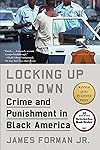
Locking Up Our Own by James Forman Jr. After reading this book and Evicted last year, I'm determined to read more Pulitzer winning non-fiction. This book looks at how our high levels of incarceration got to where they are, specifically in the African American community and how 3-4 decades ago African Americans were often the loudest voice regarding tough on crime and minimum sentences. Forman's main thread through the book is how the complex long-term solutions got left behind (better show more schools, fighting systemic racism, job training etc) while fighting drugs and violent crime got all the resources both on the local level and national. He puts the decisions in the 70s-90s in historical perspective and shows how the shift has happened over time when communities realized the unforeseen repercussions of their policies. show less
How does a majority-black district in the US, with many in positions of power, end up locking up so many of its own? In this concise yet comprehensive book, James Forman Jr thoughtfully and convincingly backs up his hypothesis with both his own experience as a public defender and extensive historical, socio-political research. He manages the impressive task of presenting the statistical data of his research alongside more personal stories of his PD experiences, humanising the individuals show more caught up in this unfair, overly-punitive system while capturing the enormity of the issue.
We are shown how the vast racist punitive system that the US has come to be known for was not built in one day. How harsher and harsher punishments were introduced gradually in response to the crisis of the moment, until now where despite comprising only about five percent of the world's population, the US holds about a quarter of the world's prison population. How racism and classism reinforced and reinforces a systemic (self-)policing amongst the (black) people in power such that black people end up occupying the prisons at a much higher rate disproportional to their white counterparts.
An eye-opening book on the origin of how these discriminatory systems came to be, the consequences (either unforeseen at the time or deemed unimportant in the face of a greater perceived evil), and how these systems could eventually be dismantled even by those not affiliated with law enforcement.
Further readings/viewings as recommended by James Forman Jr. available here. show less
We are shown how the vast racist punitive system that the US has come to be known for was not built in one day. How harsher and harsher punishments were introduced gradually in response to the crisis of the moment, until now where despite comprising only about five percent of the world's population, the US holds about a quarter of the world's prison population. How racism and classism reinforced and reinforces a systemic (self-)policing amongst the (black) people in power such that black people end up occupying the prisons at a much higher rate disproportional to their white counterparts.
An eye-opening book on the origin of how these discriminatory systems came to be, the consequences (either unforeseen at the time or deemed unimportant in the face of a greater perceived evil), and how these systems could eventually be dismantled even by those not affiliated with law enforcement.
Further readings/viewings as recommended by James Forman Jr. available here. show less
Interesting history, full of information new to me, showing how African American voters, politicians, judges, police officers and police chiefs tended to advocate for and implement tough-on-crime measures in response to the urban crime wave of the 1960-1990s. This was good detail to fill in one of the arguments in [b:Ghettoside: A True Story of Murder in America|13153693|Ghettoside A True Story of Murder in America|Jill show more Leovy|https://images.gr-assets.com/books/1417410395s/13153693.jpg|18331880], to wit that African Americans in the inner city have as great a grievance about being under-policed as over-policed: over-policed in terms of harassment and abuse, but under-policed in terms of impunity for serious crimes. Unfortunately these communities' hopes that punitive repression of drugs and criminals would improve things proved very wrong. Where they hoped to marry these policies with others to improve opportunities and to rehabilitate addicts and criminals, too often the tough measures alone went into meaningful action. Coupled with the institutional racism demonstrated in [b:The New Jim Crow: Mass Incarceration in the Age of Colorblindness|6792458|The New Jim Crow Mass Incarceration in the Age of Colorblindness|Michelle Alexander|https://images.gr-assets.com/books/1328751532s/6792458.jpg|6996712], these policies have contributed to ruining the lives and livelihoods of millions of young men especially, while doing little to aid them or their communities to prosper. This is a tragic story of unintended consequences and one that complicates our understanding of where these policies came from. show less
It is no small thing that blacks are significantly over-represented in our prison system. I was told once, by a law enforcement officer that, all things being equal, the percentage of any group in prison will match the overall percentage of the area from which the prison population is created. One can conclude, and this books explains why, all things are not equal.
We have created a society which is more interested in punishment than in rehabilitation, where punishment is defined as show more prevention. And yet there are far more effective methods of prevention that do not have incarceration as a part of the picture. We are less and less willing to consider the individual accused of a crime and look only at the crime, see the facts of the crime itself, but ignore the background events and environment that led to the crime occurring.
If we truly want to seriously reduce crime, we need to address the environment that encourages it. We need to leave behind company blanket policies that prevent someone who has been arrested (not even charged, just arrested) from getting a job. Joblessness encourages crime. We need to leave behind company blanket policies that say, although they will hire felons, they won't promote felons to responsible positions or allow them to purchase franchises. Ever. Lack of real opportunity encourages crime.
We claim to be a Christian nation, but the things missing from our system are mercy and forgiveness. We deny these to 99 out of 100 offenders because 1 might not deserve it. show less
We have created a society which is more interested in punishment than in rehabilitation, where punishment is defined as show more prevention. And yet there are far more effective methods of prevention that do not have incarceration as a part of the picture. We are less and less willing to consider the individual accused of a crime and look only at the crime, see the facts of the crime itself, but ignore the background events and environment that led to the crime occurring.
If we truly want to seriously reduce crime, we need to address the environment that encourages it. We need to leave behind company blanket policies that prevent someone who has been arrested (not even charged, just arrested) from getting a job. Joblessness encourages crime. We need to leave behind company blanket policies that say, although they will hire felons, they won't promote felons to responsible positions or allow them to purchase franchises. Ever. Lack of real opportunity encourages crime.
We claim to be a Christian nation, but the things missing from our system are mercy and forgiveness. We deny these to 99 out of 100 offenders because 1 might not deserve it. show less
Lists
True Crime (1)
Awards


You May Also Like


Associated Authors
Statistics
- Works
- 2
- Also by
- 1
- Members
- 618
- Popularity
- #40,696
- Rating
- 4.4
- Reviews
- 15
- ISBNs
- 11
- Favorited
- 1