
Hans Werner Holzwarth
Author of Modern Art: A History from Impressionism to Today
About the Author
Image credit: Hans Werner Holzwarth
Works by Hans Werner Holzwarth
Tagged
Common Knowledge
- Gender
- male
- Occupations
- book designer
book editor - Nationality
- Germany
- Places of residence
- Berlin, Germany
- Associated Place (for map)
- Berlin, Germany
Members
Reviews
Modern Art. A History from Impressionism to Today (Bibliotheca Universalis) by Hans Werner Holzwarth
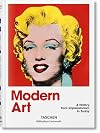
Published in 2011, Taschen's review of 'modern art' (essentially Western art from around 1870 to the end of the last century) can be praised as one of the best basic introductions to the subject. Its full page illustrations of representative works is truly excellent.
The approach is to produce an in-depth introductory essay on twelve 'schools' from impressionism to post-modernism and then to follow this up with a single page analysis of a key work by a representative artist. I did not count show more them up but we are talking about roughly 240 of them.
The authors do not give us in-depth biographies but something far more useful - accounts of how the schools developed and functioned in a market and networking context and of the individual works as clues to what individual artists were trying to do or say.
This partly de-romanticises Western art which is useful but also shows us how Western art should be considered as a series of connected developments in time with a generally solid intellectual base that becomes less and less comprehensible to the ordinary person over time.
The overwhelming impression is of an artistic tradition that shifts from speaking to a middle class market and is centred on attracting attention through novelty and 'exhibitionism' to one that speaks largely to itself and the wealthy patron and subsidised gallery system.
There is barely an artist here for whom one will not gain increased respect as a result of the text surrounding their work but there is also a sense of intellectual introversion over time and the post-bourgeois market creating some absurdity that sends us in the direction of Emperor's New Clothes.
With so many artists 'on show' there is no profit in talking of favourites but I sense the death of meaning in Art emerging with conceptualism and with some artists who 'find an angle' and flog it to death to make a buck. At times, towards the end, I became nostalgic for socialist realism.
For a British reader, there is some pleasure in being given access to the German artistic tradition rather than the usual suspects from the Tate with which we are all familiar. The Americans, of course, get the lion's share after 1945 as befits the new but now declining imperium.
An excellent book, it does raise the question of whether the creative almost philosophical incursion into culture of Duchamp has now exhausted itself and whether the purchasing power of the super-rich is not creating a fundamentally trivial culture of market-friendly assets rather than Art.
Today there are far too many people calling themselves artists with minimal innovation rather than novelty and who are using 'conceptualism' to evade the hard work of creation with materials to hand and 'post-modernism' to make jokes and offer political rants of incredible naivete.
Instead of giving us insights into the human condition or exposing the ambiguities of what it is to be human in the world or even simply exploring the qualities of their medium, we get a world of pretty eco-posturing and identity expression that is comfort food for the dim.
The weakening of the Western tradition's radical period of experimentation that began in the last third of the nineteenth century and seems to have exhausted itself in the last quarter of the twentieth may prove to be yet another sign of the relative decline of the West.
In fact, I am not so sure of this yet. Clearly the rest of the globe is still regionalising and appropriating Western forms for its own use. There is still life for the Western experimental tradition in that sense but the time may be ripe for the sort of internal revolt that the West is so good at.
The idea of the 'West' is, of course, a completely ridiculous reified invention of neurotic Atlanticist intellectuals so perhaps that is where the revolt starts ... and in the return to an interest in materials, a rediscovery of aesthetics, a return to the social and a rejection of the oligarchical turn of mind.
Perhaps Western Art needs a panicked crash in the value of the rich people's possessions hidden in vaults and of the parasitical gallery, museum and auction house community that buttresses a market largely invented by the few to possess and appropriate Art and 'trickle it down' to us.
Perhaps much of late twentieth and early twenty first century art will be seen as we see the Victorian academicism and chocolate box material that was once the marker of bourgeois sophistication in its day but which was essentially hollow, albeit that the modernist reaction may have gone too far.
I can see that a combination of socio-economic change, a revolution in taste, the further development of digitalisation (honestly, it takes a real fool to spend money on an NFT except within the economy of fake assets) and populist democratisation may give us very different Art within a couple of decades.
Having said all that, the achievements of the great experimental tradition have been enormous. The bulk of Modern Art (as expressed in this book) will continue to have historical resonance and offer inspiration to future generations as much as the Renaissance has done.
From that perspective, this book, even with its impressionistic approach, provides excellent grounding in what may be viewed one day as the 'Great Western Tradition'. It is solid, unromantic, honest and informative and it often makes you think about the very nature of Art itself. show less
The approach is to produce an in-depth introductory essay on twelve 'schools' from impressionism to post-modernism and then to follow this up with a single page analysis of a key work by a representative artist. I did not count show more them up but we are talking about roughly 240 of them.
The authors do not give us in-depth biographies but something far more useful - accounts of how the schools developed and functioned in a market and networking context and of the individual works as clues to what individual artists were trying to do or say.
This partly de-romanticises Western art which is useful but also shows us how Western art should be considered as a series of connected developments in time with a generally solid intellectual base that becomes less and less comprehensible to the ordinary person over time.
The overwhelming impression is of an artistic tradition that shifts from speaking to a middle class market and is centred on attracting attention through novelty and 'exhibitionism' to one that speaks largely to itself and the wealthy patron and subsidised gallery system.
There is barely an artist here for whom one will not gain increased respect as a result of the text surrounding their work but there is also a sense of intellectual introversion over time and the post-bourgeois market creating some absurdity that sends us in the direction of Emperor's New Clothes.
With so many artists 'on show' there is no profit in talking of favourites but I sense the death of meaning in Art emerging with conceptualism and with some artists who 'find an angle' and flog it to death to make a buck. At times, towards the end, I became nostalgic for socialist realism.
For a British reader, there is some pleasure in being given access to the German artistic tradition rather than the usual suspects from the Tate with which we are all familiar. The Americans, of course, get the lion's share after 1945 as befits the new but now declining imperium.
An excellent book, it does raise the question of whether the creative almost philosophical incursion into culture of Duchamp has now exhausted itself and whether the purchasing power of the super-rich is not creating a fundamentally trivial culture of market-friendly assets rather than Art.
Today there are far too many people calling themselves artists with minimal innovation rather than novelty and who are using 'conceptualism' to evade the hard work of creation with materials to hand and 'post-modernism' to make jokes and offer political rants of incredible naivete.
Instead of giving us insights into the human condition or exposing the ambiguities of what it is to be human in the world or even simply exploring the qualities of their medium, we get a world of pretty eco-posturing and identity expression that is comfort food for the dim.
The weakening of the Western tradition's radical period of experimentation that began in the last third of the nineteenth century and seems to have exhausted itself in the last quarter of the twentieth may prove to be yet another sign of the relative decline of the West.
In fact, I am not so sure of this yet. Clearly the rest of the globe is still regionalising and appropriating Western forms for its own use. There is still life for the Western experimental tradition in that sense but the time may be ripe for the sort of internal revolt that the West is so good at.
The idea of the 'West' is, of course, a completely ridiculous reified invention of neurotic Atlanticist intellectuals so perhaps that is where the revolt starts ... and in the return to an interest in materials, a rediscovery of aesthetics, a return to the social and a rejection of the oligarchical turn of mind.
Perhaps Western Art needs a panicked crash in the value of the rich people's possessions hidden in vaults and of the parasitical gallery, museum and auction house community that buttresses a market largely invented by the few to possess and appropriate Art and 'trickle it down' to us.
Perhaps much of late twentieth and early twenty first century art will be seen as we see the Victorian academicism and chocolate box material that was once the marker of bourgeois sophistication in its day but which was essentially hollow, albeit that the modernist reaction may have gone too far.
I can see that a combination of socio-economic change, a revolution in taste, the further development of digitalisation (honestly, it takes a real fool to spend money on an NFT except within the economy of fake assets) and populist democratisation may give us very different Art within a couple of decades.
Having said all that, the achievements of the great experimental tradition have been enormous. The bulk of Modern Art (as expressed in this book) will continue to have historical resonance and offer inspiration to future generations as much as the Renaissance has done.
From that perspective, this book, even with its impressionistic approach, provides excellent grounding in what may be viewed one day as the 'Great Western Tradition'. It is solid, unromantic, honest and informative and it often makes you think about the very nature of Art itself. show less
As his personal circumstances move in constant flux, Ai Weiwei remains a cultural magnet. Renowned for his political activism and social media activity almost as much as for his social interventions, contemporary approach to the readymade, and knowledge of Chinese traditional crafts, Ai’s fame extends throughout and beyond the art world.
Drawn from TASCHEN’s limited Collector’s Edition, this monograph explores each of Ai’s career phases up until his release from Chinese custody. It show more features extensive visual material to trace Ai’s development from his early New York days right through to his recent practice. Focus moments include his international breakthrough in the early 2000s, his porcelain Sunflower Seeds at the Turbine Hall of the Tate Modern, his response to the Sichuan earthquake of 2008, and his police detention in 2011. With behind-the-scenes studio pictures, production shots, and numerous statements derived from exclusive interviews with Ai, we gain privileged access to the artist’s process, influences, and importance.
The book includes texts from Uli Sigg, Ai’s longtime friend and former Swiss ambassador to China and Roger M. Buergel, who curated the 2007 documenta and hosted the artist’s Fairytale piece.
Signed copy show less
Drawn from TASCHEN’s limited Collector’s Edition, this monograph explores each of Ai’s career phases up until his release from Chinese custody. It show more features extensive visual material to trace Ai’s development from his early New York days right through to his recent practice. Focus moments include his international breakthrough in the early 2000s, his porcelain Sunflower Seeds at the Turbine Hall of the Tate Modern, his response to the Sichuan earthquake of 2008, and his police detention in 2011. With behind-the-scenes studio pictures, production shots, and numerous statements derived from exclusive interviews with Ai, we gain privileged access to the artist’s process, influences, and importance.
The book includes texts from Uli Sigg, Ai’s longtime friend and former Swiss ambassador to China and Roger M. Buergel, who curated the 2007 documenta and hosted the artist’s Fairytale piece.
Signed copy show less
As his personal circumstances move in constant flux, Ai Weiwei remains a cultural magnet. Renowned for his political activism and social media activity almost as much as for his social interventions, contemporary approach to the readymade, and knowledge of Chinese traditional crafts, Ai’s fame extends throughout and beyond the art world.
Drawn from TASCHEN’s limited Collector’s Edition, this monograph explores each of Ai’s career phases up until his release from Chinese custody. It show more features extensive visual material to trace Ai’s development from his early New York days right through to his recent practice. Focus moments include his international breakthrough in the early 2000s, his porcelain Sunflower Seeds at the Turbine Hall of the Tate Modern, his response to the Sichuan earthquake of 2008, and his police detention in 2011. With behind-the-scenes studio pictures, production shots, and numerous statements derived from exclusive interviews with Ai, we gain privileged access to the artist’s process, influences, and importance.
The book includes texts from Uli Sigg, Ai’s longtime friend and former Swiss ambassador to China; Roger M. Buergel, who curated the 2007 documenta and hosted the artist’s Fairytale piece; and experts on Chinese culture and politics: Carlos Rojas, William A. Callahan, and James J. Lally. show less
Drawn from TASCHEN’s limited Collector’s Edition, this monograph explores each of Ai’s career phases up until his release from Chinese custody. It show more features extensive visual material to trace Ai’s development from his early New York days right through to his recent practice. Focus moments include his international breakthrough in the early 2000s, his porcelain Sunflower Seeds at the Turbine Hall of the Tate Modern, his response to the Sichuan earthquake of 2008, and his police detention in 2011. With behind-the-scenes studio pictures, production shots, and numerous statements derived from exclusive interviews with Ai, we gain privileged access to the artist’s process, influences, and importance.
The book includes texts from Uli Sigg, Ai’s longtime friend and former Swiss ambassador to China; Roger M. Buergel, who curated the 2007 documenta and hosted the artist’s Fairytale piece; and experts on Chinese culture and politics: Carlos Rojas, William A. Callahan, and James J. Lally. show less

Quick review: I am not a formal student of art; for such a student there would probably find nothing noteworthy about this book, especially this edition which is smaller than a normal hardback (but also only $15 at B&N). For me, an amateur student of art, and mostly a denizen of the museums in New York in particular, but anywhere in general with Modern Art, I was impressed with the essay on Impressionism. I learned a lot in a brief, non-academic essay that preceded the survey of the usual show more suspects.
I selected this book because of these essays, which provide a lead-in to each of the main topics. These are Impressionism, Symbolism, Cubism, Expressionism, Futurism, Abstract Art, Dadaism, Realism, Surrealism, Abstract Expressionism, Pop Art Minimal Art, Conceptual Art, and Post-Modernism. show less
I selected this book because of these essays, which provide a lead-in to each of the main topics. These are Impressionism, Symbolism, Cubism, Expressionism, Futurism, Abstract Art, Dadaism, Realism, Surrealism, Abstract Expressionism, Pop Art Minimal Art, Conceptual Art, and Post-Modernism. show less
You May Also Like


Associated Authors
Statistics
- Works
- 20
- Members
- 604
- Popularity
- #41,610
- Rating
- 4.2
- Reviews
- 7
- ISBNs
- 40
- Languages
- 6