
Shelley Parker-Chan
Author of She Who Became the Sun
Series
Works by Shelley Parker-Chan
He Who Drowned the World 1 copy
Tagged
Common Knowledge
- Canonical name
- Shelley Parker-Chan
- Birthdate
- 20th Century
- Gender
- non-binary
- Awards and honors
- Astounding Award for Best New Writer
- Agent
- Laura Rennert
- Nationality
- Australia
- Associated Place (for map)
- Australia
Members
Reviews
Absolutely gorgeous literary fantasy. The setting was perfectly evoked, and the language beautifully immersive. (Spoiler-free example: Parker-Chan won't tell you how much starvation hurts, she'll write you beautiful passages about how delicious crickets and lizards and mud are starting to look.)
The crucial winner for me is the characters. Two main pairs stand out - Ouyang and Esen on the "empire" side, and Zhu (the female MC who pretends to be a male monk for most of the book) and Ma (Zhu's show more wife, friend, and lover). All four characters are vivid, multi-faceted, nuanced, and flawed in different ways. Huge shifting intersections between privilege, hardship, trauma, love, and grief all tangle together, spilling out to the wider storyline and ultimately having knock-on effects across the whole nation. By the end, I loved all of the characters, even if I was no longer sure who was heroic and who wasn't. PErhaps nobody was and everybody was.
Zhu's character is intricate beyond my capacity to explain in a short review (without writing a long and involved essay, I mean) but if I had to pick JUST one aspect to focus on, it's her un-Buddhist sense of desire: she struggles with wanting things beyond the life given to her, and whether that is okay. Repeatedly, that issue comes up - she wants, she desires, should she desire, doesn't desire have a cost - but notably, it's not something the male characters seem to struggle with. Because ambition, power, and greatness are seen as natural things for men to want, a kind of ingrained privilege of what it's okay to expect or hope for in life. Zhu, as both a woman and someone born to the peasant class, has to fight for the right to even want those things, let alone have them.
Every character pays a cost, and by the end I think most readers will be weighing up whether anything they gained was worth the sacrifice. Zhu is capable of goodness and love, but I am not sure that she herself is a good person, by the novel's end. That grey tangled mess does make her exactly the kind of character I really enjoy, however. show less
The crucial winner for me is the characters. Two main pairs stand out - Ouyang and Esen on the "empire" side, and Zhu (the female MC who pretends to be a male monk for most of the book) and Ma (Zhu's show more wife, friend, and lover). All four characters are vivid, multi-faceted, nuanced, and flawed in different ways. Huge shifting intersections between privilege, hardship, trauma, love, and grief all tangle together, spilling out to the wider storyline and ultimately having knock-on effects across the whole nation. By the end, I loved all of the characters, even if I was no longer sure who was heroic and who wasn't. PErhaps nobody was and everybody was.
Zhu's character is intricate beyond my capacity to explain in a short review (without writing a long and involved essay, I mean) but if I had to pick JUST one aspect to focus on, it's her un-Buddhist sense of desire: she struggles with wanting things beyond the life given to her, and whether that is okay. Repeatedly, that issue comes up - she wants, she desires, should she desire, doesn't desire have a cost - but notably, it's not something the male characters seem to struggle with. Because ambition, power, and greatness are seen as natural things for men to want, a kind of ingrained privilege of what it's okay to expect or hope for in life. Zhu, as both a woman and someone born to the peasant class, has to fight for the right to even want those things, let alone have them.
Every character pays a cost, and by the end I think most readers will be weighing up whether anything they gained was worth the sacrifice. Zhu is capable of goodness and love, but I am not sure that she herself is a good person, by the novel's end. That grey tangled mess does make her exactly the kind of character I really enjoy, however. show less
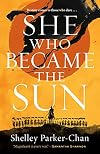
This book has taken me months to figure out how to review. I'm so torn about so many aspects! I love it, but there's so much that I take issue with at the same time. The few things I know with complete certainty is that 1. that cover is absolutely stunning, 2. the title is also excellent, 3. and I kind of wish that Shelley Parker-Chan was my best friend/writing buddy.
Content warnings:
- cissexism
- ableism
Representation:
- half of the POV characters are Chinese; the other half are Mongolian
- show more the MC and her love interest are sapphic; the MC seems to be asexual or stone butch
- the love interest is a nomad
In 1345 China, Mongol rule has left the peasants of the Central Plains starving and at the mercy of bandits. Of the Zhu family's nine children, only two are still alive. The brother is bestowed a great fate from the local fortuneteller, and the sister is told she is nothing. But when the bandits come, it is the brother who falls into nothingness—and the sister, desperate to survive, seizes his name and his fate. In her search for the greatness her brother was promised, she will become a monk, a general, a wife, an archenemy, and—revealed at the very end—an actual figure in China's history. She will do anything to seize her brother's greatness.
What struck me initially about the book was the prose. I love how mature and yet how readable the style is and how it bursts with character. It's not just written to be played in my head like a movie (and no, those writing styles are not worse in any way, I just have a soft spot for books that don't necessarily mean for the readers to insert themselves inside them). I also love how—and other people may disagree with me—the characters think more like people would in the actual 1300s rather than trying to tone down some of the things we know now to be pretty offensive or unfair. Like the protagonist, Zhu, obsessing over her gender, but also often limiting her gender to her body—i.e it's her female body that carries her "nothing fate"—even though the author themselves is non-binary and probably doesn't do this in real life (I'm assuming).
In a book for younger readers, I would probably think differently, but I'm glad Parker-Chan trusts their adult audience to be able to discern the difference between a character from a different time period and their own views. I've read so many books were the author either doesn't trust their audience enough or isn't brave enough (or their agent/publisher wasn't brave enough) to write characters who don't have current-era views. It can be exhausting to read morally correct characters in every single story. Or at least where the main character is the moral center of a story.
As the book progresses, though, the prose descends into telling and summarizing either things I wish it could show or just summarizing way too much. Add to that and exhausting amount of repetition of Zhu's desire for GREATNESS and how nothing else matters and how she will do anything to achieve this because this is her fate and she will be GREAT. It's hard to completely be on board with her goal, too, because unlike at the beginning when she took her brother's fate in order to survive, I just can't understand completely why she wants to be so great. I don't need to empathize with a main character's goal, but I do need to understand why the character would want it. This problem and the way she and her archenemy Ouyang, the eunuch general fighting for the Mongols, seem to be able to read five different emotions in a single eye twitch became pretty tiring.
Which is too bad, because I really do love how these (actually) morally gray characters think and interact to create this epic historical drama like the ones I like to watch—and the ones that the author actually admitted to inspiring this work, which makes sense.
I also do love the way Zhu and Ouyang's storylines parallel each other, especially when it comes to the way they feel about their gender. I think gender (and dysphoria) was particularly handled masterfully in this book, to be honest. It was my favorite thing about the whole story.
I think overall the book needed more editing. Maybe it was rushed or maybe the author was too fond of what she'd written, but it never does actually stick in one style and then places feels too clumsy. For everything that I love, there is something else that I have the urge to critique. But I do believe that Parker-Chan could become an incredible writer, because what they do well they do so damn well. I'm definitely going to read whatever they write next. show less
Content warnings:
- cissexism
- ableism
Representation:
- half of the POV characters are Chinese; the other half are Mongolian
- show more the MC and her love interest are sapphic; the MC seems to be asexual or stone butch
- the love interest is a nomad
In 1345 China, Mongol rule has left the peasants of the Central Plains starving and at the mercy of bandits. Of the Zhu family's nine children, only two are still alive. The brother is bestowed a great fate from the local fortuneteller, and the sister is told she is nothing. But when the bandits come, it is the brother who falls into nothingness—and the sister, desperate to survive, seizes his name and his fate. In her search for the greatness her brother was promised, she will become a monk, a general, a wife, an archenemy, and—revealed at the very end—an actual figure in China's history. She will do anything to seize her brother's greatness.
What struck me initially about the book was the prose. I love how mature and yet how readable the style is and how it bursts with character. It's not just written to be played in my head like a movie (and no, those writing styles are not worse in any way, I just have a soft spot for books that don't necessarily mean for the readers to insert themselves inside them). I also love how—and other people may disagree with me—the characters think more like people would in the actual 1300s rather than trying to tone down some of the things we know now to be pretty offensive or unfair. Like the protagonist, Zhu, obsessing over her gender, but also often limiting her gender to her body—i.e it's her female body that carries her "nothing fate"—even though the author themselves is non-binary and probably doesn't do this in real life (I'm assuming).
In a book for younger readers, I would probably think differently, but I'm glad Parker-Chan trusts their adult audience to be able to discern the difference between a character from a different time period and their own views. I've read so many books were the author either doesn't trust their audience enough or isn't brave enough (or their agent/publisher wasn't brave enough) to write characters who don't have current-era views. It can be exhausting to read morally correct characters in every single story. Or at least where the main character is the moral center of a story.
As the book progresses, though, the prose descends into telling and summarizing either things I wish it could show or just summarizing way too much. Add to that and exhausting amount of repetition of Zhu's desire for GREATNESS and how nothing else matters and how she will do anything to achieve this because this is her fate and she will be GREAT. It's hard to completely be on board with her goal, too, because unlike at the beginning when she took her brother's fate in order to survive, I just can't understand completely why she wants to be so great. I don't need to empathize with a main character's goal, but I do need to understand why the character would want it. This problem and the way she and her archenemy Ouyang, the eunuch general fighting for the Mongols, seem to be able to read five different emotions in a single eye twitch became pretty tiring.
Which is too bad, because I really do love how these (actually) morally gray characters think and interact to create this epic historical drama like the ones I like to watch—and the ones that the author actually admitted to inspiring this work, which makes sense.
I also do love the way Zhu and Ouyang's storylines parallel each other, especially when it comes to the way they feel about their gender. I think gender (and dysphoria) was particularly handled masterfully in this book, to be honest. It was my favorite thing about the whole story.
I think overall the book needed more editing. Maybe it was rushed or maybe the author was too fond of what she'd written, but it never does actually stick in one style and then places feels too clumsy. For everything that I love, there is something else that I have the urge to critique. But I do believe that Parker-Chan could become an incredible writer, because what they do well they do so damn well. I'm definitely going to read whatever they write next. show less

This is the second in a duology, continuing Zhu Yuanzhang’s pursuit of the throne alongside the parallel ambition of Wang Baoxiang. Set in an alternate fourteenth century China and loosely following the events surrounding the founding of the Ming dynasty, it borrows names and battles while dramatically reimagining outcomes. There is a light dusting of the supernatural, ghosts and divine mandate hovering at the edge of events, but the dominant intervention is elsewhere: a deliberate show more queering of history’s central figures.
The writing remains rich and densely layered. There are many characters and plot threads, all tightening toward a shared centre. A spiderweb might be the better image. You begin at the outer strands, held at some distance from the middle. Having read the first book some time ago, I did not immediately recognise every returning figure beyond Zhu and Ma, nor did I recall all the intricate political manoeuvrings of book one. I found myself relying on the brief reminders threaded through the text. That initial distance made the opening feel slower, as though I were circling the web rather than caught in it.
Absorption came gradually. As Zhu begins forging alliances and as the emotional consequences of being seen, or refused, play out through characters such as General Ouyang, the narrative tightens. By the time the strands converge toward the centre, I felt fully drawn in, the pull increasing as each ambition collided with its cost.
Queerness is not decorative here, it is foundational. Ouyang’s portrayal as a eunuch, Zhu’s fluid relationship to gender, her bond with Ma, Wang Baoxiang’s indifference to gender in his sexual relationships, all sit at the heart of the narrative. Yet this expansiveness exists within a society that remains sharply prejudiced. That prejudice becomes part of Zhu’s motivation to remake the world, alongside economic injustice, misogyny, and hostility toward those of different heritages. What emerges is a distinctly modern dream carried inside an early modern setting.
I found myself holding two responses at once. The introduction of ghosts and divine mandate gestures toward fantasy’s freedom to reshape the world, yet the social order remains recognisably brutal. Gender and sexuality are reimagined through individual characters rather than through structural transformation. Perhaps that tension is deliberate. It keeps the dream aspirational rather than realised. Still, I felt a faint friction there, a sense of possibility only partially taken up - though giving in to structural transformation may have eradicated the overwhelming motivation stemming from Zhu's convictions.
This is, unmistakably, a book about power. About what ambition demands, and about the narrowing of vision that can occur when a goal eclipses everything else. Characters sacrifice love, loyalty, and selfhood in pursuit of something that often proves smaller than they imagined. That felt uncomfortably contemporary. In modern western society, at least from my vantage point, it is easy to recognise the same tunnel vision in the pursuit of wealth, status, and advancement. The rhetoric may differ, but the emotional logic rhymes.
The endings of both Ouyang and Baoxiang crystallised this for me. The novel works hard to secure the reader’s empathy for them, and the outcomes feel bitter rather than triumphant. Not cruel, exactly, but stripped of consolation. That bitterness reinforces the novel’s thesis about ambition’s cost, even as it makes the reading experience heavy.
The violence is extensive, and the social hierarchies are stark. Groups do not merely disagree, they fail to recognise one another as fully human. That brutality feels true to the era the book draws from, though it adds to the overall weight of the reading experience.
My overarching reaction is that this novel does something important in its choice of narrators and identities. It reclaims historical myth through queer and marginalised perspectives and invites sustained discussion about power, prejudice, and the price of change. At the same time, the relentlessness of its ruthlessness leaves little space for reprieve. It is bracing rather than comforting, and not an easy read. show less
The writing remains rich and densely layered. There are many characters and plot threads, all tightening toward a shared centre. A spiderweb might be the better image. You begin at the outer strands, held at some distance from the middle. Having read the first book some time ago, I did not immediately recognise every returning figure beyond Zhu and Ma, nor did I recall all the intricate political manoeuvrings of book one. I found myself relying on the brief reminders threaded through the text. That initial distance made the opening feel slower, as though I were circling the web rather than caught in it.
Absorption came gradually. As Zhu begins forging alliances and as the emotional consequences of being seen, or refused, play out through characters such as General Ouyang, the narrative tightens. By the time the strands converge toward the centre, I felt fully drawn in, the pull increasing as each ambition collided with its cost.
Queerness is not decorative here, it is foundational. Ouyang’s portrayal as a eunuch, Zhu’s fluid relationship to gender, her bond with Ma, Wang Baoxiang’s indifference to gender in his sexual relationships, all sit at the heart of the narrative. Yet this expansiveness exists within a society that remains sharply prejudiced. That prejudice becomes part of Zhu’s motivation to remake the world, alongside economic injustice, misogyny, and hostility toward those of different heritages. What emerges is a distinctly modern dream carried inside an early modern setting.
I found myself holding two responses at once. The introduction of ghosts and divine mandate gestures toward fantasy’s freedom to reshape the world, yet the social order remains recognisably brutal. Gender and sexuality are reimagined through individual characters rather than through structural transformation. Perhaps that tension is deliberate. It keeps the dream aspirational rather than realised. Still, I felt a faint friction there, a sense of possibility only partially taken up - though giving in to structural transformation may have eradicated the overwhelming motivation stemming from Zhu's convictions.
This is, unmistakably, a book about power. About what ambition demands, and about the narrowing of vision that can occur when a goal eclipses everything else. Characters sacrifice love, loyalty, and selfhood in pursuit of something that often proves smaller than they imagined. That felt uncomfortably contemporary. In modern western society, at least from my vantage point, it is easy to recognise the same tunnel vision in the pursuit of wealth, status, and advancement. The rhetoric may differ, but the emotional logic rhymes.
The endings of both Ouyang and Baoxiang crystallised this for me. The novel works hard to secure the reader’s empathy for them, and the outcomes feel bitter rather than triumphant. Not cruel, exactly, but stripped of consolation. That bitterness reinforces the novel’s thesis about ambition’s cost, even as it makes the reading experience heavy.
The violence is extensive, and the social hierarchies are stark. Groups do not merely disagree, they fail to recognise one another as fully human. That brutality feels true to the era the book draws from, though it adds to the overall weight of the reading experience.
My overarching reaction is that this novel does something important in its choice of narrators and identities. It reclaims historical myth through queer and marginalised perspectives and invites sustained discussion about power, prejudice, and the price of change. At the same time, the relentlessness of its ruthlessness leaves little space for reprieve. It is bracing rather than comforting, and not an easy read. show less

An absolute blast of a novel. Best for those who enjoy court intrigue, moral grey areas, and suffering. Every character is fascinating and has strong motivations, and their relationships with one another are wonderfully twisted, especially on the Mongol side. The novel takes place at the end of the Yuan dynasty, and I appreciate how historically grounded it is. I also like how its language gets some flavor from translated Chinese idioms. The plot is gripping. At times, I couldn't put the show more novel down.
Many threads of the story revolve around the question of how human beings grapple with fate. The book approaches the topic from many different angles, including politics, spirituality, revenge, (trans)gender identity, and the "chosen one" narrative. The book's thematic unity really helps to create cohesion in a story with a lot of moving parts and highlight the ways various characters serve as foils to one another. For all the pain and cruelty it presents, it's ultimately quite the celebration of the power of the individual to change the world and greatness as a motivating force in history. I'm curious to see if the sequel will problematize that narrative or strengthen it even more. Whatever the case, quite an interesting read! show less
Many threads of the story revolve around the question of how human beings grapple with fate. The book approaches the topic from many different angles, including politics, spirituality, revenge, (trans)gender identity, and the "chosen one" narrative. The book's thematic unity really helps to create cohesion in a story with a lot of moving parts and highlight the ways various characters serve as foils to one another. For all the pain and cruelty it presents, it's ultimately quite the celebration of the power of the individual to change the world and greatness as a motivating force in history. I'm curious to see if the sequel will problematize that narrative or strengthen it even more. Whatever the case, quite an interesting read! show less
Lists
Awards


You May Also Like


Associated Authors
Statistics
- Works
- 7
- Members
- 3,724
- Popularity
- #6,803
- Rating
- 3.9
- Reviews
- 98
- ISBNs
- 42
- Languages
- 8
- Favorited
- 1