
Julia Galef
Author of The Scout Mindset: Why Some People See Things Clearly and Others Don't
Works by Julia Galef
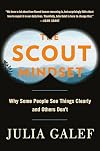
The Scout Mindset: Why Some People See Things Clearly and Others Don't (2021) 410 copies, 13 reviews
Tagged
Common Knowledge
- Birthdate
- 1983-07-04
- Gender
- female
- Education
- Columbia University (BA, Statistics)
- Occupations
- podcast host
- Organizations
- Center for Applied Rationality
New York City Skeptics
Committee for Skeptical Inquiry - Agent
- William Callahan (Inkwell)
- Nationality
- USA
- Birthplace
- Silver Spring, Maryland, USA
- Associated Place (for map)
- Maryland, USA
Members
Reviews
https://www.timothyrice.org/scoutmindset/
Rating: 4.5/5 – Recommended without hesitation
Read if you: Want to get better at changing your mind.
The Scout Mindset by Julia Galef introduces the idea that worldviews can be distilled into two primary perspectives: the Soldier and the Scout. The Soldier is defined by loyalty and passion, vigorously defending their intellectual territory against any perceived threats. To a Soldier, information that challenges their position is an attack to be show more repelled. Conversely the Scout is driven by curiosity and inquisitiveness, striving to develop the most accurate model of reality. For a Scout, new data is not an invasion to be denied but an opportunity to refine their understanding and update their mental map.
As is apparent from the title, Galef argues that the Scout’s mindset is the superior approach in every circumstance. While refuting claims about the superiority of the Soldier, she challenges the reader ask themselves: how can you be sure you’re investigating your beliefs instead of stubbornly defending them?
Two of Galef’s arguments stood out to me while reading this book. The first is about confidence – it is often argued that Soldiers make the best leaders, as a leader needs to display assurance in the face of adversity to inspire their troops. By contrast, a scout’s wishy-washy uncertainty will leave their comrades feeling like they’re passengers on a rudderless vessel, adrift and without direction.
Galef points out that there are actually two types confidence: social and epistemic. Social confidence is how an individual carries themselves, the ease and assurance with which they make their arguments, while epistemic confidence is one’ certainty in their theories and ideas. Galef argues that condemnation of a weak leader is a response to poor social – not epistemic – confidence. It is possible (desireable!) for someone to confidently express low certainty.
My second takeaway from this book is the power of your personal identity as a self-improvement tool. By telling yourself “I am the type of person who changes their mind” and not “I am someone who believes in X”, you can become more comfortable with updating your beliefs in response to new information. This idea is something that I’ve been trying to incorporate since reading Neel Nanda’s blog post on this same topic.
I enthusiastically recommend the The Scout Mindset to anyone who wants to improve their intellectual hygiene and become a more accurate thinker. Although concise, it has plenty of solid and actionable ideas for readers to apply in their everyday lives. I am looking forward to revisiting it again in a few years with fresh eyes to discover new insights and perspectives. show less
Rating: 4.5/5 – Recommended without hesitation
Read if you: Want to get better at changing your mind.
The Scout Mindset by Julia Galef introduces the idea that worldviews can be distilled into two primary perspectives: the Soldier and the Scout. The Soldier is defined by loyalty and passion, vigorously defending their intellectual territory against any perceived threats. To a Soldier, information that challenges their position is an attack to be show more repelled. Conversely the Scout is driven by curiosity and inquisitiveness, striving to develop the most accurate model of reality. For a Scout, new data is not an invasion to be denied but an opportunity to refine their understanding and update their mental map.
As is apparent from the title, Galef argues that the Scout’s mindset is the superior approach in every circumstance. While refuting claims about the superiority of the Soldier, she challenges the reader ask themselves: how can you be sure you’re investigating your beliefs instead of stubbornly defending them?
Two of Galef’s arguments stood out to me while reading this book. The first is about confidence – it is often argued that Soldiers make the best leaders, as a leader needs to display assurance in the face of adversity to inspire their troops. By contrast, a scout’s wishy-washy uncertainty will leave their comrades feeling like they’re passengers on a rudderless vessel, adrift and without direction.
Galef points out that there are actually two types confidence: social and epistemic. Social confidence is how an individual carries themselves, the ease and assurance with which they make their arguments, while epistemic confidence is one’ certainty in their theories and ideas. Galef argues that condemnation of a weak leader is a response to poor social – not epistemic – confidence. It is possible (desireable!) for someone to confidently express low certainty.
My second takeaway from this book is the power of your personal identity as a self-improvement tool. By telling yourself “I am the type of person who changes their mind” and not “I am someone who believes in X”, you can become more comfortable with updating your beliefs in response to new information. This idea is something that I’ve been trying to incorporate since reading Neel Nanda’s blog post on this same topic.
I enthusiastically recommend the The Scout Mindset to anyone who wants to improve their intellectual hygiene and become a more accurate thinker. Although concise, it has plenty of solid and actionable ideas for readers to apply in their everyday lives. I am looking forward to revisiting it again in a few years with fresh eyes to discover new insights and perspectives. show less
Julia Galef is my new hero.
Galef defines 'scout mindset' as having clear thinking as your mission, to take a true map of the terrain. This is contrasted with 'soldier' mindset, which sees itself always in combat, and thus views the surroundings primarily in terms of what needs defending, etc. It's not a perfect dichotomy, but you get the idea. Strive always to see the truth, even when unpleasant or bad for your side. A scout needs to report back with the real situation on the ground, even show more when the commanding officers might not like what they hear.
To be honest, the first four out of five sections may have had me leaving only a three or four star rating. Parts about overcoming bias seemed to be geared towards scientists and social scientists. Parts about about living without illusions seemed more for entrepreneurs. It all stated truths, but presented nothing earth-shattering.
The final section is where it really took off: Rethinking Identity. A chapter ensues about how beliefs become identities; and the next chapter presents my favorite takeaway: hold your identity lightly. My ex-therapist would have loved this. He always discouraged rigid thinking along the lines of "I am [this type of] person." One should, instead of thinking, "I am a feminist," think instead "I am someone who often sympathizes with feminist causes." Not, "I am a vegan," but "I am one who currently adheres most of the time to a vegan diet." Or whatever. You find that this subtle shift has you becoming less defensive, more liable to seek truth in others' arguments rather than digging in to a perceived threat. And if you must have an identity - try on 'scout' as an identity. "I am a scout." A scout wouldn't dismiss an argument out of hand without first giving it a fair hearing.
Some fun parts that I bookmarked:
"The Outsider Test." When faced with a tough decision, try to avoid the sunk-cost fallacy by imagining someone else has just stepped into your shoes. What would she likely think of the situation? Try imagining that YOU have teleported from the outside into your own life, and wonder, what would you tell you to do? What I liked was her "It's as if you're hanging a sign around your neck: 'Under New Management.'" I love the image. Also, this is why I love reading advice columns. It's so easy to see the solution to other people's problems. I try to imagine being an advice columnist answering myself; would the answer be crystal clear?
On holding your identity lightly: I have a friend who shall remain nameless who gets angry whenever I try to be a moderating influence, a la "let's just TRY to consider where the 'other side' is coming from on this..." He'll call it "coddling." Coddling racists, coddling evil people, whatever. Galef: "It's not a favor you do for other people, for the sake of being nice or civil. Holding your identity lightly is a favor to yourself - a way to keep your mind flexible, unconstrained by identity, and free to follow the evidence wherever it leads."
Finally, choosing your role models. I'll tell you my role model easily: Tyler Cowen. Tyler is interested in everything, and disinterested about everything (in the original correct sense of the word). Tyler doesn't take sides. Tyler is on the side of whatever improves humanity's health and happiness, and he is, as far as I have been able to tell after many years of him being my homepage, genuinely interested in seeking out what that side actually is. He will praise or censure whoever deserves it, and does not hew to any party line. If the data seems to show that universal Pre-K, for example, is beneficial for kids in the medium to long-term, he's for it; and if it starts to show actually the opposite is true, then he's against it. He doesn't come in with a pre-set belief. He really, truly wants to know the truth. And he takes interest in everything. When something just plain doesn't interest him, he takes interest in finding out why. He follows sports and popular and unpopular arts and culture. When he doesn't like something aesthetically, he asks himself why, and why other people might like it; what is the art trying to convey, on its own terms? He travels extensively, and he travels for the purpose of learning. You get the idea. I love Tyler.
And I love Julia! I'm going to listen to more of her podcasts. show less
Galef defines 'scout mindset' as having clear thinking as your mission, to take a true map of the terrain. This is contrasted with 'soldier' mindset, which sees itself always in combat, and thus views the surroundings primarily in terms of what needs defending, etc. It's not a perfect dichotomy, but you get the idea. Strive always to see the truth, even when unpleasant or bad for your side. A scout needs to report back with the real situation on the ground, even show more when the commanding officers might not like what they hear.
To be honest, the first four out of five sections may have had me leaving only a three or four star rating. Parts about overcoming bias seemed to be geared towards scientists and social scientists. Parts about about living without illusions seemed more for entrepreneurs. It all stated truths, but presented nothing earth-shattering.
The final section is where it really took off: Rethinking Identity. A chapter ensues about how beliefs become identities; and the next chapter presents my favorite takeaway: hold your identity lightly. My ex-therapist would have loved this. He always discouraged rigid thinking along the lines of "I am [this type of] person." One should, instead of thinking, "I am a feminist," think instead "I am someone who often sympathizes with feminist causes." Not, "I am a vegan," but "I am one who currently adheres most of the time to a vegan diet." Or whatever. You find that this subtle shift has you becoming less defensive, more liable to seek truth in others' arguments rather than digging in to a perceived threat. And if you must have an identity - try on 'scout' as an identity. "I am a scout." A scout wouldn't dismiss an argument out of hand without first giving it a fair hearing.
Some fun parts that I bookmarked:
"The Outsider Test." When faced with a tough decision, try to avoid the sunk-cost fallacy by imagining someone else has just stepped into your shoes. What would she likely think of the situation? Try imagining that YOU have teleported from the outside into your own life, and wonder, what would you tell you to do? What I liked was her "It's as if you're hanging a sign around your neck: 'Under New Management.'" I love the image. Also, this is why I love reading advice columns. It's so easy to see the solution to other people's problems. I try to imagine being an advice columnist answering myself; would the answer be crystal clear?
On holding your identity lightly: I have a friend who shall remain nameless who gets angry whenever I try to be a moderating influence, a la "let's just TRY to consider where the 'other side' is coming from on this..." He'll call it "coddling." Coddling racists, coddling evil people, whatever. Galef: "It's not a favor you do for other people, for the sake of being nice or civil. Holding your identity lightly is a favor to yourself - a way to keep your mind flexible, unconstrained by identity, and free to follow the evidence wherever it leads."
Finally, choosing your role models. I'll tell you my role model easily: Tyler Cowen. Tyler is interested in everything, and disinterested about everything (in the original correct sense of the word). Tyler doesn't take sides. Tyler is on the side of whatever improves humanity's health and happiness, and he is, as far as I have been able to tell after many years of him being my homepage, genuinely interested in seeking out what that side actually is. He will praise or censure whoever deserves it, and does not hew to any party line. If the data seems to show that universal Pre-K, for example, is beneficial for kids in the medium to long-term, he's for it; and if it starts to show actually the opposite is true, then he's against it. He doesn't come in with a pre-set belief. He really, truly wants to know the truth. And he takes interest in everything. When something just plain doesn't interest him, he takes interest in finding out why. He follows sports and popular and unpopular arts and culture. When he doesn't like something aesthetically, he asks himself why, and why other people might like it; what is the art trying to convey, on its own terms? He travels extensively, and he travels for the purpose of learning. You get the idea. I love Tyler.
And I love Julia! I'm going to listen to more of her podcasts. show less
One of the few books that I believe is fundamental for everyone to read. It's good to know how we function psychologically, but research rarely tells us how to make practical use of it. Julia Galef's book is one of those that fills the gap. There are ways of viewing the world, from the unyielding zealot to the delusional "my reality," but rarely engaging with reality as it is. Making the best decisions and having the clearest perceptions requires a certain mindset that doesn't just come show more naturally to us, so it must be cultivated. The Scout Mindset gives its readers overarching tools and approaches to clearer thinking. show less
This book is especially relevant and necessary right now. Popular opinion is polarized. Advocates for any range of causes cite their research and bases of beliefs, all in the name of defending their side. The more thoughtful middle tries to explore both sides, often without knowing how. The Scout Mindset shows how to gain a fact-based understanding by intentionally using different strategies compared to the soldier mindset. It's rare that I borrow a book from the library and find so much show more value that I buy a copy to keep on hand. This was one such book. show less
Lists
Awards

You May Also Like


Statistics
- Works
- 1
- Members
- 410
- Popularity
- #59,367
- Rating
- 4.0
- Reviews
- 13
- ISBNs
- 13
- Languages
- 2