
Dorothy B. Hughes (1904–1993)
Author of In a Lonely Place
About the Author
Works by Dorothy B. Hughes
Dorothy B. Hughes Mystery Reader : Containing Two Complete Novels : The So Blue Marble & The Fallen Sparrow (1944) 5 copies
Sherlock Holmes and the Muffin 3 copies
Hoation ruminates {short story} 2 copies
Blood on the Black Market | The Great Yant Mystery | The Blackbirder (1943) — Contributor — 2 copies
The Granny Woman 2 copies
Kiss for a Killer 1 copy
Carnaval in Santa Fé 1 copy
Moordvakanties 1 copy
Associated Works
The New Adventures of Sherlock Holmes: Original Stories by Eminent Mystery Writers (1976) — Contributor — 394 copies, 4 reviews
Troubled Daughters, Twisted Wives: Stories from the Trailblazers of Domestic Suspense (2013) — Contributor — 186 copies, 11 reviews
The Delicate Ape | Six Silver Handles | And the Deep Blue Sea — Contributor — 2 copies
Tagged
Common Knowledge
- Legal name
- Hughes, Dorothy Belle
- Other names
- Flanagan, Dorothy Belle (birth name)
Hughes, Dorothy B. - Birthdate
- 1904-08-10
- Date of death
- 1993-05-06
- Gender
- female
- Education
- University of Missouri (journalism)
University of New Mexico
Columbia University - Occupations
- journalist
crime novelist
literary critic
poet - Awards and honors
- MWA Grand Master (1978)
Edgar Award (Outstanding Mystery Criticism, 1951) - Relationships
- Hughes, Jr., Levi Allan (husband)
- Short biography
- Dorothy B. Hughes was one of the most popular and successful mystery and detective writers from the 1940s through the 1950s. She had a great influence on the next generation of authors, especially women. She started her literary life as a poet, which helps explain the lyrical quality of her writing. Her work had more in common with British writers of the period such as Graham Greene and Eric Ambler than with Americans such as James M. Cain and Raymond Chandler. In Hughes’s novels, the male, hardboiled swagger is replaced by a more nuanced unease, even a sense of terror, with unseen forces, doomed heroes, and existentialism questioning of a world sinking into the barbarism of World War II. She was a master of atmosphere who vividly captured the moods and the dark side of the period. Her best known novel, In a Lonely Place (1947), was adapted into a now-classic 1950 film directed by Nicholas Ray.
- Nationality
- USA
- Birthplace
- Kansas City, Missouri, USA
- Places of residence
- Santa Fe, New Mexico, USA
- Place of death
- Ashland, Oregon, USA
- Associated Place (for map)
- USA
Members
Discussions
142. In a Lonely Place by Dorothy B. Hughes in Backlisted Book Club (March 2022)
Reviews

Before it was included in the Women Crime Writers collection published by Library of America, this book was on my radar. It is one of the earliest depictions of that thriller mainstay; the serial killer. While the narration doesn’t specifically name Dex as the killer, the reader is in no doubt. He purposely re-enters the life of an old friend from his military days only to find out that friend, Brub Nicolai, has become an L.A. Detective. Instead of disappearing or failing to pursue the show more friendship, Dex insinuates himself more firmly in his life, setting up a game that only Dex knows they’re playing. Oh sure, Brub is aware of a killer on the loose and he’s tortured by it and afraid for his wife Sylvia, but he has no idea the strangler is Dex. It’s kind of delicious. Dex alternately is jealous of their marriage and despises them for their cozy conventionality. Sylvia is at turns the most desirable and elegant woman and a vapid, colorless ball and chain. Brub is hero then dupe.
The title comes from a void in Dex’s life that he’s tried to fill with the wrong woman before. When he fails he kills. It isn’t an excuse, but a reason and his latest attempt is in the shape of Laurel Gray. At first she’s depicted as fairly reasonable and decent, but she becomes an unsatisfied woman who harps and nags; typical for its time. The misogyny and sexism was surprising to me given that a woman wrote this book. I don’t know if Hughes was including it as an indictment or if it was just such the conventional view of women that she wasn’t aware of doing it.
Things get a bit spoilery if you can't spot the obvious.
Dex is a typically arrogant male who thinks every woman’s reaction to him must be intense attraction. I made a note that Sylvia’s reaction on first meeting Dex, which he mistook, was actually wariness or fear, and it was. She sensed his wrongness and in the end it undoes him. He takes chances and liberties that only a psychopath would. In that sense he reminded me of Ripley, justifying his every crime and killing with the idea that because it’s him it’s ok and that his victims deserve whatever they get. He’s repulsive. A modern writer would surely blame Dex’s mother, but Hughes doesn’t offer any reason for Dex’s defects. They just are. There’s a great sense of dissipation about him and Hughes wrote a great scene for him acting the distraught innocent when he “learns” of a woman’s death in England.
Overall the book works really well and is told with a light detachment that keeps things from being too desperate. There is no victim in his sights as such, but an overall sense of danger and dread permeates the book. That and we want him to be caught, punished and thoroughly brought down. That’s kind of where things get a bit iffy though with some plot holes and oddities I just can’t imagine happening. Like when Brub (oh what a name!) and his boss get involved in the murder in England, the one Dex reacted so histrionically to. They lay out the case and note similarities to the current killings. Every conversation they have had with Dex about the crimes paints a picture of a killer that is a dead ringer for Dex himself, but suspicion never turns his way.
Then it does and Hughes sets up a few subtle clues for the reader to know that finally, Dex is in a net. There’s a lovely set up and then they have him. Fingerprints come to light and other evidence and he’s caught, becoming a blubbering idiot bitten by the confessional bug. It’s a nice way to end it and satisfying both in the villain getting nabbed and from a dramatic perspective. It reminded me a lot of crime movies of this era; no coda, just a solid collar and scene.
In tone and style it reminded me of A Kiss Before Dying by Ira Levin that came out some years later. They both feature a sociopathic young man trying to get above his station no matter the cost. Working is below them. They despise the idle rich but long to be one. Both use and abuse the women in their orbits, but have skill in hiding who they are and keeping the women compliant. There are swishy clubs, money, sex and increasing desperation. Levin’s has a more clever construction, but both are excellent. show less
The title comes from a void in Dex’s life that he’s tried to fill with the wrong woman before. When he fails he kills. It isn’t an excuse, but a reason and his latest attempt is in the shape of Laurel Gray. At first she’s depicted as fairly reasonable and decent, but she becomes an unsatisfied woman who harps and nags; typical for its time. The misogyny and sexism was surprising to me given that a woman wrote this book. I don’t know if Hughes was including it as an indictment or if it was just such the conventional view of women that she wasn’t aware of doing it.
Things get a bit spoilery if you can't spot the obvious.
Dex is a typically arrogant male who thinks every woman’s reaction to him must be intense attraction. I made a note that Sylvia’s reaction on first meeting Dex, which he mistook, was actually wariness or fear, and it was. She sensed his wrongness and in the end it undoes him. He takes chances and liberties that only a psychopath would. In that sense he reminded me of Ripley, justifying his every crime and killing with the idea that because it’s him it’s ok and that his victims deserve whatever they get. He’s repulsive. A modern writer would surely blame Dex’s mother, but Hughes doesn’t offer any reason for Dex’s defects. They just are. There’s a great sense of dissipation about him and Hughes wrote a great scene for him acting the distraught innocent when he “learns” of a woman’s death in England.
Overall the book works really well and is told with a light detachment that keeps things from being too desperate. There is no victim in his sights as such, but an overall sense of danger and dread permeates the book. That and we want him to be caught, punished and thoroughly brought down. That’s kind of where things get a bit iffy though with some plot holes and oddities I just can’t imagine happening. Like when Brub (oh what a name!) and his boss get involved in the murder in England, the one Dex reacted so histrionically to. They lay out the case and note similarities to the current killings. Every conversation they have had with Dex about the crimes paints a picture of a killer that is a dead ringer for Dex himself, but suspicion never turns his way.
Then it does and Hughes sets up a few subtle clues for the reader to know that finally, Dex is in a net. There’s a lovely set up and then they have him. Fingerprints come to light and other evidence and he’s caught, becoming a blubbering idiot bitten by the confessional bug. It’s a nice way to end it and satisfying both in the villain getting nabbed and from a dramatic perspective. It reminded me a lot of crime movies of this era; no coda, just a solid collar and scene.
In tone and style it reminded me of A Kiss Before Dying by Ira Levin that came out some years later. They both feature a sociopathic young man trying to get above his station no matter the cost. Working is below them. They despise the idle rich but long to be one. Both use and abuse the women in their orbits, but have skill in hiding who they are and keeping the women compliant. There are swishy clubs, money, sex and increasing desperation. Levin’s has a more clever construction, but both are excellent. show less

The Publisher Says: The Terror of the Hunted
Piers Hunt was followed—by a rat-faced little man, by a detective named Cassidy, and by a dark, soundless shadow, felt rather than seen. But worse than the fear of his followers was Hunt's terror of a beautiful and passionate girl. With his emotions he loved her violently; with his mind he hated her. She was evil—a seductive force in evil hands. They all wanted what he had: information which no one but himself must know for a week. On Sunday he show more would tell it, not to a chosen few, but to the entire world.
This story by Dorothy B. Hughes, author of [The Fallen Sparrow] and [Dread Journey], is more than just a whirlwind tale of spies and intrigue. As Will Cuppy said, "Miss Hughes offers an exciting story wrapped in an idea that is certainly on the side of the angels. Complete with murder, valuable papers, problems to solve, and not one scrap of nonsense. A necessity for Grade-A addicts."
(The above is the back-cover copy of the 1947 Pocket Books mmpb edition that belonged to my father. I think it's better than the modern editions' efforts, so here it is.)
My Review: Look at her Wikipedia entry...you'd never know how much of a Thing she was back in the day. She was Miss Hughes by the "courtesy" of the times; she had three children with her husband, Lewis Allan Hughes, Junior. Her burst of creativity came in the 1940s, when twelve of her fifteen novels appeared. The last was published in 1963, The Expendable Man; it had been eleven years since the novel before it appeared and none would follow. (A far better condensation of Author Hughes's affect and effect is in the LA Review of Books, not paywalled.)
Hughes was, however, astonishingly prolific as a writer of criticism (winning an Edgar for it in 1951); she was awarded a Grand Mastership by the Mystery Writers of America in 1983 for her decades of critical work, and, I believe, in no small part for her 1978 biography, [Erle Stanley Gardner: The Case of the Real Perry Mason]. It remains my very favorite biography—it's really what we'd call today "a life" in that it's not full of footnotable "and on Wednesday the nineteenth came a surprise" stuff—of a mystery writer. It's got the insider-thriller-writer knowingness and the loving appreciation of a fan, coupled with a woman (who rejected the label "feminist" her entire life) who sees what he's doing there's tolerant tutting.
I decided that this book, an oddity in Author Hughes's career, needed a review. Most of Author Hughes's most popular works feature a woman lead. Here, not for the first time, she writes from a man's point of view, though honestly Piers doesn't feel like a man so much as a machine-part, a character without that much character. It's no one's favorite of her works, poor thing, though possibly for that reason. She wrote it in 1942-1943, set it in 1955, and made a lot of assumptions about how the post-war world would work. They are all completely wrong.That should surprise no one. After all, SF writers get *gleefully* bashed and pointed at when they get things wrong, so why exempt Author Hughes?
In a weird way, this 1947 printing is a near-future story about the US Secretary of Peace and his dealings with an about-to-be de-occupied Germany. And that, we're let in on, is a Very Bad Idea...one that even gets people killed for so much as conceptualizing. If there is to be a change in Germany's occupation, you see, it must be one that allows Germany to rise again or it will cause more wars! (If they're released from under the occupation, of course, there will be more wars...so, one might wonder, what the hell's the difference?)
Piers is in possession of evidence that will somehow derail the whole peace convocation. It isn't like anyone doesn't know he has it...the femme fatale Morgen, the love of Piers's life, is sent to violate her marriage vows to collect the information from him on her husband the German General's certainty that he is still besotted...but Piers isn't having it. The Germans must be kept down! Like the Chinese are keeping those losers the Japanese in their place!
See? She really got everything seriously wrong here.
But what she didn't get wrong is the pacing of the chases. As Piers dodges bullets and babes, as he does every-damn-thing in his power to prevent a murderous cabal of powerful profiteers from returning this peaceful 1955 to the charnel house-filling state of perma-war Author Hughes cynically posits they want, she never once takes her foot off the gas pedal. In under two hundred pages, she delivers a set-piece of an ending that wraps the speeding car of story around the lamp-post of inevitability.
It's a weirdo, a little misshapen bump in the road of her career. I think it's all the more fun for that. I also think that the pleasures of reading it are sharpened if one deals with it as alternate history of World War II's ending.
Don't be fooled by Dorothy B. Hughes's factually unsupported claims for her fictional 1955...she saw what was coming. She wasn't a fan of the Germans. She wasn't fooled by the industrialists' patriotic mouthings. She was limpidly clear about what a raw deal ordinary people will always get, especially when they're standing up to be counted for the Right Thing to be done (read [The Expendable Man]!!).
And she wrapped it all in clear, clean prose that ages like single-malt whisky. show less
Piers Hunt was followed—by a rat-faced little man, by a detective named Cassidy, and by a dark, soundless shadow, felt rather than seen. But worse than the fear of his followers was Hunt's terror of a beautiful and passionate girl. With his emotions he loved her violently; with his mind he hated her. She was evil—a seductive force in evil hands. They all wanted what he had: information which no one but himself must know for a week. On Sunday he show more would tell it, not to a chosen few, but to the entire world.
This story by Dorothy B. Hughes, author of [The Fallen Sparrow] and [Dread Journey], is more than just a whirlwind tale of spies and intrigue. As Will Cuppy said, "Miss Hughes offers an exciting story wrapped in an idea that is certainly on the side of the angels. Complete with murder, valuable papers, problems to solve, and not one scrap of nonsense. A necessity for Grade-A addicts."
(The above is the back-cover copy of the 1947 Pocket Books mmpb edition that belonged to my father. I think it's better than the modern editions' efforts, so here it is.)
My Review: Look at her Wikipedia entry...you'd never know how much of a Thing she was back in the day. She was Miss Hughes by the "courtesy" of the times; she had three children with her husband, Lewis Allan Hughes, Junior. Her burst of creativity came in the 1940s, when twelve of her fifteen novels appeared. The last was published in 1963, The Expendable Man; it had been eleven years since the novel before it appeared and none would follow. (A far better condensation of Author Hughes's affect and effect is in the LA Review of Books, not paywalled.)
Hughes was, however, astonishingly prolific as a writer of criticism (winning an Edgar for it in 1951); she was awarded a Grand Mastership by the Mystery Writers of America in 1983 for her decades of critical work, and, I believe, in no small part for her 1978 biography, [Erle Stanley Gardner: The Case of the Real Perry Mason]. It remains my very favorite biography—it's really what we'd call today "a life" in that it's not full of footnotable "and on Wednesday the nineteenth came a surprise" stuff—of a mystery writer. It's got the insider-thriller-writer knowingness and the loving appreciation of a fan, coupled with a woman (who rejected the label "feminist" her entire life) who sees what he's doing there's tolerant tutting.
I decided that this book, an oddity in Author Hughes's career, needed a review. Most of Author Hughes's most popular works feature a woman lead. Here, not for the first time, she writes from a man's point of view, though honestly Piers doesn't feel like a man so much as a machine-part, a character without that much character. It's no one's favorite of her works, poor thing, though possibly for that reason. She wrote it in 1942-1943, set it in 1955, and made a lot of assumptions about how the post-war world would work. They are all completely wrong.That should surprise no one. After all, SF writers get *gleefully* bashed and pointed at when they get things wrong, so why exempt Author Hughes?
In a weird way, this 1947 printing is a near-future story about the US Secretary of Peace and his dealings with an about-to-be de-occupied Germany. And that, we're let in on, is a Very Bad Idea...one that even gets people killed for so much as conceptualizing. If there is to be a change in Germany's occupation, you see, it must be one that allows Germany to rise again or it will cause more wars! (If they're released from under the occupation, of course, there will be more wars...so, one might wonder, what the hell's the difference?)
Piers is in possession of evidence that will somehow derail the whole peace convocation. It isn't like anyone doesn't know he has it...the femme fatale Morgen, the love of Piers's life, is sent to violate her marriage vows to collect the information from him on her husband the German General's certainty that he is still besotted...but Piers isn't having it. The Germans must be kept down! Like the Chinese are keeping those losers the Japanese in their place!
See? She really got everything seriously wrong here.
But what she didn't get wrong is the pacing of the chases. As Piers dodges bullets and babes, as he does every-damn-thing in his power to prevent a murderous cabal of powerful profiteers from returning this peaceful 1955 to the charnel house-filling state of perma-war Author Hughes cynically posits they want, she never once takes her foot off the gas pedal. In under two hundred pages, she delivers a set-piece of an ending that wraps the speeding car of story around the lamp-post of inevitability.
It's a weirdo, a little misshapen bump in the road of her career. I think it's all the more fun for that. I also think that the pleasures of reading it are sharpened if one deals with it as alternate history of World War II's ending.
Don't be fooled by Dorothy B. Hughes's factually unsupported claims for her fictional 1955...she saw what was coming. She wasn't a fan of the Germans. She wasn't fooled by the industrialists' patriotic mouthings. She was limpidly clear about what a raw deal ordinary people will always get, especially when they're standing up to be counted for the Right Thing to be done (read [The Expendable Man]!!).
And she wrapped it all in clear, clean prose that ages like single-malt whisky. show less
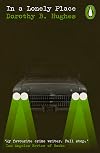
Blimey, what a book this is. Published in 1947, In a Lonely Place is murky, hard boiled, dark and delicious. Set in Los Angeles just after WW2, it’s the story of Dix Steele, a Princeton grad and former fighter pilot. He’s a predatory, angry misogynist and a serial killer. Being inside the head of Dix Steele is unforgettable and deeply unpleasant. His paranoia creates an incredibly claustrophobic novel, the sexual tension jumps off the page. What makes it stand out is Hughes’s ability show more to link violence and misogyny. The strong characters in the novel are female and they ultimately bring about his downfall. It makes it a compelling read. Noir doesn’t get better than this. show less

So very noir that I pictured the whole story in black and white.
Dix Steele (how many pornstar wanna-bes are kicking themselves for not thinking up that name?) is a serial killer, and his best friend, Brum, is a cop. So the mystery isn't one of who did it or who will catch the killer as the reader already knows these things. Instead, Hughes keeps us guessing as to which of the three potential victims offered up will Dix choose next. It just boils down to who does he hate more?
Hughes does a show more commendable job of writing in the voice of a man, and a psychotic one at that. Dix's mind ricochets between anger, hunger and sleep deprivation with the occasional bouts of joy over tricking his cop friend to give him lots of police information. His version of falling in love, as he does with a neighbor, shows Dix in full stalker mode and gives the reader another scary aspect of his personality.
I'm glad I've finally discovered Hughes and I'll be reading more from her. show less
Dix Steele (how many pornstar wanna-bes are kicking themselves for not thinking up that name?) is a serial killer, and his best friend, Brum, is a cop. So the mystery isn't one of who did it or who will catch the killer as the reader already knows these things. Instead, Hughes keeps us guessing as to which of the three potential victims offered up will Dix choose next. It just boils down to who does he hate more?
Hughes does a show more commendable job of writing in the voice of a man, and a psychotic one at that. Dix's mind ricochets between anger, hunger and sleep deprivation with the occasional bouts of joy over tricking his cop friend to give him lots of police information. His version of falling in love, as he does with a neighbor, shows Dix in full stalker mode and gives the reader another scary aspect of his personality.
I'm glad I've finally discovered Hughes and I'll be reading more from her. show less
Lists
Awards


You May Also Like


Associated Authors
Statistics
- Works
- 34
- Also by
- 21
- Members
- 2,959
- Popularity
- #8,623
- Rating
- 3.9
- Reviews
- 117
- ISBNs
- 145
- Languages
- 7
- Favorited
- 5
